Star Diagonal Function in Refractor Telescopes
Refractor telescopes require star diagonals to provide comfortable viewing angles at high zeniths. These precision accessories bend light paths by 90 degrees for optimal ergonomics.


Star diagonals redirect incoming light beams from the objective lens toward an accessible eyepiece position. Always select matched barrel sizes to maintain optical alignment and prevent mechanical tilt.
Ready to compare models? Start with our Best Telescope: Top Backyard Picks for Astronomy.
Practical Quick-Reference Table
| Scenario / Metric | Recommended Target | Why It Matters |
|---|---|---|
| Barrel Size Standard | 2-inch or 1.25-inch | Ensures structural compatibility with focusers and eyepieces. |
| Reflectivity Rating | 99 percent dielectric | Maximizes photon throughput across the visible spectrum. |
| Prism Material | BK7 or BaSF optical glass | Controls internal scatter and chromatic dispersion. |
| Collimation Tolerance | Under 10 arcseconds | Prevents double images at high magnifications. |
| Optical Path Length | 80mm to 100mm | Determines inward focus travel requirements. |
| Compression Ring | Brass material | Protects eyepiece barrels from setscrew scoring. |
Optical Geometry and Ergonomic Benefits of Star Diagonals
Refractor telescope optical tubes position the focuser at the rear extremity. Selecting the best refractor telescope for viewing planets and galaxies helps prevent uncomfortable physical postures and neck strain.
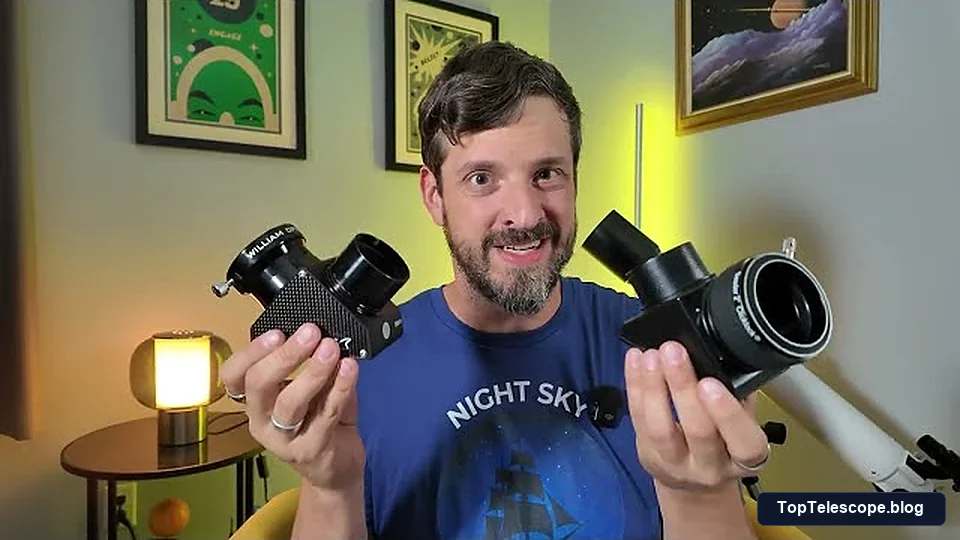
A star diagonal interposes an optical element between the rear focuser and the eyepiece. This component bends the converging light cone by a standard 90-degree angle for comfortable viewing.
Some specialized terrestrial viewing setups utilize a 45-degree erecting prism instead. Astronomical configurations rely almost exclusively on 90-degree designs to minimize postural fatigue during extended sessions.
Internal ray traces reveal that light convergence must remain undisturbed by the deflection mechanism. Maintaining precise mechanical tolerances prevents wavefront aberrations from degrading the final stellar image.
- Relieves physical strain during high-altitude celestial observations.
- Bends incoming optical paths by exactly 90 degrees.
- Preserves convergent wavefront integrity through precision mechanics.
- Accommodates standard astronomical eyepieces without focal shift.
Focal Plane Adjustments and Backfocus Considerations
Inserting a diagonal consumes a measurable amount of inward focuser travel distance. Refractor optical designs must provide adequate backfocus capacity to reach sharp infinity focus.
Low-profile diagonal housings alleviate backfocus limitations on telescopes with restricted drawtube travel. Always calculate total optical path length before pairing accessories.
- Consumes critical backfocus distance along the optical axis.
- Requires careful calculation of total optical path length.
Mechanics of Total Internal Reflection in Prism Diagonals
Prism-based star diagonals rely on the physical principle of total internal reflection. High-grade optical glass bends the light beam without requiring a traditional front-surface metallic coating.
Amici roof prisms simultaneously erect the image for correct terrestrial orientation. However, a sharp diffraction spike often bisects bright stars due to the central roof ridge.
Standard right-angle prisms avoid the roof ridge diffraction artifact entirely. They deliver pristine stellar point-source images suitable for high-resolution planetary and lunar astronomy.
Glass purity directly dictates how effectively a prism transmits short-wavelength blue light. Premium optical glasses like BaK4 minimize internal absorption across the entire visible spectrum.
- Utilizes total internal reflection to redirect light cleanly.
- Amici roof prisms introduce subtle diffraction spikes on bright stars.
- Right-angle prisms preserve flawless stellar point-source clarity.
- High-grade glass formulations eliminate unwanted chromatic absorption.
Controlling Secondary Spectrum in Glass Prisms
Thick glass blocks introduce minor amounts of longitudinal chromatic aberration. When evaluating the best refractor telescope for beginners, note that fast optical objectives frequently exhibit visible color fringes with standard prisms.
Using specialized low-dispersion glass minimizes secondary spectrum introduction in fast optical systems. This maintains high-contrast planet details during high-power viewing.
- Thick glass can introduce slight chromatic aberration.
- Specialized low-dispersion glass preserves planetary contrast.
Video Walkthrough: Search filters
Enhanced Dielectric Coatings in Mirror Diagonals
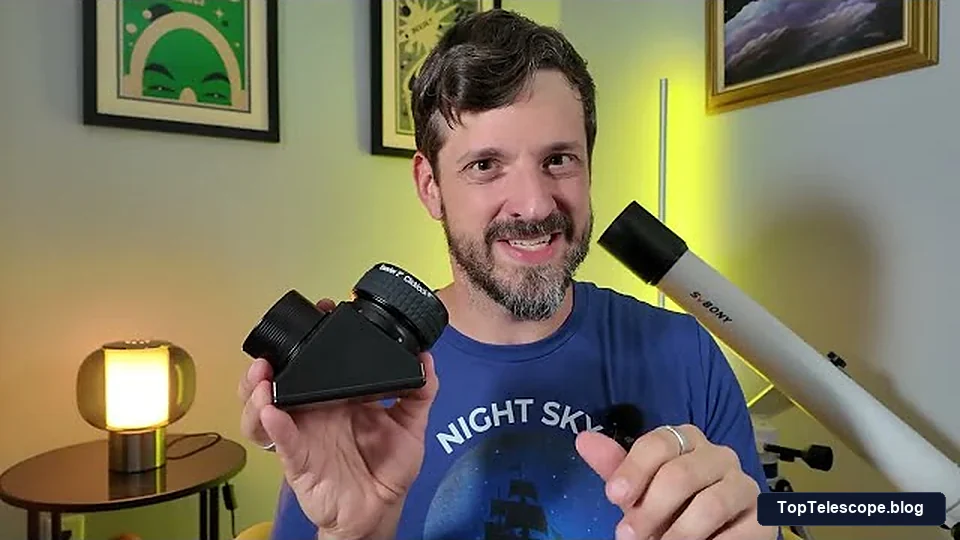
Mirror-based star diagonals substitute glass prisms with flat, highly reflective optical surfaces. These mirrors require multi-layer dielectric coatings to maximize overall photon reflection efficiency.
Aluminum and silver vacuum-deposited layers are frequently protected by durable quartz overcoats. Modern dielectric stacks achieve up to 99 percent reflectivity across all visual wavelengths.
Substrate flatness must exceed one-tenth wave accuracy to prevent wavefront deformation. Inferior mirror substrates scatter light and degrade high-magnification planetary resolution significantly.
Unlike glass prisms, mirror diagonals do not introduce secondary chromatic dispersion. When exploring a refractor vs reflector telescope comparison, you will notice mirrors dominate fast optical systems.
- Employs flat reflective surfaces instead of solid glass prisms.
- Dielectric coatings deliver up to 99 percent optical reflectivity.
- Substrate surface accuracy must exceed one-tenth wave tolerances.
- Eliminates secondary chromatic dispersion in fast refractors.
Surface Longevity and Environmental Protection
Exposed mirror coatings face degradation from atmospheric moisture and dust accumulation. Hard dielectric overcoats protect delicate reflective layers from cleaning friction and oxidation.
Store diagonals in low-humidity environments with dust caps securely attached to preserve coating integrity.
- Hard overcoats protect reflective layers from cleaning friction.
- Proper storage prevents premature environmental degradation.
Barrel Standards and Mechanical Connection Tolerances
Star diagonals interface with telescopes via standardized cylindrical barrel diameters. The two primary industry sizes are 1.25 inches and larger 2 inches for wide-field eyepieces.
Precision machining ensures the insertion barrel remains perfectly perpendicular to the optical axis. Mechanical slop or tilt causes severe off-axis astigmatism and image degradation.
Compression rings replace traditional thumbscrews to secure eyepieces without marring barrels. This internal brass band distributes clamping pressure evenly around the entire circumference.
Threaded filter cells attach directly to the front nosepiece of the diagonal. This configuration allows convenient swapping of narrowband nebular filters without removing the eyepiece.
- Standardized barrel sizes include 1.25-inch and 2-inch formats.
- Precision machining prevents off-axis optical tilt and astigmatism.
- Brass compression rings protect eyepiece barrels from setscrew scoring.
- Nosepiece threads accommodate standard astronomical glass filters.
Securing Heavy Imaging and Observing Payloads
Large 2-inch diagonals require robust locking mechanisms to support heavy multi-element eyepieces. Twist-lock collars provide secure, self-centering retention superior to standard thumbscrews.
Check all mechanical retention rings periodically to prevent accidental equipment slippage.
- Heavy payloads require robust twist-lock retention collars.
- Regularly inspect mechanical locks to prevent accidental slippage.
Image Orientation Transformations and Zenith Viewing
Standard 90-degree star diagonals yield images with correct up-and-down orientation. However, the left-to-right axis remains mirrored, presenting a reversed perspective to observers.

Terrestrial spotters require correct-image erecting prisms to match standard map orientations. Astronomical observers quickly adapt to left-right mirrored fields during celestial navigation.
Zenith observations present unique tracking challenges due to field rotation mechanics. Using a star diagonal prevents awkward neck strain when pointing straight overhead.
Comet hunting and deep-sky sweeping benefit greatly from comfortable zenith viewing angles. The diagonal acts as the ultimate ergonomic bridge between observer and sky.
- Standard diagonals produce left-right mirrored visual fields.
- Erecting prisms are reserved for terrestrial spotting applications.
- Eliminates severe ergonomic discomfort during zenith observations.
- Optimizes body posture for extended deep-sky observing sessions.
Adapting to Alt-Azimuth Versus Equatorial Mounts
Alt-azimuth mounts paired with star diagonals create shifting diagonal orientations. Rotating the diagonal within the focuser restores comfortable eyepiece viewing angles effortlessly.
Equatorial mounts maintain consistent eyepiece orientations through polar axis alignment.
- Rotating the diagonal restores comfortable eyepiece positions.
- Equatorial mounts maintain consistent viewing angles naturally.
Alignment Maintenance and Optical Collimation Checks
Maintaining precise mechanical collimation within the diagonal is paramount. Dropping or bumping the housing can misalign internal mirrors or prisms, causing astigmatism.
Calculate optimal high power using our telescope magnification calculator before performing star tests on Polaris. An asymmetrical diffraction pattern clearly indicates internal optical tilt requiring careful adjustment.
Adjustable mirror diagonals feature precision collimation screws on the rear housing. These allow users to tweak mirror tilt angles safely using a small hex wrench.
Never force stuck threaded components or overtighten clamping rings. Gentle handling ensures long-term mechanical reliability and pristine optical performance.
- Physical impacts can misalign internal mirrors or prisms.
- High-magnification star tests reveal hidden optical tilt issues.
- Adjustable housings feature accessible rear collimation screws.
- Avoid overtightening clamping rings to preserve alignment.
Performing an Out-of-Focus Star Test
Center a bright star at high magnification and defocus slightly. Concentric diffraction rings should remain perfectly circular without elliptical distortion.
Elliptical patterns confirm mechanical misalignment within the optical train.
- Defocus a bright star to evaluate diffraction ring symmetry.
- Elliptical patterns confirm internal mechanical misalignment.
Troubleshooting Vignetting and Optical Obstructions
Vignetting occurs when internal apertures restrict the converging light cone prematurely. Using 1.25-inch diagonals with massive wide-field eyepieces frequently causes dark field borders.
Upgrading to a 2-inch optical path eliminates mechanical vignetting for large field stops. Ensure focuser drawtubes do not protrude into the internal light path.
Internal baffling and flat black anti-reflection paint suppress stray internal reflections. Glossy metal surfaces inside the diagonal housing create unwanted ghost images.
Inspect internal baffles regularly to ensure matte black surfaces remain pristine. Reflected stray light drastically reduces visual contrast on faint deep-sky targets.
- Undersized clear apertures cause noticeable field vignetting.
- Two-inch optical paths eliminate peripheral light restriction.
- Internal baffling suppresses stray reflections and ghosting.
- Matte black interior surfaces maximize deep-sky contrast.
Verifying Clear Aperture Dimensions
Measure the clear aperture of the nosepiece and mirror housing carefully. Ensure these inner diameters match or exceed your eyepiece field stop limits.
Unrestricted apertures guarantee maximum illuminated field delivery.
- Measure clear apertures against eyepiece field stops.
- Unrestricted inner diameters guarantee full field illumination.
Frequently Asked Questions
Why is a star diagonal necessary for refractor telescopes?
Refractor telescopes position focusers at the rear, making zenith viewing extremely uncomfortable without redirection. A star diagonal bends the light path by 90 degrees to provide ergonomic viewing angles.
What is the difference between mirror and prism diagonals?
Mirror diagonals use reflective dielectric coatings to achieve up to 99 percent reflectivity without introducing color dispersion. Glass prisms use total internal reflection but can introduce minor secondary chromatic aberration.
Does a star diagonal affect backfocus requirements?
Yes, inserting a diagonal consumes a measurable amount of inward focuser travel distance. Refractor optical designs must provide adequate backfocus capacity to reach sharp infinity focus successfully.
How do I fix left-right image reversal in astronomy?
Astronomical star diagonals produce a mirrored left-right field that does not hinder celestial navigation. Observers quickly adapt to this perspective without needing specialized erecting prism correctors.
What causes vignetting when using a star diagonal?
Vignetting occurs when undersized clear apertures or narrow barrels restrict wide light cones. Upgrading to a 2-inch optical format eliminates peripheral field darkening completely.