Dobsonian vs Refractor: Definitive Comparison
Choosing between a Dobsonian and a refractor defines your entire astronomy experience. Understanding their fundamental engineering differences ensures you invest in the right optical instrument for your backyard observing sessions.

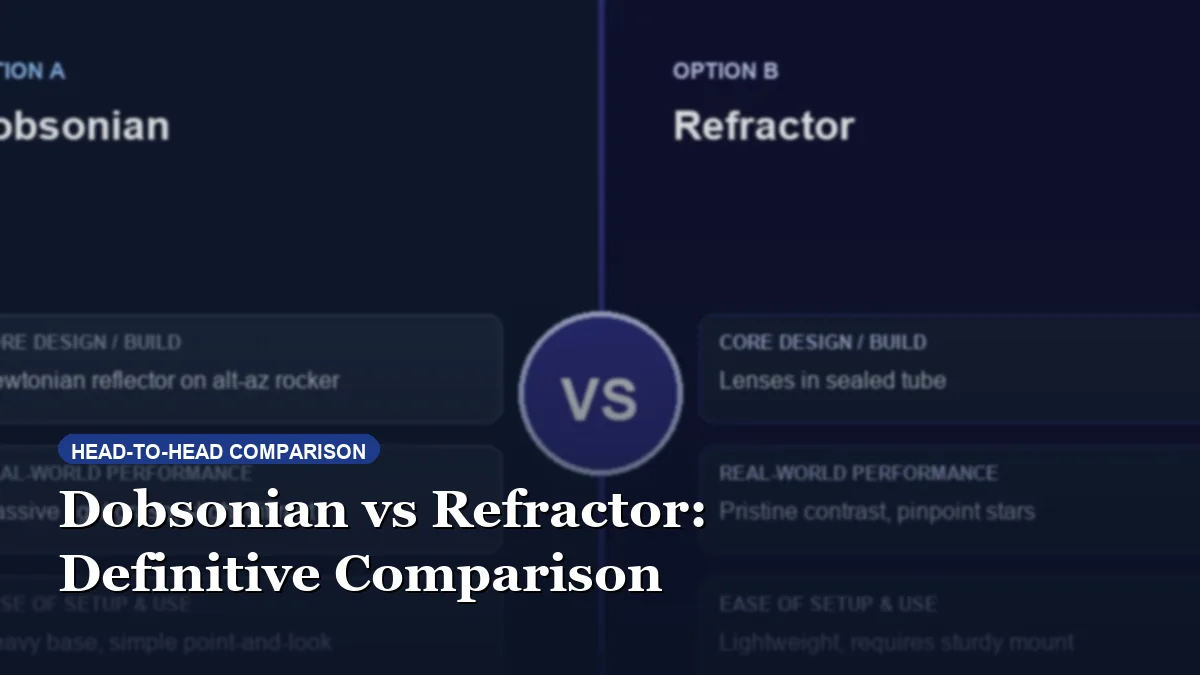
Choose a Dobsonian for maximum light-gathering aperture on faint deep-sky targets. Select a refractor if you prioritize razor-sharp planetary contrast and zero-maintenance optical tube assemblies.
Compare all top models in our Best Telescope: Top Backyard Picks for Astronomy.
Side-by-Side Breakdown
| Criteria | Dobsonian | Refractor | Edge |
|---|---|---|---|
| Core Design / Build | Newtonian reflector on alt-az rocker box | Lenses in sealed tube | Dobsonian |
| Real-World Performance | Massive light grasp, slight diffraction | Pristine contrast, pinpoint stars | Refractor |
| Ease of Setup & Use | Heavy base, simple point-and-look | Lightweight, requires sturdy mount | Refractor |
| Durability & Reliability | Mirrors require periodic manual adjustment | Sealed cells resist thermal shock | Refractor |
| Efficiency / Operating Footprint | Wide footprint, excellent value per inch | Long tube requires tall mounting | Dobsonian |
| Maintenance Requirements | Regular mirror cleaning and collimation | Minimal lens cleaning, no alignment | Refractor |
| Best Ideal Use Case | Deep-sky nebulae and faint galaxies | Lunar, planetary, and wide-field imaging | Dobsonian |
Core Design and Optical Architecture
Our best dobsonian telescope for beginners guide highlights systems utilizing a Newtonian reflector design featuring a primary parabolic mirror at the base, gathering light efficiently without chromatic aberration.
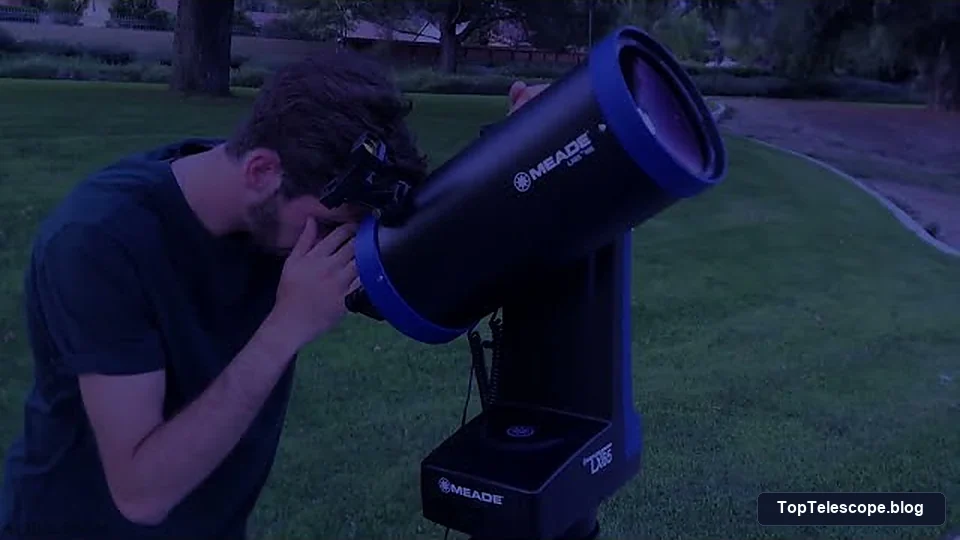
In contrast, refractor telescopes employ glass lenses at the front objective end of the tube. Light passes directly through these refractive elements before converging at the rear focal plane for viewing.
Dobsonian telescopes utilize a Newtonian reflector design featuring a parabolic primary mirror that reflects light upward to a flat secondary mirror. This setup eliminates chromatic aberration completely across the visible spectrum.
Refractor telescopes deploy front objective lenses, often crafted from ED glass or triplet configurations, to bend incoming light waves to a focal point. This closed tube design protects delicate optical coatings from environmental debris.
- Primary parabolic mirror vs glass objective lens
- Open optical tube assembly vs sealed chassis
- Alt-azimuth rocker mount vs equatorial tripod
Mechanical Housing Differences
Dobsonian systems rely on simplified particle board or metal rocker boxes utilizing friction pads. This minimalist mounting philosophy eliminates heavy equatorial counterweight shafts for intuitive manual tracking.
Refractors demand rigid mechanical housings and precision focusers to maintain lens alignment. Heavy glass elements require robust cell mountings to prevent internal shifting during transport.
- Particle board rocker boxes with friction pads
- Rigid metal housings for precision lens cells
Real-World Performance and Resolution Limits
Aperture remains king in amateur astronomy, granting Dobsonians a massive advantage for deep-sky observation. Larger primary mirrors resolve fainter galaxies and subtle structural details within distant nebulae.
Refractors deliver unmatched optical contrast because they lack central obstructions in the light path. Planetary observers benefit immensely from this clear, unscattered light transmission during high-magnification viewing.
Aperture diameter dictates light-gathering power and theoretical resolution. Dobsonians offer massive apertures starting around eight inches, resolving tight binary star systems and faint deep-sky nebulae that refractors cannot capture easily.
Refractors provide uninhibited light paths free from central obstructions, yielding higher contrast lunar and planetary images. This unobstructed design maximizes the Strehl ratio, delivering sharper details on subtle planetary cloud belts.
- Zero central obstruction in refractor light paths
- Superior light-gathering power in larger Dobsonians
- Enhanced planetary detail visibility in refractors
Resolving Power Under Poor Seeing
Turbulent atmospheric conditions affect both optical designs differently during planetary viewing sessions. Smaller refractors often punch above their weight class when atmospheric seeing degrades thermal stability.
Large aperture Dobsonians struggle when thermal currents mix inside unventilated tubes. Proper cooling fans become essential accessories for maintaining sharp planetary resolution throughout long observation nights.
- Atmospheric seeing impact on small optics
- Thermal current mixing in unventilated tubes
Setup, Ergonomics, and Field Portability
Field portability separates popular instruments into distinct logistical tiers. When exploring mid-range sizes, our best 8 inch dobsonian telescope guide examines components consisting of the optical tube and base.
Refractors offer streamlined transportability when paired with compact carbon-fiber tripods. However, long focal ratio models demand significantly taller mounts to prevent the eyepiece from striking tripod legs.
Dobsonians rely on heavy particle board or metal rocker boxes, distributing substantial weight across wide footprints. Transporting these large optical tubes requires serious vehicle cargo space and careful handling during field assembly.
Refractors boast exceptional portability, mounting easily on lightweight alt-azimuth or equatorial tripods. Their compact physical dimensions allow for rapid deployment, making impromptu backyard stargazing sessions considerably more convenient and frequent.
- Two-piece transport format for large Dobsonians
- Single-tube convenience for small-to-medium refractors
- Eyepiece height variations across long focal lengths
Eyepiece Height and Observational Comfort
Using a Dobsonian near the zenith requires standing on a step stool due to eyepiece positioning. This ergonomic challenge disappears when tracking targets near the horizon during evening hours.
Models highlighted in our best refractor telescope overview rotate freely to maintain comfortable viewing angles regardless of pointing direction, reducing neck strain during extended marathon sessions.
- Zenith viewing requiring stable step stools
- Rotating diagonals for flexible neck comfort
Thermal Management and Acclimation Speeds
Glass thickness dictates how quickly an optical instrument reaches ambient outdoor temperatures. Thick pyrex primary mirrors in large Dobsonians require substantial time to shed daytime heat accumulation.
Sealed refractor tubes trap internal air masses, slowing thermal equalization unless equipped with special cooling features. Doublet and triplet lens cells must cool uniformly to eliminate boundary layer distortions.
Thick pyrex or glass mirror substrates in large Dobsonians demand extended thermal acclimation times before achieving stable high-magnification focus. Heat trapped inside closed tubes creates internal air currents that severely degrade planetary sharpness.
Smaller refractor objectives cool down much faster, reaching thermal equilibrium within minutes of exposure to outdoor ambient temperatures. This swift adaptation ensures immediate stability, bypassing the prolonged wait times inherent to reflectors.
- Extended cooling times for massive primary mirrors
- Trapped air pockets inside sealed refractor tubes
- Active cooling fan benefits for reflectors
Managing Dew and Condensation
Open mirror cells make Dobsonians vulnerable to rapid dew formation on cold nights. Using secondary mirror heaters helps combat moisture accumulation during heavy autumn dewing conditions.
Refractors utilize extended dew shields to protect exposed objective lenses from stray moisture. Adding a flexible dew strap ensures uninterrupted imaging or visual performance throughout damp nights.
- Secondary mirror heaters for open cells
- Extended dew shields for objective lenses
Maintenance, Alignment, and Longevity
Collimation stands out as a routine maintenance requirement for Newtonian optical systems. Transporting a Dobsonian across bumpy roads inevitably knocks the primary and secondary mirrors slightly out of alignment.
Refractors provide a near maintenance-free experience because their optical elements remain permanently aligned in heavy cells. Owners rarely need to touch the lens adjustments once factory collimation is set.
Newtonian reflectors require regular mirror alignment, known as collimation, using laser tools or Cheshire eyepieces before every serious observing session. Mirror coatings also degrade over decades, eventually necessitating professional re-aluminization services.
Refractors feature permanently factory-aligned optics housed in robust cells, requiring virtually zero mechanical maintenance over their operational lifespans. This sealed architecture shields internal glass surfaces from humidity, dust, and aggressive chemical oxidation.
- Periodic mirror alignment using laser collimators
- Factory-sealed lens cells requiring zero adjustments
- Protective coatings degradation over extended decades
Cleaning Optical Surfaces Safely
Cleaning a massive primary mirror requires removing the cell and bathing the glass carefully. This intimidating procedure demands patience and strict adherence to proper mirror cleaning protocols.
Cleaning refractor objective lenses happens infrequently and focuses primarily on the outer glass surface. Dust accumulation on front elements has negligible impact on overall visual contrast performance.
- Primary mirror removal and washing procedures
- Infrequent outer glass lens cleaning tasks
Optical Aberrations and Field Correction
Refractive optics bend different wavelengths of light at slightly varying angles, causing chromatic aberration. This purple fringing around bright stars requires expensive apochromatic glass designs to eliminate completely.
Reflective Newtonian mirrors bounce all light wavelengths equally, completely eliminating false color distortion. However, fast focal ratio Dobsonians suffer from coma, making stars near the edge appear slightly distorted.
Reflectors remain entirely free of false color fringing because mirrors reflect all visible wavelengths identically. However, fast focal ratios introduce coma aberrations, distorting stars near the extreme edges of wide-field eyepieces.
Apochromatic refractors virtually eliminate chromatic and spherical aberrations, producing pinpoint stellar images across pristine flat fields. Simple achromats, conversely, exhibit noticeable purple halos around bright objects unless paired with minus-violet filters.
- Chromatic aberration in standard achromat refractors
- Coma aberration in fast focal ratio reflectors
- Apochromatic triplet solutions for color purity
Utilizing Corrective Field Lenses
Coma correctors thread into the focuser to restore pinpoint stars across wide fields of view. These optical accessories prove invaluable when using wide-angle eyepieces with fast Dobsonian telescopes.
Apochromatic refractors use special extra-dispersion glass to bring three distinct color wavelengths into a common focus. This engineering triumph delivers breathtaking planetary images completely devoid of chromatic scattering.
- Coma correctors for wide-field reflector views
- Extra-dispersion glass for color correction
Choosing Your Ideal Telescope Platform
Selecting between these iconic telescope designs depends entirely on your specific astronomical goals. Urban stargazers facing light pollution often prefer portable refractors for quick planetary and lunar sessions.
Rural observers seeking faint Messier catalog objects will extract maximum satisfaction from large aperture Dobsonians. Evaluating your storage space and physical strength ensures long-term observing enjoyment.
When evaluating deep-sky instruments, consult our best dobsonian telescope guide to prioritize maximum aperture for exploring faint galaxies and star clusters under dark rural skies.
Choose a high-grade refractor if you prioritize quick setup routines, zero maintenance, and immaculate high-contrast views of the moon and planets. Accept smaller apertures for unrivaled optical crispness and ease of travel.
- Urban viewing favoring planetary contrast and portability
- Dark sky travel favoring maximum light gathering
- Storage constraints dictating maximum tube length
Final Decision Framework
Assess your local sky conditions and available vehicle storage before finalizing your telescope purchase. Matching your lifestyle requirements to the correct optical platform guarantees countless rewarding nights under the stars.
Both optical designs offer exceptional windows into the universe when chosen thoughtfully. Understanding their mechanical and optical traits empowers you to make a confident, future-proof investment.
- Evaluating local sky conditions and storage
- Matching lifestyle to optical platform traits
Frequently Asked Questions
Can I use a Dobsonian telescope for astrophotography of deep-sky objects?
Standard manual Dobsonian telescopes are fundamentally optimized for visual astronomy because their wooden alt-azimuth rocker boxes inherently introduce noticeable field rotation during extended photographic exposure sequences.
Capturing faint deep-sky nebulae successfully typically requires investing in an equatorial platform and specialized camera guiding equipment to fully compensate smoothly for continuous earth rotation.
Why do apochromatic refractors cost significantly more than standard achromats?
High-end apochromatic refractors utilize exotic synthetic extra-dispersion glass elements and complex multi-element lens configurations designed specifically to bring three separate color wavelengths into a precise single focal point.
Manufacturing these specialized optical glasses demands meticulous hand-figuring precision and strict factory quality control measures, which substantially increases overall manufacturing production costs.
How often do I need to collimate a mirror-based telescope?
Routine mechanical collimation frequency depends heavily on how frequently you transport your optical reflector telescope across bumpy unpaved roads to distant dark sky observing locations.
Checking primary optical mirror alignment before every single viewing session using a reliable laser collimation tool ensures your system consistently delivers maximum possible image resolution.
Are refractors better suited for beginners than Dobsonians?
Small aperture refractors offer an exceptionally user-friendly and virtually maintenance-free introduction to amateur recreational stargazing because their factory-sealed objective optics never require manual alignment adjustments over time.
However, enthusiastic beginners must carefully balance this operational convenience against the severely reduced light-gathering aperture available at comparable equipment size tiers.
What accessories are essential for getting started with a Dobsonian?
Essential practical accessories include a comfortable ergonomic adjustable observing chair and a high-quality multi-element Barlow lens to expand your available magnification options.
Additionally, adding a zero-power reflex sight or a battery-powered thermal cooling fan significantly improves target pointing accuracy and internal optical acclimation speeds.