How to Calculate Eyepiece Magnification?
Calculating optical power is essential for planetary and deep-sky observation. Proper mathematical understanding prevents unrealistic expectations during viewing sessions.

Magnification equals telescope focal length divided by eyepiece focal length. Always remember that maximum useful magnification depends strictly on your aperture size in millimeters.
Ready to compare models? Start with our Best Telescope: Top Backyard Picks for Astronomy.
Practical Quick-Reference Table
| Scenario / Metric | Recommended Target | Why It Matters |
|---|---|---|
| Aperture Limit | 2x per millimeter | Prevents empty empty magnification and optical breakdown. |
| Planetary Power | 150x to 250x | Balancing atmospheric seeing with fine structural detail. |
| Deep-Sky Power | 50x to 100x | Maximizing exit pupil brightness for faint nebulae. |
| Focal Ratio (f/) | f/5 to f/10 | Determines native telescope focal length dimensions. |
| Eyepiece Focal | 6mm to 32mm | Standard range for variable telescopic power scaling. |
| Barlow Factor | 2x or 3x | Doubles or triples effective focal length safely. |
Fundamental Optics Formulas For Telescopes
Understanding optical math begins with knowing your equipment specifications. Every telescope features a designated focal length measured in millimeters.
Eyepieces also carry specific focal length ratings stamped on their barrels. Dividing these two core numbers yields your exact magnifying power.
This foundational equation remains constant across all optical designs. Refractors, reflectors, and catadioptrics all obey this exact physical law.
Ignoring these mathematical principles often leads to purchasing redundant gear. Always check manufacturer specifications before planning your observation sessions.
- Always divide telescope focal length by eyepiece focal length.
- Keep all measurements in millimeters for mathematical accuracy.
- Ignore marketing claims regarding extreme magnification limits.
- Document your baseline optical specs in a field notebook.
Core Mathematical Variables
Variable identification prevents costly calculation errors during dark-sky sessions. Telescope focal length is universally represented by a capital letter.
Eyepiece focal length uses lowercase measurements to maintain standard algebraic clarity. Selecting options from our best eyepiece for Jupiter review helps resolve subtle cloud belts on gas giants.
- Use standard symbols for algebraic optical formulas.
- Double-check your unit conversions before calculating final values.
Measuring Focal Lengths Accurately In The Field
Manufacturer labels are usually accurate, but verify them if necessary. The telescope focal length is the distance from primary lens to focus.
For Newtonian reflectors, measure from the primary mirror surface. Refractor telescopes measure from the main objective lens assembly directly.
Eyepiece focal lengths are engineered inside complex glass groups. Consulting our best eyepiece for solar viewing guide ensures you pick certified safe accessories for photosphere observation.
Trust the engraved barrel text for standard commercial telescope eyepieces. Modern CNC manufacturing ensures precise focal tolerances for amateur astronomers.
- Locate engraved focal text on the eyepiece barrel edge.
- Measure refractor tubes from lens cell to focal plane.
- Account for internal baffling in complex optical tube assemblies.
- Record exact manufacturer specifications for reliable field calculations.
Verifying Manufacturer Specifications
Sometimes older or custom optics lack clear external labeling data. You can measure effective focal length using distant terrestrial targets.
Calculate the projection distance and image size to derive numbers.
- Use distant daytime landmarks for optical bench testing.
- Calculate projection ratios carefully to find missing focal lengths.
Video Walkthrough: How to Calibrate an Eyepiece Micrometer | Step-by-Step Guide
Step-by-Step Magnification Computation Process
Begin your calculation by noting your telescope focal length. A typical amateur refractor might feature a thousand millimeter focal length.
Next, select your high-power glass carefully from your accessory case. Choosing options from our best eyepiece for planetary viewing guide ensures crisp contrast on planetary details.
Divide one thousand by ten to get your result. Your current optical configuration is delivering one hundred power magnification.
Repeat this simple division whenever you swap out optical components. Maintaining mental arithmetic fluency enhances your efficiency under dark skies.
- Write down telescope focal length as your primary numerator.
- Select eyepiece focal length to serve as your denominator.
- Perform basic division to isolate the final magnification figure.
- Test your math with multiple eyepieces before observing.
Executing Calculations Under Dark Skies
Red flashlight illumination preserves night vision while checking gear. Calculate your target powers before stepping outside into the cold.
Label your eyepiece cases clearly to speed up field changes.
- Use filtered red light to read equipment labels safely.
- Pre-calculate standard magnifications for quick reference.
Understanding Practical Magnification Limits and Aperture
Pushing magnification too high destroys image brightness and sharpness. Every optical tube has a strict maximum useful limit based on physics.
As a general rule, multiply your aperture in inches by fifty. Alternatively, multiply your aperture in millimeters by two times magnification.
Exceeding this threshold results in empty magnification without detail. You simply enlarge a dim, blurry diffraction pattern rather than revealing features.
Atmospheric turbulence frequently imposes lower limits than your optics. Local seeing conditions dictate whether high power is actually usable tonight.
- Calculate maximum useful power using aperture measurements.
- Never exceed fifty times magnification per inch of aperture.
- Recognize when atmospheric seeing degrades high-power views.
- Prioritize crisp, bright images over extreme magnification figures.
The Physics of Empty Magnification
Light waves diffract when passing through a finite aperture opening. Over-magnifying spreads this diffraction pattern across too much area.
Image contrast drops drastically during these over-powered viewing sessions.
- Understand Airy disk limitations in high-power optics.
- Watch for sudden loss of image contrast and sharpness.
Using Barlow Lenses and Focal Extenders Correctly
A Barlow lens effectively doubles or triples your optical focal length. Inserting this accessory multiplies your base magnification by its rated factor.
A standard two-element Barlow transforms a twenty millimeter into a ten. This clever design effectively doubles your eyepiece collection instantly.
Quality telecentric extenders maintain eye relief across complex designs. Poorly manufactured Barlow lenses introduce chromatic aberration and image scatter.
Always place the Barlow lens ahead of the eyepiece securely. Secure thumbscrews prevent expensive glass elements from falling onto hard ground.
- Insert the Barlow lens before mounting your eyepiece securely.
- Multiply your standard magnification result by the Barlow factor.
- Check mechanical clearance to avoid striking internal diagonals.
- Invest in multi-coated glass to preserve optimal light transmission.
Calculating Extended Focal Lengths
Multiply your telescope focal length by the Barlow magnification rating, then divide by your eyepiece focal length. Alternatively, use our telescope magnification calculator to instantly compute final power ratings.
This yields your true magnified power with the accessory.
- Factor the Barlow multiplier into your primary numerator.
- Verify total system focal length before calculating final power.
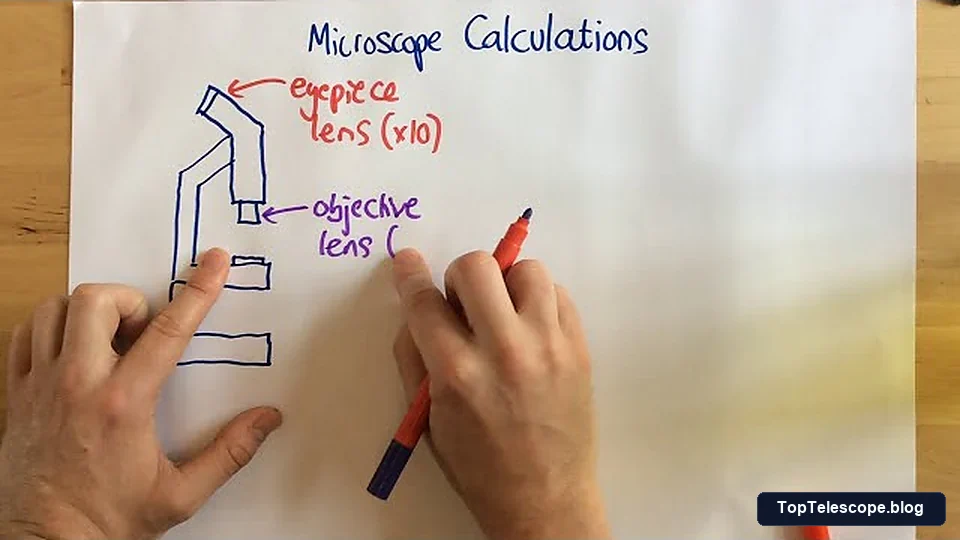
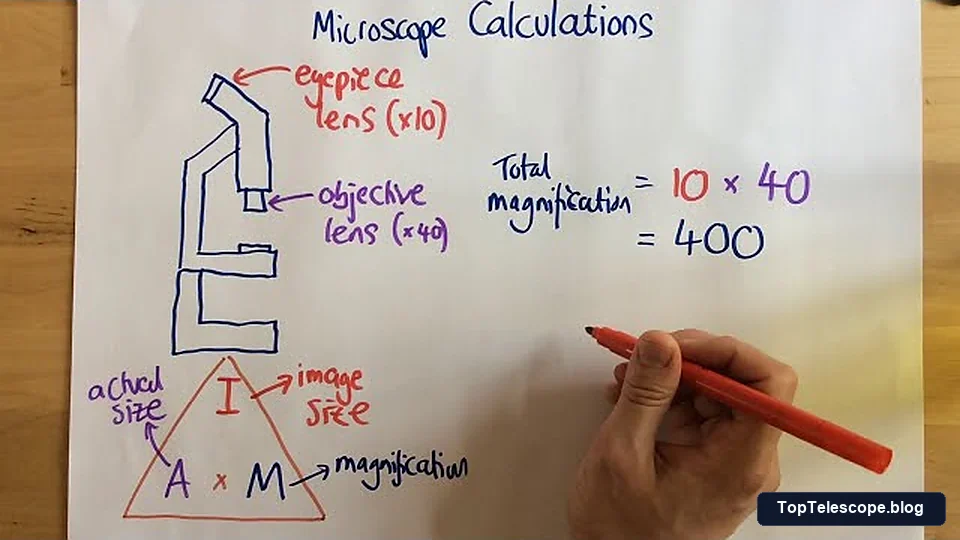
Video Walkthrough: Microscope Calculations - p14
Exit Pupil Calculations and Visual Comfort Metrics
Exit pupil size measures the column of light exiting your eyepiece. Divide your eyepiece focal length by the telescope focal ratio value.
A comfortable exit pupil matches your dark-adapted human eye pupil. Typical maximum human eye dilation reaches seven millimeters in total diameter.
Exceeding a seven millimeter exit pupil wastes collected starlight entirely. The secondary mirror shadow may block light entering your eye.
Tiny exit pupils under one millimeter strain vision on faint objects. Balance your magnification choices to maintain optimal visual comfort levels.
- Calculate exit pupil by dividing eyepiece focal by f-ratio.
- Keep exit pupils below seven millimeters for dark skies.
- Avoid overly small exit pupils when viewing faint nebulae.
- Prioritize observer comfort during long planetary sketching sessions.
Matching Exit Pupil to Target Types
Extended deep-sky objects require larger exit pupils for brightness. Planetary targets benefit from smaller exit pupils and higher contrast.
Tailor your glass choices to specific astronomical targets.
- Select two to three millimeter exit pupils for galaxies.
- Use one millimeter exit pupils for lunar observation.
Troubleshooting Atmospheric Seeing and Blur Factors
Poor atmospheric seeing ruins high-power planetary telescopic observations. Jet stream turbulence creates shimmering air currents that distort planetary wavefronts instantly.
If stars twinkle violently, high magnification will fail completely. Reduce your magnification until the image settles into sharp focus reliably.
Thermal currents inside the telescope tube also cause image degradation. Allow your optics to cool down before attempting high-power viewing.
Observe away from concrete parking lots that radiate daytime heat. Grass fields provide much more stable local microclimate conditions for astronomy.
- Check jet stream forecasts before planning high-power sessions.
- Allow adequate cool-down time for primary mirror stabilization.
- Drop magnification when atmospheric boiling blurs details.
- Set up on natural grass to minimize ground thermal currents.
Managing Thermal Equilibrium
Mirrors trapped in warm air cells create internal tube currents. Use cooling fans to accelerate thermal equalization with ambient air.
Sharp views require stable internal and external temperatures.
- Deploy cooling fans thirty minutes before observation starts.
- Keep optical tubes shaded during warm afternoon hours.
Essential Field Maintenance and Optical Safety
Protect your valuable glass elements from dust and moisture damage. Always replace dust caps immediately after removing eyepieces from focusers.
Never use unapproved chemical cleaners on coated optical surfaces. Specialized optical cleaning fluid and microfiber cloths prevent scratching delicate coatings.
Secure all gear bags away from tripping hazards in darkness. Keep your mathematics notes protected inside waterproof notebook covers outdoors.
Proper equipment care ensures reliable performance for decades of stargazing. Clean optics deliver maximum contrast and accurate magnification calculations always.
- Replace dust caps immediately after every equipment swap.
- Use certified optical cleaning solutions and microfiber cloths.
- Store eyepieces in padded cases with desiccant packs.
- Inspect mechanical thumbscrews regularly for secure retention.
Cleaning Coated Glass Surfaces
Blow away loose dust particles using a manual bulb blower. Gently wipe remaining debris with a clean optical microfiber cloth.
Avoid excessive pressure to protect anti-reflective coatings.
- Blow off loose grit before touching glass surfaces.
- Use minimal pressure when cleaning precision optics.
Frequently Asked Questions
How do I calculate telescope magnification?
Divide your telescope focal length by your eyepiece focal length. This simple equation gives your exact magnifying power for any lens combination.
What is maximum useful magnification?
Multiply your aperture in millimeters by two. Exceeding this limit results in empty magnification without revealing any additional structural details.
How does a Barlow lens affect magnification?
A standard Barlow lens multiplies your calculated power by two or three. Always insert the Barlow before the eyepiece to secure optical alignment.
Why does high magnification look blurry?
Atmospheric turbulence or thermal currents frequently degrade high-power views. Reduce your magnification until the image stabilizes into sharp focus.
What is an exit pupil in telescopes?
Exit pupil is the beam of light exiting your eyepiece lens. Keep this measurement under seven millimeters to match your dark-adapted eye.