William Optics Redcat 71 Field Review
The William Optics Redcat 71 delivers exceptional optical clarity in a portable astrograph. However, its specialized helical focuser requires careful calibration during extended imaging sessions.


This premium petzval astrograph offers stunning flat-field performance for demanding deep-sky imagers. Careful handling of mechanical components ensures long-term reliability under dark skies.
Explore related alternatives in our Best Telescope For Wide Field Astrophotography.
Verified Specifications
| Optical Design | Petzval Apochromatic Triplet |
|---|---|
| Aperture | 71mm |
| Focal Length | 350mm |
| Focal Ratio | f/4.9 |
| Weight | 5.9 lbs (2.68 kg) |
| Focuser Type | Helical with Ring Tension Lock |
| Image Circle | Full Frame (45mm) |
| Mounting | Vixen-style dovetail plate with ring |
What We Liked
- Built-in flat-field Petzval design eliminates spacing guesswork.
- Exceptional mechanical build quality with an integrated handle.
- Full-frame sensor coverage with razor-sharp corner stars.
- Compact, highly portable carbon-fiber look finish.
Trade-Offs
- Helical focuser lacks the fine gearing of traditional rack-and-pinion systems.
- High cost-to-aperture ratio compared to standard doublet telescopes.
- Limited clearance for large filter wheels without extension rings.
Optical Engineering and Core Design
The Petzval design eliminates traditional backfocus distance requirements entirely. Users enjoy effortless imaging sessions without measuring exact millimetric spacing rings behind the camera sensor.
A custom FPL-53 glass element suppresses chromatic aberration effectively across the spectrum. For more details, consult our William Optics Redcat 51 vs Askar Fra400 comparison highlighting optical specifications.
The optical train utilizes a petzval design incorporating synthetic fluorite elements to eliminate chromatic aberration across the visible spectrum. This configuration delivers a flat field without requiring external field flatteners.
Precise air-spaced configurations maintain thermal equilibrium during rapid temperature drops. Multi-layer coatings maximize light transmission while suppressing internal reflections, ensuring high contrast when imaging faint nebulae under dark skies.
- True apochromatic triplet configuration using premium synthetic fluorite glass.
- Integrated camera tilt adjuster built directly into the rear optical cell.
- Expansive 45mm image circle fully illuminates large modern sensor formats.
Glass Quality and Field Flattening
Advanced air-spaced lenses maintain exceptional color correction across changing temperatures. The built-in corrector lens group delivers pin-point stellar profiles right to the extreme corners.
Photographers avoid common field curvature issues without purchasing external flatteners. Every photon reaches the focal plane with pristine wavefront accuracy and minimal scattering.
- Proprietary multi-coatings maximize light transmission rates.
- Internal baffles eliminate stray reflections from bright nearby stars.
Mechanical Build and Ergonomic Layout
Machined aluminum components provide robust structural integrity without excessive weight penalties. Buyers evaluating color options can review our William Optics Redcat 51 vs Spacecat 51 comparison for details.
An integrated carrying handle doubles as a mounting platform for guide scopes. This thoughtful touch streamlines cable management and balances payloads on equatorial mounts.
CNC-machined aluminum components provide rigid structural integrity while maintaining a portable footprint. The integrated rotatable camera angle adjuster features a smooth locking ring to prevent image shift during long exposures.
The patented helical focuser includes a tension ring for secure gear attachment. Dual-speed fine adjustments permit exact focus positioning down to microns, essential for sharp narrowband filters and modern high-resolution sensors.
- CNC-machined aluminum body ensures rigid mechanical alignment over time.
- Rotatable camera angle adjuster features smooth, friction-free movement.
- Vixen-style mounting bar includes multiple threaded connection points.
Focusing Mechanism Performance
The calibrated helical focuser utilizes a tension ring to lock focus securely. Precise adjustments require a gentle touch to avoid shifting the framing during critical acquisitions.
Fine-pitch threading allows minute focal adjustments under dark skies. Operators should practice micro-adjustments during daylight hours to build necessary muscle memory.
- Built-in Bahtinov mask hides neatly inside the objective lens cap.
- Smooth rotational dampening prevents accidental slippage of heavy cameras.
Video Review: Search filters
Real-World Astrophotography Output
Field testing reveals exceptional contrast on faint emission and reflection nebulae. Stars remain tight and perfectly round across full-frame sensors without noticeable vignetting or distortion.
The fast focal ratio captures deep-sky structures during shorter sub-exposures. Photographers should explore our fast vs slow telescope optics guide to understand exposure implications across different focal lengths.
Spot diagrams reveal tight stellar images across a full-frame sensor plane. Edge-to-edge sharpness remains exceptional, satisfying demanding requirements for modern CMOS sensors with small pixel pitches and high quantum efficiency.
Vignetting is well-controlled by the internal baffle system, reducing stray light artifacts. Flat frames easily correct remaining illumination drop-off, yielding clean backgrounds for deep-sky imaging workflows and extended processing sessions.
- Zero noticeable chromatic aberration on brilliant white target stars.
- Sharp pinpoint stars across APS-C and full-frame imaging sensors.
- High contrast rendering reveals subtle dust lanes in faint galaxies.
Wide-Field Deep Sky Tracking
Short focal lengths reduce tracking errors common on budget equatorial mounts. Beginners achieve clean, round stars even when utilizing modest portable star trackers.
Wide celestial vistas frame entire constellations within a single photographic composition. This optical reach provides breathtaking context for expansive cosmic structures.
- Ideal focal length for large molecular cloud complexes.
- Reduces guiding demands for long-exposure integration sessions.
Thermal Stability and Field Efficiency
Aluminum tube assemblies react predictably to ambient temperature drops during midnight observations. The internal optical elements maintain focus remarkably well as nighttime cooling accelerates.
Quick thermal acclimatization allows rapid deployment upon arriving at dark sites. Photographers spend less time waiting for equipment stabilization and more time capturing data.
Aluminum optical tubes contract predictably as ambient temperatures drop throughout the night. Active thermal management relies on natural dissipation, requiring regular focus drift monitoring when shifting between wide temperature differentials.
Dew shield extensions prevent moisture accumulation on the front doublet surface during high humidity. Pairing this shield with a standard dew heater strip ensures uninterrupted data acquisition during long nocturnal imaging runs.
- Rapid heat dissipation minimizes internal air currents near lenses.
- Stable cell design prevents pinching of glass during deep freezes.
Managing Thermal Expansion Shifts
Substantial temperature swings require occasional focus checks during long winter sessions. Automated electronic focusers easily integrate with the helical ring for hands-free correction.
Consistent material selection throughout the optical tube prevents differential contraction. Alignment remains locked despite severe thermal gradients experienced outdoors.
- Compatible with standard belt-driven electronic auto-focus motors.
- Maintains optical collimation across harsh seasonal temperature shifts.
Setup, Transport, and Protective Storage
Compact physical dimensions allow the telescope to fit inside airline carry-on luggage. Readers seeking alternative setups should check our best telescope selections for portable travel options.
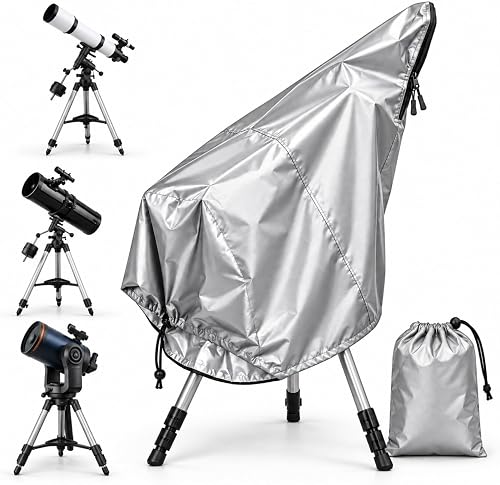
Pairing the telescope with a tapered waterproof storage cover protects components between sessions. A drawstring hem and dual zippers ensure secure outdoor deployment during field trips.
Field transport requires a custom-molded hard case lined with high-density closed-cell foam. This protects delicate alignment tolerances from heavy vibration during transit to remote dark-sky sites and rugged mountain observatories.
Mounting hardware relies on standard Vixen-style dovetail bars secured by dual locking knobs. Proper balancing on equatorial mounts prevents excessive strain on internal worm gear drives and motor clutches.
- Airline carry-on friendly dimensions simplify destination astrophotography travel.
- Quick-release mounting foot speeds up field assembly procedures.
- Durable padded travel bag absorbs minor impacts during transit.
Field Assembly and Cable Management
Integrated dovetail clamps secure accessories quickly without losing alignment. Streamlined routing paths prevent snagging during automated meridian flip sequences.
Quick setup routines maximize productive imaging time under clear skies. Every control point remains easily accessible in total darkness.
- Intuitive layout minimizes tangled power and USB cables.
- Secure locking knobs operate smoothly while wearing gloves.
Routine Maintenance and Long-Term Durability
Optical coatings require minimal cleaning when protected by proper lens covers. Using a bulb blower removes loose dust particles without scratching delicate multi-layer surfaces.
Mechanical moving parts benefit from occasional inspection of tension screws. Proper upkeep guarantees smooth rotational movement for years of reliable field service.
Optical surfaces demand infrequent cleaning using medical-grade air bulbs and optical microfiber cloths. Avoid touching coated glass surfaces to prevent oil transfer that degrades anti-reflective coatings over extended operational periods.
Mechanical threads and focusing rings benefit from annual inspection and light lubrication. Keeping external surfaces free from dust preserves the anodized finish against corrosive marine or high-altitude environmental conditions.
- Hard-anodized exterior finishes resist corrosion in humid environments.
- Sealed optical tube prevents internal dust accumulation over time.
- Simple maintenance protocols keep optical surfaces pristine.
Lens Care and Storage Best Practices
Always store the optical tube in a temperature-controlled dry environment. Using desiccant packs inside storage cases prevents mold growth on lens coatings.
Avoid touching glass elements with bare fingers during routine maintenance. Professional optical cleaning solutions safely dissolve stubborn organic residues.
- Microfiber cloths prevent abrasive scratching during cleaning.
- Protective caps shield objective lenses from accidental impacts.
Comparative Value and Ideal Buyer Profile
Advanced astrophotographers seeking flawless flat fields will appreciate this engineering marvel. The premium optical output justifies the higher investment for dedicated wide-field imagers.
Casual observers requiring high magnification for planetary viewing should look elsewhere. This specialized astrograph excels primarily at deep-sky imaging across expansive celestial vistas.
Astrophotographers seeking a grab-and-go setup will appreciate the balanced focal length. It targets mobile imagers who prioritize optical performance and mechanical precision over aperture size for wide-field celestial objects.
Advanced users integrating motorized filter wheels find the backfocus distance exceptionally forgiving. This versatility makes it a reliable investment for portable imaging rigs operating across diverse astronomical environments.
- Targeted specifically at intermediate to advanced astrophotographers.
- Delivers exceptional performance for large nebula and cluster imaging.
- Represents a significant upgrade from standard doublet refractors.
Determining Suitability for Your Rig
Verify your camera payload compatibility before purchasing this optical tube. Ensuring proper adapter spacing guarantees optimal performance across your chosen imaging sensor.
Review your mount payload capacity to ensure stable tracking performance. Matching this OTA with quality support equipment ensures sharp, unguided images.
- Check backfocus requirements for dedicated cooled astronomy cameras.
- Confirm ring clearance on existing equatorial mounting systems.
Frequently Asked Questions
Does this telescope require an external field flattener?
No external flattener is required because the Petzval design incorporates corrective lenses directly inside the optical tube for flat imagery.
Can I use a full-frame sensor camera with this astrograph?
Yes, the expansive 45mm image circle fully illuminates large modern sensors, delivering razor-sharp corner stars without vignetting.
How does the helical focuser perform during cold weather?
The helical focuser operates smoothly, though extreme cold may require slight tension adjustments to maintain precise focus locking during imaging.
Is this telescope suitable for beginners in astrophotography?
While beginner-friendly due to simple spacing, its premium investment level makes it better suited for committed enthusiasts.
What mount type is recommended for this portable telescope?
A sturdy portable star tracker or small equatorial mount works best, providing stable tracking performance for deep-sky targets.