Virtuoso Gti 150P Review: Automated Tabletop Reflector
The Sky-Watcher Virtuoso Gti 150P combines a 150mm parabolic mirror with automated GoTo tracking. Users gain extreme portability while trading away heavy-duty equatorial polar alignment capabilities.



This computerized tabletop telescope delivers bright, contrast-rich deep-sky views via Wi-Fi control. It represents an exceptional portable package for beginners demanding automated tracking without complex setups.
Explore related alternatives in our Best Tabletop Telescope.
Verified Specifications
| Category / Type | Tabletop GoTo Newtonian Reflector |
|---|---|
| Rated Output / Capacity | 150mm Aperture |
| Power / Motor | DC Servo Dual-Axis Motors |
| Build & Materials | Borosilicate Glass Mirror, Steel Tube |
| Operating Noise | Low-Decibel Slewing Hum |
| Duty Cycle / Runtime | 8x AA Batteries or External 12V DC |
| Dimensions & Weight | 10 kg Total System Weight |
| Key Safety & Controls | SynScan Wi-Fi App Control |
What We Liked
- Large 150mm optical aperture
- Automated SynScan Wi-Fi GoTo tracking
- Collapsible truss-tube portability
- Precise 1.25-inch helical focuser
Trade-Offs
- Requires a sturdy tabletop surface
- Internal battery drain is rapid
- Plastic components in mount housing
Optical Design and Primary Mirror Engineering
The optical configuration utilizes a fast f/5 focal ratio housed inside a compact 750mm focal length optical tube. This design prioritizes wide-field viewing capabilities while maintaining sharp on-axis imagery.
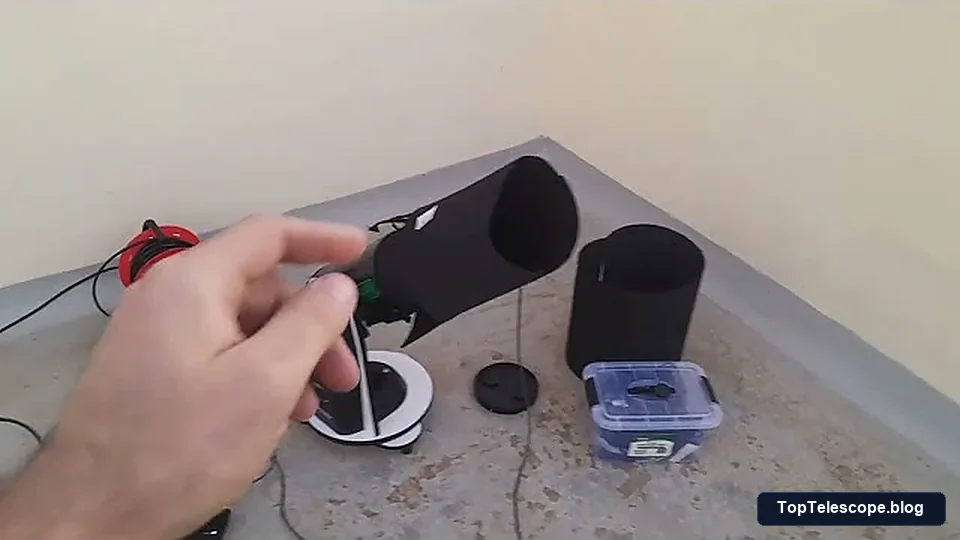
Engineers integrated a parabolic primary mirror ground from low-expansion borosilicate glass. This specific material choice minimizes thermal distortion during rapid temperature drops encountered during evening observation sessions.
The 150mm parabolic primary mirror utilizes a fast f/5 focal ratio, yielding a 750mm focal length suited for wide-field vistas. This parabolic figure eliminates spherical aberration across the entire visual field.
Enhanced aluminum coatings deliver approximately 94 percent reflectivity, maximizing photon throughput before light strikes the diagonal mirror. The secondary mirror sports a 45mm minor axis to balance central obstruction limits.
- 150mm clear aperture diameter
- 750mm physical focal length
- Parabolic figure eliminates spherical aberration
Borosilicate Substrate and Aluminum Coatings
For deeper insights, check out the Sky-Watcher 150P and Virtuoso GTi comparison detailing optical coatings and mirror specs. These protective layers ensure high reflectivity ratings while safeguarding the delicate aluminum deposition from oxidation.
Secondary obstruction remains minimal thanks to a well-sized diagonal flat supported by thin spider vanes. This geometry reduces diffraction spikes and preserves high contrast ratios across planetary targets.
- Proprietary protective quartz overcoat
- Thin secondary mirror spider vanes
Mechanical Structure and Collapsible Tube Mechanics
Transporting a 150mm Newtonian usually demands bulky rigging, but this model features a collapsible truss design. Our Skywatcher Heritage 130P vs 150P comparison details how twin metal guide rails allow the optical tube to shorten significantly.
Positive-stop locking screws ensure the upper cage repeats its exact focal plane position when extended. Field tests confirm that collimation remains remarkably stable across repeated assembly cycles.
The collapsible truss tube design employs three dual-rod aluminum struts that lock securely into position via thumb screws. This mechanism reduces transport length while maintaining optical collimation stability during frequent field teardowns.
Machined aluminum rings maintain rigid alignment between the primary cell and spider vanes. Users must verify the tension control handles remain snug to prevent any mechanical sag during zenith pointing maneuvers.
- Dual-rail sliding truss poles
- Positive-stop mechanical locking thumb screws
Video Review: REVIEW (2026): Virtuoso GTI 150P Telescope. Features
GoTo Control Systems and Wi-Fi Integration
Eschewing traditional hand controllers, the mount generates its own internal Wi-Fi network signal. Users connect smartphones or tablets directly to operate the automated dual-axis tracking system.
The onboard computer communicates seamlessly with the free SynScan application available on major mobile platforms. This digital ecosystem simplifies celestial database navigation and automated object slewing routines.
Built-in Wi-Fi architecture broadcasts an independent network, allowing direct connection to smartphones running the SynScan Pro application. This removes the need for traditional hand controllers while enabling seamless wireless alignment.
Dual-axis encoders permit manual repositioning without losing alignment data, a feature known as Freedom-Find technology. Motor gears operate quietly, driven by an internal board running on standard 12-volt battery packs.
- Internal Wi-Fi access point
- Dual-axis DC servo motor drives
SynScan App Alignment Protocols
Initial sky calibration relies on simplified procedures like bright star alignment or manual pointing methods. As noted in our Sky-Watcher Heritage 150P vs 130P guide, the system tracks targets accurately across the celestial sphere.
Auxiliary encoder technology permits manual repositioning of the optical tube. The computer maintains positional tracking awareness even if users physically nudge the telescope toward a new target.
- Multiple alignment star routines
- Dual-encoder clutchless manual override
Altazimuth Mount Stability and Tabletop Ergonomics
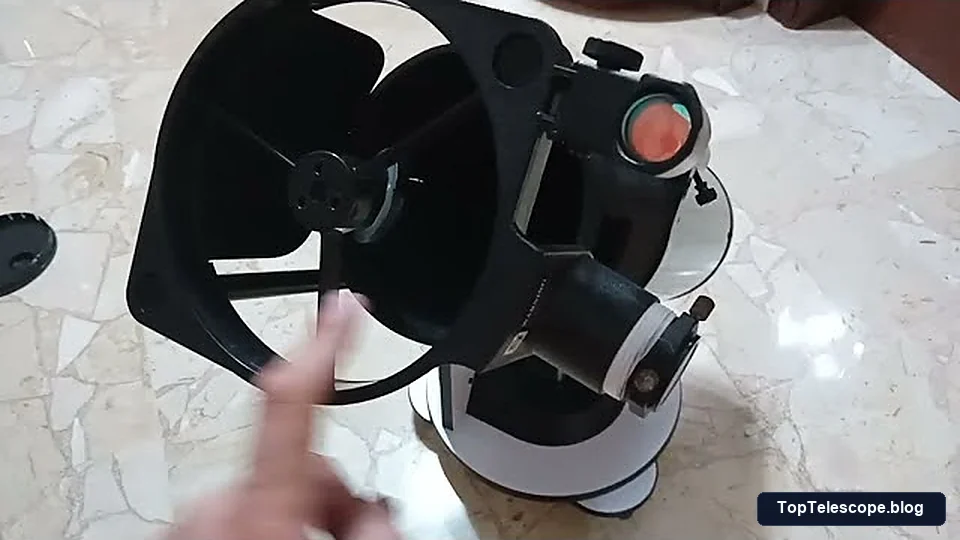
The motorized single-arm altazimuth base rests upon three broad rubber feet designed to dampen ground vibrations. Total system mass hovers near ten kilograms, striking a balance between stability and portability.
Operating this system requires a rigid, level platform such as a sturdy picnic table or dedicated tripod pier. Unstable surfaces will amplify minor mechanical slewing vibrations into noticeable image jitter.
The single-arm motorized altazimuth base supports the optical tube assembly with minimal flexure when balanced properly. Its cast aluminum housing absorbs moderate wind loads while remaining light enough for rapid grab-and-go deployment.
Operating this system requires a sturdy horizontal surface to prevent vibrational damping issues at high magnifications. Standard 3/8-inch threaded studs allow direct attachment to heavy photographic tripods for elevated field viewing.
- Vibration-dampening rubber foot pads
- Standard 3/8-inch tripod thread mount
Field Performance on Lunar and Deep-Sky Targets
Under dark skies, the 150mm light-gathering aperture resolves faint nebulae and distant globular clusters with ease. Messier catalog objects reveal distinct structural details previously invisible in smaller beginner refractors.
Lunar and planetary observation benefits immensely from the fast optical system paired with high-magnification eyepieces. Craters, cloud belts, and planetary rings display crisp boundaries free from chromatic aberration.
Lunar observations reveal crisp crater walls and rilles when paired with high-grade planetary eyepieces. The fast focal ratio provides expansive star fields that showcase open clusters and large emission nebulae brilliantly.
Surface brightness on faint galaxies remains respectable given the moderate aperture, though light pollution filters are recommended. Globular clusters resolve cleanly into distinct stellar points when seeing conditions stabilize during midnight viewing.
- Deep-sky object resolution limit
- Zero false color dispersion
Thermal Management and Collimation Maintenance
Newtonian reflectors require thermal acclimation before delivering peak high-magnification planetary performance. Leaving the optical tube outside for thirty minutes allows the borosilicate mirror to reach ambient temperature equilibrium.
Collimation screws on the rear cell utilize user-friendly knurled knobs requiring no specialized tools. Periodic optical alignment checks ensure pinpoint star images remain sharp throughout extended observation sessions.
Parabolic mirrors require adequate thermal acclimation time to match ambient outdoor temperatures before high-power viewing commences. Leaving the optical tube exposed outside for thirty minutes usually suffices for complete heat dissipation.
Regular collimation using a laser collimator ensures pinpoint stellar images across the optical axis. Adjusting the primary mirror thumbscrews is straightforward, requiring no tools beyond an Allen key for secondary alignment.
- Tool-free primary mirror adjustment
- Open truss design accelerates cooling
Maintenance Routine and Long-Term Durability
Maintaining optical cleanliness involves storing the telescope with dust caps securely attached to prevent mirror contamination. Users should avoid touching the reflective coatings directly to prevent permanent chemical degradation.
Mechanical joints and clutch gears benefit from occasional inspection to ensure smooth tracking operation. Keeping the internal battery compartment clean prevents corrosion from leaking alkaline cells over time.
Protecting open truss assemblies demands regular inspection of internal optical surfaces for accumulated dust or dew residue. Users should apply silicone grease sparingly to mechanical gears to ensure smooth tracking across cold winter nights.
Storing the optical tube with dust caps attached prevents particulate scratching on delicate aluminum coatings during transit. Electronic ports require protection from heavy moisture to safeguard internal circuit boards against accidental short circuits.
- Protective dust cap maintenance
- Battery compartment inspection protocol
Final Engineering Verdict and Buyer Guidance
This instrument delivers an exceptional blend of large aperture optics and modern GoTo automation. It ranks highly within any best telescope guide for intermediate hobbyists and dedicated beginners seeking portable backyard equipment.
Buyers must acknowledge the necessity of a stable tabletop surface and auxiliary power supplies. Overall, the engineering execution offers remarkable value for mobile stargazing enthusiasts worldwide.
This motorized Newtonian delivers an exceptional blend of aperture and portability for intermediate stargazers seeking automated tracking. Its rigid truss mechanics and wireless control system satisfy demanding field requirements reliably.
Prospective buyers should ensure access to a stable power source and a flat support platform for optimal operational performance. Careful attention to collimation will unlock the true resolving power of this versatile optical instrument.
- Ideal portable GoTo reflector
- Requires stable platform placement
Frequently Asked Questions
Can this telescope run on standard household electrical wall outlets?
The mount requires an optional twelve-volt DC power adapter because standard household electrical wall outlets are completely incompatible with the sensitive onboard electronics.
Field operators can easily power the unit using portable lithium power banks, external field batteries, or internal battery trays during remote stargazing sessions.
Does the collapsible tube design require frequent optical realignment?
The robust dual-rail truss system maintains mechanical registration reliably across assembly cycles. However, verifying primary mirror alignment using a Cheshire eyepiece before complex imaging sessions remains standard best practice.
Can advanced users mount different optical tubes onto this motorized base?
The single-arm altazimuth base utilizes a standard Vixen-style dovetail clamp fitting compatible with various small OTAs. Operators must ensure total payload mass stays strictly within manufacturer weight limits.
How does the built-in Wi-Fi connection operate without an internet router?
The internal transceiver broadcasts an independent wireless access point directly to smart devices running the SynScan app. An active cellular or internet connection is completely unnecessary for field operation.
What specific accessories come included straight out of the product box?
Standard equipment bundles include a reflex finderscope, a 1.25-inch helical focuser, and select Plossl eyepieces. Users frequently upgrade to specialized planetary lenses for high-magnification lunar viewing.