Vaonis Vespera II Review: Smart Scope Analyzed
The Vaonis Vespera II brings fully automated deep-sky imaging to casual stargazers through an ultra-portable chassis. However, its small objective aperture limits high-resolution planetary details during tight viewing sessions.

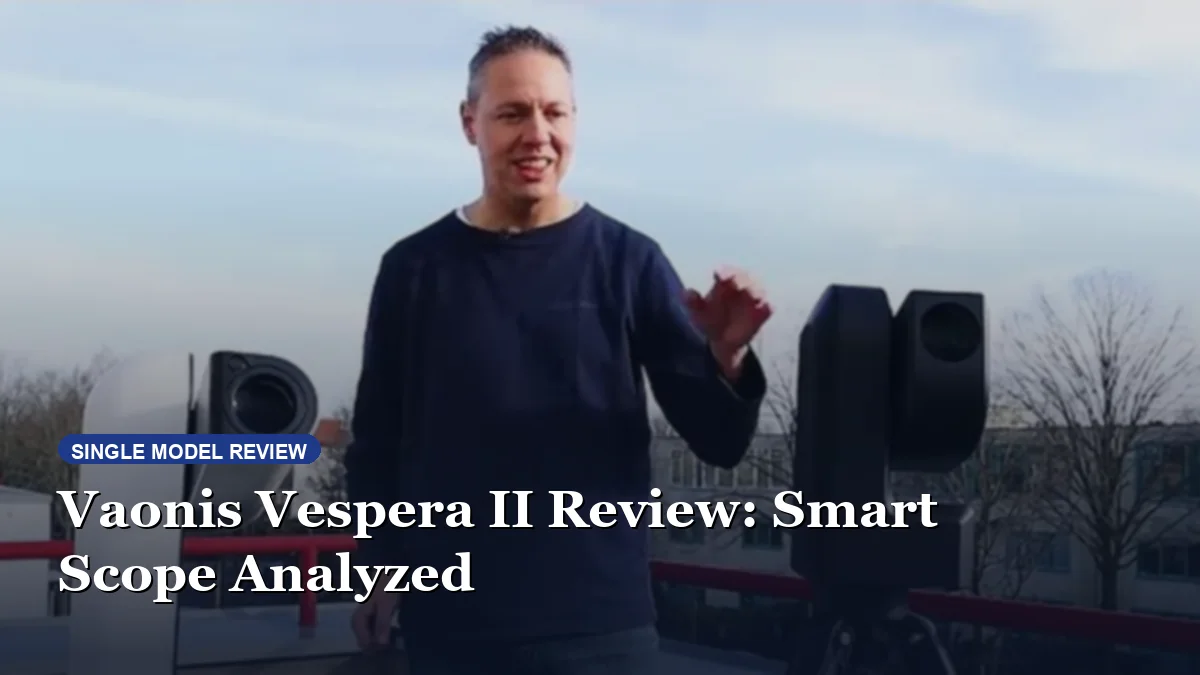

This smart telescope excels at hands-off nebula captures, making field astrophotography accessible without complex mounts. Buyers must accept fixed sensor parameters in exchange for effortless automated setup.
See our flagship Best Telescope: Top Backyard Picks for Astronomy.
Verified Specifications
| Category / Type | Smart Astrophotography Station |
|---|---|
| Rated Output / Capacity | Built-in rechargeable battery |
| Power / Motor | Internal battery powered system |
| Build & Materials | Water-resistant composite housing |
| Operating Noise | Low-decibel altazimuth slewing motors |
| Duty Cycle / Runtime | Extended overnight integration support |
| Dimensions & Weight | 8 inches x 8 inches x 3.5 inches, 11 pounds |
| Key Safety & Controls | Vaonis mobile app integration |
What We Liked
- Fully automated star-field recognition technology
- Lightweight 11-pound chassis for travel
- Integrated smartphone application support
- Built-in water-resistant rain protection
Trade-Offs
- Fixed 50mm objective lens aperture
- Non-upgradable internal camera sensor
- Dependent on mobile device connectivity
Engineering and Optical Chassis Design
The optical tube features a compact 25-centimeter length paired with a 50mm objective lens diameter to maintain portability. This refractor design utilizes fully coated glass to maximize light transmission across faint deep-sky targets.
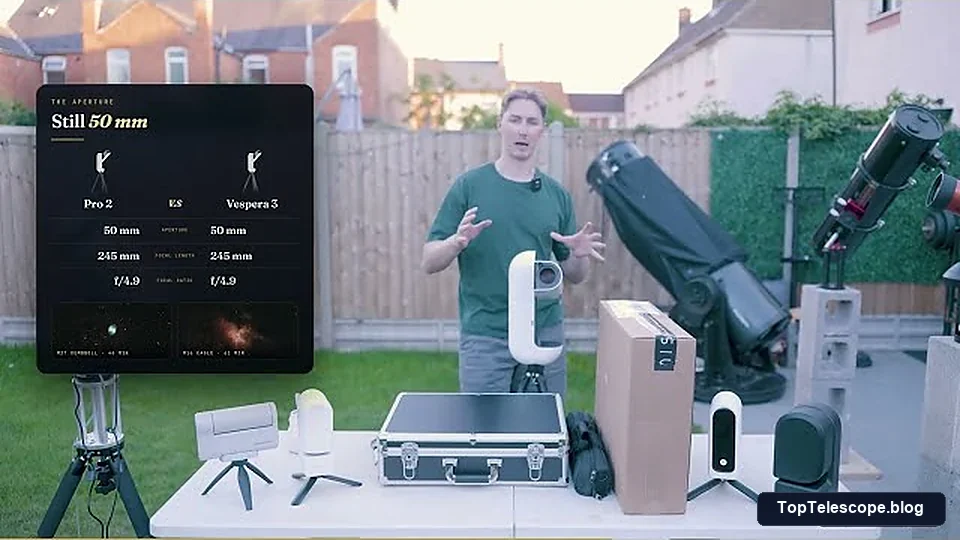
Weighing just 11 pounds, the physical assembly travels easily inside standard backpacks. Operators can deploy the system outdoors without lugging heavy counterweights or balancing traditional equatorial tracking mounts.
The Vaonis Vespera II utilizes a quadruplet apochromatic optical design featuring a 50mm aperture. Review our Zwo Seestar S50 vs Vaonis Vespera comparison for critical technical specs.
Enclosed within a cast-aluminum chassis, the internal baffle system suppresses stray light reflections. Maintenance requires using compressed air on exterior surfaces while avoiding harsh chemical solvents on the delicate multi-coated objective lens elements.
- 50mm objective aperture
- 250mm focal length optical system
- Fully coated glass elements
Optical Specifications Analysis
The native 250mm focal length provides a wide field of view suitable for large emission nebulae. A built-in Barlow lens further expands optical utility during specific observation runs.
- Compact 25-centimeter optical tube
- Wide field of view optimization
Automated Alignment and Field Mechanics
Setup complexity vanishes thanks to proprietary star field recognition technology built into the hardware. Browse our curated best telescope guide featuring leading backyard picks for observers.
An integrated altazimuth mount handles the tracking mechanics smoothly while compensating for field rotation during long exposure sequences. Motors operate quietly, minimizing acoustic disruption in quiet suburban backyards.
Field operations rely on an autonomous plate solving algorithm that maps star fields without manual user intervention. The motorized alt-azimuth mount utilizes quiet stepper motors to track celestial targets across the diurnal rotation arc.
Mechanical backlash is minimized via spring-loaded worm gears, ensuring precise pointing accuracy during long exposure sessions. Periodic calibration procedures via the companion application keep the pointing model accurate under varying ambient temperature gradients.
- Autonomous plate-solving alignment
- Altazimuth tracking configuration
- Low-noise slewing motors
Video Review: Is this smart scope worth its $1690 Price Tag?! FULL \u0026 HONEST review of Vaonis Vespera II!
Imaging Sensor Performance and Processing
Stacking algorithms run continuously in the background to build vibrant color images of faint galaxies and star clusters. Users watch exposures develop directly on their connected mobile devices in real time.
While the sensor excels at wide-field nebulosity, planetary imaging remains limited by the short focal length. Small lunar craters appear recognizable, but high-magnification planetary details stay out of reach.
Inside the optical tube, a Sony IMX585 sensor delivers high quantum efficiency and low read noise. This back-illuminated sensor format captures deep sky details while processing data directly through an onboard computing unit.
Real-time image stacking algorithms automatically align individual sub-exposures, rejecting frames impacted by satellite trails or wind gusts. Users can export raw FITS files for advanced post-processing workflows using standard astrophotography software suites.
- Real-time image stacking
- Optimized for deep-sky objects
- Wireless live preview
Power Management, Charging, and Field Operation
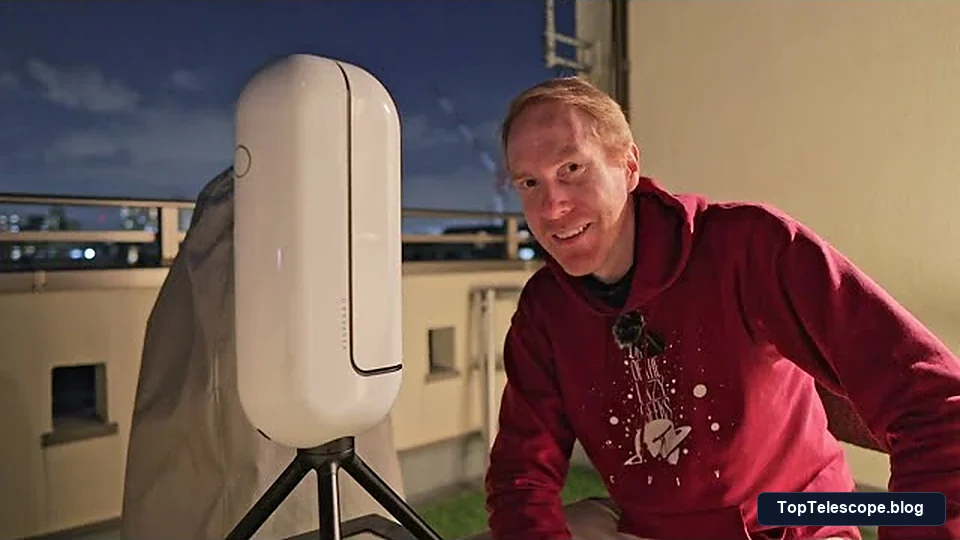
Powering the unit relies on an internal battery system designed to support hours of continuous field imaging. Field operators should pack a compatible external USB power bank for multi-night wilderness expeditions.
The instrument manages power intelligently, shutting down safely when unexpected rain threatens electronic integrity. This protective automation safeguards internal components against sudden weather shifts during unattended sessions.
Powering the system requires an internal lithium-ion battery delivering approximately four hours of continuous field operation. Field technicians can extend this runtime by connecting an external USB-C power bank supporting standard delivery protocols.
Thermal management during heavy charging cycles relies on passive dissipation through the aluminum chassis. Users must store the device within recommended temperature parameters to preserve battery chemistry health over extended storage periods.
- Internal rechargeable battery
- External USB power compatibility
- Weather-triggered safety shutdown
Software Integration and Wireless Control
Controlling the observation station requires pairing the hardware with the dedicated Vaonis mobile app. Consult our Unistellar Evscope 2 vs Vaonis Vespera II comparison to evaluate alternative systems.
Wireless connectivity remains stable within standard backyard ranges, letting users monitor imaging progress from indoors. Firmware updates deploy seamlessly through the application, introducing new catalog objects and performance refinements.
Wireless communication relies on an integrated Wi-Fi hotspot that connects directly to mobile devices running the Singularity app. The interface streamlines target selection, observation parameters, and live stacking progress monitoring.
Firmware updates install seamlessly via wireless transfers, introducing new catalog databases and algorithmic improvements. Network security protocols protect the local connection from interference during public outreach or remote observation sessions.
- Dedicated smartphone application
- Local Wi-Fi network streaming
- Over-the-air firmware updates
Environmental Resilience and Build Durability
Outdoor durability is enhanced by water-resistant exterior seals designed to withstand light moisture exposure. The automated rain sensor actively triggers safety protocols, retracting operations if precipitation begins.
Routine maintenance requires only basic lens cleaning procedures to keep optical surfaces free from dust and pollen. The rugged composite housing resists minor bumps encountered during transport to remote dark-sky sites.
Built for outdoor deployment, the chassis features weather-resistant seals protecting internal electronics from dew and dust. Maintenance protocols require thorough drying before housing the instrument inside its padded transport case.
Structural integrity withstands minor field bumps, though the optical assembly requires careful handling during tripod mounting. Avoid exposing the mechanical housing to corrosive coastal environments without subsequent freshwater wipe downs and protective covers.
- Water-resistant exterior chassis
- Automated rain detection sensor
- Rugged travel-ready housing
Comprehensive Buyer Assessment and Verdict
This smart telescope redefines entry-level astrophotography by eliminating manual alignment frustrations completely. Beginners and travelers gain immediate access to deep-sky wonders without mastering complex equatorial polar alignment steps.
Advanced astronomers seeking interchangeable eyepieces or modular optical tubes should look elsewhere. However, anyone prioritizing ultimate portability and effortless automated imaging will find exceptional value here.
Technical evaluations confirm that this smart telescope excels at automated deep-sky imaging. Read our Vaonis Stellina vs Evscope 2 comparison to analyze competing hardware options for astronomy enthusiasts.
Consideration of hardware limitations helps users align expectations regarding aperture size and focal length constraints. Proper upkeep and adherence to operational guidelines ensure reliable performance across numerous observation nights.
- Ideal for novice astrophotographers
- Ultra-portable travel footprint
- Streamlined automated workflow
Frequently Asked Questions
How does the telescope align itself without manual intervention?
The unit utilizes sophisticated star field recognition technology to automatically photograph overhead constellations and match coordinates. This internal plate-solving completely eliminates the need for traditional manual star alignments or complex finder scopes.
Can I use this telescope for detailed planetary viewing?
The short focal length and compact objective lens are optimized for wide-field deep-sky objects rather than high-magnification planetary targets. While you can observe the Moon, planets will appear relatively small without heavy cropping.
Is an internet connection required to operate the system outdoors?
The telescope generates its own local Wi-Fi network to communicate directly with your smartphone or tablet application. Therefore, you do not need an active cellular or internet connection while operating in remote locations.
What happens if it starts raining during an imaging session?
The system features built-in water-resistant housing and an automatic rain sensor that detects moisture. When precipitation is detected, the unit safely halts operations to protect its internal electronic components from water damage.
How long does the internal battery last during field use?
The self-contained battery supports several hours of continuous target stacking and tracking in the field. For extended overnight imaging sessions, users can easily connect an external USB power bank for continuous operation.