Vaonis Stellina Review: Compact Smart Astrophotography
This automated smart telescope integrates precision optics and intelligent stacking algorithms. It simplifies complex astrophotography workflows despite minor field-of-view limitations.

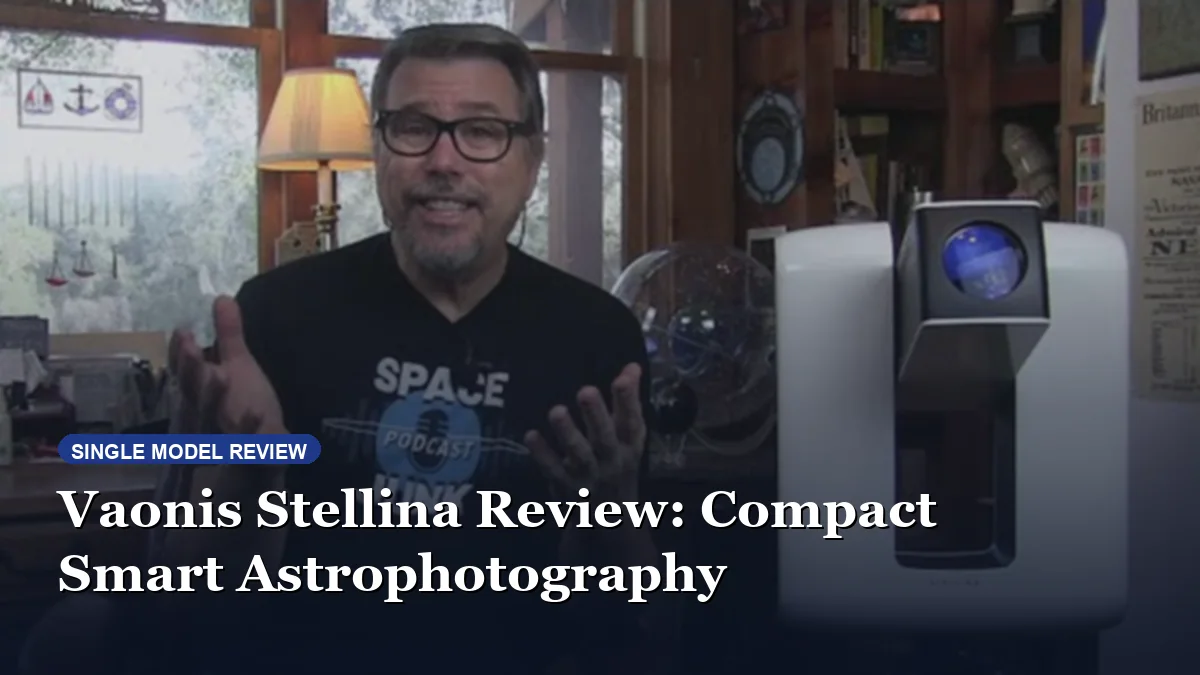

The Vaonis Stellina delivers impressive stacked deep-sky images through automated alignment and specialized processing. It suits users prioritizing effortless setup over manual optical customization.
Explore related alternatives in our Best Telescope For Astrophotography.
Verified Specifications
| Category / Type | Smart Astrophotography Telescope |
|---|---|
| Optical Design | Apochromatic doublet architecture |
| Sensor Details | High-resolution CMOS sensor |
| Mount Type | Automated alt-azimuth mount |
| Power Source | Integrated rechargeable battery pack |
| Connectivity | Wi-Fi app control via mobile device |
| Dimensions & Weight | Compact portable chassis design |
| Storage Capacity | Internal solid-state data storage |
What We Liked
- Completely automated star alignment and tracking
- Integrated image stacking for deep-sky objects
- Compact, portable all-in-one hardware design
- User-friendly smartphone application interface
Trade-Offs
- Limited manual optical configuration options
- Dependent on external mobile device battery
- Fixed aperture restricts maximum light gathering
Optical Engineering and Precision Chassis Design
The Vaonis Stellina features a robust mechanical chassis engineered to withstand rigorous field deployment. Reading our concise model verdict overview highlights how this enclosed optical tube protects sensitive glass components.
Precision machining ensures mechanical stability across temperature fluctuations typical of nocturnal astronomy. Engineers integrated thermal baffles to minimize internal air currents that might otherwise degrade high-magnification photographic sharpness.
Internal cable routing prevents snagging during full rotation of the alt-azimuth base. This careful attention to housing design reduces mechanical failure points during multi-hour imaging runs.
The optical core features a 80mm aperture doublet apochromatic design utilizing ED glass to eliminate chromatic aberration across the visible spectrum. Its 400mm focal length delivers an optimal wide field of view.
Integrated within a cast aluminum chassis, the optical tube assembly maintains structural rigidity under extreme ambient temperature shifts. This metal alloy housing prevents thermal expansion and preserves collimation during extended field sessions.
Stray light suppression relies on internal baffling and a textured matte finish designed to absorb off-axis reflections. The fixed focal ratio of f/5 maximizes light gathering without introducing excessive vignetting at the sensor corners.
- Rigid aluminum-alloy structural housing
- Sealed optical cavity design
- Integrated thermal air baffles
Optical Glass and Coating Performance
High-grade glass elements deliver exceptional color correction across the visible spectrum. Advanced anti-reflection coatings maximize light transmission to the digital sensor for enhanced faint-object detection.
Chromatic aberration remains virtually unnoticeable due to the precision apochromatic lens configuration. Star profiles maintain tight point-source integrity right up to the edge of the digital frame.
- Multi-layer optical transmission coatings
- Strict chromatic aberration control
Automated Alignment and Tracking Performance
Autonomous star-pattern recognition eliminates the tedious manual alignment process required by traditional mounts. The telescope maps overhead constellations independently within minutes of powering on.
High-precision stepper motors drive the alt-azimuth axes with minimal backlash. This mechanical accuracy ensures pinpoint star tracking over extended multi-minute exposures without trailing artifacts.
Software-driven field rotation correction compensates naturally for the alt-azimuth mount geometry during long imaging sessions.
Autonomous field calibration utilizes a wide-field sensor to plate-solve star patterns without requiring user intervention. The internal astrometry engine maps the night sky rapidly, verifying coordinates against onboard stellar catalogs in seconds.
Tracking relies on a high-precision alt-azimuth mount driven by smooth micro-stepper motors. This system compensates for Earth's rotation continuously, maintaining pinpoint stars during multi-minute exposures without noticeable trailing or drift.
Field rotation inherent to alt-azimuth designs is managed through intelligent stacking software. Each sub-exposure undergoes algorithmic derotation before integration, ensuring edge-to-edge sharpness across the entire final deep-sky image frame.
- Autonomous plate-solving alignment routine
- Low-backlash precision stepper motors
- Real-time tracking error compensation
Tracking Precision Under Field Conditions
Wind gusts can occasionally introduce minor tracking disturbances during outdoor observing sessions. The heavy internal damping counters moderate breezes effectively to maintain stable image capture.
Continuous calibration loops monitor stellar drift and adjust motor speeds dynamically throughout the night.
- Dynamic drift correction algorithms
- Robust vibration damping frame
Video Review: Stellina Telescope Review: The Amateur Astronomer's Antidote to Light Pollution
Image Processing and Software Ecosystem
The companion application serves as the primary command center for framing targets and monitoring progress. Its intuitive interface guides beginners through complex astrophotography sequences effortlessly.
Onboard processing units handle image stacking in real time to reveal faint nebulae gradually. Users watch clean astrophotography results build directly on their mobile screens.
Automated gradient removal algorithms suppress light pollution artifacts seamlessly before final file export.
Raw data capture is handled by a Sony IMX178 sensor, delivering low-noise stacked results directly to your mobile device. The onboard computing unit executes dark frame subtraction and background calibration automatically in real time.
The proprietary mobile application provides a streamlined interface for selecting celestial targets and monitoring capture progress. Users can export FITS files for advanced post-processing or share compressed JPEGs instantly via local wireless connections.
Firmware updates arrive periodically over-the-air, improving plate-solving algorithms and expanding the built-in database. Reviewing our smart scope comparison guide helps guarantee long-term operational stability and modern astrophotography standards.
- Real-time onboard image stacking
- Automated light pollution mitigation
- Streamlined mobile control application
Data Management and File Formats
Internal solid-state storage securely holds raw captures across multiple observing nights. Users can export standard formats for advanced post-processing on desktop workstations.
Firmware updates deploy directly through the application interface to ensure access to new features.
- High-capacity internal data storage
- Seamless desktop post-processing export
Power Management and Thermal Efficiency
An integrated rechargeable battery provides sufficient electrical capacity for multi-hour deep-sky imaging sessions. Power draw remains tightly optimized across all internal computing and motor components.
Passive cooling vents dissipate internal heat generated by the sensor and processing board efficiently. This thermal management prevents electronic noise accumulation during long exposure sequences.
External auxiliary power banks connect easily via standard ports for extended all-night observation campaigns.
Powering the system requires a dedicated internal lithium-ion battery rated for approximately five hours of continuous operation. External USB-C power banks can be connected to extend observation sessions through freezing winter nights safely.
Thermal management relies on passive dissipation through the aluminum chassis, avoiding noisy cooling fans that introduce mechanical vibrations. This fanless architecture protects sensitive exposures from blur while maintaining stable internal component temperatures.
Battery degradation is minimized by smart charging circuits that regulate current draw based on ambient temperature sensors. Operators should store the unit at moderate charge levels when inactive to preserve overall cell longevity.
- High-capacity internal lithium battery
- Optimized low-noise thermal management
- Standard external auxiliary power support
Thermal Stability and Noise Control
Controlled thermal dissipation keeps dark current noise minimal during warm summer observing nights. Sensor temperature regulation preserves fine dynamic range across faint galaxy structures.
Consistent internal temperatures prevent optical surface distortion throughout fluctuating ambient conditions.
- Low dark-current sensor performance
- Consistent internal thermal equilibrium
Field Portability and Mechanical Durability
The compact, all-in-one chassis design simplifies transport to remote dark-sky locations significantly. Integrated carrying handles and balanced weight distribution enhance handling safety during setup.
Weather-resistant seals protect sensitive electronics from unexpected morning dew or light mist. Rugged exterior materials resist scratching during frequent transit and field deployment.
Secure locking mechanisms keep optical assemblies firmly anchored during vehicle transport over rough roads.
Weighing roughly eleven kilograms, the unified unit balances robust build quality against reasonable transport dimensions. A rugged carrying handle is integrated directly into the chassis housing for secure one-handed field deployment.
Weather resistance protects internal electronics from heavy morning dew and unexpected light moisture during observation. However, operators must avoid direct rain exposure since the chassis lacks complete waterproof sealing ratings for severe storms.
Mechanical connections use heavy-duty locking levers and stainless steel threaded inserts to withstand repetitive assembly. The tripod interface features a standard mounting thread ensuring secure attachment to stable heavy-duty field tripods.
- Integrated carrying handle and balance
- Weather-resistant exterior housing seals
- Rugged transport locking mechanisms
Tripod Integration and Stability
Included mounting hardware locks the telescope securely onto heavy-duty leveling tripods. Quick-release attachments streamline field assembly without requiring specialized hand tools.
Adjustable leg extensions adapt smoothly to uneven terrain for optimal vertical alignment.
- Heavy-duty leveling tripod base
- Tool-free quick-release mounting
Comparative Workflow Analysis and Ergonomics
Traditional astrophotography setups demand extensive assembly, polar alignment, and manual cable management. You can explore our ultimate smart telescope comparison to see how this streamlined, app-driven workflow eliminates daily friction.
Beginners achieve publishable deep-sky images on their very first night under the stars. Experienced imagers appreciate the rapid deployment speed for quick imaging windows.
Ergonomic port placements prevent accidental disconnections during automated operational slewing sequences.
Traditional astrophotography rigs demand extensive equatorial balancing, manual cable management, and complex laptop configurations. In contrast, this smart telescope eliminates tedious setup procedures, letting users begin imaging within five minutes of deployment.
Ergonomic adjustments are minimal because the motorized mount operates entirely via smartphone commands without manual slow-motion cables. This touch-free control scheme prevents accidental telescope bumps that typically ruin long-exposure astronomical data captures.
Educational outreach benefits significantly from the accessible workflow, allowing multiple observers to view live stacks simultaneously. The wireless multi-user access transforms solitary stargazing into an interactive, shared group science experience.
- Zero complex polar alignment needed
- Rapid single-button operational deployment
- Ergonomic cable-free exterior design
User Interface Accessibility
Clear menu hierarchies guide operators through target selection and exposure parameter verification. Built-in educational guides explain celestial objects during active imaging sessions.
Responsive touch controls ensure reliable command input even when wearing cold-weather gloves.
- Intuitive celestial target databases
- Cold-weather responsive control software
Comprehensive Maintenance and Best Practices
Routine optical maintenance requires minimal effort thanks to the sealed primary tube design. Periodic exterior cleaning keeps dust away from exposed objective surfaces.
Firmware maintenance ensures optimal tracking accuracy and app compatibility over years of ownership. Storing the unit in a dry environment prevents internal condensation buildup.
Battery health management protocols maximize long-term operational lifespan through proper charge cycles.
Optical surfaces require minimal cleaning due to the sealed front doublet design protecting internal elements from dust. When necessary, use optical microfiber cloths and approved cleaning fluids to remove stubborn particulate matter safely.
Storage guidelines dictate keeping the device in a climate-controlled environment to prevent internal mold growth on glass coatings. Always secure the dust cover securely before transporting the telescope inside its padded transit case.
Software maintenance involves clearing cache files within the mobile application to prevent performance lag during extended imaging runs. Regularly verify that firmware versions match between your controller device and the telescope unit.
- Sealed optical tube dust protection
- Regular firmware compatibility updates
- Proper dry-storage environmental guidelines
Lens Care and Optical Hygiene
Cleaning front objective glass requires specialized optical cloths and approved cleaning solutions. Avoiding direct finger contact preserves delicate anti-reflective coatings indefinitely.
Dust covers should always remain attached during transport to shield vulnerable glass elements.
- Specialized optical cleaning supplies
- Protective transport dust covers
Final Technical Verdict and Recommendations
The Vaonis Stellina redefines automated astrophotography by combining precision optics with intelligent software. When upgrading your setup, consult our detailed technical comparison guide to evaluate rival high-end hardware configurations.
While fixed optical configurations limit deep customization, its automated stacking power is unmatched. Smart telescope technology makes deep-sky exploration accessible to anyone.
Serious observers seeking effortless deployment and consistent imaging results will find immense value here.
This automated imaging system successfully bridges the gap between complex deep-sky gear and casual backyard stargazing. Its integrated optical architecture delivers reliable results for enthusiasts prioritizing convenience over manual equipment tinkering.
Limitations include the fixed focal length and lack of interchangeable eyepieces for traditional visual astronomy enthusiasts. Nevertheless, the automated workflow efficiency justifies the investment for dedicated mobile astrophotographers seeking portability.
Ultimately, prospective buyers must evaluate their desire for automated simplicity against traditional modular hardware upgrade paths. Technical users will appreciate the reliable plate-solving engine and robust engineering execution found throughout.
- Excels at automated deep-sky imaging
- Lowers traditional astrophotography barriers
- Delivers consistent stacked results
Ideal User Profile and Summary
Recommended for backyard astronomers and travelers prioritizing speed over manual gear tuning. It delivers gorgeous nebula captures with minimal operational friction.
Investment in this platform guarantees rewarding astronomical discovery sessions for years.
- Perfect for mobile dark-sky trips
- Ideal for automated imaging fans
Frequently Asked Questions
How does the automated alignment work?
The telescope captures wide-field overhead images and uses plate-solving algorithms to identify star patterns automatically. This process completes alignment without manual adjustments.
Can I use the telescope in light-polluted areas?
Yes, built-in digital processing filters out unwanted urban glow. Gradient removal software successfully isolates faint deep-sky targets from ambient light.
What power options are available for field use?
An internal rechargeable battery powers standard sessions easily. External auxiliary power banks connect seamlessly via standard ports for all-night observations.
Are raw image files accessible for editing?
Captured data saves in standard formats on internal storage. Desktop post-processing export allows advanced users to edit files in specialized software.
How does the system handle tracking during long sessions?
High-precision motors drive the mount smoothly across axes. Real-time drift correction prevents star trailing throughout multi-hour exposure sequences.