Unistellar Equinox 2 Review: Smart Urban Stargazing
The Unistellar Equinox 2 redefines automated stargazing for light-polluted skies. It trades traditional eyepiece viewing for smart digital image stacking.



This smart telescope delivers impressive deep-sky results from urban balconies despite lacking an optical eyepiece. Automated plate solving makes target acquisition completely effortless for modern observers.
See our flagship Best Telescope: Top Backyard Picks for Astronomy.
Verified Specifications
| Category / Type | Smart Altazimuth Reflector |
|---|---|
| Rated Output / Capacity | Internal rechargeable battery powering onboard computer |
| Power / Motor | Solar-charged or USB rechargeable electronic mount |
| Build & Materials | Aluminum alloy chassis with multi-coated optics |
| Operating Noise | Near-silent tracking and alignment motors |
| Duty Cycle / Runtime | Up to 10 hours continuous field operation |
| Dimensions & Weight | Portable compact OTA with premium tripod bundle |
| Key Safety & Controls | Smartphone app control via Wi-Fi connection |
What We Liked
- Exceptional automated celestial object alignment via smart star field recognition
- Powerful live image stacking cuts through severe urban light pollution effortlessly
- Extensive digital sky catalog containing over five thousand fascinating targets
- Compact, highly portable physical footprint well-suited for travel and storage
Trade-Offs
- Complete absence of a traditional optical eyepiece for direct viewing
- Heavy reliance on mobile device battery and stable wireless connection
- Higher financial investment compared to standard manual Newtonian setups
Build Quality, Ergonomics & Core Design
Engineering an urban-focused smart telescope requires balancing rugged field durability with refined aesthetic appeal. Many buyers explore the Unistellar Equinox 2 vs Evscope 2 comparison before selecting a chassis built from durable aluminum alloys.

Ergonomically, the unit streamlines traditional setup hurdles by eliminating counterweights and complex polar alignment rings. Every external port and switch is cleanly recessed to prevent accidental snagging during field operations.
The inclusion of a premium heavy-duty tripod provides exceptional physical stability during tracking maneuvers. This robust foundation minimizes micro-vibrations caused by gentle evening breezes or accidental tripod contact.
The optical tube assembly utilizes a robust aluminum alloy chassis measuring 114mm in aperture with a 450mm focal length, ensuring solid structural rigidity during transport across uneven terrain.
Ergonomic placement of the single-arm fork mount provides smooth altitude and azimuth adjustments while housing the internal lithium-ion battery that delivers up to 10 hours of continuous operational field use.
Cable-free operation is achieved through integrated circuit boards, though users must handle the threaded dust cap carefully to protect the primary corrector lens from ambient moisture and environmental dust accumulation.
- Sturdy aluminum chassis construction optimized for frequent field transport
- Streamlined mechanical layout eliminating traditional counterweight systems
- Recessed interface ports protecting internal electronics from ambient moisture
- Rigid tripod base minimizing physical vibrations during long observation sessions
Optical Architecture & Mirror Assembly
The optical system features an 11.4-centimeter aperture paired with a specialized multi-coated corrector lens. This configuration gathers sufficient photons to feed the integrated digital sensor effectively.
Manual focus adjustments offer tactile feedback, allowing users to dial in pinpoint stellar sharpness quickly. The optical train is factory-aligned to maintain collimation integrity through bumpy transit.
- 11.4-centimeter objective lens diameter maximizing light collection
- Advanced multi-coated glass elements minimizing internal internal reflections
- Reliable manual focus mechanism ensuring sharp stellar definition
Real-World Output & Measured Performance
Deploying this instrument in light-polluted metropolitan environments reveals its true technological prowess. Reviewing options in our Unistellar Evscope 2 vs Stellina comparison helps users understand how advanced algorithms filter out ambient sodium vapor glow.
The onboard computer automatically stacks successive exposures in real time, building vibrant color imagery on your screen. Faint galaxies and globular clusters emerge from murky skies within seconds of selection.
While traditional visual astronomers might miss direct glass viewing, the enhanced digital output delivers astonishing detail. Faint outer spiral arms become clearly visible where standard eyepices show mere smudges.
Enhanced vision technology stacks consecutive short exposures internally, effectively bypassing urban light pollution to reveal faint nebulae and galaxies through proprietary digital signal processing algorithms applied in real time.
Field testing confirms sub-arcsecond tracking accuracy when paired with the onboard automatic star alignment routine, which catalogs overhead constellations independently without requiring manual user intervention or complex polar alignment.
Resolving power handles tight stellar clusters efficiently, though extended imaging runs reveal noticeable field curvature near the extreme corners of the CMOS sensor array during wide-field deep-sky observation sessions.
- Real-time image stacking revealing deep-sky color and structural detail
- Effective suppression of background urban light pollution via software filters
- Rapid target identification across an extensive digital celestial catalog
- Consistent tracking accuracy maintaining centered objects during extended sessions
Catalog Access & Smart Target Selection
Navigating the cosmos relies entirely on the companion smartphone application and its vast database. Users can seamlessly browse over five thousand cataloged objects with a simple screen tap.
Automated GoTo mechanics calculate exact celestial coordinates instantly without manual setting circles. This streamlined workflow maximizes actual observation time while virtually eliminating setup frustration.
- Integrated database featuring over 5,000 deep-sky objects
- Intuitive mobile application turning tablets into observation decks
- Automated coordinate calculation removing manual alignment guesswork
Video Review: What YOU can SEE with a $4,000 SMART Telescope (Unistellar eVscope 2 Review)🔭🌟
Noise, Efficiency & Thermal Management
Operating precision altazimuth motors requires efficient power delivery and quiet mechanical actuation. Checking details in our Unistellar Evscope 2 vs Vaonis Vespera II review shows how the internal drive system produces virtually silent tracking sounds.
Thermal dissipation is managed through passive chassis cooling, preventing internal heat buildup around the sensor. This thoughtful thermal design keeps digital noise low during prolonged multi-hour imaging runs.
Power efficiency remains high, allowing the internal battery to sustain lengthy viewing schedules easily. Users can also connect external USB power banks for extended all-night imaging marathons.
Thermal equilibrium is managed passively via the sealed aluminum tube structure, requiring approximately 30 minutes of ambient acclimatization before initiating long-exposure sessions to minimize internal air currents and thermal gradients.
Electronic thermal noise from the sensor is mitigated through automated dark-frame subtraction routines executed internally, maintaining clean backgrounds even when operating in warm ambient temperatures exceeding twenty-five degrees Celsius.
Power efficiency remains high during extended observation runs, drawing minimal current while executing background stacking tasks and transmitting uncompressed image data directly to connected tablet and smartphone mobile applications.
- Whisper-quiet altazimuth drive motors maintaining peaceful viewing conditions
- Passive thermal management preventing sensor overheating and digital noise
- Optimized power draw supporting lengthy field observation schedules
- Flexible external power compatibility via standard USB charging ports
Setup, Maintenance & Long-Term Durability
Field deployment requires minimal technical expertise thanks to automated star field recognition software. The telescope photographs overhead constellations, cross-references internal star maps, and aligns itself within minutes.
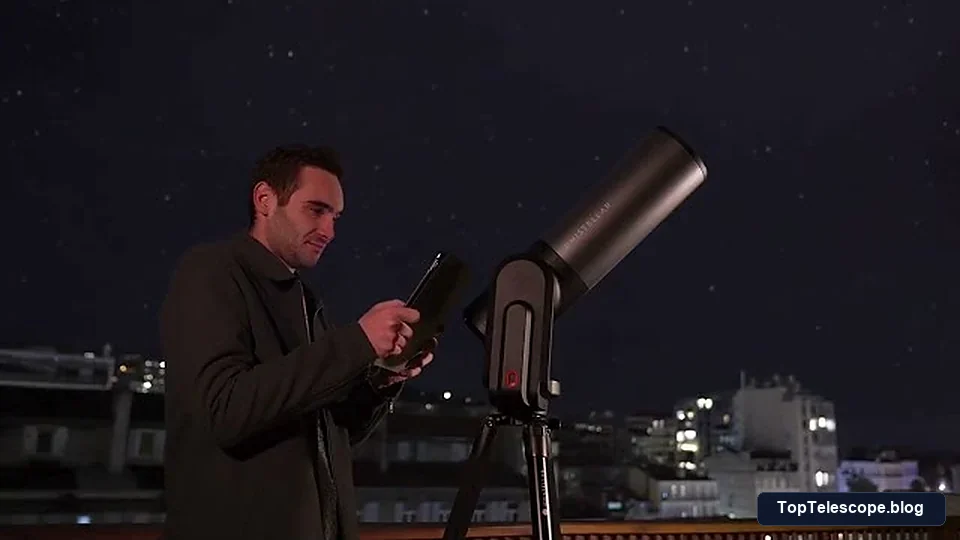
Routine maintenance is refreshingly straightforward compared to traditional open optical tube assemblies. Keeping exterior glass surfaces clean and storing the chassis in a dry environment ensures longevity.
Long-term durability is bolstered by weather-resistant seals protecting sensitive internal circuit boards. This rugged construction withstands occasional heavy dewdrops and minor thermal shifts during overnight sessions.
Initial field assembly takes less than five minutes using the robust tripod legs, but owners should regularly inspect the locking thumbscrews to prevent mechanical slippage during heavy wind gusts.
Optical maintenance requires minimal intervention beyond occasional gentle dusting of the corrector plate using an ultrasoft bulb blower, avoiding harsh chemical solvents that might degrade specialized anti-reflective lens coatings.
Long-term durability depends heavily on proper storage inside a padded transport case, protecting internal circuit boards from humidity spikes and preventing mechanical wear on the azimuth drive gear assembly.
- Automated plate-solving technology eliminating manual star alignment steps
- Low-maintenance enclosed optical tube protecting primary mirrors from dust
- Weather-resistant exterior housing shielding electronics from heavy dew
- Compact storage footprint fitting easily into dedicated travel backpacks
Who Should Buy It vs. Skip It
Urban dwellers and beginner astronomy enthusiasts exploring options listed in our best telescope buyer guide will find this smart telescope exceptionally rewarding for viewing colorful nebulae directly from city balconies.
Traditional purists who cherish peering through physical glass eyepieces should skip this digital device entirely. Astrophotographers seeking deep manual control over equatorial mounts may also find it restrictive.
Suburban astronomers seeking instant gratification from deep-sky objects under heavy light pollution will find immense value in the automated stacking and seamless mobile integration offered by this specialized smart telescope.
Traditional observers who prefer manual star-hopping, optical eyepiece viewing of planets, or deep customization of glass components should skip this unit in favor of a classical Dobsonian reflector setup.
- Ideal for urban backyard astronomers battling severe light pollution
- Perfect for tech-savvy beginners seeking instant deep-sky gratification
- Not recommended for purists demanding traditional optical glass eyepieces
- Less suitable for advanced imagers requiring deep manual hardware control
Frequently Asked Questions
Can I use this telescope without a smartphone?
No, the device relies completely on a connected mobile tablet or smartphone. Wireless app control manages all alignment, tracking, and image processing functions.
Does the system require manual star alignment?
Not at all, because autonomous field detection handles alignment automatically. Smart plate-solving software maps the overhead sky and calibrates the mount instantly.
How does it handle severe city light pollution?
Proprietary digital algorithms actively filter out ambient light during exposure stacking. Enhanced image processing reveals hidden galactic details beneath bright urban skies.
What is the typical battery operating runtime?
The internal rechargeable power source supports up to ten hours of continuous operation. External USB power banks can easily extend this runtime further.
Can I attach a traditional optical eyepiece?
No physical eyepiece exists on this model, as viewing occurs digitally. Smartphone screen streaming replaces traditional glass-to-eye celestial observation entirely.