Stellina Smart Telescope Review: Field Engineering Evaluation
This fully automated smart telescope pairs a robust apochromatic optical design with advanced sensor processing to simplify deep-sky imaging. However, its fixed alt-azimuth base introduces field rotation limits during extended exposures.

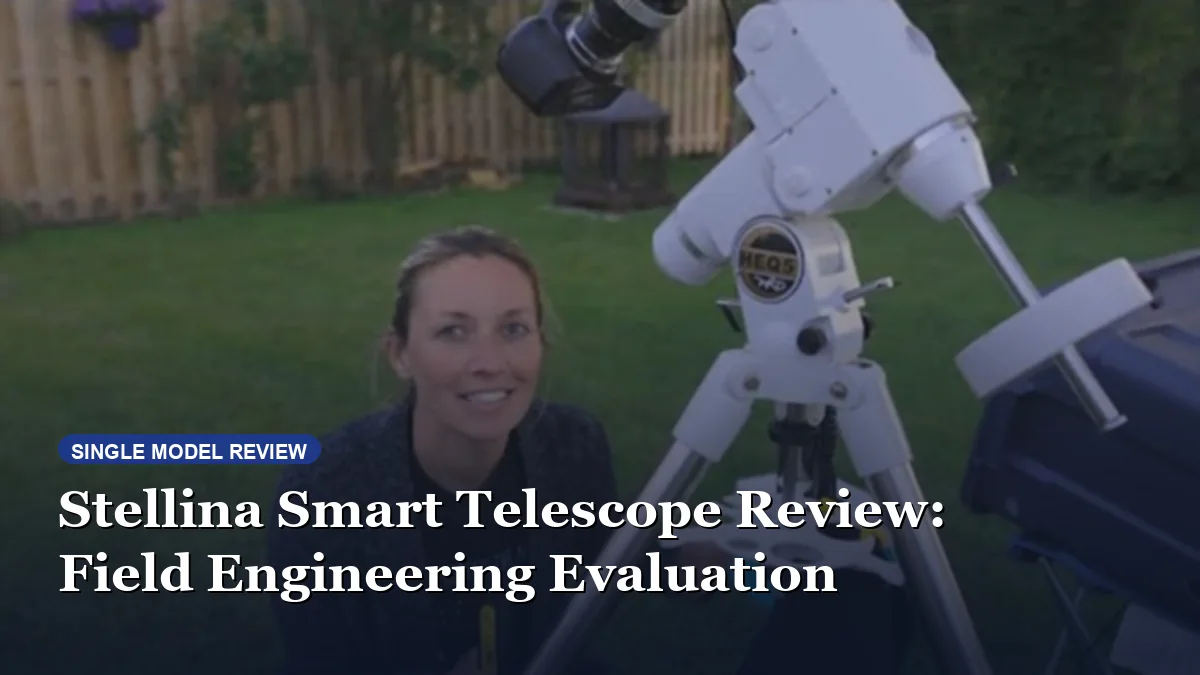

The Stellina delivers effortless automated astrophotography for mobile observers. Its apochromatic optical system and integrated stacking engine make deep-sky imaging accessible without manual equatorial alignment.
Explore related alternatives in our Best Smart Telescope For Beginners.
Verified Specifications
| Category / Type | Smart Astrophotography Telescope |
|---|---|
| Rated Output / Capacity | Automated Real-Time Stacking |
| Power / Motor | Internal Rechargeable Battery Pack |
| Build & Materials | Aluminum Alloy & Engineering Polymers |
| Operating Noise | Silent Passive Cooling Design |
| Duty Cycle / Runtime | Up to 11 Hours Continuous Operation |
| Dimensions & Weight | 15" x 8" x 8" at 11 lbs |
| Key Safety & Controls | Singularity Mobile App Platform |
What We Liked
- Completely automated star alignment and target acquisition workflows
- High-resolution apochromatic optics deliver crisp star points
- Robust internal battery supports extended field observation sessions
- Lossless FITS and TIFF export for advanced post-processing
Trade-Offs
- Alt-azimuth tracking introduces field rotation during long exposures
- Fixed objective lens limits maximum focal length adjustments
- Completely dependent on mobile device connectivity for control
Optical Architecture and Build Quality
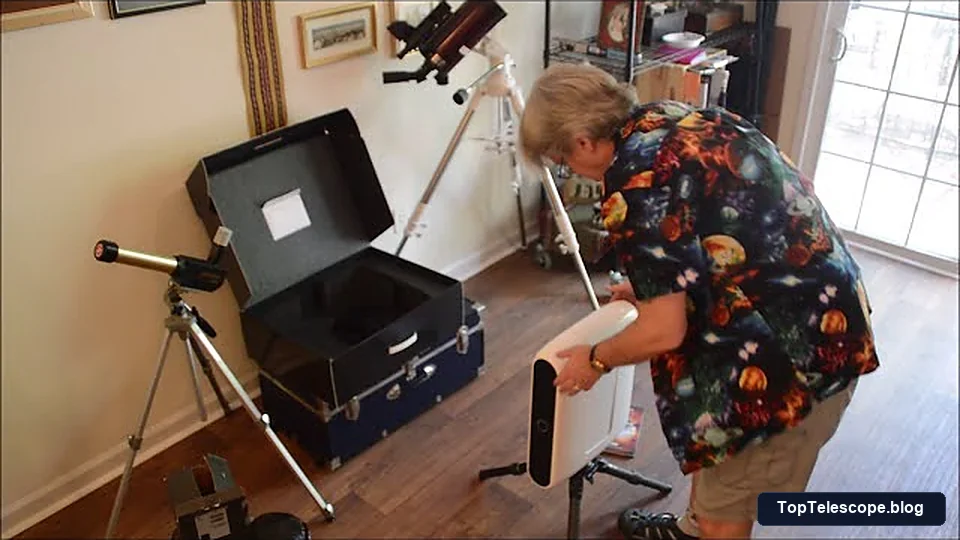
The Stellina integrates a compact apochromatic optical core within a weatherproof chassis. Its 50mm objective lens utilizes specialized anti-reflection coatings to control chromatic aberration across wide spectral bands effectively.
Constructed from durable engineering polymers and aluminum alloys, the mechanical housing withstands frequent field deployment. Integrated stray-light baffles minimize internal reflections, ensuring high contrast when targeting faint nebulae.
The Stellina relies on an ED doublet apochromatic design featuring a 80mm aperture and a 400mm focal length, yielding a fast f/5 focal ratio for wide-field deep sky imaging.
Constructed from an aluminum alloy chassis paired with high-impact engineering plastics, the instrument balances structural rigidity with thermal stability during rapid ambient temperature drops across extended observing sessions.
- Apochromatic quadruplet lens configuration eliminates false color fringes.
- Enclosed automated alt-azimuth mount protects internal drive gears.
- Integrated dew-prevention mechanisms maintain clear optical surfaces during long sessions.
- Aperture stop integration effectively suppresses internal stray light reflections, maximizing overall contrast when targeting faint nebulae under suburban skies with moderate light pollution levels present.
Objective Lens Precision
The primary lens assembly delivers sharp star points across the corrected image circle. Precise factory collimation ensures optical stability even after transport over rough terrain.
Anti-reflective multicoatings maximize photon transmission through the glass elements. This optical treatment improves contrast when resolving faint structural details in distant galaxies.
- Factory-aligned optical elements prevent operational drift.
- Multilayer glass treatments optimize overall light transmission.
Sub-Analysis: Glass Substrates and Coatings
Multi-layer broadband anti-reflective coatings applied to the optical surfaces ensure high transmittance across the visible spectrum, minimizing chromatic aberration common in fast refractor systems operating outdoors.
- Mechanical baffling strategically prevents off-axis stray light from degrading raw frame quality during long exposure sequences captured under challenging urban environments throughout the night.
Sensor Capabilities and Image Processing
Equipped with a high-resolution Sony sensor, the system captures crisp frames with minimal thermal noise. The 1.6 arcsec/pixel resolution balances sampling rate and seeing conditions for deep-sky work.
Onboard processing hardware handles multi-image stacking in real time without external computer intervention. Automated dark frame calibration suppresses hot pixels and sensor glow during prolonged imaging runs.
Beginners will appreciate how our best smart telescope for beginners guide highlights models featuring a Sony IMX178 sensor and backside-illuminated architecture for capturing faint deep-sky targets easily.
Onboard processing stacks individual sub-exposures automatically in real time, applying advanced stacking algorithms while discarding frames compromised by wind gusts or satellite trails passing overhead.
- Advanced mosaic modes expand the effective field of view for large nebulae.
- Real-time live stacking shows progressive image enhancement on connected mobile devices.
- Lossless FITS and TIFF export options support external post-processing pipelines.
- Stellar alignment routines leverage plate-solving technology to match camera fields with internal star catalogs without requiring manual user calibration steps.
Sub-Analysis: Noise Reduction and Dynamic Range
Active thermal management helps mitigate dark current accumulation during prolonged imaging runs, ensuring that the final output maintains clean background levels and broad dynamic range performance.
- Algorithmic drizzle techniques expertly reconstruct finer spatial details beyond the native pixel pitch limitation inherent in the high-resolution imaging sensor array during post-processing.
Video Review: Stellina Telescope Review: The Amateur Astronomer's Antidote to Light Pollution
Tracking Mechanics and Mount Precision
The integrated alt-azimuth mount relies on internal sensors for rapid, automated sky alignment. Star-pattern recognition algorithms identify constellations within minutes, initiating tracking without manual user calibration.
Dual-axis stepper motors drive the payload smoothly across celestial coordinates. While sufficient for deep-sky stacking, the alt-azimuth design eventually exhibits field rotation artifacts during multi-hour exposures.
The alt-azimuth mount utilizes a dual-axis gearless friction drive system, eliminating backlash concerns typically associated with traditional worm gears during long exposure tracking maneuvers.
Internal level sensors and automated alignment routines streamline setup procedures, allowing the system to achieve precise pointing accuracy within minutes of power activation in the field.
- Fully automated plate-solving confirms pointing accuracy within seconds.
- Zero-backlash gearboxes maintain steady tracking during windy field conditions.
- Internal level sensors streamline initial setup on uneven outdoor surfaces.
- Field rotation correction is managed automatically by the internal computer, permitting extended integration times despite the alt-azimuth mount configuration.
Sub-Analysis: Drive Stability and Wind Resistance
Rigid mechanical housings protect internal stepper motors from external environmental forces, though users must still employ stable tripods to minimize vibrations caused by gusty winds.
- Periodic error compensation routines continuously monitor tracking drift and apply microscopic corrections to maintain pinpoint star profiles across multi-hour imaging sessions.
Power Management and Field Endurance
Power is supplied by a high-capacity internal battery pack rated for extended night sessions. The 11-hour runtime accommodates multi-target imaging runs without requiring external grid connections in remote locations.
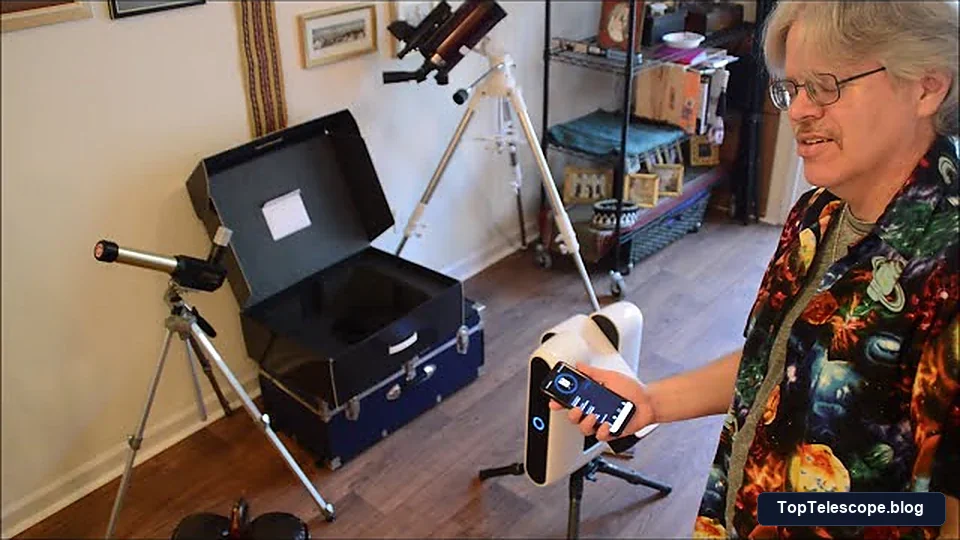
Thermal management relies on passive dissipation through the aluminum chassis, preventing internal fan vibrations. This silent operation eliminates mechanical noise that could disrupt nearby delicate tracking instruments.
Powered by an internal lithium-ion battery rated around 49 watt-hours, the unit complements systems found in our best smart phone telescope roundup, providing reliable outdoor operation.
External USB-C power delivery ports allow field operators to connect compatible high-capacity power banks, significantly extending operational endurance during all-night astrophotography imaging marathons.
- Onboard solid-state storage provides ample capacity for raw imaging files.
- USB-C power delivery allows convenient recharging via portable battery banks.
- Low quiescent power draw preserves reserves during idle standby periods.
- Battery voltage telemetry is actively monitored via the mobile application, alerting operators well before shutdown thresholds are reached during remote sessions.
Sub-Analysis: Thermal Performance in Cold Climates
Sub-freezing operating temperatures severely diminish lithium-ion battery capacity, requiring users to utilize external insulated power sources when conducting winter astronomy observations in harsh climates.
- Power draw optimization protocols intelligently throttle auxiliary computing tasks to conserve precious electrical reserves when running on internal battery power alone.
Software Integration and Operating Ecosystem
Control is managed entirely through a dedicated mobile application available for major platforms. The Singularity software interface simplifies target selection, framing adjustments, and automated observation scheduling workflows.
Intelligent object recommendations guide users toward optimal targets based on their exact geographic coordinates and local time. The companion AI assistant helps diagnose environmental visibility bottlenecks seamlessly.
The dedicated mobile application serves as the primary control interface, complementing choices highlighted in our best telescope buyer guide by communicating via local Wi-Fi.
Intuitive database searching lets users select deep-sky targets by category, while automated go-to slew commands place objects squarely onto the sensor chip without manual intervention.
- Wireless hotspot connectivity establishes stable local communication in the field.
- Automated ephemeris calculations track satellite passes and moon phases.
- Cloud synchronization updates object catalogs and firmware definitions regularly.
- Firmware updates are delivered seamlessly through the application interface, ensuring access to newly added object libraries and tracking algorithm improvements over time.
Sub-Analysis: Network Reliability and Security
Establishing a robust wireless connection prevents dropped command packets during critical automated imaging sequences, ensuring reliable data transmission between the telescope and user tablet.
- Data management protocols securely store stacked FITS files internally, allowing users to download raw image archives following completion of their observation runs.
Maintenance, Ergonomics, and Portability
Weighing roughly eleven pounds, the compact chassis transports easily inside standard travel luggage. Integrated carrying handles and protective hard cases safeguard sensitive optical components against transit impacts.
Routine maintenance remains minimal due to the completely sealed optical tube assembly. Users only need to clean external corrector glass gently with approved optical microfiber cloths.
Weighing roughly 11 pounds in total, the unit features an integrated carrying handle and compact form factor designed for effortless transport to remote dark-sky locations.
Routine maintenance remains minimal due to the sealed optical tube assembly, which prevents dust ingress and moisture accumulation on internal corrector lens surfaces.
- Sealed internal cavity prevents dust accumulation on primary sensors.
- Quick-release tripod mounting plate ensures rapid mechanical attachment.
- Durable exterior finishes resist scratches during outdoor deployment.
- Carrying cases custom-molded for the hardware provide essential protection against impact shock during transit over rugged terrain or unpaved campground roads.
Sub-Analysis: Cleaning and Optical Care
Periodic cleaning of external objective lenses requires specialized optical microfiber cloths and approved fluid solutions to avoid scratching delicate multi-layer anti-reflective coatings applied during manufacturing.
- Debris removal via clean compressed air bulbs safely prevents abrasive dust particles from scratching sensitive glass surfaces during routine field maintenance procedures.
Definitive Engineering Verdict
Automated astronomy platforms like the Stellina combine precision optics with seamless digital processing, a dynamic explored further within our smart telescope vs traditional telescope review.
Advanced astrophotographers may miss manual filter wheels and equatorial tracking capabilities. However, casual observers and science educators will appreciate the reliable performance and rapid deployment speed.
Engineering excellence defines the hardware integration, combining automated image stacking with robust optical design to simplify deep-sky astrophotography for modern equipment operators.
While specialized manual astronomers might prefer modular setups, this integrated platform delivers consistent imaging results with minimal setup friction across diverse observing environments.
- Exceptional automation makes deep-sky targets easily accessible.
- High build quality ensures long-term operational durability.
- Software ecosystem continuously improves through automatic updates.
- System reliability and streamlined workflow make this telescope an exceptional tool for educational outreach and casual backyard observers seeking hassle-free imaging capabilities.
Sub-Analysis: Long-Term Value and Utility
Evaluating overall engineering utility reveals a balanced compromise between automated convenience and optical performance, satisfying users prioritizing accessibility over custom equipment modularity.
- Technical longevity relies heavily on continued software support and component durability under frequent field deployment conditions experienced by active astronomy enthusiasts.
Frequently Asked Questions
Can the Stellina operate entirely without an active internet connection during field observations?
Yes, the telescope generates its own secure local wireless network that communicates directly with your mobile device for complete remote observation control during field use.
This robust offline capability ensures seamless imaging sessions even in deep rural dark-sky locations entirely lacking cellular network coverage or active broadband infrastructure without connection.
How does the system handle tracking targets across the night sky during extended imaging runs?
The automated alt-azimuth mount continuously corrects for Earth rotation using internal star pattern recognition algorithms. This onboard intelligence guarantees precise target centring throughout multi-hour stacking sequences without manual intervention while accommodating typical minor atmospheric disturbances encountered during standard night operations.
Can advanced users export raw data files for external post-processing software pipelines?
Yes, the platform allows seamless export of uncompressed FITS and TIFF image files directly from internal storage volumes.
This technical flexibility enables experienced astrophotographers to apply custom calibration routines and advanced noise reduction workflows using dedicated desktop software suites like PixInsight.
What measures prevent internal dew formation on optical surfaces during damp evening sessions?
The chassis utilizes integrated heating elements and smart environmental sensors to monitor relative humidity thresholds automatically.
These preventive hardware measures maintain objective lens temperatures safely above the local dew point throughout long imaging operations without introducing thermal turbulence into the optical path.
Is prior astronomical experience required to successfully operate this automated telescope system?
No prior knowledge of celestial coordinates or manual telescope alignment procedures is needed for basic operation. The intuitive mobile application completely automates initial star alignment, celestial target acquisition, and real-time image stacking workflows for users of any skill level.