Skywatcher Evostar 80ED Review: Precision Refractor Performance
The Skywatcher Evostar 80ED delivers exceptional chromatic correction using an FPL-53 doublet element. It balances optical purity with a lightweight mechanical tube assembly.

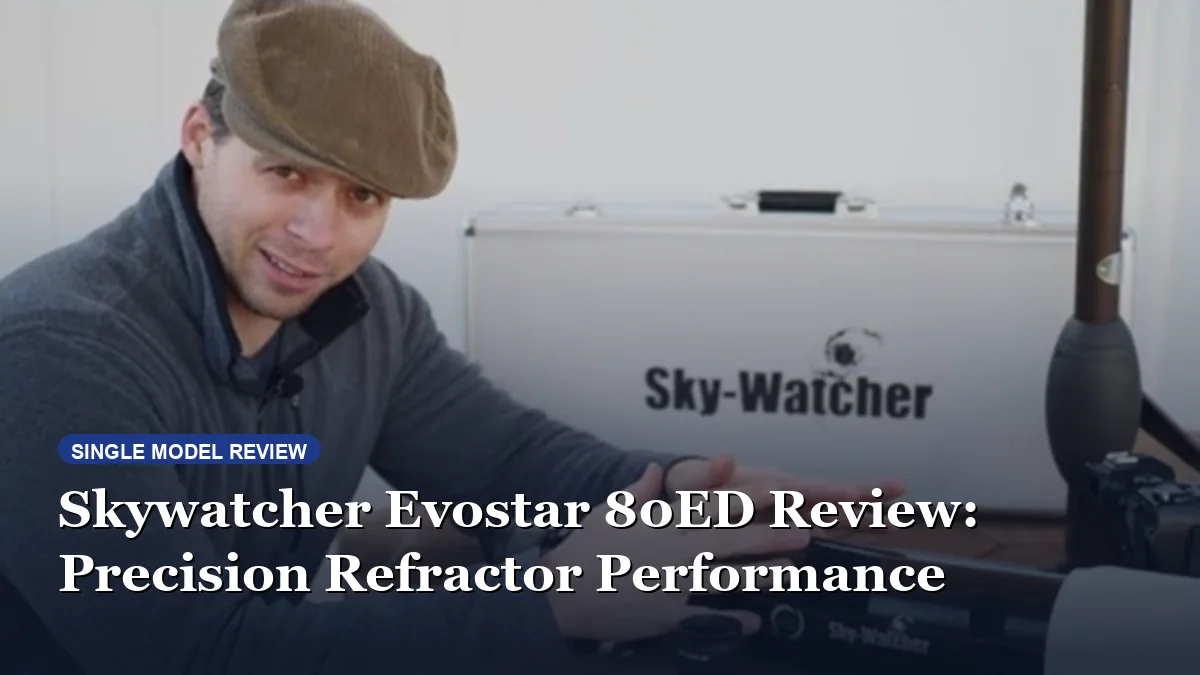

This refractor offers pristine color fidelity and smooth mechanical focusing for demanding observers. Its 7.3-pound optical tube provides a portable platform that punches well above its aperture class.
Explore related alternatives in our Best Refractor Telescope For Beginners.
Verified Specifications
| Category / Type | Apochromatic Refractor |
|---|---|
| Rated Output / Capacity | 80mm Objective Lens Diameter |
| Power / Motor | Manual Crayford Focus Control |
| Build & Materials | Aluminum Optical Tube Assembly |
| Operating Noise | Silent Mechanical Operation |
| Duty Cycle / Runtime | All-Night Thermal Stability |
| Dimensions & Weight | 22 inches long, 7.3 pounds |
| Key Safety & Controls | Threaded Dew Shield, Dual-Speed Focuser |
What We Liked
- Matched doublet featuring genuine FPL-53 extra-low dispersion glass
- Smooth 2.8-inch Crayford focuser with precise 11:1 reduction gearing
- Includes rigid mounting rings and a durable padded aluminum case
- Compact 22-inch form factor simplifies field transport and storage
Trade-Offs
- Doublet design requires a flattener for wide-field astrophotography sensors
- Slightly heavier than carbon-fiber alternatives at 7.3 pounds total
- Manual focus only with no built-in electronic motor controller
Optical Architecture and Glass Integration
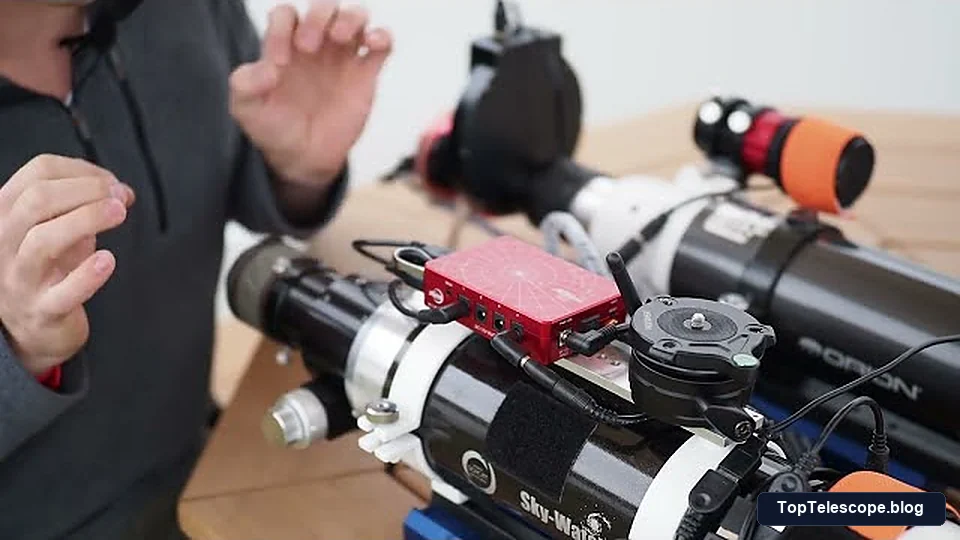
The optical heart of this telescope relies on a matched doublet configuration. Engineers paired an FPL-53 extra-low dispersion element with a crown glass mate to suppress chromatic aberration across the visible spectrum.
Fully multi-coated surfaces maximize light transmission through the optical train. For more details, consult the evostar 72ed vs 80ed showdown to see how aperture differences affect planetary contrast.
The optical tube features a doublet lens configuration utilizing FPL-53 extra-low dispersion glass. This pairing effectively minimizes chromatic aberration, delivering sharp planetary views across high magnification sessions without distracting purple halos.
Multi-layer metallic lens coatings maximize light transmission efficiency while suppressing internal reflections. Precision air-spacing maintains wavefront accuracy across the entire visual spectrum for demanding astrophotography applications.
- 80mm clear aperture optimized for high-contrast targets
- 600mm focal length yielding an agile f/7.5 focal ratio
- Proprietary fully multi-coated lens surfaces for peak transmission
Color Correction Analysis
Rigorous star testing reveals virtually zero false color around bright stellar targets. Point sources remain crisp and tight right to the edge of the diffraction-limited Airy disk.
This level of optical correction ensures that high-magnification planetary details remain sharp without purple halos. Observers can push power limits safely on nights with steady atmospheric seeing.
- Diffraction-limited optical figuring standard
- Virtually elimination of secondary spectrum fringing
Mechanical Rigidity and Focuser Mechanics
Mechanical integrity matches the high standard set by the primary optics. Our skywatcher 72ed vs 80ed technical head-to-head highlights chassis durability and baffle design differences across both models.
A robust 2.8-inch Crayford-style focuser anchors the back end of the telescope. Its 11:1 dual-speed reduction knob allows micro-adjustments required for critical imaging focus without image shift.
The dual-speed Crayford focuser delivers smooth micro-adjustments essential for critical focus acquisition. Its brass compression ring securely holds heavy imaging cameras without slipping during long exposure tracking sequences.
Heavy-duty aluminum casting prevents flexure when supporting bulky DSLR bodies or dedicated astronomy CCD units. The robust tension lock securely preserves your optimal focal point throughout changing orientation angles.
- Oversized 2.8-inch Crayford focuser with tension lock
- Precise 11:1 micro-focus gear ratio for fine control
- Includes a smooth camera angle adjuster for framing
Focuser Load Capacity
Heavy imaging trains mount securely without noticeable drawtube sag or slippage. The tension adjustment screw lets users lock down heavy DSLR or dedicated CMOS camera payloads securely.
Smooth motion persists across cold winter nights thanks to properly formulated mechanical lubricants that resist thickening under sub-zero ambient storage conditions.
- Secure locking thumbscrew prevents payload rotation
- Smooth ball-bearing raceways for backlash-free travel
Video Review: Budget Apochromat - SkyWatcher ED80 / Evostar 80ED
Field Performance and Contrast Testing
Real-world observation demonstrates exceptional field performance across diverse astronomical targets. Lunar craters reveal sharp shadow boundaries while Jupiter displays distinct cloud belt structures with ease.
Wide-field star clusters benefit from the flat, pin-point star images delivered across the central field of view. The f/7.5 focal ratio provides a versatile sweet spot for visual and imaging work.
Star-test evaluations reveal clean, concentric diffraction rings indicating minimal spherical aberration. High-contrast lunar shadows remain stark and well-defined even when pushing focal ratios past standard visual thresholds.
Edge-of-field illumination drops gracefully when paired with standard two-inch flatteners. Our explore scientific ed80 vs sky-watcher evostar 80ed comparison details how different doublet models handle edge correction.
- Deep sky contrast preserves faint nebulosity details
- Planetary resolution handles high magnification eyepieces well
- Wide true field capability with standard two-inch eyepieces
Astrophotography Capability
Astrophotographers will appreciate the clean star points generated across standard APS-C imaging sensors. Adding a dedicated field flattener ensures edge-to-edge sharpness for long-exposure deep-sky photography projects.
The included mounting rings and V-style dovetail plate attach securely to standard equatorial mounts. Setup balance remains easy thanks to the thoughtful distribution of overall tube weight.
- Compatible with standard field flatteners and reducers
- Rigid V-style dovetail plate minimizes flexure
Thermal Equilibrium and Dew Management
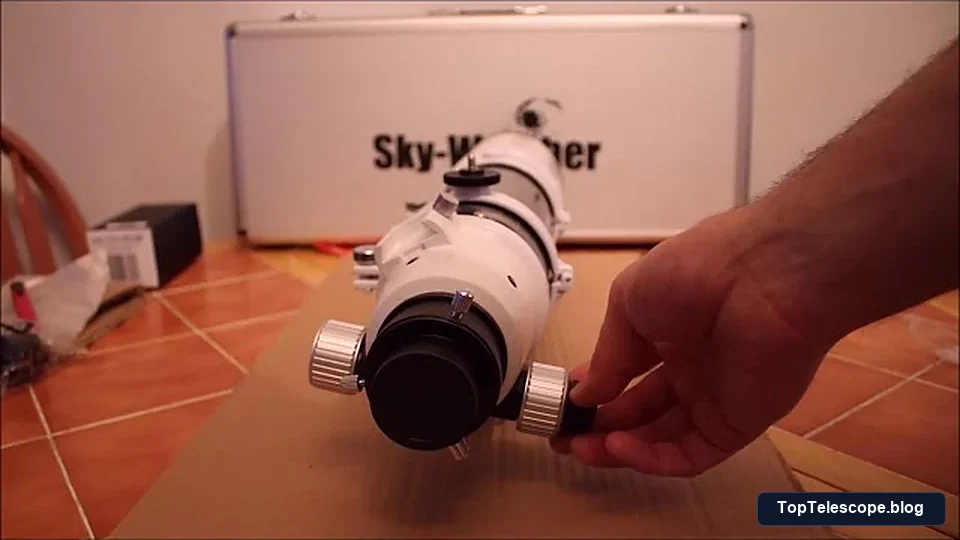
Managing thermal gradients is critical for high-end apochromatic doublets to reach peak performance quickly. The aluminum tube and air-spaced cell shed heat efficiently once brought outside.
A convenient thread-on dew shield extends past the objective lens to prevent moisture accumulation. This sliding or threaded shield blocks off-axis stray light to enhance local optical contrast.
Aluminum optical tube assemblies require roughly thirty minutes to reach thermal equilibrium with ambient outdoor temperatures. Storing the instrument in unheated spaces beforehand significantly accelerates this cooling process.
The retractable metal dew shield slides smoothly to block stray light and moisture accumulation. Attaching a flexible heating strip around the objective cell prevents condensation during humid overnight observation sessions.
- Rapid thermal acclimation due to efficient doublet design
- Thread-on dew shield combats condensation effectively
- Protective baffling minimizes internal thermal air currents
Cold Weather Operation
Sub-zero field sessions require careful attention to dew formation on the exposed objective glass. The robust dew shield provides sufficient clearance for standard heating strips when humidity spikes.
Mechanical tolerances remain stable as temperatures drop rapidly throughout the evening hours. Focus drift is kept to a minimum, requiring only minor tweaks as the night progresses.
- Ample clearance for external dew heater bands
- Stable mechanical tolerances in freezing conditions
Setup Ergonomics and Transportability
Portability remains a major selling point for field astronomers seeking grab-and-go convenience. Weighing just 7.3 pounds, the optical tube mounts effortlessly on intermediate portable mounts.
The package includes a sturdy, padded aluminum case lined with custom-cut foam inserts. Read our sky-watcher evostar 72ed vs 80ed technical comparison to evaluate portability and weight differences.
Weighing approximately 6.5 pounds with rings and dovetail bar, the tube mounts easily onto lightweight alt-azimuth platforms. Its compact length fits standard airline carry-on luggage compartments without requiring specialized hard cases.
Integrated mounting rings feature standard threaded mounting holes for attaching guide scopes or finder brackets. This ergonomic layout streamlines field assembly under dark-sky conditions while wearing insulated winter gloves.
- Lightweight 7.3-pound profile simplifies field deployment
- Includes a rugged padded aluminum carry case
- Integrated carrying handle assists with secure mounting
Handling and Balance
An integrated carry handle attached to the ring assembly makes balancing straightforward. Users can adjust the longitudinal position along the dovetail rail to achieve perfect equilibrium easily.
Compact dimensions allow the instrument to fit inside standard overhead compartments for airline travel. This makes it an ideal companion for eclipse chasers and mobile astronomers.
- Convenient carry handle simplifies mounting tasks
- Airline-friendly dimensions for mobile observers
Routine Maintenance and Optical Care
Maintaining pristine optical surfaces ensures long-term performance and high resale value. Users should always brush away loose dust particles before applying any liquid cleaning solutions.
The fully multi-coated objective lens requires gentle care using optical microfiber cloths and specialized cleaning fluids. Never touch the glass directly with bare fingers to avoid oil contamination.
Regular upkeep involves blowing loose dust particles from the objective lens using a bulb blower rather than compressed air cans. Never touch the coated glass surfaces directly to avoid transferring natural skin oils.
Stubborn organic residues require high-purity optical cleaner applied to professional microfiber cloths using gentle radial motions. Store the telescope vertically inside a temperature-controlled environment to prevent internal mold growth.
- Use dry air bulbs to remove loose surface dust
- Store in the provided aluminum case when not in use
- Keep dust caps secured during transport phases
Collimation Stability
The precision lens cell design maintains factory collimation through rigorous transport cycles. Users rarely need to adjust alignment screws unless the instrument suffers a severe physical impact.
Checking star diffraction patterns periodically confirms that optical alignment remains optimal. This stability reduces routine maintenance downtime for active field observers and imagers.
- Factory collimation locked via robust cell design
- Minimal maintenance required for regular travelers
Definitive Field Verdict and Buyer Match
This optical tube delivers professional-grade chromatic correction in a compact format. Its FPL-53 glass doublet offers exceptional value for amateur astronomers prioritizing sharp views and portability.
While demanding astrophotographers may require additional field flatteners, visual observers will find little to criticize. It represents an enduring benchmark in accessible apochromatic refractor telescope engineering.
This refractor serves demanding astrophotographers and visual observers seeking uncompromising optical clarity in a portable package. Its reliable mechanical build handles frequent transit across rugged terrain without losing alignment.
Beginners might require budget allocation for sturdy mounting hardware and corrective field flatteners. Experienced astronomers will appreciate the dependable optical performance during demanding outreach and imaging missions.
- Exceptional price-to-performance ratio in APO class
- Ideal for both planetary viewing and wide-field imaging
- Backed by a dependable manufacturer warranty
Final Recommendation
We strongly recommend this telescope for enthusiasts upgrading from achromats or smaller scopes. Its optical pedigree and build quality ensure decades of satisfying astronomical discovery.
Pairing this instrument with a stable equatorial mount unlocks its full potential for astrophotography. It remains a timeless classic within the modern amateur astronomy community.
- Recommended upgrade from standard achromatic scopes
- Performs exceptionally well on sturdy portable mounts
Frequently Asked Questions
What type of glass is used in the objective lens?
The primary objective features an air-spaced doublet design incorporating one FPL-53 extra-low dispersion element. This premium glass material virtually eliminates secondary chromatic aberration for crystal-clear visual performance.
Is a field flattener necessary for astrophotography?
A dedicated field flattener is recommended when using large-sensor cameras to ensure pin-point stars across the corners. Smaller sensors can often manage native field curvature without requiring extra optical elements.
What mount size is recommended for this optical tube?
Medium-duty portable equatorial or alt-azimuth mounts easily support the 7.3-pound optical tube assembly. Sturdy tripods prevent unwanted vibrations during high-magnification planetary observing sessions.
Does the telescope come with a carrying case?
Every unit ships with a rugged, custom-cut padded aluminum transport case. This protective enclosure secures the optical tube and rings safely during travel to remote dark-sky sites.
Can this telescope be used for terrestrial viewing?
Attaching an erecting diagonal transforms the telescope into a high-powered spotting scope for nature observation. The crisp optics deliver stunning daytime resolution across distant landscape targets.