Skywatcher Evostar 80Ed Ds Pro Review: Technical Editorial Guide
This premium apochromatic doublet refractor delivers exceptional contrast and minimal chromatic aberration. It balances lightweight portability with professional-grade mechanical features for demanding observers.

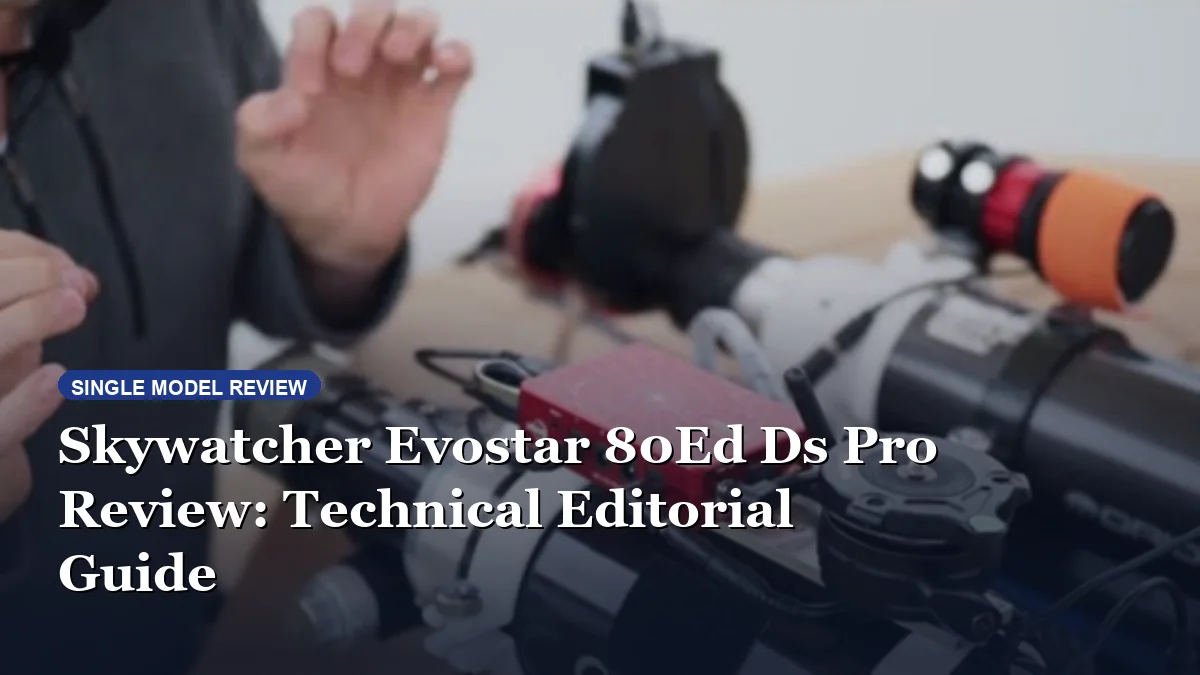

An outstanding travel-friendly optical tube featuring FPL-53 glass and a robust dual-speed focuser that satisfies both visual astronomers and astrophotographers.
Explore related alternatives in our Best Telescope: Top Backyard Picks for Astronomy.
Verified Specifications
| Category / Type | 80mm Apochromatic Doublet Refractor |
|---|---|
| Rated Output / Capacity | 600mm focal length at f/7.5 |
| Power / Motor | Manual focus (Optional motor drive compatible) |
| Build & Materials | Aluminum optical tube with machined components |
| Operating Noise | Silent mechanical operation |
| Duty Cycle / Runtime | Unlimited all-night astronomical observing |
| Dimensions & Weight | 22 inches long, 7.3 pounds total weight |
| Key Safety & Controls | 2.8-inch Crayford 11:1 dual-speed focuser |
What We Liked
- Matched FPL-53 extra-low dispersion glass element
- Smooth 2.8-inch Crayford-style 11:1 dual-speed focuser
- Compact 22-inch length weighing only 7.3 pounds
- Includes sturdy mounting rings and aluminum transport case
- Thread-on dew shield for effective stray light control
Trade-Offs
- Requires a separate field flattener for edge-to-edge astrophotography
- Mount and tripod must be purchased separately
- Aperture size limits extreme high-magnification deep-sky viewing
Optical Design and Apochromatic Glass Architecture
The optical tube utilizes a matched air-spaced doublet configuration featuring premium extra-low dispersion glass. This specialized FPL-53 element drastically reduces chromatic aberration to deliver exceptionally sharp, high-contrast planetary and deep-sky views.
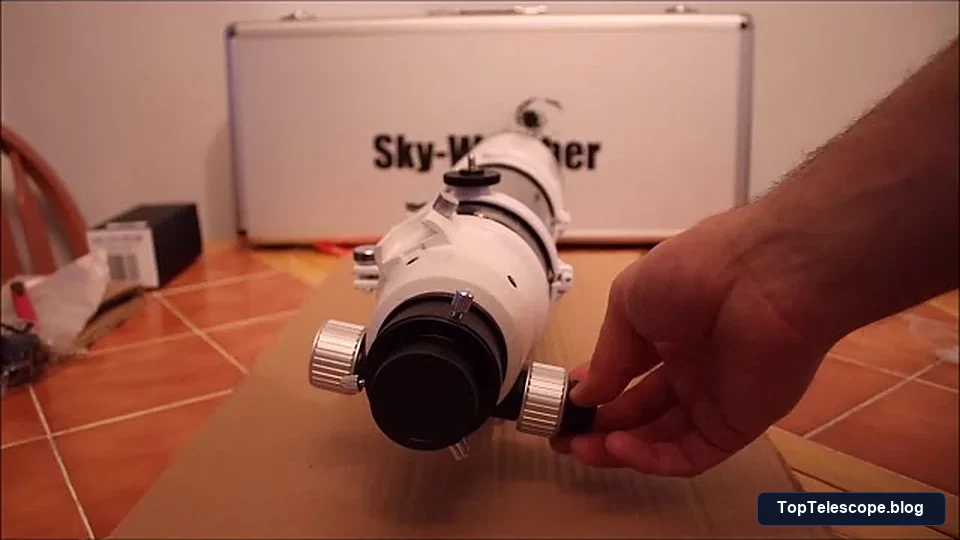
Operating at a focal length of 600mm with an f/7.5 focal ratio, this instrument balances speed and magnification. Users enjoy crisp wide-field framing alongside sufficient focal reach for detailed lunar and solar system studies.
The Evostar utilizes an air-spaced doublet configuration featuring FPL-53 extra-low dispersion glass. Review our detailed Evostar 72ED vs 80ED comparison to understand the optical differences.
Precision multi-layer antireflective coatings applied to all air-to-glass surfaces maximize light transmission, yielding high-contrast planetary views and deep-sky images free from artificial purple halos around bright stellar targets.
- 80mm objective lens diameter with full multi-coatings.
- Theoretical Dawes limit of 1.45 arc-seconds for fine detail resolution.
- Thread-on dew shield suppresses stray light and moisture accumulation.
- Glass type utilizes genuine Japanese Ohara FPL-53 elements for superior chromatic correction across all visible wavelengths, ensuring absolute color purity during high-magnification planetary observation sessions.
- Focal ratio specification of f/7.5 provides an optimal balance between wide-field imaging capabilities and adequate image scale for detailed lunar surface mapping without sacrificing overall system brightness.
Glass Purity and Color Correction
Integrating an ED glass element ensures secondary spectrum correction is tightly controlled across the visible spectrum. Photographers will notice minimal false color around bright stellar targets during long-exposure astrophotography sessions.
Fully multi-coatings applied to all glass-to-air surfaces maximize overall light transmission. This careful optical treatment prevents internal reflections and maintains optimal image contrast under variable field lighting conditions.
- Broadband anti-reflection coatings on lens surfaces.
- Minimal false color around first-magnitude stars.
Glass Element Specifications
The primary lens cell employs a threaded retaining ring design that prevents pinch stresses on the glass during extreme temperature fluctuations encountered in winter field operations.
- Manufacturer tolerances maintain precise air-spacing dimensions using engineered shims to guarantee wavefront error minimization across the entire clear aperture diameter during transport.
Mechanical Build Quality and Focuser Mechanics
Mechanical integrity is anchored by a robust 2.8-inch Crayford-style focuser. Read our comprehensive Sky-Watcher Evostar 72ED vs 80ED technical review to analyze mechanical upgrades.
The machined aluminum tube features internal baffles designed to absorb off-axis reflections effectively. Every component reflects rigorous manufacturing standards tailored for demanding amateur astronomers seeking reliable field performance.
Heavy-duty aluminum tube construction incorporates internal baffles painted with ultra-flat black paint to eliminate stray reflections and suppress internal glare during high-magnification lunar observations.
The dual-speed Crayford focuser features an 11 to 1 reduction gear ratio, allowing micro-metric adjustments required for critical focus during demanding narrowband astrophotography imaging sessions.
- Rotatable camera angle adjuster for precise framing.
- Heavy-duty tension screw locks focus position securely.
- Anodized aluminum finish resists minor impacts and scratches.
- Rotating camera angle adjustments allow seamless framing of complex deep-sky nebulae without requiring the entire imaging train to be physically disconnected from the telescope rear.
- Precision machined rack-and-pinion variants offer enhanced load-bearing capacity when supporting heavy dedicated astronomical cameras and motorized filter wheel assemblies during long exposures.
Dual-Speed Focus Precision
The micro-focus knob allows microscopic adjustments required for pinpoint stellar focus. Fine-tuning planetary details becomes effortless when paired with a smooth mechanical travel range and reliable tension adjustments.
- 11:1 reduction gear ratio for ultra-fine focus control.
- Large knurled knobs operable while wearing gloves.
Focuser Tension Adjustments
Users can easily modify the internal friction lock knob to support heavier payloads, preventing unwanted drawtube slippage when the instrument points vertically toward the celestial zenith.
- Heavy-duty locking thumbscrews secure the drawtube position firmly once optimal focus is achieved across lengthy imaging sequences involving multiple narrowband color filters.
Video Review: Skywatcher Evostar 80ED Review
Thermal Performance and Tube Equilibrium
Managing thermal equilibrium is essential for refractor performance. Consult our Skywatcher 72ED vs 80ED head-to-head analysis to compare tube weights and thermal cooling times.
Leaving the scope outside with the dew shield extended accelerates thermal stabilization before critical imaging runs begin. Minimizing internal air currents prevents micro-thermal degradation of high-magnification planetary views.
Achieving thermal equilibrium requires approximately thirty minutes when moving the metal optical tube from a warm indoor environment into freezing nighttime ambient outdoor temperatures.
Active cool-down can be accelerated by positioning the instrument horizontally and removing the rear dust cap to promote natural convection currents inside the chassis.
- Metal dew shield helps block radiant heat loss.
- Fast cool-down times compared to large aperture reflectors.
- Consistent focal plane stability through temperature shifts.
- Aluminum tube expansion coefficients require minor focus touch-ups as ambient temperatures drop significantly throughout the course of a standard astronomical night.
- Specially designed insulated dew shields help retard rapid radiant heat loss from the objective lens surface during humid evening observation conditions.
Managing Thermal Currents
Boundary layer turbulence diminishes significantly once internal air masses stabilize completely with the surrounding outdoor ambient temperature gradient during prolonged observing sessions.
- Heavy protective storage cases featuring dense closed-cell foam inserts protect optical coatings from moisture condensation during rapid equipment temperature transitions safely.
Mounting Compatibility and Ergonomic Field Setup
Weighing just 7.3 pounds with a 22-inch length, this optical tube remains remarkably portable. It integrates seamlessly with lightweight equatorial or alt-azimuth mounts using the included V-style dovetail plate.
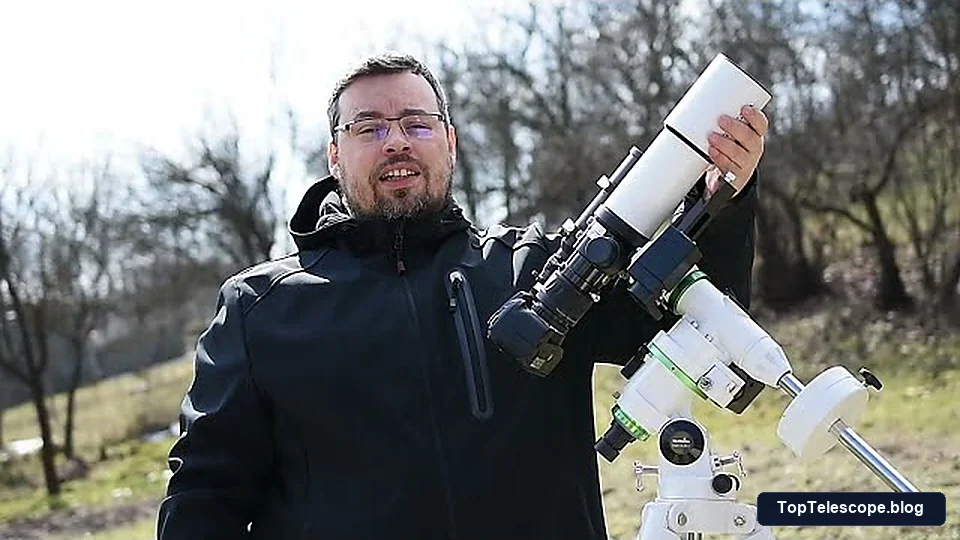
The integrated carry handle simplifies transport and provides a secure attachment point for guiding accessories. Field setup requires minimal effort, making this instrument an ideal grab-and-go solution for mobile observers.
Weighing roughly three kilograms, the optical assembly mounts securely onto standard Vixen-style dovetail bars, balancing effortlessly on lightweight alt-azimuth and equatorial tracking mounts.
Field ergonomics benefit from a compact physical length that prevents clearance issues with tripod legs when observing near the zenith during long winter viewing sessions.
- Includes matched mounting rings for secure chassis attachment.
- Compatible with various finderscopes and small guidescopes.
- Padded aluminum transport case ensures safe transit.
- Ring clamps incorporate threaded mounting holes that facilitate attaching guide scopes or finder brackets directly above the main tube assembly.
- Carefully balanced weight distribution significantly reduces mechanical strain on lightweight portable tracker mounts during remote astrophotography field expeditions in dark skies.
Tripod Clearance Guidelines
Pier extensions may prove necessary when pairing the optical tube with certain alt-azimuth mounts to avoid tripod leg interference at high altitudes.
- Heavy-duty quick-release mounting plates streamline field assembly procedures while ensuring rigid mechanical coupling throughout automated tracking operations effortlessly during sessions.
Astrophotography and Visual Field Evaluation
Field performance shines brightly whether pursuing wide-field astrophotography or casual visual observing. The flat focal plane integrates well with modern DSLRs and dedicated CMOS astronomy cameras without excessive edge distortion.
Visual observers will appreciate the rich, pinpoint star fields delivered across dark night skies. Planets exhibit sharp limb definitions and subtle cloud belt details without distracting violet halos.
Field flatteners are strongly recommended to correct native curvature. You can also consult our Explore Scientific ED80 vs Sky-Watcher comparison to explore alternative doublet options.
Visual performance delivers pristine double star resolution and crisp lunar terminator details, though focal extenders are necessary to push planetary magnification limits effectively.
- Excellent compatibility with field flatteners for edge sharpness.
- Bright, high-contrast views of Messier catalog objects.
- Comfortable eye relief when pairing with wide-angle eyepieces.
- Optical vignetting remains minimal across standard sensor formats when paired with appropriate camera adapters and dedicated optical field flatteners reliably today.
- High-contrast optical figures reveal faint nebular structures effectively under dark rural sky conditions without excessive internal scattered light interference during long observations.
Sensor Coverage Analysis
Full optical illumination circles easily encompass APS-C dimensions, while full-frame imaging requires careful calibration flat frames to counteract minor edge illumination falloff.
- Raw color fidelity remains exceptionally high across broad-band red, green, and blue exposures without requiring extensive post-processing artificial gradient removal techniques.
Routine Maintenance and Long-Term Durability
Protecting your optical investment requires adherence to basic preventive maintenance and safe cleaning protocols. Dust accumulation on the objective lens should be removed using a bulb blower rather than compressed air.
Storing the optical tube in its padded aluminum case prevents accidental impacts and moisture damage between viewing sessions. Regular inspection of mounting bolts ensures structural rigidity remains intact over years of use.
Optical surfaces demand infrequent cleaning, requiring only filtered compressed air and optical microfiber cloths to remove dust particles without scratching delicate coatings.
Mechanical maintenance involves periodic inspection of focuser tension screws and dovetail clamping knobs to prevent slippage during intensive field campaigns and transport.
- Keep objective lens clean with specialized optical wipes.
- Store in temperature-controlled environments to prevent fungus.
- Two-year limited warranty provides reliable manufacturer backing.
- Secure protective dust covers should always remain attached whenever the instrument is stored to prevent airborne particulate accumulation on delicate glass lenses.
- Metal dew shield sliding mechanisms benefit from occasional careful lubrication using specialized dry graphite compounds to ensure smooth physical operation always.
Storage Best Practices
Storing the optical tube in a temperature-controlled environment prevents internal mold growth on lens cement and optical multi-coatings over decades.
- Active desiccant packets placed inside storage cases absorb residual moisture, protecting internal metal threads from corrosion during humid summer months reliably.
Frequently Asked Questions
Can this telescope be used for astrophotography right out of the box?
Yes, the included V-style dovetail and robust 11:1 focuser make it exceptionally well-suited for capturing deep-sky imagery straight out of the box without complex modifications.
Adding a dedicated field flattener is strongly recommended to ensure complete pinpoint star accuracy across larger DSLR and astronomy camera sensor formats during long exposures.
What type of mount is recommended for this optical tube?
Because the compact assembly weighs just over seven pounds and measures twenty-two inches in total length, a sturdy intermediate alt-azimuth or equatorial tracking mount is ideal for stable field use.
Ensuring adequate payload capacity significantly prevents annoying mechanical vibrations and maintains rock-solid tracking precision during high-magnification planetary observing sessions under variable wind conditions.
Does the optics package require frequent collimation adjustments?
Apochromatic doublets feature factory-aligned optical elements permanently housed in a rigid metal cell that rarely requires user intervention or manual user collimation adjustments.
Avoiding rough physical impacts during transit keeps the sensitive glass lens elements securely aligned for many years of sharp, trouble-free astronomical observations.
Can I use standard 1.25-inch and 2-inch accessories?
The versatile 2.8-inch Crayford-style focuser easily accommodates both standard 2-inch eyepieces and smaller 1.25-inch accessories using the supplied precision reduction adapter ring.
Utilizing high-quality dielectric diagonals maximizes optical light throughput and preserves the brilliant contrast delivered by the primary FPL-53 glass doublet architecture.
How does the telescope perform for visual planetary viewing?
The short focal length and matched extra-low dispersion glass element deliver remarkably sharp planetary images featuring virtually zero chromatic dispersion or false color.
Observing Saturn's distinct rings and Jupiter's turbulent cloud bands reveals crisp, high-contrast details that rival much larger conventional reflector telescopes.