Skywatcher Esprit 100 Review: Precision Optics Evaluated
This premium triplet apochromat delivers exceptional color correction and sharp stellar points. Field flattening optics make it a top choice for serious astrophotographers.

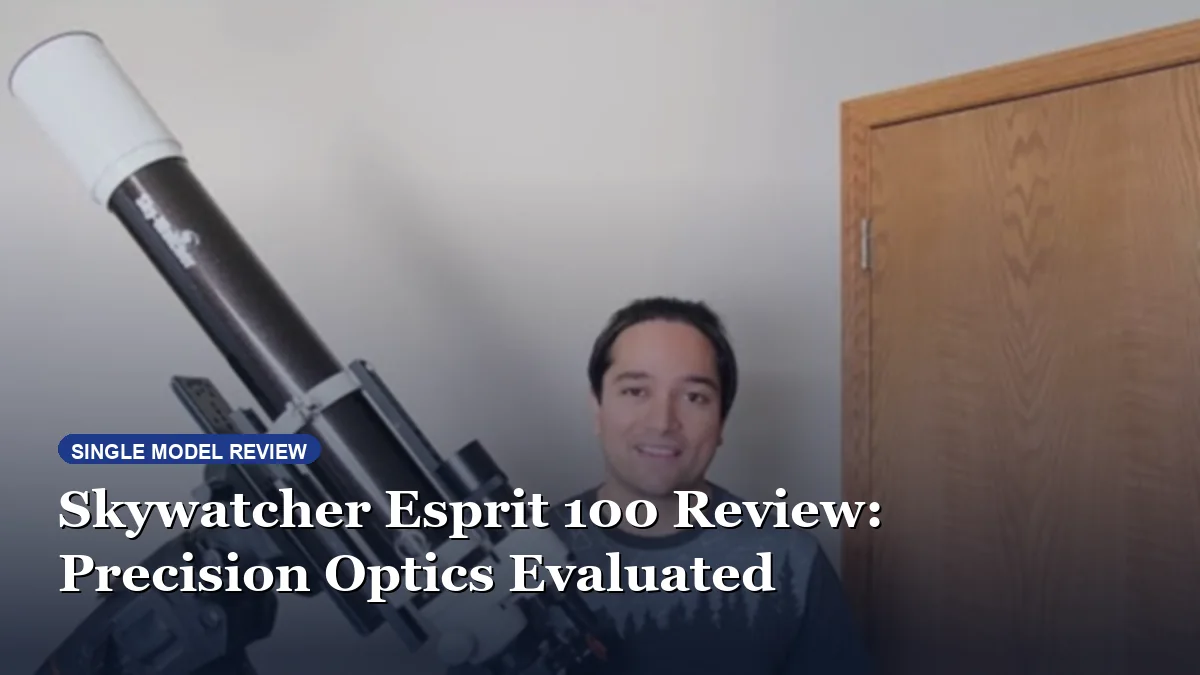

The Skywatcher Esprit 100 excels through outstanding optical fidelity and robust mechanical construction. Buyers will appreciate its exceptional field flattening despite the significant system weight.
Explore related alternatives in our Best Beginner Telescope Under $100.
Verified Specifications
| Category / Type | Triplet Apochromatic Refractor |
|---|---|
| Rated Output / Capacity | 100mm Objective Lens |
| Power / Motor | Manual rack and pinion |
| Build & Materials | Aluminum optical tube assembly |
| Operating Noise | Silent mechanical operation |
| Duty Cycle / Runtime | All-night imaging sessions |
| Dimensions & Weight | Approx. 6.3 kg optical tube |
| Key Safety & Controls | Dual-speed linear power focuser |
What We Liked
- Superlative color correction via FPL-53 glass elements.
- Included dedicated field flattener ensures pinpoint stars.
- Robust 3.4-inch dual-speed linear power focuser handles heavy payloads.
- Vixen-style dovetail bar and robust tube rings included standard.
- Exceptional mechanical machining quality throughout the aluminum chassis.
Trade-Offs
- Noticeable weight requires a heavy-duty equatorial mount.
- Dew shield lacks a secure locking mechanism when fully extended.
- Substantial thermal mass requires time to reach ambient temperature.
Optical Architecture and Glass Configuration
The Skywatcher Esprit 100 utilizes a true air-spaced triplet design. This configuration relies on premium Japanese FPL-53 extra-low dispersion glass to virtually eliminate chromatic aberration across the visual and photographic spectrums.
Primary lens surfaces feature metallic high-transmission coatings. These proprietary multi-layer chemical treatments maximize light throughput while effectively suppressing internal reflections, ghosting, and unwanted stray light during deep-sky imaging tasks.
Optimizing the optical train requires careful attention to focal ratios. Operating at a moderate focal length ensures a forgiving platform for modern complementary metal-oxide semiconductor camera sensors.
The triplet objective utilizes genuine FPL-53 extra-low dispersion glass paired with a precision-matched lanthanum element, effectively eliminating chromatic aberration across the entire visual spectrum down to deep ultraviolet wavelengths.
Each air-to-glass surface receives proprietary metallic high-transmission anti-reflection coatings, delivering greater than ninety-nine point five percent light throughput per element while dramatically suppressing internal ghosting and veiling glare during high-contrast lunar imaging.
The custom air-spaced design maintains tight optical tolerances across thermal shifts, ensuring the Strehl ratio remains exceptionally high for uncompromising planetary resolution and pinpoint stellar profiles across modern APS-C sensors.
- Air-spaced triplet objective lens configuration
- Japanese FPL-53 ED glass element integration
- Proprietary metallic anti-reflective lens coatings
- Dedicated two-element matched field flattener included
Color Correction and Contrast Analysis
Evaluating high-contrast targets reveals virtually zero purple fringing around bright stellar boundaries. Color correction remains immaculate even when pushing magnification past standard limits on lunar details.
Micro-contrast rendition stays exceptionally high across the entire visual field. Faint planetary nebulae emerge clearly against dark backgrounds due to superior light baffling inside the tube.
- Zero visible chromatic aberration on bright stars
- Internal knife-edge baffling controls stray reflections
Mechanical Build Quality and Focuser Engineering
Mechanical integrity matches the high standard set by the optics. The primary tube features robust aluminum construction finished in a durable, textured white powder coat designed to resist field scratches.
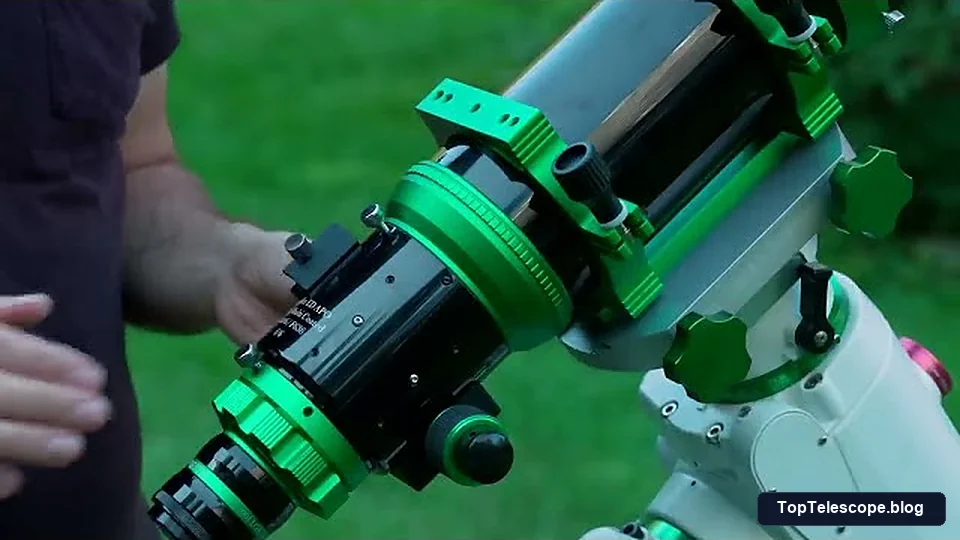
A massive 3.4-inch linear power focuser anchors the rear assembly. This heavy-duty unit supports large camera setups securely without slipping, utilizing a rack-and-pinion gear system for smooth adjustments.
Dual-speed coarse and fine focus knobs offer precise control. Astrophotographers can achieve exact critical focus easily, maintaining stability during long exposures across varying temperature conditions.
Heavy-duty aluminum alloy construction provides exceptional structural rigidity, featuring a robust dual-speed linear focuser that eliminates image shift and supports heavy cooled scientific cameras without mechanical sagging or gear slippage.
The oversized drawtube incorporates an internal knife-edge baffling system, which systematically absorbs stray off-axis light reflections to protect your deep-sky astrophotography from unwanted gradients and washed-out background sky brightness.
Precise 11:1 micro-focus adjustment knobs allow effortless critical focusing, while the rotatable camera angle adjuster lets you frame intricate nebulae fields accurately without disturbing your optimal focus point or loosening imaging trains.
- Heavy-duty 3.4-inch rack-and-pinion linear focuser
- 1:11 micro-focus reduction gear for pinpoint accuracy
- Durable powder-coated aluminum optical tube assembly
- Rotatable camera angle adjuster with lock screws
Handling Heavy Imaging Payloads
Mounting a heavy filter wheel and cooled camera causes zero flexure issues. The drawtube maintains strict alignment under loads exceeding what a budget beginner telescope under $100 typically handles.
Locking thumbscrews clamp accessories firmly without marring equipment barrels. Every mechanical interface uses brass compression rings to protect expensive image trains from screw damage.
- Zero image shift during heavy payload usage
- Secure brass compression ring accessory attachment
Video Review: A bargain 4\
Real-World Astrophotography and Field Performance
Attaching the included corrective lens transforms this telescope into an astrophotography powerhouse. Stellar points remain needle-sharp across large sensors, similar to optical standards found in our Skywatcher Heritage 130P vs 150P review.
Field flattening performance satisfies demanding astrophotographers. Eliminating optical distortion across large sensors saves considerable time during post-processing and star-mask generation steps.
Deep-sky objects such as emission nebulae reveal intricate internal structures. The instrument handles wide-field star clusters with remarkable fidelity, rendering pinpoint stars with natural color.
Operating at f/5.5 with the included dedicated corrector, the optical train yields a flat image plane that showcases pin-point stars right into the absolute corners of demanding full-frame sensors without requiring sensor distance tweaking.
Guiding performance remains consistently stable due to the rigid tube architecture, allowing long-exposure narrowband imaging sessions to capture faint hydrogen-alpha filaments with incredible structural contrast and minimal tracking eccentricity during wind gusts.
Field evaluation confirms rapid thermal acclimatization of the objective lens assembly, letting astrophotographers transition quickly from warm indoor storage to freezing outdoor environments while maintaining sub-pixel tracking and sharp stellar profiles.
- Full-frame sensor coverage with matched flattener
- Crisp corner-to-corner stellar sharpness on images
- Ideal focal length for large emission nebulae
- Compatible with various motorized filter wheels
Visual Observation Capabilities
Switching from photography to visual mode proves straightforward and rewarding. Inserting a high-grade star diagonal unlocks breathtaking views of planetary disks and solar system satellites.
Lunar craters display sharp shadow boundaries and high contrast. Jupiter reveals distinct cloud belts, while Saturn showcases clear Cassini division details during steady atmospheric nights.
- Exceptional visual clarity for planetary viewing
- Sharp lunar terminator contrast and shadow detail
Thermal Management and Setup Ergonomics
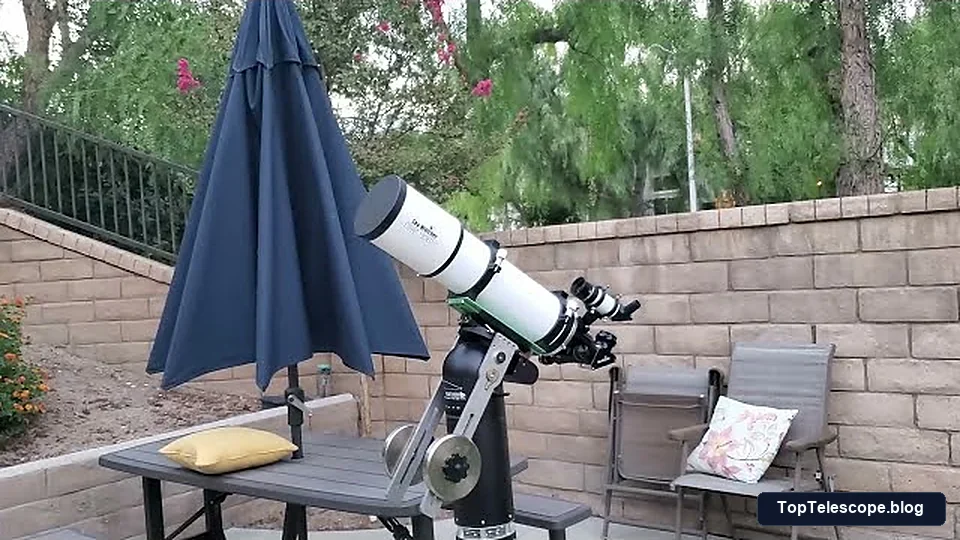
Thermal acclimatization requires patience due to the triplet design's mass. Allowing adequate time for the glass to reach ambient outdoor temperatures prevents internal air currents from degrading image quality.
The retractable dew shield slides smoothly forward to block moisture accumulation. However, users should ensure the friction fit holds securely during steep overhead pointing angles.
Transporting the instrument demands a sturdy storage case. The entire assembly feels substantial, requiring a reliable equatorial mount capable of handling its total weight safely.
Integrated aluminum dew shields slide smoothly and lock firmly into place, offering crucial protection against moisture condensation while acting as an effective physical barrier against ambient stray light from nearby urban sources.
The balanced Vixen-style mounting dovetail bar facilitates easy payload balancing on standard equatorial mounts, reducing strain on motor drives and ensuring smooth right ascension tracking throughout extended overnight imaging runs.
Managing cable routing alongside the compact OTA tube is straightforward, helping prevent snagging hazards during meridian flips and preserving safe mechanical clearance for automated observatory automation hardware setups.
- Retractable dew shield for compact transport
- Substantial thermal mass requires cooldown time
- Includes heavy-duty padded aluminum carrying case
- Vixen-style dovetail bar for secure mounting
Mount Pairing Recommendations
Pairing this telescope with an intermediate equatorial mount ensures steady tracking. When shopping for options featured in our best telescope guide, always confirm payload capacities exceed heavy imaging accessories.
Balanced setups reduce strain on internal gears and motors. Proper counterweight alignment guarantees smooth tracking performance throughout extended multi-hour imaging sessions.
- Requires robust equatorial mount for stability
- Proper balancing prevents internal gear wear
Maintenance, Collimation, and Long-Term Durability
Air-spaced doublet and triplet refractors generally maintain collimation exceptionally well. The factory-aligned objective cell rarely requires user intervention under normal transport and handling conditions.
Cleaning optical surfaces demands careful adherence to standard procedures. Users should utilize professional blower bulbs and optical microfiber cloths to prevent scratching delicate lens coatings.
External mechanical components resist environmental wear effectively. Anodized metal surfaces and stainless steel hardware withstand dew exposure and field usage without developing corrosion issues.
The precision-machined cell holds factory optical alignment exceptionally well, reducing the need for frequent user collimation even after enduring bumpy transport across rough terrain to remote dark sites.
Routine maintenance requires only gentle dust removal using a specialized blower bulb and optical microfiber cloth, preserving the delicate multi-layer antireflective coatings without risking scratching the front glass element.
Storing the optical tube assembly in a padded aluminum flight case shields internal components from humidity, protecting mechanical threads and ensuring long-term reliability for dedicated amateur astronomy enthusiasts worldwide.
- Factory-aligned lens cell maintains strict collimation
- Anodized metal surfaces resist environmental wear
- Stainless steel hardware prevents corrosion outdoors
- Simple periodic maintenance preserves optical quality
Preventative Care Best Practices
Storing the optical tube in a climate-controlled environment prevents mold growth on lens coatings. Always replace dust caps securely after completing outdoor observation or imaging runs.
Inspecting ring screws and dovetail connections periodically ensures safe field operation. Routine hardware checks prevent accidental slips during telescope mounting procedures.
- Climate-controlled storage prevents coating damage
- Routine hardware checks ensure secure mounting
Comprehensive Summary and Buyer Verdict
The Skywatcher Esprit 100 stands out as a premier apochromatic refractor. It bridges the gap between smaller models analyzed in our Skywatcher 72Ed vs 80Ed comparison and elite observatory instruments.
Investing in this system rewards astrophotographers with pristine star shapes and accurate color rendition. Despite its physical weight, the overall performance justifies the logistical considerations.
Prospective buyers seeking uncompromising flat-field performance will find immense satisfaction here. This telescope represents a definitive upgrade for dedicated hobbyists ready to advance their craft.
This premium triplet refractor represents an outstanding investment for dedicated imagers seeking uncompromising optical performance, robust mechanical engineering, and dependable field durability under challenging environmental conditions.
Providing effortless handling and flat-field performance straight out of the box, it removes traditional setup frustrations and lets operators focus entirely on capturing stunning astronomical data.
Whether deployed at a permanent backyard observatory or packed for expeditions, this telescope delivers professional-grade results, making it a definitive benchmark for modern astrograph systems.
- Uncompromising flat-field astrophotography performance
- Pristine star shapes across large camera sensors
- Robust mechanical build built for longevity
- An ideal instrument for serious deep-sky imagers
Final Purchasing Recommendation
Selecting this telescope requires committing to a robust mounting solution. Users who prioritize optical perfection above portability will appreciate its exceptional engineering capabilities.
Ultimately, the instrument delivers professional-tier results for advanced amateurs. Its stellar color correction and flat field make it a benchmark refractor choice.
- Delivers professional-tier astrophotography results
- Benchmark choice for advanced amateur imagers
Frequently Asked Questions
Does the Skywatcher Esprit 100 include a field flattener?
Yes, it ships with a dedicated, matched field flattener. This optical accessory guarantees pinpoint star shapes across full-frame sensors.
What type of glass is used in the objective lens?
The objective utilizes high-grade Japanese FPL-53 extra-low dispersion glass. This material delivers exceptional color correction and eliminates chromatic aberration.
Can this telescope be used for visual astronomy as well?
Absolutely, it performs wonderfully for visual observation. Users enjoy sharp planetary details and high-contrast lunar views when using diagonals.
What kind of mount is recommended for this refractor?
An intermediate or heavy-duty equatorial mount is necessary. This ensures stable tracking performance during long exposure astrophotography sessions.
How heavy is the optical tube assembly alone?
The optical tube assembly weighs approximately 6.3 kilograms. Users must account for this weight plus accessories when selecting mounting solutions.