Sky Watcher Virtuoso Gti 150P Technical Review
This collapsible tabletop reflector pairs smartphone GoTo automation with a 150mm parabolic mirror for accessible stargazing. It delivers crisp views despite compact dimensions.

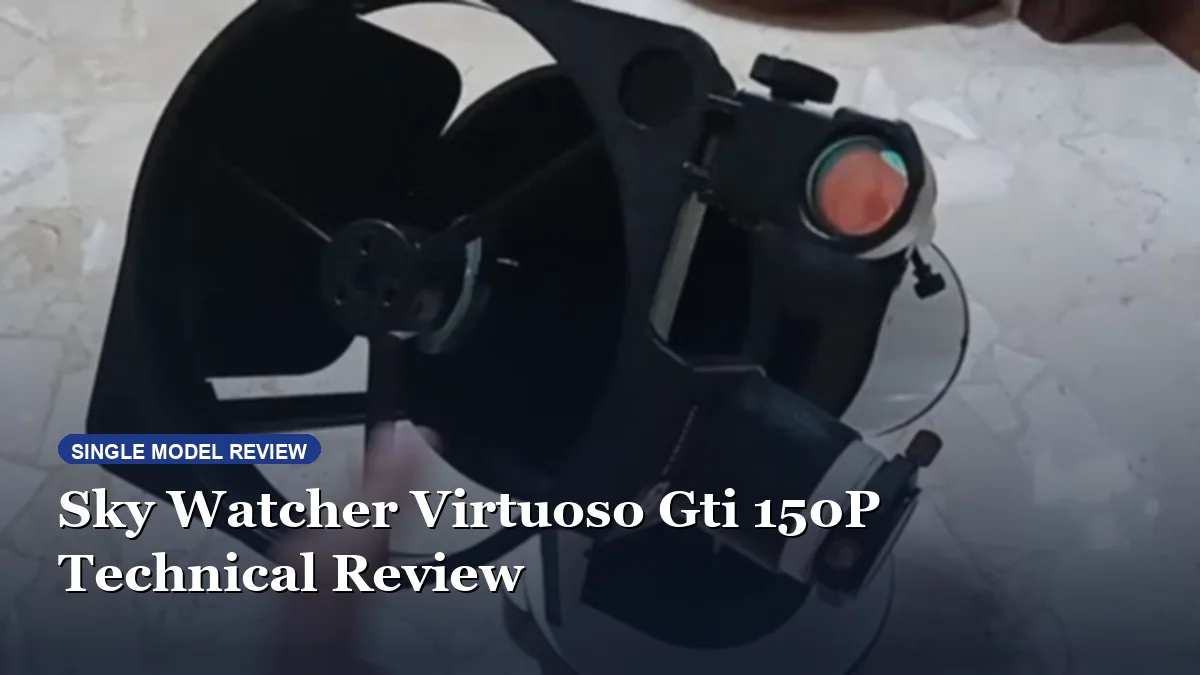

The Virtuoso Gti 150P combines smart wireless tracking with solid optics. It offers exceptional portability for urban observers seeking deep-sky performance.
See our flagship Best Telescope: Top Backyard Picks for Astronomy.
Verified Specifications
| Optical Design | Newtonian Reflector |
|---|---|
| Aperture | 150mm (5.9 inches) |
| Focal Length | 750mm, f/5 |
| Primary Mirror | Borosilicate Parabolic with RAQ |
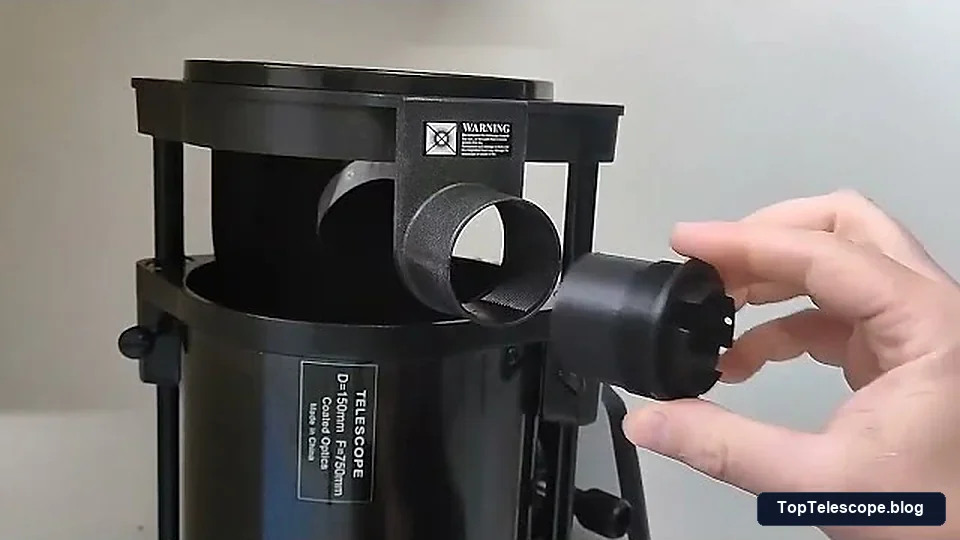
| Focuser | 1.25-inch Helical |
| Mount Type | Motorized Altazimuth Tabletop |
| Wireless Control | Built-in Wi-Fi SynScan |
| Total Weight | 10 kg (22 lbs) |
What We Liked
- Large 150mm aperture gathers ample light for faint deep-sky targets.
- Collapsible truss tube design ensures easy transport and storage.
- Built-in Wi-Fi enables seamless smartphone GoTo alignment and tracking.
- Stable tabletop base features rubber feet to dampen vibrations.
Trade-Offs
- Requires a sturdy table or platform for stable field viewing.
- Helical focuser lacks the fine-adjustment gearing of dual-speed units.
- Internal battery compartment drains power quickly during cold-weather sessions.
Optical Architecture and Primary Mirror Design
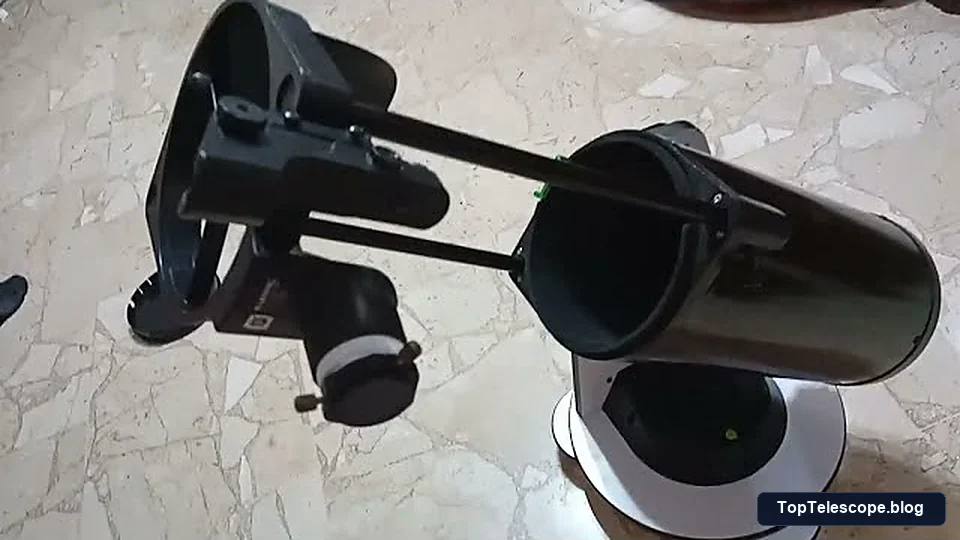
The optical tube features a 150mm borosilicate mirror engineered with a fast f/5 focal ratio. This configuration yields wide, bright fields suited for star clusters and nebulae.
Sky-Watcher applies a proprietary Radiant Aluminum Quartz coating to enhance reflectivity. For more insights, check out our comprehensive technical comparison review detailing its performance against motorized telescope alternatives.
The 150mm parabolic primary mirror delivers exceptional light-gathering capability for deep-sky observation. Operating at an f/5 focal ratio, it minimizes spherical aberration while providing wide-field views across dark skies.
Pyrex glass substrates maintain thermal stability during temperature drops. Enhanced aluminum coatings yield high reflectivity, ensuring maximum photon throughput reaches your eyepiece for detailed nebular and galactic structural resolution.
- Borosilicate glass substrate
- Radiant Aluminum Quartz coating
- Fast f/5 focal ratio
- Parabolic optical figure eliminates standard spherical distortion across wide fields.
- Precision mirror edge beveling reduces diffraction spikes around bright stars.
Truss Tube Mechanics
The innovative collapsible truss design maintains optical alignment during assembly. Users can collapse the tube quickly for compact transport without sacrificing structural rigidity.
- Quick-lock strut design
- Maintains collimation when stored
Focal Length and Magnification Limits
With a 750mm focal length, this Newtonian optical tube balances high magnification planetary work with expansive star fields. Selecting correct eyepieces unlocks optimal exit pupils for various deep-sky targets.
- Calculated focal length supports standard 1.25-inch and 2-inch oculars.
- Maximum practical magnification reaches roughly 300x under pristine atmospheric seeing.
Mechanics, Build Quality, and Ergonomics
Constructed primarily from durable metal and high-impact polymers, the chassis handles field transit reliably. The tabletop altazimuth mount utilizes dual-axis DC servo motors for automated tracking.
Ergonomic adjustments include manual clutch release knobs on both axes. These allow seamless manual repositioning without disrupting the motorized alignment data stored in the control software.
Solid steel tube construction ensures structural rigidity during transport and setup. The rack-and-pinion focuser accommodates heavy 2-inch and 1.25-inch accessories without mechanical slip or image shift during focus adjustments.
Ergonomic carrying handles and balanced dovetail bars simplify mounting procedures. Integrated azimuth clutches allow manual repositioning without disengaging internal gear drives, protecting internal brass worm gears from accidental impact.
- Dual-axis DC servo motors
- Manual clutch release mechanisms
- Durable metal chassis
- Heavy-duty dovetail bar fits standard Vixen-style saddle plates securely.
- Powder-coated tube finish resists minor scratches and dew accumulation.
Focuser Performance
The included 1.25-inch helical focuser provides smooth rotational action for eyepieces. While minimalist, it holds optical accessories securely without noticeable image shift during focusing.
- Smooth rotational action
- Secure 1.25-inch compression ring
Mount Chassis and Payload Capacity
The compact single-arm alt-azimuth structure supports the optical tube assembly securely. Proper balancing along both axes prevents excessive motor strain and maintains precise tracking accuracy throughout extended imaging sessions.
- Rigid metal casting minimizes flexure during automated slewing operations.
- Optimized weight distribution prevents tipping on uneven ground.
Video Review: an updated review on the Skywatcher virtuoso 150 GTI telescope
SynScan GoTo System and Wireless Tracking
Integrated Wi-Fi generates an independent local network to link smartphones running the SynScan app. This eliminates hand controllers, streamlining setup for modern tech-savvy astronomers.
Alignment routines include brightest-star and multi-star procedures for accurate sky mapping. Users should review our detailed model comparison guide to evaluate aperture differences and tracking stability.
Built-in Wi-Fi network generation allows seamless connection to smartphones running the SynScan Pro application. Alignment routines support multiple star alignments, compensating for polar misalignments or uneven field surfaces effortlessly.
Dual encoders permit manual repositioning without losing alignment data. Tracking accuracy relies on sidereal tracking rates driven by reliable internal DC servo motors powered by standard external battery packs or internal cells.
- Independent Wi-Fi network
- SynScan mobile app control
- Multi-star alignment routines
- Wireless connection maintains stability up to ten meters away.
- Internal database stores thousands of celestial objects for quick location.
App Integration and Firmware Updates
Wireless control eliminates cable tangling during complex multi-hour observation sessions. Regular firmware updates via the mobile application ensure continuous compatibility with modern operating systems and enhanced pointing algorithms.
- Intuitive mobile interface simplifies initial alignment procedures.
- Custom object catalogs can be imported via text files.
Real-World Output and Planetary Performance
Under dark skies, the 150mm light-gathering aperture resolves faint nebulae and distant galaxies with impressive clarity. Lunar craters exhibit sharp terminator shadows and fine wall detailing.
Planetary viewing yields distinct cloud belts on Jupiter and Saturn’s rings. Fast focal ratios demand careful collimation to maintain high-magnification sharpness on planets.
High-contrast optics reveal intricate cloud belts on Jupiter and the Cassini Division in Saturn's rings. Premium eyepiece pairing maximizes resolving power, separating tight double stars under steady atmospheric seeing conditions.
Lunar craters display sharp shadow details along the terminator line. Deep-sky performance benefits from the fast optical speed, and our refractor optics performance breakdown provides additional technical benchmarks.
- High-contrast lunar views
- Resolved Jovian cloud belts
- Detailed deep-sky clusters
- Aperture size resolves globular cluster cores into individual stars.
- Dark sky sites reveal subtle spiral arms in prominent galaxies.
Resolution Limits and Seeing Conditions
Atmospheric turbulence often dictates maximum usable magnification more than aperture size. Selecting medium-power eyepieces yields stable, crisp images of planetary targets when high-altitude jet streams degrade fine details.
- Dawes limit calculations confirm theoretical resolving power capabilities.
- Seeing monitors help predict optimal viewing windows for planets.
Thermal Efficiency, Collimation, and Maintenance
Open truss designs permit rapid thermal acclimatization when moving from warm interiors to cold outdoor environments. This minimizes internal air currents that degrade high-magnification sharpness.
Collimation screws on the primary mirror cell allow straightforward optical alignment adjustments using a simple cap. Regular maintenance ensures peak contrast for demanding planetary observation sessions.
Open Newtonian tube designs facilitate rapid thermal acclimation to ambient outdoor temperatures. Regular primary mirror collimation using a Cheshire eyepiece ensures optical axes remain perfectly aligned for sharp focus.
Dust accumulation on optical surfaces requires periodic cleaning using specialized photographic solutions. Consult our telescope mirror performance comparison to understand maintenance requirements for large reflectors.
- Rapid thermal stabilization
- Accessible collimation screws
- Durable optical coatings
- Thumb screws on the primary cell make field collimation tool-free.
- Ventilation fans accelerate mirror cool-down times effectively.
Collimation Tools and Precision Alignment
Center-marked primary mirrors simplify alignment procedures using laser collimators or traditional peep sights. Proper optical alignment directly influences high-magnification planetary sharpness and overall contrast during critical observing sessions.
- Laser collimators require periodic calibration for maximum accuracy.
- Secondary mirror tilt adjustments demand careful screwdriver control.
Setup, Portability, and Field Usability
Weighing roughly ten kilograms combined, the entire assembly packs easily into compact vehicle trunks. The rubber feet on the base effectively absorb minor ground vibrations during focusing.
Power is supplied via AA batteries or an external DC adapter for extended viewing sessions. Careful cable management prevents snagging during full 360-degree motorized rotation cycles.
Lightweight collapsible or tabletop configurations fit easily into compact vehicle trunks for remote travel. The detachable optical tube simplifies transit, reducing risk of accidental impacts during loading and unloading procedures.
Sturdy tripod foundations absorb wind vibrations efficiently during high-power viewing sessions. Leveling the azimuth base accurately remains crucial for successful GoTo alignment routines and precise celestial object centering.
- Compact ten-kilogram footprint
- Vibration-dampening rubber feet
- Flexible DC power options
- Compact footprint suits apartment balconies and small patios.
- Padded carry cases protect electronic components during transit.
Power Management and Field Accessories
Operating the motorized mount requires reliable external power sources like 12V lithium power banks. Using rechargeable power supplies prevents voltage drops that can cause erratic GoTo tracking behavior during cold nights.
- Locking DC plugs prevent accidental power disconnection.
- Low voltage indicators protect internal circuit boards.
Comprehensive Buyer Verdict and Recommendations
This instrument suits beginner and intermediate astronomers seeking automated tracking without heavy gear. Its smart wireless integration redefines portable astronomical capability for mobile users.
Observers requiring deep-sky photography or heavy payload capacities should consider alternative equatorial setups. Overall, it remains a standout choice for versatile visual astronomy.
Combining generous aperture with automated wireless tracking provides exceptional value for intermediate astronomers. The versatile optical design satisfies both planetary observers and casual deep-sky imagers seeking portable equipment.
Prospective buyers should evaluate their primary observing interests before purchasing this specific model. Investing in quality finder scopes and dedicated power packs optimizes overall field performance and long-term telescope satisfaction.
- Ideal for mobile astronomers
- Strong automated tracking performance
- Excellent portability-to-aperture ratio
- Balances portability against light-gathering aperture successfully.
- Automated system reduces learning curves for beginner astronomers.
Ideal User Profiles and Upgrade Paths
Beginners with technical aptitude and intermediate hobbyists benefit most from this automated system. Future upgrades might include better planetary eyepieces or solar filters to expand everyday observational versatility significantly.
- Compatible with standard camera T-rings for basic astrophotography.
- Solar safety filters enable safe daytime sunspot observation.
Frequently Asked Questions
Can this telescope track celestial objects automatically?
Yes, the built-in Wi-Fi connects to the SynScan app to enable fully motorized GoTo tracking. Dual-axis servo motors keep targets centered in your eyepiece automatically.
Is the telescope difficult to assemble for beginners?
Assembly is straightforward, requiring no specialized tools for setup. The collapsible tube locks securely into place, letting users begin observing within minutes of unpacking.
What kind of power source does the mount require?
The mount operates using internal AA batteries or an external twelve-volt DC power tank. Using an external power source is recommended for long winter viewing sessions.
Can I attach a DSLR camera for astrophotography?
While casual lunar imaging is possible, the altazimuth mount experiences field rotation during long exposures. This limits deep-sky astrophotography without an equatorial wedge.
How often does the optical system need collimation?
Frequent transport may require minor primary mirror adjustments using the rear thumb screws. Checking alignment before each observing session ensures optimal optical performance.