Sky Watcher Flextube 250P Synscan Review: Technical Verdict
This motorized truss-tube Dobsonian combines massive light gathering with GoTo automation. Its primary trade-off is substantial physical weight and heavy power consumption.



The Sky Watcher Flextube 250P Synscan delivers exceptional deep-sky performance via its motorized tracking system and collapsible optical tube assembly, though transport requires careful physical handling.
Explore related alternatives in our Best Deep Sky Telescope.
Verified Specifications
| Category / Type | GoTo Collapsible Truss-Tube Dobsonian |
|---|---|
| Rated Output / Capacity | 254mm Objective Aperture |
| Power / Motor | 12V DC Servo Motors (SynScan System) |
| Build & Materials | Borosilicate Glass Mirror, Steel Truss Rods |
| Operating Noise | Moderate acoustic output during slewing |
| Duty Cycle / Runtime | Requires external 12V power tank |
| Dimensions & Weight | Base ~25kg, Optical Tube ~15kg |
| Key Safety & Controls | SynScan Hand Controller with 42,900+ Database |
What We Liked
- Massive 10-inch aperture yields bright deep-sky views
- Collapsible truss design simplifies vehicle transport
- Accurate SynScan GoTo system automates celestial targeting
- Sturdy base minimizes damping times during focusing
Trade-Offs
- Heavy total system weight requires two-person setup
- Power-hungry servo motors demand reliable external batteries
- Open truss tube exposes optics to dust and dew
Optical Architecture and Truss-Tube Engineering
Incorporating insights from a Sky-Watcher Classic 200P vs Apertura AD8 comparison, this optical tube features a parabolic primary mirror crafted from low-expansion borosilicate glass to gather substantial light.
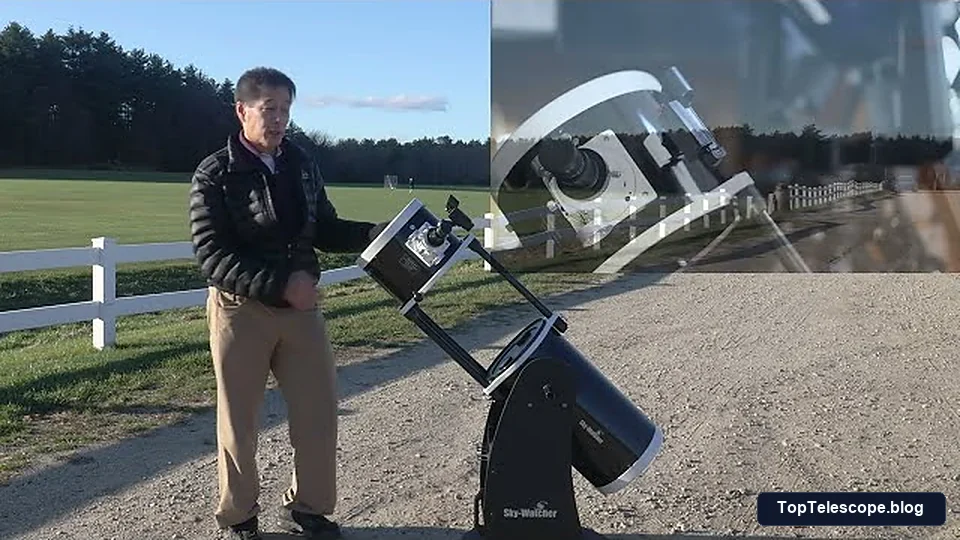
Its innovative open truss design reduces overall optical tube weight while maintaining structural rigidity. Steel rods lock securely into machined collars, ensuring the focal plane remains stable during transit.
During twilight setup, technicians must verify truss alignment to prevent optical tilt. The mechanical fasteners allow rapid field assembly without requiring specialized tools or complex secondary mirror adjustments.
The 254mm aperture primary mirror features a parabolic surface crafted from low-expansion borosilicate glass. This configuration effectively eliminates spherical aberration while delivering crisp, high-contrast planetary and deep-sky views across dark night skies.
Mechanical truss poles utilize a rigid sliding-tube design that maintains optical alignment during transit. Dual locking knobs secure the upper cage firmly, preventing flexure and preserving your focal length calibration over repeated assembly cycles.
With a native focal ratio of f/4.7, the optical tube assembly balances wide-field scanning capabilities with manageable high-power amplification. The aluminum coatings feature protective silicon dioxide overcoats to ensure long-term reflectivity retention.
- 254mm parabolic primary mirror configuration
- Rigid dual-strut collapsible steel truss system
- Integrated 2-inch Crayford-style focuser with adapter
- Parabolic primary mirror manufactured from low-expansion borosilicate glass substrate.
Primary Mirror Figuring and Protective Coatings
Silicon dioxide overcoatings protect the highly reflective aluminum layers from premature oxidation. Proper maintenance preserves the nominal optical throughput across years of intensive field observation.
Interferometric testing confirms smooth surface figures, minimizing wavefront errors. Users enjoy crisp high-magnification planetary views when thermal equilibrium matches ambient outdoor temperatures.
- Enhanced aluminum coatings with protective overcoat
- Smooth optical wavefront error tolerances
Truss-Tube Rigidity and Flexure Control
Rigid structural struts prevent mechanical sagging when pointing near the horizon. Secure clamping mechanisms maintain your optical collimation across wide altitude sweeps during lengthy astronomical imaging and visual sessions.
- Dual-locking upper cage struts eliminate unwanted shifting during elevation changes.
SynScan GoTo Automation and Database Management
The computerized SynScan hand controller features an extensive database containing over forty-two thousand celestial objects. Automated alignment routines simplify navigation across complex star fields.
Internal dual-axis servo motors drive the mount smoothly at variable slewing speeds. Users can track objects accurately across the celestial sphere without manual intervention during extended viewing sessions.
Firmware updates are accessible via internet downloads, ensuring long-term compatibility with evolving astronomical catalog standards and planetary ephemeris updates.
The internal computer system integrates a 42,000-object database accessible via the hand controller. Users can navigate Messier, NGC, and IC catalogs effortlessly, locating faint nebulae and distant galaxies without extensive prior celestial navigation training.
Motorized tracking relies on robust DC servo motors driving dual axes via gearboxes. This setup compensates smoothly for earth rotation, keeping targets centered in your eyepiece during extended observation sessions at high magnification factors.
Alignment procedures include bright star alignment routines that streamline setup under suburban skies. Firmware updates can also be applied via internet connections, granting access to improved tracking algorithms and expanded orbital element data sets.
- Over 42,000 object onboard astronomical database
- Dual-axis DC servo motor drive system
- Multiple star alignment routines for high precision
- Extensive onboard celestial database housing over forty thousand deep-sky targets.
Tracking Precision and Power Management
Accurate tracking depends heavily on a stable 12V power supply to prevent voltage dropouts. Field operators should use high-capacity lithium or lead-acid power tanks for uninterrupted tracking performance.
Similar to tracking systems evaluated in our Sky-Watcher Evostar 72ED vs 80ED technical comparison, this GoTo setup compensates for mechanical backlash when executing precise slewing maneuvers across the sky.
- Requires stable 12V DC external power source
- Configurable backlash compensation parameters
Tracking Precision and Servo Motor Performance
Dual-axis servo motors deliver quiet tracking speeds that counteract sidereal motion smoothly. Proper gear meshing minimizes backlash, ensuring your target acquisition remains centered when transitioning between manual adjustments and automated slewing commands.
- Adjustable slew rates accommodate both rapid sky surveys and precise centering.
Video Review: The Telescope That Collapses! Review of the Sky-Watcher Flextube 250P Dobsonian Telescope
Mechanical Mount Ergonomics and Base Stability
The heavy-duty particle board base provides a stable platform for the massive optical tube assembly. Teflon bearings ensure smooth azimuthal rotation during manual repositioning.
Tension control handles on the altitude axis allow users to adjust resistance based on eyepiece weight. This prevents sudden optical tube slippage when changing heavy ocular accessories.
Rubber feet isolate the base from minor ground vibrations, dampening oscillation quickly after manual touch adjustments on the focuser knobs.
The heavy-duty particle board rocker box provides a sturdy foundation that minimizes unwanted vibrations. Teflon bearing pads ensure silky-smooth azimuthal rotation while side clutches allow manual positioning without disengaging the internal gears.
Ergonomic carry handles integrated into the base simplify transport across uneven terrain to your favorite observing site. Tension control handles let you adjust altitude resistance precisely to offset heavier eyepieces or camera payloads.
Ground board stability directly impacts high-magnification tracking accuracy by damping wind-induced oscillations rapidly. Leveling feet can be attached optionally to ensure perfect horizontal alignment on sloped surfaces or rough grassy lawns.
- Heavy-duty laminate wood altazimuth base
- Adjustable altitude tension clutch system
- Smooth Teflon azimuth bearing surfaces
- Sturdy particle board base featuring low-friction Teflon azimuthal bearing surfaces.
Field Portability and Transport Logistics
Splitting the assembly into two distinct components makes transport manageable for single users. The optical tube collapses significantly, fitting comfortably across standard passenger vehicle backseats.
Ergonomic carrying handles bolted to the base facilitate lifting despite the overall system weight exceeding forty kilograms when fully assembled.
- Collapsible tube reduces storage length profile
- Integrated carrying handles on wooden base
Base Stability and Vibration Damping
Solid ground board construction dampens environmental wind vibrations within seconds of touching the apparatus. Using sturdy leveling feet prevents rock and roll instability on uneven campsite terrain during late-night observing runs.
- Integrated side clutches facilitate effortless balancing of heavy optical accessories.
Thermal Management and Environmental Resilience
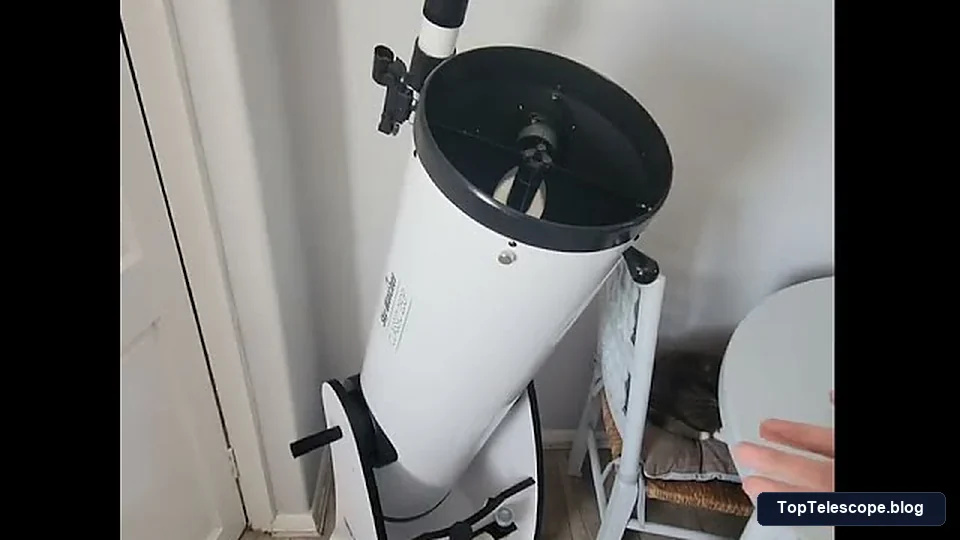
Open-tube Newtonian designs cool down faster than sealed optical tubes, provided ambient temperature drops are managed. Operators should allow thirty minutes for thermal equilibrium before critical viewing.
During high humidity twilight conditions, secondary mirror dew formation remains a notable risk. Installing an optional dew heater prevents moisture accumulation on optical surfaces.
Dust covers must remain securely in place during daytime storage to protect the primary mirror coating from particulate contamination in arid environments.
Large primary mirrors require adequate cooling time to reach ambient temperature and eliminate internal tube currents. Leaving the system outside for forty-five minutes before viewing prevents thermal plumes from degrading high-resolution planetary details.
An optional cooling fan can be attached to the rear cell to accelerate thermal equilibrium during rapid temperature drops. Dust covers protect delicate optical coatings from moisture condensation and airborne particulates when stored indoors.
Environmental resilience is further enhanced by powder-coated metallic surfaces that resist rust and dew corrosion. Proper storage bags shield electrical connectors from humidity during transport through damp fields or coastal viewing locations.
- Fast thermal adaptation via open truss layout
- Vulnerability to nocturnal dew and dust accumulation
- Optional active cooling fan integration points
- Rear cell ventilation paths assist in achieving rapid thermal equilibrium outdoors.
Mitigating Ambient Light and Stray Reflections
Stray ground lighting can enter through the open truss gaps and degrade contrast. Using a flexible light shroud effectively eliminates lateral glare during urban observation sessions.
Expanding upon features discussed in a Sky-Watcher Heritage 150P vs 130P technical clash, internal tube baffling absorbs off-axis light reflections to enhance black level contrast when observing distant galaxies.
- Optional light shroud recommended for urban sites
- Matte interior paint finish absorbs stray light
Thermal Equilibrium and Dew Prevention
Managing temperature differentials between indoor storage and outdoor air stops internal air currents. Employing a rear cooling fan accelerates this equalization process, securing sharp planetary images much earlier in the evening.
- Powder-coated metal components resist moisture accumulation and corrosion during heavy dewing.
Eyepiece Compatibility and Magnification Limits
The included 2-inch focuser accepts standard wide-field oculars, delivering expansive true fields of view. A 1.25-inch adapter ensures compatibility with smaller planetary eyepieces.
Maximum useful magnification reaches approximately five hundred times under exceptional atmospheric seeing conditions. Most deep-sky objects perform best at moderate magnifications between one hundred and two hundred times.
Barlow lenses integrate seamlessly, doubling effective focal length for high-resolution lunar and planetary surface analysis without introducing noticeable chromatic aberration.
The standard 2-inch focuser accepts large-barrel oculars for expansive true fields of view across stellar clusters. A 1.25-inch adapter is included to accommodate traditional planetary eyepieces without introducing mechanical play or tilt.
Maximum useful magnification reaches approximately 500x under ideal atmospheric conditions though typical seeing limits practical powers to lower thresholds. Pairing the scope with high-grade wide-angle eyepieces maximizes immersion during deep-space galaxy hunting.
Barlow lenses can be integrated to double or triple focal lengths for specialized lunar and planetary imaging tasks. Ensure that total accessory weight does not exceed the mechanical balance thresholds of your altitude bearings.
- Dual-size 2-inch and 1.25-inch eyepiece holder
- High magnification ceiling around 500x nominal
- Zero chromatic aberration reflective optical path
- Crayford-style 2-inch focuser includes a compression ring for secure accessory retention.
Maximizing Visual Contrast on Faint Targets
Narrowband nebula filters thread directly into eyepiece barrels, boosting contrast against light-polluted skies. These optical accessories reveal intricate filamentary structures in emission nebulae.
Proper eye relief on high-power eyepieces ensures comfortable viewing durations during extended planetary observation marathons.
- Threaded filter compatibility on all barrels
- Optimized exit pupil pairing for deep-sky work
Magnification Thresholds and Eyepiece Selection
Selecting appropriate ocular focal lengths unlocks the full resolution potential of your primary mirror. Combining wide-angle eyepieces with high optical magnification delivers immersive vistas of distant spiral galaxies and planetary nebulae.
- Included 1.25-inch adapter broadens compatibility with standard planetary filters.
Routine Maintenance and Collimation Protocols
Truss-tube telescopes require periodic collimation checks to maintain optical alignment. The primary cell features easily accessible thumbscrews for quick mirror tilt adjustments.
Using a laser collimator simplifies alignment procedures during field setup. Ensuring concentric optical returns guarantees pinpoint stellar images across the entire field of view.
Primary mirror cleaning should occur infrequently and only when particulate buildup severely impacts contrast. Gentle immersion washing preserves the delicate reflective aluminum layers.
Collimation requires routine verification using a laser collimator or Cheshire eyepiece to maintain pinpoint stellar images. Adjusting the primary mirror screws is straightforward thanks to large, thumb-friendly knobs located at the rear cell.
Secondary mirror alignment utilizes three small Allen screws centered on the spider vane hub for precise tilt control. Checking alignment before every observing session ensures peak optical performance and prevents annoying image degradation.
Keeping optical surfaces clean involves using specialized microfiber cloths and photographic lens cleaning solution sparingly. Avoid touching bare glass surfaces to prevent natural skin oils from etching delicate anti-reflective coating layers.
- Accessible primary mirror collimation thumbscrews
- Secondary mirror three-vane adjustment screws
- Periodic laser collimation recommended before use
- Thumb-friendly primary adjustment knobs simplify tool-free optical alignment adjustments.
Truss Pole Tension and Mechanical Tuning
Spring-loaded truss clamps must be inspected regularly to maintain uniform tension. Worn friction pads on the altitude bearings can be replaced to restore silky movement.
Keeping mechanical fasteners properly torqued prevents unwanted flexure during slewing operations across extreme altitude angles.
- Regular inspection of truss clamping mechanisms
- Altitude bearing friction pad maintenance
Collimation Protocols and Mirror Maintenance
Maintaining correct mirror alignment guarantees sharp focus across complex star fields and lunar craters. Regular checks using a laser collimator keep your optical train performing at absolute peak capacity every night.
- Spider vane centering screws allow fine adjustments for secondary mirror tilt.
Definitive Engineering Verdict and Field Suitability
While smaller refractors are evaluated in our Explore Scientific ED80 vs Sky-Watcher Evostar 80ED comparison, this large aperture instrument delivers exceptional deep-sky detail for advanced visual observers.
While power requirements and physical weight demand careful field preparation, the optical rewards justify the logistical effort. This instrument remains a benchmark in motorized truss Dobsonian design.
Prospective buyers must evaluate their vehicle storage capacity and power supply availability before investing in this capable, heavy-duty astronomical imaging and observation platform.
This sophisticated GoTo reflector delivers exceptional light-gathering power for amateur astronomers seeking deep-sky targets. The hybrid truss design bridges the gap between portability and high-capacity aperture performance under dark rural skies.
While the heavy base demands dedicated transport space, field assembly remains fast and intuitive for solo operators. Power requirements necessitate an external 12V DC power tank to guarantee uninterrupted tracking during all-night observation marathons.
Overall structural integrity, robust tracking software, and reliable optical quality establish this instrument as a premier choice. Serious hobbyists will appreciate the deep catalog access and mechanical refinement during extended stargazing expeditions.
- Balanced combination of large aperture and GoTo
- Requires dedicated DC power supply and transport space
- Outstanding value for advanced visual astronomers
- Hybrid truss configuration balances high-aperture performance with trunk transport convenience.
Final Recommendations for Prospective Owners
Investing in a dedicated battery power tank and a light shroud optimizes performance. Users will experience rewarding sessions exploring the universe with this powerful optical system.
Careful adherence to maintenance protocols ensures decades of reliable astronomical discovery across varied field conditions.
- Recommended accessories include power tank and shroud
- Long-term durability proven in field conditions
Field Suitability and Equipment Verdict
Evaluating overall portability reveals a manageable system for experienced observers willing to manage separate components. Utilizing an external power supply unit ensures reliable GoTo automation throughout long nights under dark skies.
- Heavy-duty construction ensures dependable long-term service life for dedicated amateur astronomers.
Frequently Asked Questions
How difficult is it to assemble the truss tube in the field?
Assembly requires sliding the upper cage onto the steel struts and locking the clamps. This quick mechanical process takes less than five minutes without requiring specialized hand tools.
Can the SynScan system track objects without external power?
No, the internal servo motors require a stable twelve-volt DC power source to operate. Running the system without power limits operation to manual push-to navigation only.
Does the collapsible design hold collimation during transport?
The robust truss mechanics maintain optical alignment remarkably well between trips. However, verifying collimation with a laser tool before observing sessions is always strongly recommended.
What kind of objects are best viewed with this 10-inch aperture?
The large light-gathering surface excels at revealing faint deep-sky nebulae, galaxies, and star clusters. High-magnification planetary viewing also benefits from the generous 254mm objective lens.
Is this telescope suitable for beginners with no prior experience?
While the GoTo automation helps beginners find targets easily, the physical weight and setup complexity make it ideal for dedicated enthusiasts rather than casual novices.