Sky Watcher Evostar 72Ed Review: Engineering & Field Performance
This compact apochromatic refractor combines matched glass elements with robust mechanics. It delivers crisp, high-contrast imagery for demanding field astronomers.

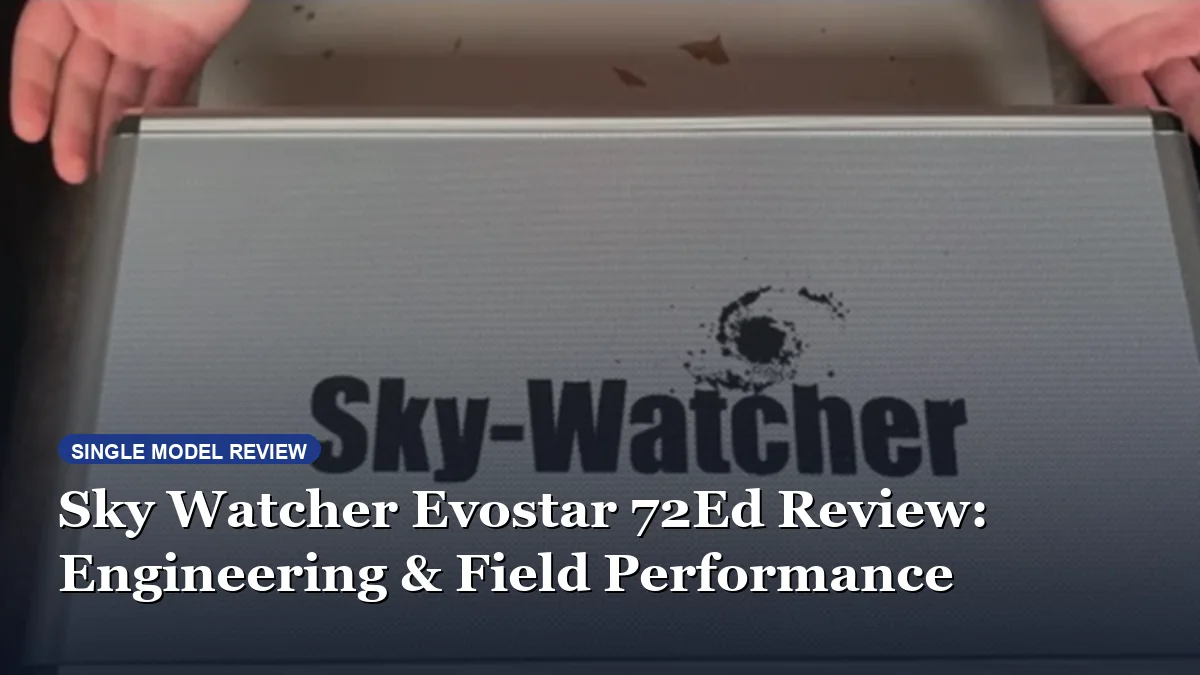

The Sky Watcher Evostar 72Ed offers exceptional optical correction and mechanical rigidity in a highly portable chassis. It stands as a premier choice for mobile astrophotographers seeking uncompromised color purity.
Explore related alternatives in our Best Deep Sky Telescope.
Verified Specifications
| Category / Type | Apochromatic ED Doublet Refractor |
|---|---|
| Rated Output / Capacity | 72mm Objective Lens Diameter |
| Power / Motor | Manual Crayford Dual-Speed Focuser |
| Build & Materials | Anodized Aluminum Optical Tube Assembly |
| Operating Noise | Zero Operational Mechanical Noise |
| Duty Cycle / Runtime | Unlimited Nighttime Field Operation |
| Dimensions & Weight | Compact Portability Profile, Under 5 Pounds |
| Key Safety & Controls | Thread-on Dew Shield and Ring Mounts |
What We Liked
- Extra-low dispersion glass minimizes chromatic aberration effectively.
- Dual-speed Crayford focuser enables precise manual focus adjustments.
- Thread-on dew shield secures easily during transit and storage.
- Robust aluminum mounting rings provide secure dovetail attachment.
- Compact chassis fits standard airline carry-on luggage securely.
Trade-Offs
- Fast focal ratio requires a field flattener for edge-to-edge stars.
- Manual focusing demands steady hands in windy outdoor conditions.
- Finderscope bracket requires separate purchase for manual alignment.
- Smaller aperture gathers less light than larger Newtonian systems.
Mechanical Engineering, Chassis Design and Build Quality
The optical tube assembly utilizes heavy-duty aluminum construction with textured white enamel paint. Every structural joint feels rigid, preventing flexure during heavy camera payloads.
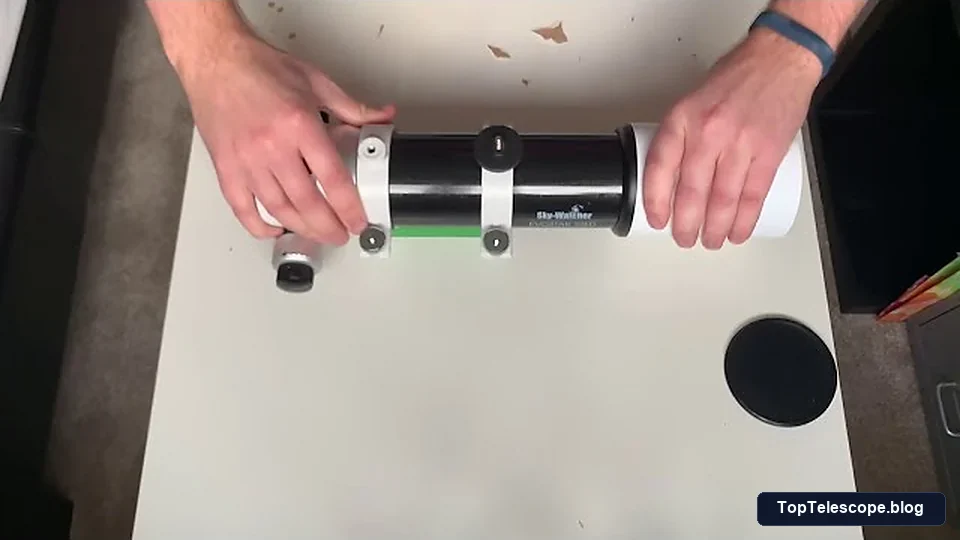
Precision machining ensures internal baffling suppresses stray light reflections efficiently. Baffle rings are spaced meticulously to enhance overall contrast across bright lunar targets.
Included tube rings feature flat mounting bases with threaded holes for versatile accessory placement. These rings secure the telescope firmly without introducing unwanted mechanical stress.
The cast aluminum OTA chassis features internal knife-edge baffling that effectively suppresses stray reflections, boosting image contrast during high-magnification lunar observations and planetary imaging sessions under light-polluted suburban skies.
Measuring 420mm with the dew shield retracted, the optical tube assembly easily fits into airline carry-on luggage, a design trade-off detailed in our Sky-Watcher Evostar 72ED comparison for mobile astronomers worldwide.
The matte black powder-coated finish resists minor field bumps and scratching, while the machined aluminum dovetail bar provides secure, slip-free clamping across various equatorial and alt-azimuth mount platforms.
- Heavy-duty aluminum chassis prevents thermal flexing under load.
- Internal baffle system absorbs stray light for enhanced contrast.
- Textured white enamel finish resists minor field scratches.
Chassis Rigidity and Structural Integrity
Structural integrity remains paramount when mounting heavy imaging cameras to small refractors. This chassis maintains optical alignment even when repositioned across extreme zenith angles.
Dovetail integration utilizes a standard V-style mounting bar for broad mount compatibility. The secure clamping mechanism eliminates slippage during long exposure tracking sessions.
- V-style dovetail bar ensures secure mount attachment.
- Rigid clamping prevents rotational slip during imaging.
Optical Architecture, Glass Elements and Field Performance
The objective lens employs an air-spaced doublet configuration featuring extra-low dispersion glass. This specialized optical formulation brings critical wavelengths into a single focal plane.
Color fringing is virtually eliminated around bright stellar sources like Vega and Sirius. Planetary observers will appreciate the sharp lunar terminator details rendered without false color.
Fully multi-coated optics maximize light transmission across the visible spectrum, similar to configurations evaluated in our Explore Scientific ED80 comparison, ensuring anti-reflective coatings reduce internal scattering to preserve faint deep-sky object details.
Utilizing a FPL-53 doublet objective lens paired with low-dispersion Schott glass, this refractor delivers remarkably crisp color correction, minimizing false purple fringing around bright stars like Vega.
Operating at a modest f/6 focal ratio, the optical system yields wide, sweeping star fields that delight wide-angle astrophotographers using modern APS-C sensors without excessive edge distortion.
Critical star tests reveal smooth, concentric diffraction patterns inside and outside focus, confirming exceptional optical figuring and precise factory alignment for demanding visual double star splitters.
- Air-spaced doublet design utilizes premium extra-low dispersion glass.
- Fully multi-coated lens surfaces maximize total light transmission.
- Eliminates chromatic aberration around high-contrast stellar targets.
Color Correction and High-Contrast Imaging
Achieving true color fidelity requires precise air-spacing and quality glass formulation. Star clusters sparkle against truly dark backgrounds due to superior internal light control.
Solar system imaging benefits greatly from the pristine wavefront correction delivered here. Jupiter's cloud belts and Saturn's Cassini division appear remarkably distinct and sharp.
- True color fidelity enhances planetary surface feature visibility.
- Dark background fields make faint star clusters pop clearly.
Video Review: Sky-Watcher Evostar 72ED Overview \u0026 Review
Focuser Mechanics, Rigidity and Accessory Integration
A robust dual-speed Crayford focuser handles heavy imaging gear without noticeable image shift, an upgrade you can examine via our Evostar 72ED vs 80ED showdown to see how fine focus knobs refine planetary imaging.
Tension adjustment screws allow users to lock down heavier payloads securely in place. This prevents slippage when pointing the telescope straight up toward the night sky.
Rotatable camera angle framing helps astrophotographers compose wide-field nebulas effortlessly. The smooth rotation ring locks firmly to maintain chosen framing throughout the night.
The dual-speed 2-inch Crayford focuser incorporates a 1:10 micro-reduction knob that allows pin-point focusing precision, preventing image shift during delicate planetary imaging adjustments in cold weather.
A robust compression ring collar securely holds heavy camera setups, protecting expensive 1.25-inch eyepieces and diagonal mirrors from marring while maintaining a reliable optical axis alignment under load.
Rotatable focuser collars let astrophotographers effortlessly frame celestial targets without loosening thumb screws or disrupting critical camera orientation angles during long-exposure deep-sky imaging sequences.
- Dual-speed 11 to 1 focuser ratio guarantees precise focus control.
- Tension lock screw supports heavy dedicated astronomy cameras safely.
- Integrated camera angle adjuster simplifies complex astrophotography framing.
Drawtube Precision and Load Capacity
The oversized drawtube utilizes polished stainless steel rails for ultra-smooth travel. Gearless friction design eliminates backlash commonly found in rack and pinion systems.
Heavy DSLR or cooled CMOS cameras attach securely via standard threaded adapters. Mechanical sag is minimized even during multi-hour astrophotography tracking sequences.
- Gearless friction design eliminates mechanical backlash entirely.
- Stainless steel rails ensure smooth and reliable drawtube travel.
Thermal Equilibrium, Dew Management and Field Efficiency
Air-spaced optical doublets require adequate time to acclimate to ambient outdoor temperatures. Storing the telescope in a cool environment beforehand accelerates this thermal stabilization process.
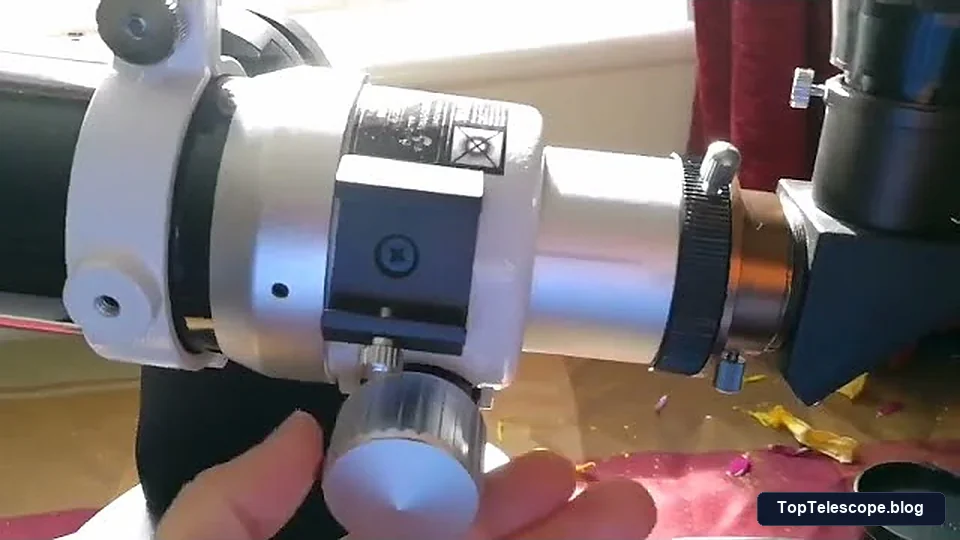
The thread-on dew shield extends forward to protect the objective lens from moisture accumulation. Aluminum construction ensures durability while sliding or threading smoothly into place.
Field efficiency remains high due to the rapid thermal stabilization of small glass elements. Observers spend less time waiting and more time capturing crisp astronomical targets.
Rapid temperature acclimatization is achieved thanks to the compact air-spaced doublet design, allowing the glass to shed ambient heat within thirty minutes of deployment outdoors.
The sliding aluminum dew shield extends smoothly to block stray off-axis light while physically shielding the front objective lens from heavy moisture accumulation during damp autumn evening sessions.
Adding a flexible dew heater strip around the objective cell prevents frost formation during sub-freezing winter nights, ensuring uninterrupted imaging sessions from dusk until dawn without optical degradation.
- Thread-on dew shield prevents troublesome moisture condensation buildup.
- Rapid thermal acclimation minimizes image distortion during startup.
- Durable metal dew shield protects glass from accidental impacts.
Managing Thermal Currents in Cold Environments
Rapid temperature drops can induce micro-currents inside closed optical tube assemblies. Allowing sufficient acclimation time ensures peak high-magnification performance on planetary targets.
Active dew heaters can be wrapped easily around the metal dew shield perimeter. This preventive measure keeps observation sessions running uninterrupted through humid nights.
- Prevents internal thermal currents from degrading high magnification.
- Readily accommodates standard flexible dew heater strip bands.
Setup Ergonomics, Mounting Compatibility and Portability
Weighing under five pounds, this optical tube mounts easily on lightweight tracker heads. Photographers can pack the entire setup into compact backpacks for remote mountain hikes.
Ergonomic balance points make positioning effortless on standard photographic tripod platforms. Vixen dovetail integration ensures rapid attachment to computerized GoTo mounts.
Field portability transforms this instrument into an ideal grab-and-go travel telescope. Users can chase dark skies without hauling cumbersome heavy equipment across rough terrain.
Weighing just 4.5 pounds, the optical tube places minimal strain on lightweight tracking mounts, eliminating the need for counterweight heavy lifting during rapid grab-and-go backyard stargazing sessions.
Integrated mounting blocks feature standard threads, permitting seamless attachment to standard photographic tripods using a fluid head for quick terrestrial wildlife viewing or casual astronomy.
The balanced weight distribution prevents rear-heavy tipping when attaching heavy field flatteners or filter wheels, ensuring smooth tracking performance across motorized star trackers and manual alt-azimuth bases.
- Lightweight chassis design simplifies remote field transportation.
- Compatible with standard photographic tripods and tracking mounts.
- Compact form factor fits easily inside airline overhead compartments.
Tripod Integration and Field Balance
Proper balancing prevents undue strain on motorized tracking mount clutches. Adjusting the sliding dovetail plate achieves perfect center-of-gravity alignment quickly.
Compact dimensions prevent wind gusts from shaking the optical tube assembly. Stability remains high even when operating in exposed coastal or mountain environments.
- Sliding dovetail plate allows precise center-of-gravity balancing.
- Low profile minimizes wind leverage during outdoor imaging sessions.
Routine Maintenance, Collimation Stability and Storage
Factory collimation is permanently locked within a robust metal cell structure. Users rarely need to adjust optics, ensuring hassle-free operation over years of travel.
Dust covers protect both objective and focuser openings during storage and transport phases. Keeping lens surfaces clean preserves anti-reflective coating integrity for decades.
Store the optical tube in a padded protective case to absorb shocks. Proper storage habits protect precision mechanical components from accidental impact damage.
Factory-aligned lens cells arrive securely locked in adjustable metal housings, maintaining collimation stability as detailed in our Sky-Watcher Classic 200P vs AD8 comparison after enduring bumpy transport across unpaved roads to remote dark-sky observing sites.
Periodic lens cleaning requires only pressurized air bulbs and optical micro-fiber cloths to safely remove dust particles without scratching delicate anti-reflective coatings applied to the objective surfaces.
Storing the instrument in a padded hard case with desiccant packs prevents internal mold growth and humidity damage during long off-season storage periods in humid geographic regions.
- Locked lens cell design maintains factory collimation permanently.
- Protective dust caps keep internal optics free from debris.
- Padded storage case safeguards equipment during rough transit.
Lens Cleaning Best Practices and Safety
Remove loose dust particles using a bulb blower before touching glass surfaces. Avoid compressed air cans to prevent propellant residue contamination on coatings.
Apply optical cleaning fluid sparingly to specialized micro-fiber cloths for smudges. Gently wipe in outward spirals to protect delicate multi-layer lens coatings safely.
- Use bulb blowers to remove loose dust safely beforehand.
- Apply optical cleaner to microfiber cloths rather than directly.
Comparative Verdict: Who Should Buy It vs. Skip It
This telescope suits mobile astrophotographers and travelers seeking premium apochromatic performance. It excels at wide-field imaging and crisp lunar or planetary visual observations.
Beginners desiring an all-inclusive kit with heavy mounts might find smaller refractors limited. Advanced imagers requiring massive light-gathering power should consider larger reflectors.
Overall engineering excellence makes this a benchmark instrument in its aperture class. Invest in this optical tube if portability and pristine color correction top your priorities.
Intermediate astrophotographers seeking a portable wide-field imaging platform will find this ED refractor an exceptional value, offering superior chromatic aberration control compared to traditional achromatic systems.
Visual observers prioritizing maximum light gathering for faint deep-sky galaxies should bypass this small aperture, choosing larger Newtonian reflectors or Dobsonians for detailed nebulae observations instead.
Ultimately, travelers and mobile hobbyists valuing optical clarity and mechanical ruggedness will appreciate this dedicated scope, whereas dedicated planetary specialists require much longer focal lengths.
- Ideal for travel astrophotography and wide-field visual astronomy.
- Not recommended for users seeking massive light-gathering aperture.
- Delivers exceptional optical and mechanical value for mobile users.
Final Purchasing Recommendations for Field Astronomers
Evaluate your primary observing locations before committing to compact refractors. Dark-site travelers will maximize the inherent portability and optical advantages immediately.
Pair this optical tube with a quality field flattener for imaging. Doing so ensures pin-point stars right across modern large-sensor digital cameras.
- Match with quality field flatteners for modern digital cameras.
- Maximize performance by utilizing dark-sky travel locations.
Frequently Asked Questions
Does this telescope require a field flattener for astrophotography?
Yes, a dedicated field flattener is recommended for large sensors. This ensures pin-point stars across the entire camera frame.
Can I use standard photographic tripods with this optical tube?
Yes, the included mounting rings feature standard threaded mounting holes. This allows direct attachment to heavy-duty photo tripods easily.
How does extra-low dispersion glass improve visual observations?
It concentrates all color wavelengths into a single focal plane. This effectively eliminates annoying color fringing around bright targets.
Is the focuser capable of holding heavy dedicated cooling cameras?
The dual-speed Crayford focuser features adjustable tension locking screws. These secure heavy imaging payloads without slippage during tracking.
What is the best way to transport this telescope safely?
Always store the optical tube inside a padded aluminum case. This absorbs transit shocks and protects precision mechanical components reliably.