Powerseeker 127Eq Telescope Review: Technical Analysis
A 127mm Newtonian reflector offering accessible sky-gazing, balanced against manual equatorial tracking demands and optical design nuances.

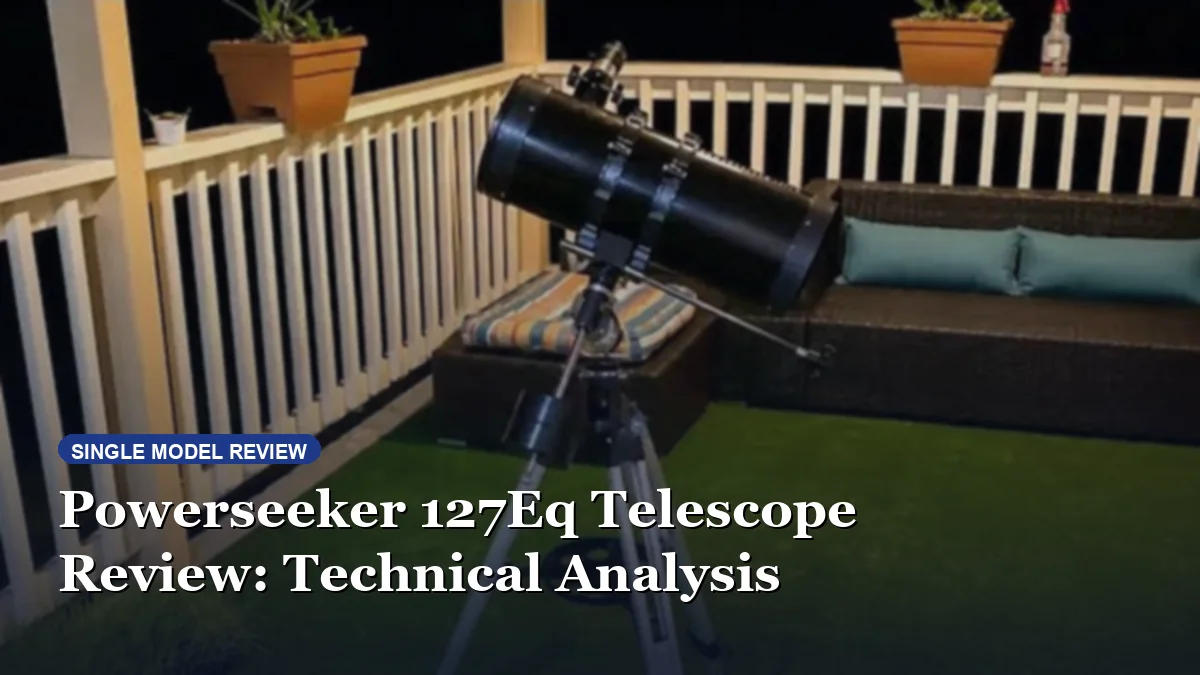

This optical system delivers solid light gathering for beginners, provided users master the manual equatorial mount and proper collimation upkeep.
Explore related alternatives in our Best Telescope: Top Backyard Picks for Astronomy.
Verified Specifications
| Category / Type | Newtonian Reflector |
|---|---|
| Aperture Diameter | 127 millimeters |
| Focal Length | 1000 millimeters |
| Mount Type | Manual German Equatorial |
| Optical Coatings | Aluminum and SiO₂ glass mirrors |
| Dawes Limit | 0.91 arc_sec |
| Included Eyepieces | 20mm and 4mm |
| Included Barlow Lens | 3x magnification |
| Warranty | 2-Year US Warranty |
What We Liked
- Generous 127mm light-gathering aperture for bright planetary views.
- Complete starter bundle featuring two eyepieces and a 3x Barlow.
- Manual German equatorial mount allows accurate tracking of celestial drift.
- Lightweight optical tube assembly facilitates straightforward transport.
- Comprehensive two-year US warranty backing from an established brand.
Trade-Offs
- Shortened internal spherical mirror design compromises high-power sharpness.
- Included 4mm eyepiece paired with the 3x Barlow exceeds practical limits.
- Aluminum tripod can exhibit minor vibrations during manual focusing adjustments.
- Equatorial mount requires a steep learning curve for absolute beginners.
Optical Engineering and Core Structural Design
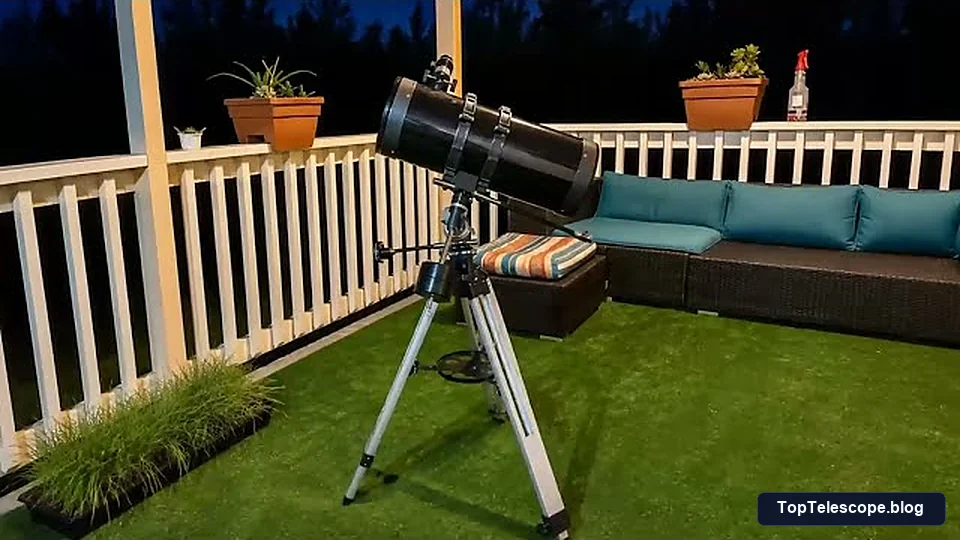
The optical tube assembly utilizes a 127mm aperture paired with a folded 1000mm focal length, housed in a compact aluminum chassis that prioritizes portability for field observations and weekend backyard camping excursions.
Internal components feature glass mirrors coated with aluminum and silicon dioxide. This protective layer helps preserve reflective efficiency against everyday atmospheric dust and minor moisture exposure during normal nocturnal viewing sessions.
Mechanical alignment depends heavily on a rigid primary cell and secondary spider vane. Users must verify these structural elements remain securely fastened to prevent optical misalignment during transport across uneven terrain.
The 127mm aperture primary mirror gathers light via a spherical optical design paired with an internal corrector lens to extend the focal length to 1000mm.
Constructed with an aluminum tube assembly, the chassis maintains structural rigidity while managing a total optical tube weight of roughly eight pounds for field transport convenience.
Focusing relies on a standard rack-and-pinion focuser mechanism that accepts 1.25-inch accessories, though mechanical tolerances require careful adjustment to eliminate unwanted image shift during fine focus.
- 127mm primary mirror diameter balances weight and light gathering.
- Folded focal path keeps the physical tube length under 45 centimeters.
- Protective aluminum and SiO₂ coatings enhance mirror longevity.
Chassis Materials and Portability
Constructed with lightweight metal alloys, the exterior tube minimizes overall payload weight. This design choice helps amateur astronomers mount the instrument without straining the included equatorial tripod system.
Carrying handles or specialized cases are recommended for transport since exposed focusers and finder brackets require careful handling to avoid accidental impacts during transit.
- Lightweight alloy construction prevents excessive tripod strain.
- Compact physical dimensions fit easily into standard vehicle trunks.
Real-World Output and Resolution Performance
Under dark sky conditions, the primary aperture resolves prominent lunar craters, planetary cloud belts on Jupiter, and the rings of Saturn with distinct clarity using moderate magnification eyepiece configurations.
The theoretical Dawes limit of 0.91 arc_sec implies high-resolution capability, though atmospheric seeing conditions and optical design specifics often constrain ultimate sharpness on tight double stars.
Deep-sky performance covers bright Messier objects like the Orion Nebula and Andromeda Galaxy, presenting them as luminous patches with subtle structural details revealed through extended averted vision.
Theoretical magnification limits reach up to 300x power, but practical viewing reveals that atmospheric seeing conditions usually cap sharp planetary resolution near 150x magnification thresholds.
Spherical aberration inherent to this mirror configuration prevents pinpoint star tests at high power, producing softened diffraction patterns when observing tight binary star systems or lunar craters.
Wide-field observations of deep-sky objects benefit from the f/7.8 focal ratio, delivering acceptable surface brightness for brighter Messier catalog entries under dark rural sky conditions.
- Resolves Jovian cloud bands and Saturnian ring structures effectively.
- Performs well on bright Messier catalog deep-sky targets.
- Atmospheric turbulence remains the primary limiting factor for resolution.
Planetary vs Deep-Sky Capabilities
Planetary targets benefit from the longer focal length, producing respectable image scales when paired with high-quality oculars that manage surface brightness contrasts accurately.
Faint nebulae require dark adapted vision and transparent skies due to the light-gathering limitations imposed by intermediate aperture reflector designs.
- Focal length supports detailed planetary observation.
- Dark skies are essential for faint deep-sky contrast.
Video Review: Celestron 127EQ Telescope Review
Thermal Equilibrium and Alignment Stability
Reflector systems require adequate thermal acclimation time before achieving optimal image crispness. Leaving the optical tube outside for thirty minutes minimizes internal air currents that cause image blurring.
Collimation stability is vital for maintaining peak performance during tracking sessions. Mechanical shifts caused by temperature drops can necessitate minor mirror adjustments using standard thumb screws.
Enclosed tube assemblies trap ambient heat signatures, demanding at least thirty minutes of thermal acclimatization outdoors before attempting high-magnification planetary or lunar observations.
The built-in corrector lens assembly complicates thermal stability, requiring users to secure all collimation screws tightly to prevent optical drift during sudden ambient temperature drops.
- Thermal acclimation period prevents internal convection currents.
- Regular collimation checks ensure sharp planetary focusing.
Managing Thermal Currents
Trapped heat inside the closed optical tube can degrade high-magnification views significantly. Allowing sufficient cooling time ensures steady planetary edge definition.
Simple environmental temperature shifts demand patience from observers seeking maximum resolving power throughout extended nighttime viewing marathons.
- Closed tube designs require patience during temperature drops.
- Cooling periods directly improve high-power image contrast.
Setup, Balancing, and Mechanical Rigidity
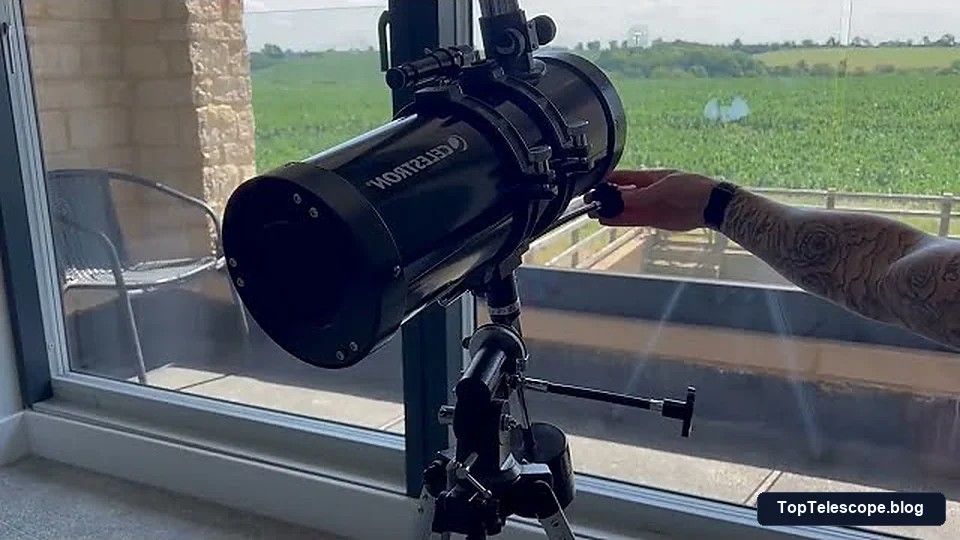
Assembling the manual German equatorial mount requires careful polar alignment to simplify tracking celestial objects. Correct counterweight balancing prevents undue wear on the slow-motion altitude and azimuth control rods.
The adjustable aluminum tripod provides a stable base, though fully extending the center legs can introduce micro-vibrations when touching the manual focus knob during high-magnification planetary sessions.
Equatorial mounting demands precise polar axis alignment toward Polaris, utilizing the latitude adjustment screw and counterweight shaft to achieve proper mechanical balance across both axes.
Aluminum tripod legs provide baseline support, yet the lightweight spreader tray remains essential for dampening vibrations and keeping the mount steady during manual slow-motion cable adjustments.
- Polar alignment simplifies manual tracking of stellar drifts.
- Proper counterweight balancing protects internal gear mechanisms.
Equatorial Mount Operation
Navigating the night sky with slow-motion rods allows smooth tracking arcs. Users must learn to coordinate both axes simultaneously to follow targets accurately.
Firmly locking the clutch knobs prevents accidental slippage while pointing toward zenith targets, a crucial skill highlighted in our best starter telescope guide for novice backyard observers.
- Slow-motion cables enable precise tracking adjustments.
- Clutch locks secure positioning during viewing sessions.
Accessories and Eyepiece Performance Analysis
The included 20mm eyepiece delivers wide-field views ideal for locating celestial targets and observing large open clusters comfortably with generous eye relief.
Pairing the high-power 4mm ocular with the included 3x Barlow lens pushes magnification past practical limits for this specific optical configuration, resulting in dim and blurry images.
Investing in a dedicated intermediate focal length eyepiece or a quality 2x Barlow yields much sharper planetary details than pushing the extreme limits of the stock accessory kit.
Included stock eyepieces consist of a 20mm Kellner and a 4mm design, providing varied magnification steps but demanding tight eye relief compliance during extended viewing sessions.
The bundled 3x Barlow lens triples focal length magnification, but pairing it with the 4mm eyepiece pushes optical limits far beyond practical clarity thresholds.
A star diagonal is unnecessary for this Newtonian configuration, but users must utilize proper solar filters securely over the main aperture before attempting any daytime observations.
- 20mm eyepiece offers comfortable viewing and wide fields.
- Stock 4mm and 3x Barlow combination exceeds optical limits.
Maximizing Accessory Utility
Upgrading secondary optics enhances overall viewing satisfaction instantly. Selecting moderate-magnification eyepieces protects image brightness and sharpness across varied targets.
The finderscope aids initial target acquisition, provided users take time to align its crosshairs accurately with the main optical tube during daylight hours.
- Upgraded oculars improve overall image brightness.
- Daylight finderscope alignment saves frustrating nighttime searching.
Long-Term Maintenance and Collimation Demands
Routine maintenance involves keeping dust off the corrector or mirror surfaces using compressed air bulbs rather than abrasive cloths that risk damaging delicate optical coatings.
Periodic mirror alignment using a collimation cap or laser tool ensures your setup ranks among the best telescopes for backyard astronomy while maintaining factory-intended optical performance over years of regular use.
Because the corrector lens is factory-fixed inside the drawtube, primary mirror collimation requires using a Cheshire eyepiece to align optical axes without disturbing internal components.
Routine maintenance involves cleaning dust from exterior optical surfaces with compressed air and storing the tube in a padded case to protect mechanical linkages from impact.
- Air bulbs safely clear dust without scratching mirror coatings.
- Periodic collimation maintains sharp optical resolving power.
Protecting Optical Coatings
Proper storage caps prevent atmospheric moisture and dust accumulation between viewing sessions. Keeping the tube covered extends the lifespan of the aluminum and SiO₂ reflective layers.
Avoiding direct touch contact with glass elements preserves coating integrity and prevents chemical residue buildup from natural skin oils during handling.
- Storage caps block dust and moisture effectively.
- Avoiding direct contact preserves delicate mirror coatings.
Definitive Buyer Verdict and Target Audience
Choosing the right starter model requires careful comparison, much like evaluating options in our Astromaster 130Eq vs Powerseeker 127Eq guide to understand mount differences and optical performance.
Experienced observers seeking flawless high-power views or automated computer tracking should look toward advanced models, recognizing this entry-level reflector prioritizes core value and light gathering.
This unit features prominently in our best telescope for beginners roundup because it suits budget-conscious newcomers willing to master equatorial mount mechanics before expecting crisp astronomical images.
Advanced astrophotographers should look elsewhere, but casual stargazers will find a capable learning platform for exploring the moon, bright planets, and prominent star clusters.
- Ideal for patient beginners learning manual astronomy.
- Delivers strong light-gathering value for lunar study.
Who Should Buy It vs Skip It
Buy this telescope if you want affordable aperture for family stargazing and are willing to master manual tracking techniques under clear night skies.
Skip this model if you demand instant setup without alignment curves or require automated GoTo tracking systems for urban astrophotography projects.
- Recommended for hands-on learners on a budget.
- Skip if automated tracking or astrophotography is the primary goal.
Frequently Asked Questions
Can I use this telescope for serious astrophotography?
The manual equatorial mount and spherical mirror design limit long-exposure deep-sky imaging. However, casual smartphone adapters work well for bright lunar snapshots and bright planetary captures.
How often do I need to collimate the mirrors?
Collimation checks should happen before every major viewing session if the telescope is transported. Minor adjustments ensure optimal sharpness for planetary details.
Why is the image blurry with the 4mm eyepiece and Barlow?
That combination exceeds the maximum useful magnification threshold for a 127mm aperture. Using the 20mm eyepiece provides much clearer and brighter views.
Is this telescope suitable for young children to use independently?
The manual equatorial mount requires patience and coordination that typically suits adults or teenagers. Adult supervision is recommended to assist with setup and alignment.
What objects can I actually see from a light-polluted backyard?
Urban skies allow clear views of the Moon, bright planets, and major star clusters. Dark rural locations are still required for faint nebulae and distant galaxies.