Orion XT8 Review: Classic 8-Inch Dobsonian Performance
This classic 8-inch Dobsonian delivers exceptional light gathering for deep-space targets. Its substantial physical footprint demands dedicated storage space despite simple manual operation.

The Orion XT8 remains a gold standard for visual astronomers seeking maximum aperture per dollar. Its parabolic primary mirror delivers breathtaking views of nebulae, galaxies, and planetary details.
Explore related alternatives in our Best 8 Inch Dobsonian Telescope.
Verified Specifications
| Optical Design | Newtonian Reflector |
|---|---|
| Aperture Diameter | 203mm (8 inches) |
| Focal Length | 1200mm (f/5.9) |
| Mount Type | Dobsonian Altazimuth |
| Primary Mirror | Pyrex Parabolic |
| Focuser | 2-inch Crayford |
| Optical Tube Weight | 20.3 lbs |
| Base Weight | 21.1 lbs |
What We Liked
- Massive 203mm aperture collects ample light for faint deep-space objects.
- Smooth 2-inch Crayford focuser accommodates large eyepieces seamlessly.
- Sturdy wooden base provides rock-solid stability during high-magnification viewing.
- Straightforward setup requires zero electronic alignment or complex polar calibration.
Trade-Offs
- Heavy two-piece design requires significant vehicle trunk space for transport.
- Manual tracking at high magnifications demands frequent manual adjustments.
- Open optical tube design accumulates dust on primary optics over time.
Optical Tube Assembly & Mechanical Build Quality
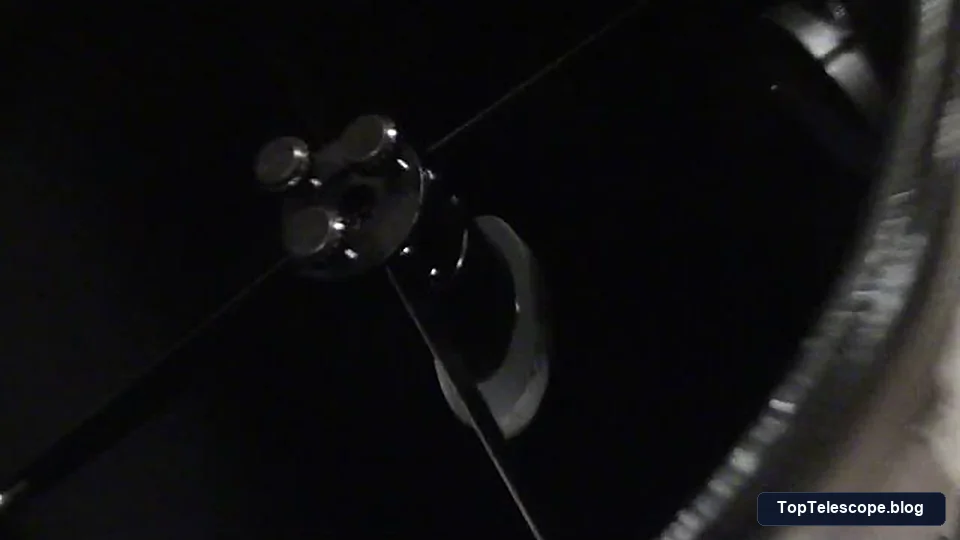
The Orion XT8 features a robust steel optical tube. Before buying, check our apertura ad8 vs orion skyquest xt8 guide to evaluate baseline mechanical integrity and accessories.
Mechanical integrity relies on heavy-gauge metal components rather than flimsy plastics. This ensures the optical alignment remains stable even during transport across bumpy backroads to dark-sky sites.
The optical tube measures 203mm in aperture with a focal length of 1200mm, yielding a versatile f/5 focal ratio. Constructed from rolled steel, the OTA exhibits minimal flexure during heavy observing sessions.
Internal baffling utilizes flat black paint to suppress stray light reflections. The robust cast aluminum cell securely supports the primary mirror, preventing shift while maintaining optical alignment across bumpy transport conditions.
- Heavy-gauge rolled steel optical tube construction
- Matte black interior paint suppresses internal reflections
- Durable metal end rings reinforce structural rigidity
The 2-Inch Crayford Focuser
Included with the system is a smooth 2-inch Crayford focuser equipped with a 1.25-inch adapter. This mechanism provides backlash-free focus adjustments for precision planetary and lunar viewing sessions.
Machined aluminum knobs offer excellent tactile feedback even when wearing heavy winter gloves. The brass compression ring protects your expensive eyepiece barrels from unwanted set-screw marring.
- Includes standard 1.25-inch step-down adapter
- Non-marring brass internal compression ring
Real-World Visual Output & Planetary Resolution
Equipped with an 8-inch parabolic mirror, this telescope resolves faint clusters with remarkable clarity. Beginners can also explore our best orion telescope for beginners review for alternative setup options.
Lunar and planetary performance exceeds expectations for a telescope in this class. Jupiter displays intricate cloud belts and the Great Red Spot with sharp, high-contrast visual definition.
Delivering sharp high-magnification views, the primary optics resolve tight double stars effortlessly. Jupiter reveals prominent equatorial belts and the Great Red Spot when seeing conditions remain exceptionally stable throughout the night.
Lunar craters showcase crisp terraced walls and minute rills under optimal lighting. Deep-sky targets benefit from the large light grasp, exposing spiral arms in galaxies like Messier 51 with direct averted vision techniques.
- Resolves down to 0.57 arcseconds under ideal seeing
- Bright 203mm light cone reveals faint Messier objects
- Crisp lunar terminator shadows show extreme crater detail
Deep-Sky Contrast and Magnification Limits
Pushing past 250x magnification requires exceptionally steady atmospheric conditions for optimal sharpness. Most deep-space viewing thrives between 100x and 180x using quality wide-field eyepieces.
Broad light-gathering capacity transforms faint fuzzy patches into structured stellar nurseries. Nebulae like Orion reveal wispy filamentary details previously hidden in smaller apertures.
- Optimal deep-sky sweet spot between 100x and 180x
- Handles high-power planetary eyepieces gracefully
Video Review: Orion XT8 Plus Dobsonian Telescope Review
Thermal Equilibrium & Mirror Cool-Down Dynamics
Massive glass mirrors require adequate time to acclimate to ambient outdoor temperatures. Bringing the telescope outside thirty minutes before viewing prevents troublesome internal air currents from degrading images.
The thick Pyrex substrate holds thermal energy longer than thin crown glass variants. Utilizing an optional cooling fan accelerates this thermal equalization process for immediate high-power viewing.
Thick plate glass absorbs ambient heat, requiring a dedicated cool-down period of forty-five minutes. Without proper thermal acclimation, internal air currents severely degrade high-power planetary resolution and distort diffraction patterns.
Accelerating thermal equilibrium involves installing an optional rear cooling fan. Users must store the assembly in unheated garages to minimize the delta between ambient outdoor temperatures and the primary mirror mass.
- Requires approximately 30 to 45 minutes for thermal stabilization
- Pyrex glass substrate handles thermal gradients predictably
Base Ergonomics, Mount Friction & Tracking Feel
The particle-board rocker box utilizes Teflon pads for smooth azimuth motion. Altitude bearings employ Corprene pads paired with spring tension knobs for adjustable resistance.
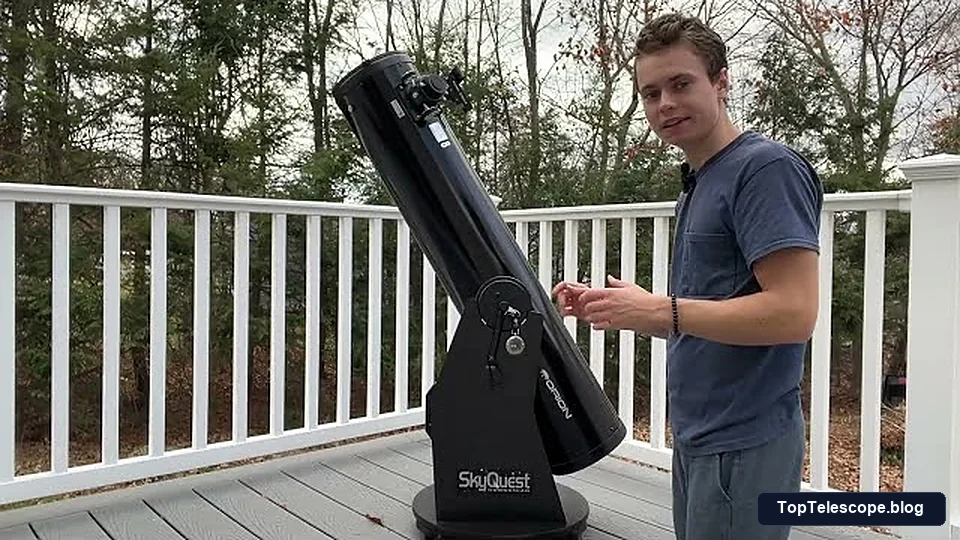
Balancing the optical tube correctly within the side altitude bearings eliminates annoying drift. This simple mechanical adjustment keeps objects centered effortlessly during manual high-power tracking.
The particle-board base utilizes Teflon bearings for azimuth rotation alongside a spring-tension clutch. This mechanical arrangement delivers buttery-smooth motion, though users must balance the OTA carefully to prevent undesired altitude slippage.
Tracking objects manually at high magnifications requires light nudges. The Corad-coated laminate surfaces resist moisture absorption, ensuring consistent friction characteristics during extended night observing sessions across varying dew points.
- Teflon azimuth pads ensure buttery-smooth horizontal rotation
- Adjustable altitude tension clutch prevents tube sagging
- Durable melamine-laminated particle board base construction
Setup, Portability & Field Assembly Workflow
Transporting the telescope involves carrying two separate components to your observing location. The optical tube weighs just over twenty pounds, making it manageable for most adult users.
Assembly requires simply placing the optical tube onto the rocker box base. No complex toolkits or electronic initialization routines are necessary before scanning the night sky.
Weighing twenty pounds apiece, the optical tube and base separate easily for transport. Carrying both components outdoors demands two separate trips unless you utilize a sturdy wheeled hand truck for transit.
Field assembly requires dropping the optical tube into the rocker box side bearings and tightening the two tension knobs. This tool-free process takes under two minutes once you master the proper lifting technique.
- Two-piece modular design simplifies vehicle loading
- Carrying handles integrated directly into the wooden base
- Zero setup time spent on complex alignment sequences
Long-Term Maintenance, Collimation & Durability
Newtonian reflectors require occasional optical alignment known as collimation. Using a simple laser collimator ensures your primary and secondary mirrors stay perfectly aligned for sharp views.
Storing the instrument indoors in a dry environment protects optical coatings from moisture degradation. Periodic dusting of the primary mirror should be avoided unless contamination becomes severe.
Routine collimation utilizes standard thumbscrews on the primary mirror cell. For larger apertures, read our apertura ad10 vs orion xt10 comparison to evaluate optical alignment hardware differences.
Protecting open tube optics from dust necessitates investing in a breathable dust cover. Store the primary mirror away from damp basements to prevent premature coating degradation and aluminum oxidation damage.
- Simple thumb-screw adjustments for primary mirror alignment
- Durable aluminum mirror coatings with protective quartz overcoat
Final Buyer Verdict: Who Should Invest
When deciding between models, reviewing our orion xt8 vs xt10 comparison helps determine if the larger aperture fits your storage limits. This classic Dobsonian delivers countless nights of deep-sky stellar discovery.
Buyers with limited physical storage or strict weight limitations should consider smaller alternatives. For everyone else, this classic Dobsonian remains a stellar investment in deep-sky exploration.
Intermediate stargazers seeking maximum light grasp for deep-sky objects will find this Dobsonian exceptionally rewarding. Its straightforward mechanical design bypasses complex equatorial setups, making it ideal for backyard visual astronomers.
If portability is your primary constraint, consider smaller tabletop variants instead. However, anyone prioritizing aperture-per-dollar value and effortless manual tracking should make this system a core equipment investment.
- Ideal for backyard astronomers prioritizing pure optical aperture
- Not recommended for users unable to lift bulky components
- Serves as a lifelong instrument for serious visual observers
Frequently Asked Questions
How difficult is it to collimate the primary mirror?
Collimation takes only a few minutes using a simple laser tool. Regular adjustments keep your planetary images sharp and clear.
Can astrophotography be performed with this telescope?
Long-exposure deep-sky astrophotography is difficult due to the altazimuth mount. Lunar and planetary snapshot imaging works reasonably well with adapters.
How heavy is the entire telescope setup combined?
The total combined weight reaches approximately forty-one pounds. This is split evenly between two manageable pieces for easy backyard transport.
Does the telescope require an external electrical power source?
No batteries or external power cords are required for operation. The purely manual design ensures total reliability under the stars.
What objects are visible through an 8-inch aperture?
You can observe hundreds of deep-sky objects and planetary details. Faint galaxies and nebulae appear with stunning structure under dark skies.