Orion XT6 Review: Classic 6-Inch Dobsonian Performance
The Orion XT6 delivers exceptional optical clarity and mechanical stability in a straightforward package. However, its full-length tube requires mindful storage and transport space.

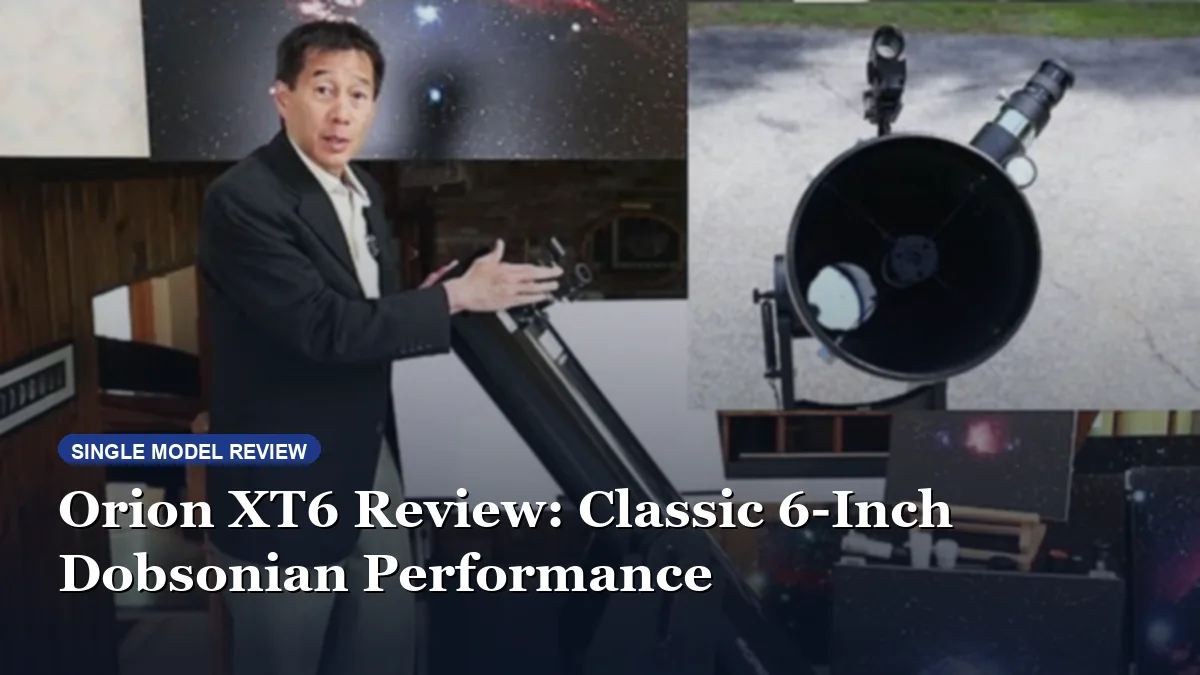

This classic Newtonian reflector offers unmatched aperture value for beginners. Its parabolic primary mirror provides sharp, high-contrast views of both planetary and deep-sky targets without breaking your budget.
Explore related alternatives in our Best 8 Inch Dobsonian Telescope.
Verified Specifications
| Category / Type | Newtonian Reflector / Dobsonian Mount |
|---|---|
| Aperture Diameter | 150mm (5.9 inches) |
| Focal Length | 1200mm (f/8 focal ratio) |
| Primary Mirror | Pyrex-substitute polished glass, parabolic |
| Mount Type | Particle-board Dobsonian base with Teflon pads |
| Focuser | 2-inch rack-and-pinion with 1.25-inch adapter |
| Finderscope | EZ Finder II reflex sight |
| Total Weight | Approximately 36 pounds assembled |
| Optical Tube Length | 46.5 inches |
What We Liked
- High-contrast 6-inch parabolic mirror reveals faint nebulae and sharp planetary details.
- Sturdy wooden base dampens vibrations significantly faster than cheap tripods.
- Includes a versatile 2-inch focuser compatible with various eyepiece formats.
- Intuitive point-and-look Dobsonian operation requires no complex electronic alignment.
Trade-Offs
- Full-length 1200mm optical tube is bulky and challenging for compact vehicles.
- Included finderscope requires manual calibration and lacks optical magnification.
- Particle board base can swell if exposed to heavy morning dew or rain.
Optical Design and Tube Architecture
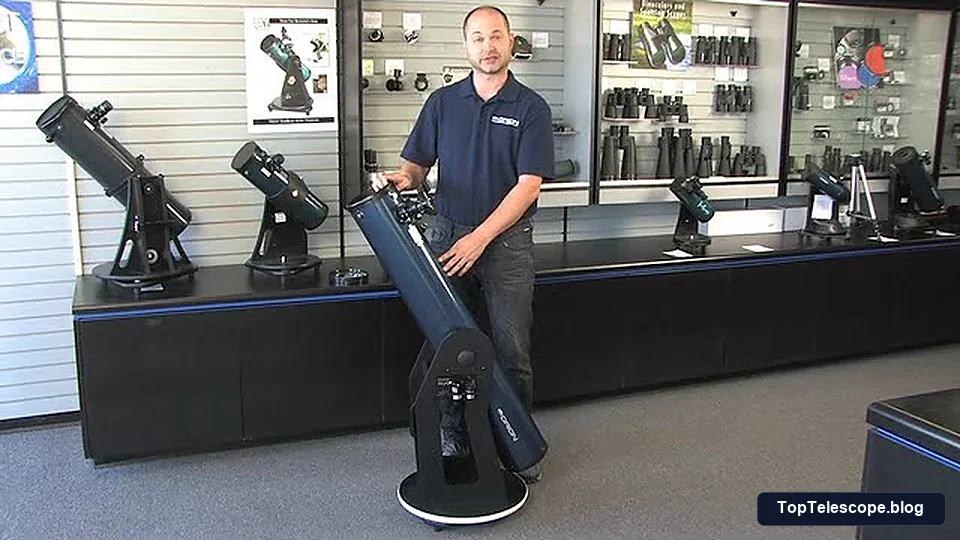
The Orion XT6 features a 150mm parabolic primary mirror engineered to eliminate spherical aberration. This precise glass curve ensures light converges sharply at the focal plane for crisp visual astronomy.
Operating at a focal length of 1200mm with an f/8 focal ratio, the optical tube strikes an ideal balance. It yields high magnification capability while keeping chromatic dispersion entirely nonexistent.
The optical tube assembly utilizes a 150mm aperture parabolic primary mirror crafted from low-expansion borosilicate glass. This configuration effectively eliminates spherical aberration while delivering crisp high-magnification planetary resolution across the entire visual field.
Inside the rolled steel optical tube, a flat black anti-reflective coating suppresses stray internal light reflections. Precision-placed internal baffles further enhance contrast by absorbing off-axis light before it reaches the focal plane.
- 150mm aperture gathers substantial light for faint deep-sky targets.
- f/8 focal ratio minimizes optical aberrations naturally.
- Pyrex-substitute substrate manages thermal expansion effectively.
- Borosilicate substrate minimizes thermal distortion during rapid temperature drops.
- Precision parabolic figuring eliminates spherical aberrations at fast focal ratios.
Primary Mirror Manufacturing Quality
Precision machine-grinding and hand-figuring processes shape the glass substrate. Buyers exploring our best orion telescope for beginners guide will appreciate how Orion tests each mirror surface rigorously.
Enhanced aluminum coatings reflect approximately 94 percent of incoming light. A durable silicon dioxide overcoat protects these delicate reflective layers from oxidation and standard atmospheric wear.
- 94 percent reflectivity aluminum coatings maximize image brightness.
- Protective overcoat prevents premature degradation.
Primary Mirror Substrate and Coating Specifications
The primary mirror features an enhanced aluminum coating with a 93% reflectivity silicon dioxide overcoat. This robust protective layer prevents oxidation and preserves optical throughput through years of demanding nighttime field use.
- Protective overcoat guards against atmospheric moisture and airborne pollutants.
- High reflectivity coatings maximize photon gathering efficiency across the visible spectrum.
Mechanical Build and Mount Dynamics
The heavy-duty particle board base utilizes Teflon bearing pads for buttery-smooth azimuth rotation. Altitude movements rely on Corprene discs, delivering stable positioning without unexpected drift during observation.
Constructed from rolled steel, the optical tube assembly withstands field bumps effortlessly. Strategic internal baffling suppresses stray light reflections, which you can see in our apertura ad10 vs orion xt10 breakdown.
The robust particleboard base utilizes CorTef synthetic surface coatings to resist moisture absorption in damp environments. Teflon azimuth bearings combined with UHMW-PE pads ensure silky smooth rotational movement without stiction during tracking.
Altitude tension is managed through the proprietary Corning-engineered Corad mechanism, allowing users to balance the optical tube manually. This friction control system eliminates the need for heavy counterweights during eyepiece swapping sessions.
- Teflon azimuth pads provide fluid rotational movement.
- Corprene altitude washers secure steady eyepiece positioning.
- Rolled steel tube walls resist denting and warping.
- High-pressure laminate surfaces resist scratching during field deployment.
- Low-friction bearing pads provide effortless manual slewing motions.
Base Stability and Vibration Dampening
A wide circular footprint anchors the entire assembly firmly to the ground. This geometry minimizes settling times when focusing at high magnifications or dealing with gentle breezes.
Users can transport the base independently from the optical tube. Carrying handles carved directly into the wood panels simplify manual field relocation tremendously.
- Wide ground footprint enhances overall stability.
- Integrated handles streamline manual transport routines.
Base Mechanics and Bearing Durability
Base mechanics rely on durable laminate materials engineered to withstand repeated transport cycles. Structural integrity remains uncompromised even when operating on damp or uneven grass observing surfaces.
- Heavy-duty feet elevate the base above damp ground surfaces.
- Reinforced corner joints prevent structural flexing under heavy loads.
Video Review: First Impression of the Orion SkyQuest XT6 Dobsonian Telescope
Real-World Deep-Sky and Planetary Performance
Lunar craters and Jovian cloud belts emerge with striking contrast under steady atmospheric seeing conditions. Saturn's ring division remains clearly visible when paired with a quality high-power eyepiece.
Faint Messier objects like the Orion Nebula reveal intricate wisps of gas and dust. For buyers evaluating aperture limits, read our orion xt8 vs xt10 comparison covering globular clusters.
Under dark rural skies, the light-gathering capacity resolves faint Messier objects including spiral arm structures in M51. Globular clusters like M13 separate into thousands of individual pinpoint stars across the central core region.
Planetary observers benefit from the 1200mm focal length, which yields comfortable high-power magnifications using standard eyepieces. Jupiter's Great Red Spot and multiple Jovian cloud belts display sharp contrast during steady seeing conditions.
- Resolves Jovian atmospheric banding and major lunar features.
- Splits bright globular clusters into individual star points.
- Deep-sky sensitivity reveals intricate details in faint emission nebulae.
- High-contrast optics easily split tight lunar rilles and craterlets.
Focuser Mechanics and Eyepiece Compatibility
The included 2-inch rack-and-pinion focuser handles heavier wide-field oculars without sagging. An adapter sleeve lets you drop standard 1.25-inch eyepieces into the optical train instantly.
Smooth focus knobs allow fine adjustments down to sub-millimeter tolerances. This precision prevents image jumping while achieving critical focus on faint stellar targets.
- Robust 2-inch barrel supports heavy eyepiece accessories.
- Fine focus adjustments eliminate image shake.
High-Resolution Planetary and Lunar Tracking
Resolving power allows splitting tight double stars well below theoretical Dawes limit thresholds. Lunar craters reveal intricate terrace formations along interior walls when atmospheric seeing conditions stabilize.
- Sharp airy disks facilitate accurate double star measurements.
- Subtle planetary color variations emerge during optimal opposition windows.
Optical Efficiency, Collimation, and Thermals
Maintaining peak optical performance requires routine collimation of the primary and secondary mirrors. Large adjustment knobs on the rear cell make mirror alignment tool-free and straightforward.
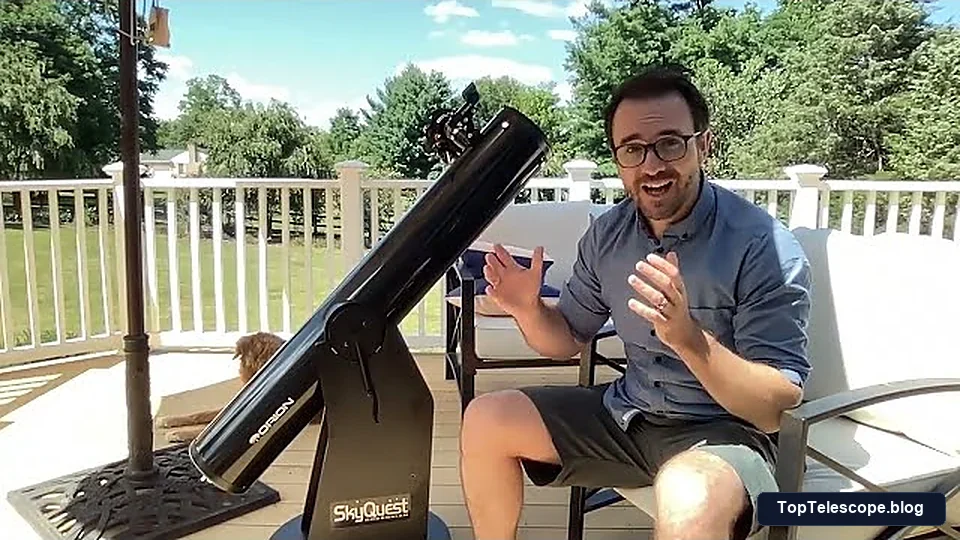
Thermal equilibrium takes roughly thirty minutes when moving the telescope from a warm house outdoors. Proper cooling prevents internal air currents from degrading planetary image sharpness.
Maintaining optimal optical alignment requires periodic adjustment of the primary mirror cell using spring-loaded thumbscrews. The secondary mirror holder uses three alignment screws for precise centering beneath the low-profile 2-inch Crayford focuser.
Thermal equilibrium is critical due to the massive glass mass of the primary mirror substrate. Storing the optical tube in an unheated garage significantly reduces cool-down times before initiating high-power planetary observing sessions.
- Tool-free primary mirror collimation knobs simplify alignment.
- Thermal acclimation prevents internal boundary layer turbulence.
- Spring-loaded collimation knobs secure alignment during transport.
- Crayford focuser design eliminates image shift during focusing adjustments.
Collimation Maintenance in the Field
Using a simple Cheshire eyepiece or laser collimator ensures optical axes align perfectly. The sturdy mirror cell design holds collimation remarkably well even after transport.
Checking alignment before every observing session guarantees optimal high-magnification clarity. Neglecting this step will noticeably soften planetary details and faint star images.
- Cell design retains alignment during bumpy car rides.
- Regular checks preserve maximum contrast capability.
Thermal Management and Cooling Protocols
Active cooling fans can be retrofitted to accelerate thermal stabilization processes significantly. Minimizing internal air currents prevents micro-thermal plumes from degrading high-magnification planetary image sharpness.
- Rapid ambient temperature adaptation reduces boundary layer turbulence.
- Enclosed tube designs require adequate ventilation before critical sessions.
Setup, Ergonomics, and Field Portability
Assembly takes less than two minutes once you place the optical tube into the rocker box. Two spring-loaded tension clutches secure the tube safely at any chosen altitude angle.
At thirty-six pounds total, the telescope splits nicely into two manageable pieces. Most adults can carry the setup outdoors in separate trips without straining their backs.
Transporting the system involves separating the optical tube from the heavy wooden base assembly. Carrying handles attached securely to the base provide ergonomic grip points for moving the 41-pound total weight across uneven terrain.
The optical tube fits across the back seat of most compact sedans without requiring complex disassembly procedures. Setting up at a dark-site location takes under three minutes from unlatching to final eyepiece insertion.
- Quick two-minute field assembly process.
- Spring-loaded tension system balances heavy oculars.
- Modular construction allows single-person field transport and assembly.
- Secure carry straps simplify moving the awkward optical tube.
Finderscope Integration and Alignment
The EZ Finder II reflex sight projects an unmagnified red LED dot onto the sky. Aligning this sight with the main optical axis during daylight hours makes targeting simple.
While adequate for bright stars, users observing extremely faint deep-sky objects may eventually upgrade to an optical finderscope with crosshairs and magnification.
- Red dot sight offers intuitive two-eyed viewing.
- Daylight alignment saves precious nighttime observation hours.
Field Ergonomics and Transport Logistics
Ergonomic balance points make carrying the optical tube comfortable over short distances. Proper lifting techniques protect your lower back when loading heavy telescope bases into vehicles.
- Compact footprint fits easily inside standard vehicle trunks.
- Balanced carrying handles reduce hand fatigue during setup.
Routine Maintenance and Component Longevity
Protecting optical surfaces from dust requires replacing dust caps immediately after every session. Never touch the glass directly, as skin oils degrade specialized aluminum mirror coatings over time.
Store the wooden base indoors in a dry environment to prevent moisture damage. Particle board can swell permanently if subjected to standing water or heavy rain.
Cleaning optical surfaces should be performed infrequently using compressed air and specialized micro-fiber lens cleaning solutions. Avoid aggressive rubbing to protect the delicate protective aluminum coatings applied across the primary mirror face.
Mechanical fasteners on the base and spider vanes require semi-annual inspection and tightening to prevent structural wobbles. Applying a thin layer of lithium grease to metal pivot points maintains smooth azimuth rotation performance.
- Always replace dust caps when storage time begins.
- Keep wooden components away from wet grass.
- Infrequent wet cleaning preserves fragile optical mirror coatings.
- Regular fastener checks prevent loosening from operational vibrations.
Mirror Cleaning Best Practices
Deep cleaning should occur infrequently, perhaps once every few years for heavily used optics. Immersion in distilled water with mild dish soap safely removes accumulated atmospheric grime.
Avoid wiping dry mirrors with abrasive cloths to prevent microscopic scratches. Always let the optical components air dry completely before reassembly.
- Distilled water immersion prevents mineral spot deposits.
- Air drying eliminates risk of cloth abrasion.
Long-Term Component Care and Maintenance
Dust accumulation on optics degrades contrast over long periods of extended field exposure. Store optical assemblies vertically with secure dust caps to minimize particulate settling.
- Vertical storage prevents warping of internal structural supports.
- Dust caps protect optical surfaces between scheduled observations.
Definitive Engineering Verdict and Buyer Guidance
The Orion XT6 represents an exceptional entry point for serious amateur astronomy enthusiasts. Its combination of generous aperture and mechanical stability shines brightly in our apertura ad8 vs orion xt8 comparison.
While bulkier than tabletop models, it rewards owners with breathtaking lunar and planetary views. Anyone seeking a reliable, high-performance visual instrument will find tremendous value here.
This Newtonian reflector delivers exceptional optical performance balanced against practical mechanical limitations for intermediate astronomers. The combination of aperture and mechanical stability establishes a high benchmark for traditional Dobsonian telescope designs.
Prospective buyers should verify vehicle transport dimensions and storage space before committing to this full-sized optical system. Overall engineering execution ensures decades of reliable service for dedicated visual astronomy enthusiasts worldwide.
- Unmatched aperture-to-cost ratio for visual astronomy.
- Durable construction ensures decades of reliable use.
- Exceptional aperture-to-cost ratio maximizes visual observing potential.
- Rugged mechanical construction guarantees long operational lifespans.
Final Engineering Assessment and Value
Value proposition remains exceptionally high for users prioritizing pure optical aperture. Upgrading eyepieces later maximizes the inherent performance limits of this versatile optical platform.
- Solid mechanical engineering supports lifetime observational use.
- Scalable accessory compatibility enhances long-term utility.
Frequently Asked Questions
Can I use the Orion XT6 for astrophotography?
The Dobsonian mount lacks motorized tracking required for long exposures. However, you can capture stunning lunar and planetary snapshots using a smartphone adapter.
How difficult is it to assemble the telescope?
Assembly takes only minutes without requiring specialized tools. You simply place the optical tube into the pre-built wooden rocker base.
Does the telescope require regular maintenance?
Routine care involves keeping dust caps on and occasionally checking mirror alignment. Proper storage in a dry area ensures long-term optical durability.
What objects can I see with a six-inch mirror?
You can easily view lunar craters, planetary cloud bands, and bright deep-sky objects. Dark skies reveal faint nebulae and distant galaxies with clear contrast.
Is this telescope suitable for complete beginners?
The intuitive point-and-look design makes learning the night sky effortless. Beginners appreciate the stable platform and sharp optics right out of the box.