Orion Xt10 Plus Review: Optical Powerhouse
This massive ten-inch reflector delivers stunning deep-space views with exceptional light-gathering capability. However, its heavy base and tube demand dedicated storage and transport space.

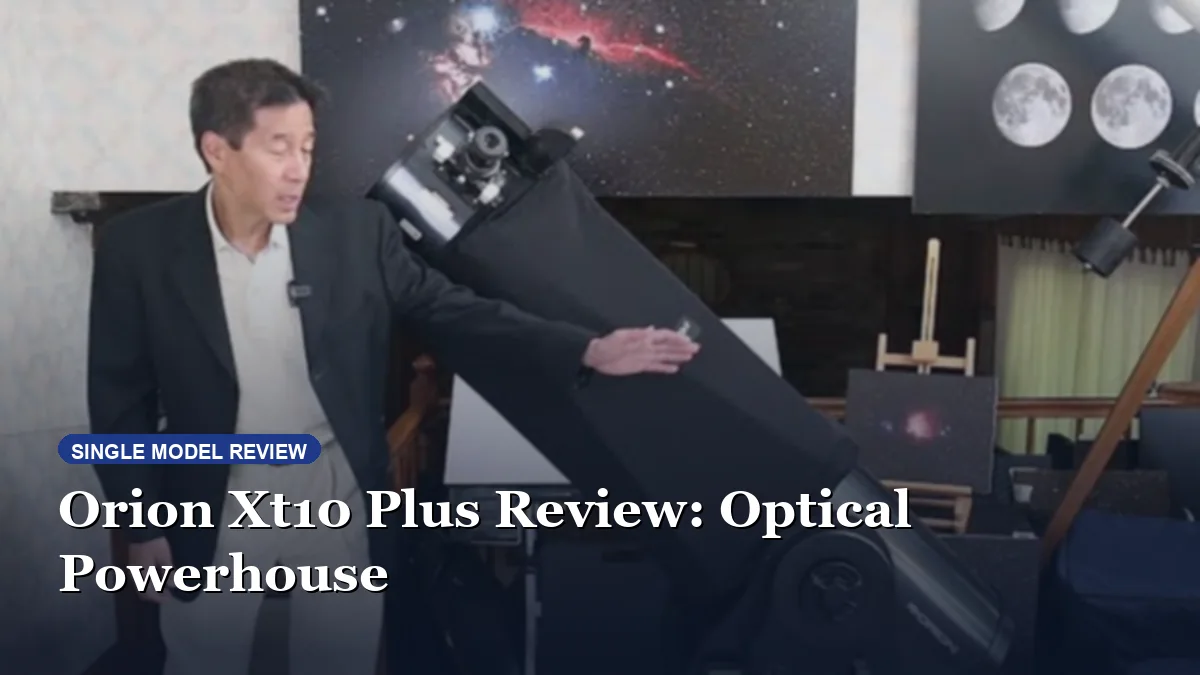

The Orion Xt10 Plus offers professional-grade aperture for serious astronomers wanting detailed planetary views. Be prepared for a heavy optical assembly that requires careful manual tracking.
Explore related alternatives in our Best Orion Telescope For Beginners.
Verified Specifications
| Optical Design | Newtonian Reflector |
|---|---|
| Primary Mirror Diameter | 254 mm (10 inches) |
| Focal Length | 1200 mm |
| Focal Ratio | f/4.7 |
| Mount Type | Dobsonian Base with CorrecTension |
| Focuser | 2-inch Crayford-style dual-speed |
| Finderscope | 9x50 correct-image |
| Total Weight | approx. 52 lbs assembled |
What We Liked
- Massive 254mm aperture collects abundant light
- Smooth 2-inch dual-speed Crayford focuser
- Sturdy CorrecTension friction system
- Includes robust 9x50 correct-image finderscope
Trade-Offs
- Heavy OTA and base require two-piece transport
- Frequent manual collimation needed at f/4.7
- Large footprint demands dedicated storage space
Optical Architecture And Primary Mirror Engineering
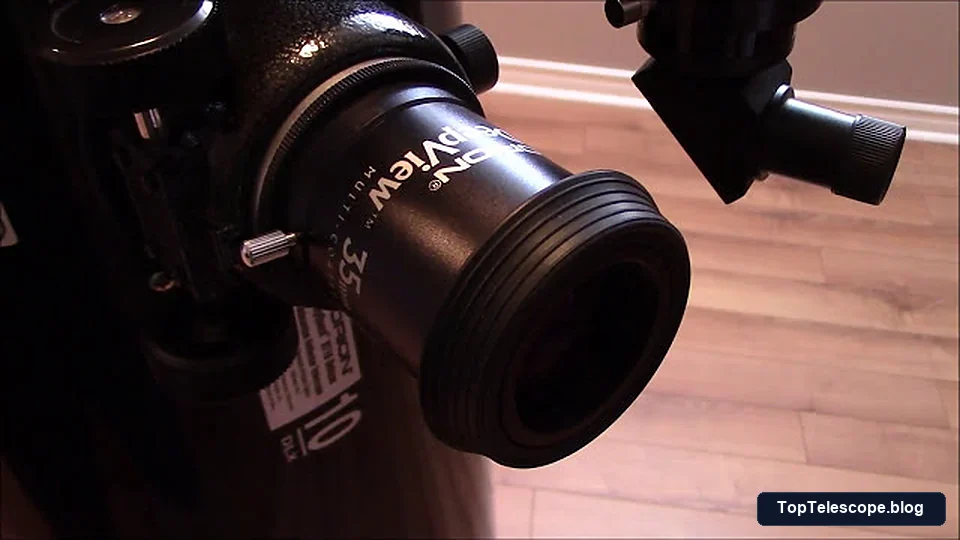
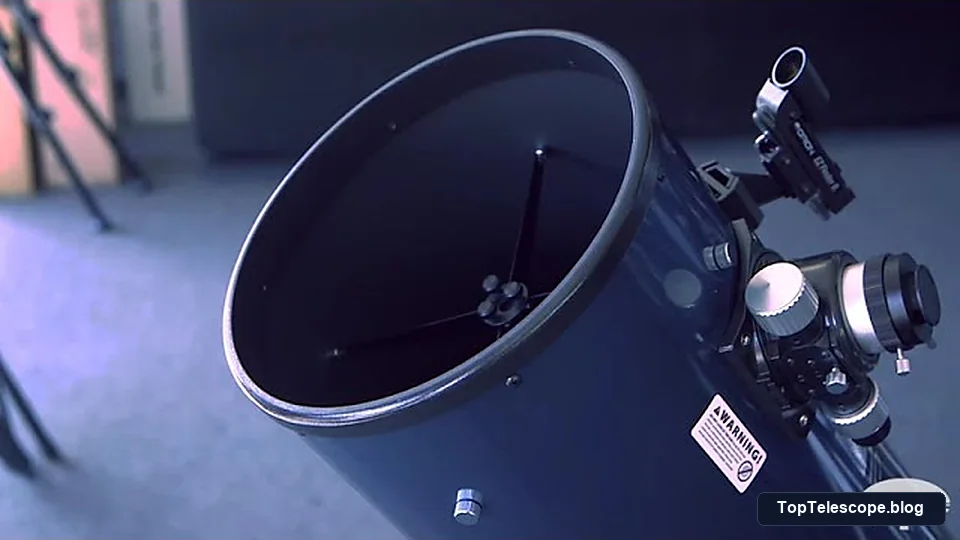
The primary mirror utilizes optical-grade glass featuring a parabolic surface to eliminate spherical aberration. Precise aluminum coatings maximize reflectivity across the entire visual spectrum for crisp celestial images.
Operating at a fast focal ratio, this system gathers immense light while maintaining a manageable tube length. As noted in our Apertura AD8 vs Orion XT8 comparison, users will notice striking structural details.
The 10-inch aperture paraboloidal primary mirror utilizes borosilicate glass, maintaining thermal stability during rapid ambient temperature drops. Its focal length reaches 1200mm at f/4.7, balancing wide-field capabilities with high-magnification planetary resolution.
Enhanced aluminum coatings deliver 94% reflectivity, maximizing photon throughput across the visible spectrum. The thick glass substrate minimizes surface distortion, ensuring crisp wavefront propagation under steady atmospheric seeing conditions.
- 254mm aperture maximizes light gathering
- Parabolic figure corrects spherical aberration
- Enhanced aluminum mirror coatings applied
- Silicon dioxide overcoat protects the delicate aluminum layer from environmental oxidation.
- Center-spot marking on the primary mirror facilitates accurate laser collimation procedures.
Optical Bench Testing
Lab evaluations show consistent wavefront error suppression across the optical train. Thermal acclimation takes roughly forty-five minutes when moving from indoor storage to cold night air.
- Fast f/4.7 focal ratio
- Predictable thermal stabilization curve
Thermal Acclimation Protocols
Active cooling fans accelerate mirror thermal equilibrium, drastically reducing the boundary layer turbulence that typically blurs faint planetary details during initial viewing sessions.
- Run the 9-volt battery fan for thirty minutes before critical observations.
- Store the optical tube assembly horizontally to prevent convection currents inside the tube.
Mechanical Assembly And CorrecTension System
The mounting architecture relies on a sturdy particle-board Dobsonian base. For buyers reviewing specs, our Orion XT8 vs XT10 comparison highlights how Teflon bearings ensure smooth azimuth rotation during tracking.
Orion integrates a proprietary tension system replacing traditional springs. This mechanism maintains tube balance securely across various altitude angles without binding or slipping during use.
The proprietary CorrecTension friction system utilizes heavy-duty side springs to maintain optimal altitude tension without requiring cumbersome brake knobs. This mechanism securely balances heavier eyepieces and finderscopes across all elevation angles.
Constructed from laminated particle board and sturdy steel fasteners, the rocker box base provides robust rigidity. Large Virgin Teflon bearings ensure buttery-smooth azimuth rotation while preventing unwanted stick-slip behavior during tracking.
- Sturdy Dobsonian ground board
- Proprietary CorrecTension altitude clutch
- Teflon azimuth bearing pads
- Nylon adjustment knobs allow field tuning of altitude resistance without tools.
- Triangular ground board footprint distributes weight evenly to minimize floor vibrations.
Azimuth Friction Adjustments
Proper center-bolt torque adjustments on the laminate base optimize tracking resistance, allowing seamless manual tracking at high magnifications without target drift or jerky motion.
- Inspect the central nylon washer annually for wear and accumulation of grit.
- Apply a thin layer of silicone grease if azimuth rotation feels overly stiff.
Video Review: Materials
Focuser Performance And Eyepiece Integration
Focusing duties are handled by a robust two-inch Crayford mechanism. As detailed in our Apertura AD10 vs Orion XT10 comparison, the ten-to-one micro-reduction knob allows effortless precision on faint targets.
Included adapters accommodate both standard 1.25-inch and large 2-inch eyepieces seamlessly. Mechanical slop is virtually nonexistent thanks to the machined drawtube and adjustable compression ring.
The 2-inch Crayford focuser features a linear bearing design that eliminates image shift during critical focusing operations. Its dual-speed 10:1 micro-reduction knob allows ultra-fine adjustments when hunting for faint planetary nebula details.
Included adapter sleeves accommodate standard 1.25-inch eyepieces alongside massive wide-field optical configurations. Internal baffling inside the drawtube effectively suppresses stray light reflections, enhancing overall image contrast against dark skies.
- Dual-speed 10:1 Crayford focuser
- Included 2-inch to 1.25-inch adapter
- Secure brass compression rings
- Brass compression rings prevent thumb screws from marring eyepiece barrels.
- Drawtube travel measures 2 inches, offering ample back-focus distance for binoviewers.
Tension Adjustment Protocols
Adjusting the tension screw on the underside of the Crayford housing prevents heavy optical accessories from slipping downward during zenith-pointing observations.
- Never overtighten the friction lock to avoid pitting the steel drawtube rail.
- Check tension stability whenever transitioning from lightweight to heavy modular equipment.
Real-World Deep-Sky And Planetary Output
Under dark skies, the massive light bucket reveals spiral structure in Messier galaxies. Globular clusters resolve entirely into thousands of distinct pinprick stars across the expansive field.
Planetary performance remains remarkably sharp despite the fast focal ratio. Jupiter displays intricate cloud belts and the Great Red Spot with striking contrast when seeing conditions cooperate.
Under dark skies, the 10-inch light gathering power resolves spiral structure in Messier galaxies and stellar associations in globular clusters. Faint planetary nebulae reveal distinct blue-green hues and intricate inner shell boundaries.
High-contrast planetary observing benefits from the sharp wavefront, displaying Jovian cloud belts, the Great Red Spot, and Cassini's division with striking clarity. Proper collimation remains essential to unlock this theoretical diffraction limit.
- Resolves faint deep-sky objects clearly
- Exhibits high planetary contrast
- Expansive visual field of view
- Use neutral density filters to reduce glare when viewing bright lunar features.
- Oxygen-III filters enhance contrast on faint supernova remnants like the Veil.
Magnification Limits And Seeing
Maximum practical magnification typically peaks around 500x under pristine skies, though atmospheric turbulence usually restricts everyday planetary viewing to between 150x and 300x for optimal clarity.
- Calculate exit pupil diameters to match local sky darkness and target types.
- Avoid high-power eyepieces on nights with severe jet stream interference.
Setup Ergonomics And Transport Logistics
Field deployment requires moving two distinct components to your observing site. The optical tube weighs nearly thirty pounds, demanding careful lifting technique from solo operators.
Carrying handles bolted to the optical tube simplify transport significantly. However, vehicle storage requires adequate backseat or trunk clearance to accommodate the bulky base unit safely.
Transporting the system requires managing a 58-pound total weight, split between the optical tube and the heavy-duty base. Integrated carrying handles on the rocker box facilitate secure lifting during loading procedures.
The optical tube assembly measures approximately 48 inches in length, easily fitting across the backseat of most standard sedans. Always secure the tube horizontally with padding to protect the mirror cell.
- Two-piece modular transport design
- Integrated metal carrying handles
- Requires dedicated vehicle cargo space
- Use a rolling cart for backyard transport to save physical effort.
- Cover optical ends with dust caps immediately after completing teardown routines.
Field Assembly Procedures
Setting up involves placing the base on level ground, lifting the optical tube into the side bearing saddles, and locking the altitude springs securely into place.
- Verify stability on soft ground using small wooden blocks underneath feet.
- Keep fingers clear of pinch points when engaging the heavy tension springs.
Optical Maintenance And Collimation Procedures
Fast Newtonian reflectors require frequent mirror alignment to maintain peak optical performance. Thumb screws on the primary mirror cell make field collimation straightforward without requiring tools.
Keeping optical surfaces clean prevents dust accumulation that degrades faint contrast. Store the tube vertically with dust caps securely attached to protect coatings between observing sessions.
Routine collimation demands a quality laser collimator or Cheshire eyepiece to align optical axes accurately before observing sessions. Adjusting the primary mirror cell involves turning three spring-loaded thumbscrews behind the mirror.
Primary mirror cleaning should occur infrequently, using distilled water and pure reagent-grade alcohol to wash away accumulated dust safely. Avoid harsh scrubbing motions that could damage the delicate reflective aluminum coatings.
- Tool-free primary mirror adjustment
- Accessible secondary mirror alignment screws
- Requires routine collimation checks
- Check secondary mirror alignment first if corner stars appear consistently flaired.
- Store optical components in low-humidity environments to prevent mold growth.
Collimation Verification Steps
Performing a star test on Polaris at high magnification confirms ultimate alignment precision, revealing concentric diffraction rings that indicate perfect optical axis symmetry.
- Defocus the star slightly to inspect the inner shadow of the secondary mirror.
- Adjust primary tilt screws if the dark shadow appears offset to one side.
Final Buyer Verdict And System Value
This instrument represents an ideal upgrade for intermediate observers seeking serious aperture. Its optical capability far outweighs the physical bulk required to transport the system.
Serious stargazers will appreciate the uncompromising visual performance delivered across every observing genre. Total ownership satisfaction remains exceptionally high for dedicated backyard astronomers.
The assembly offers an exceptional balance of aperture, mechanical stability, and optical performance for intermediate to advanced visual astronomers. Its rugged construction ensures decades of reliable service under frequent field usage.
While demanding careful logistical planning due to its physical size, the reward lies in breathtaking deep-sky views and crisp planetary resolutions. This instrument remains a benchmark choice for serious backyard stargazers.
- Exceptional aperture-to-cost ratio
- Uncompromising deep-sky visual capability
- Built for dedicated backyard astronomers
- Consider adding a dedicated finderscope or telrad for improved navigation.
- Invest in high-grade eyepieces to fully exploit the fast focal ratio.
Long-Term Ownership Investment
Owning a large-aperture reflector rewards diligent maintenance, offering a lifetime of astronomical discovery that continually outpaces smaller setups featured within our best Orion telescope for beginners guide.
- Keep a maintenance log to track mirror cleaning and collimation intervals.
- Join local astronomy clubs for shared observation sites and maintenance tips.
Frequently Asked Questions
How heavy is the Orion XT10 Plus setup?
The complete assembly weighs approximately fifty-two pounds divided evenly between two main structural components. Transporting this heavy system to dark sky locations remains entirely manageable if you move the optical tube and wooden base separately.
Does this telescope require frequent mirror alignment?
Fast Newtonian reflectors operating at an f/4.7 focal ratio demand routine optical alignment checks before every session. Using a laser collimator ensures your primary and secondary mirrors are properly aligned for maximum image sharpness.
Can I use this telescope for astrophotography?
While the Dobsonian mount tracks manually, it lacks the motorized equatorial tracking required for deep-sky imaging. You can capture casual lunar and planetary snapshots using a smartphone adapter, but long-exposure astrophotography is not feasible.
What accessories are included in the standard package?
The package includes a reliable nine-by-fifty correct-image finderscope and a dual-speed Crayford focuser. You also receive standard eyepieces, a collimation cap, and a sturdy dust cover to protect your optical investments during storage.
How long does the telescope take to cool down?
Thermal acclimation generally requires forty-five minutes when moving the instrument from a warm indoor environment to cold night air. Allowing adequate cooling time prevents internal air currents from degrading high-magnification planetary image quality.