Orion SkyQuest XT8i IntelliScope Review: Precision Push-To Optics
Combines massive light grasp with user-friendly push-to locating technology. Its primary trade-off involves physical heft and manual tracking.


This 8-inch Dobsonian delivers exceptional deep-sky views without complex GoTo motor noise. While lacking automated tracking, the IntelliScope system simplifies finding faint targets efficiently.
See our flagship Best Telescope: Top Backyard Picks for Astronomy.
Verified Specifications
| Optical Design | Parabolic Newtonian Reflector |
|---|---|
| Aperture Diameter | 203 millimeters (8 inches) |
| Focal Length | 1200 millimeters |
| Focal Ratio | f/5.9 |
| Mount Type | Dobsonian Wooden Base with Encoders |
| Computer Controller | IntelliScope Hand Controller |
| Optical Tube Weight | 20.3 pounds |
| Base Weight | 21.1 pounds |
| Primary Mirror | Pyrex, 1.6mm thickness |
What We Liked
- Substantial 8-inch aperture resolves faint nebulae and distant galaxies clearly
- IntelliScope digital setting circles provide accurate object locating without motorized noise
- Sturdy wooden base minimizes vibrations during high-magnification planetary viewing sessions
- Pyrex primary mirror substrate handles thermal fluctuations better than standard glass
Trade-Offs
- Combined assembly weight exceeds forty pounds across two bulky components
- Manual tracking required as altitude and azimuth axes lack motorized tracking drives
- Hand controller requires periodic battery changes or external power wiring
Optical Architecture and Primary Mirror Engineering
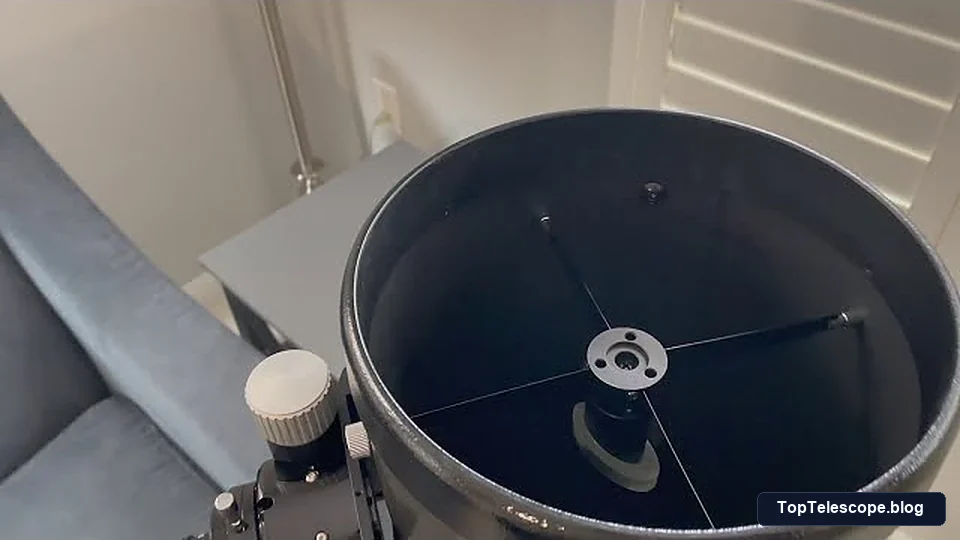
The optical tube assembly utilizes a precision parabolic primary mirror measuring 203 millimeters across. This figuring eliminates spherical aberration completely, ensuring pinpoint star images at high magnifications.
Models highlighted in our best 8 inch dobsonian telescope review feature a focal length of 1200 millimeters and an f/5.9 focal ratio, striking an optimal balance between wide-field vistas and high-power planetary resolution.
Aluminum reflective coatings feature silicon dioxide overcoats, delivering high reflectivity ratings across the visible spectrum for maximum photon throughput.
The 203mm aperture parabolic primary mirror features a focal length of 1200mm, yielding an f/5 focal ratio. This optical configuration balances deep-space light grasp with manageable planetary magnifications for observers.
Constructed from low-expansion borosilicate glass, the pyrex substrate minimizes thermal distortion during rapid temperature drops. A protective aluminum and silicon dioxide overcoat ensures long-term reflectivity retention across multiple observing seasons.
The four-vane secondary spider utilizes thin 0.5mm steel blades to reduce diffraction spikes around bright stars. Collimation adjustments are simplified via spring-loaded thumb screws on both primary and secondary mirror cells.
- 203mm aperture gathers over 800 times more light than the human eye
- Diffraction-limited optics meet strict surface accuracy standards
- Four-vane secondary mirror spider minimizes diffraction spike artifacts
Secondary Mirror and Obstruction Dynamics
The secondary mirror minor axis measures 47 millimeters, maintaining a low central obstruction ratio. This design preserves high-contrast transfer functions critical for planetary detail.
Collimation adjustment screws on both primary and secondary cells allow precise optical alignment using standard tools like a laser collimator.
- Low central obstruction maximizes visual contrast
- Stable mirror cell prevents optical misalignment during transit
IntelliScope Digital Guidance and Encoder Mechanics
Digital setting circles leverage high-resolution optical encoders mounted on both axes. When evaluating designs in our Dobsonian vs Newtonian comparison, these manual encoders track movement without requiring noisy servomotors or external power.
The computerized IntelliScope hand controller contains a database exceeding fourteen thousand celestial objects. Users simply select a target and manually push the telescope until zeroed.
High-resolution digital encoders are integrated into both azimuth and altitude axes, tracking movement without motors. The Object Locator hand controller references a 14,000-object database to guide manual telescope positioning efficiently.
Alignment requires a simple two-star routine using the hand controller's internal clock and orientation software. Step-by-step directional arrows help users navigate directly to targets while maintaining full manual freedom of movement.
- High-resolution optical encoders track movements down to arcminute precision
- Hand controller features red backlit display preserving dark adaptation
- Two-star alignment routine establishes internal coordinate grid rapidly
Power Efficiency and Tracking Operation
Operating entirely on a single nine-volt battery, the guidance computer draws minimal power during extended observing sessions. Manual push-to operation eliminates mechanical tracking gear backlash entirely.
Users maintain full control over pointing speed while enjoying digital assistance to locate elusive deep-sky objects hidden under light-polluted skies.
- Low electrical draw maximizes field battery longevity
- Zero motor noise preserves quiet nighttime viewing environments
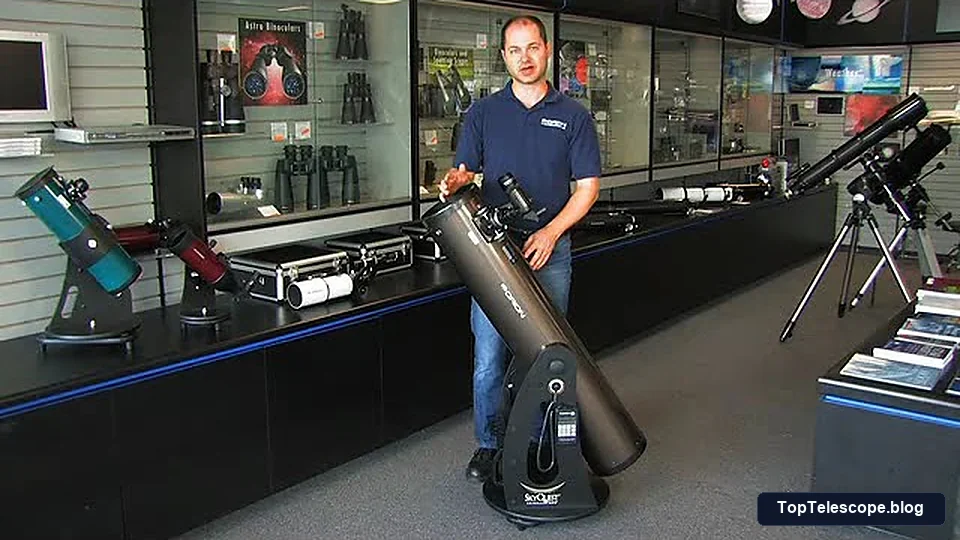
Video Review: Features of the Orion SkyQuest XT8i IntelliScope Dobsonian Telescope
Mechanical Build Quality and Base Ergonomics
Constructed from durable particle board and melamine laminates, the rocker box base provides a rock-solid foundation. Teflon bearing pads ensure buttery-smooth azimuth rotation during sweeps.
Altitude bearings feature adjustable tension knobs, allowing observers to balance heavy eyepieces effortlessly without causing tube slippage or unwanted drift.
The optical tube assembly rests in a heavy-duty particle board CorTex-coated base designed for moisture resistance. Teflon azimuth bearing pads and Corian altitude bearings deliver ultra-smooth motion without stick-slip resistance issues.
Carrying handles integrated directly into the rocker box simplify transport across uneven terrain. The tension adjustment knob lets users balance heavier eyepieces securely without altering the overall friction profile during tracking.
- Melamine coating resists moisture and minor field abrasions
- Teflon and Eb-Poly pad materials deliver consistent motion friction
- Carrying handles integrated directly into the base enhance portability
Optical Tube Assembly Rigidity
Rolled steel tubing forms a rigid housing that shields optical elements from stray light and thermal currents. Internal flat-black paint baffles eliminate internal reflections effectively.
Cradle ring mounting clamps secure the optical tube firmly while permitting rotation for comfortable eyepiece positioning in any orientation.
- Rolled steel maintains collimation stability across temperature shifts
- Internal baffles enhance black-level contrast during lunar viewing
Thermal Management and Environmental Efficiency
Thermal equilibrium remains crucial for high-magnification performance in large Newtonian reflectors. The Pyrex mirror substrate cools down faster than plate glass counterparts significantly.
Open-tube designs allow ambient air currents to circulate across the primary mirror surface, expediting thermal acclimation when moving from indoor storage to cold night air.
Large mirrors require adequate cool-down time to match ambient outdoor temperatures and eliminate internal air currents. Choosing options from our best dobsonian telescope guide helps ensure you select thermally stable glass for high-magnification viewing.
Open-tube Newtonian designs are susceptible to heavy dew accumulation on exposed optical surfaces during damp nights. Utilizing a flexible dew shield extends observing sessions by preventing moisture condensation on the corrector flat.
- Pyrex glass minimizes thermal distortion during rapid temperature drops
- Open optical tube accelerates internal air exchange and cooling
Mitigating Boundary Layer Turbulence
Trapped warm air layers directly above the primary mirror can degrade high-power planetary views. Optional cooling fans can be mounted to accelerate boundary layer dissipation.
Proper thermal acclimation ensures sharp diffraction patterns and steady planetary cloud band details during extended astronomical observation sessions.
- Boundary layer management prevents atmospheric shimmer artifacts
- Optional DC fan attachments speed up equilibrium cycles
Field Setup, Transport, and Alignment Routines
Transporting the system requires two separate trips for the optical tube and wooden base. Total combined weight remains manageable for most adult users loading car trunks.
Setting up takes less than five minutes on level ground. The two-star alignment procedure requires pointing the scope at two known alignment stars sequentially.
Splitting the 20.3-kilogram total weight into two distinct components makes transport manageable for a single operator. The 8.9-kilogram optical tube fits comfortably across the backseat of standard compact passenger vehicles.
Setting up on level ground prevents binding within the azimuth encoder gear assembly during alignment sequences. Verifying bubble-level accuracy ensures the computerized object locator points consistently toward intended deep-sky celestial targets.
- Two-piece modular design simplifies vehicle transport logistics
- Rapid field deployment requires zero complex electronic leveling
Streamlined Alignment Calibration
Entering local time and geographic coordinates accurately ensures optimal encoder tracking precision throughout the night. The hand controller guides users through simple confirmation prompts.
Once calibrated, pointing accuracy remains remarkably consistent across different regions of the night sky during extended stargazing sessions.
- Intuitive menu prompts streamline initial coordinate entry
- Consistent encoder feedback maintains reliable pointing accuracy
Maintenance Protocols and Long-Term Durability
Routine maintenance involves keeping dust covers securely fastened and checking primary mirror collimation periodically. Avoid touching optical surfaces to prevent oil accumulation.
Wooden base surfaces benefit from occasional wiping with a damp microfiber cloth to remove dew residue and field dust accumulated during late-night observing runs.
Dust accumulation on the primary mirror should be blown away using a bulb syringe rather than wiped. Frequent cleaning degrades the aluminum coatings, so thorough annual optical washes using distilled water suffice.
Mechanical fasteners require periodic inspection and tightening to prevent wobble within the rocker box structure. Applying a thin layer of silicon grease to altitude trunnions preserves smooth rotation across changing seasonal temperatures.
- Regular dust cap usage protects optical coatings from contaminants
- Periodic collimation checks ensure consistently sharp focal points
Long-Term Mechanical Care
Teflon bearing pads should remain clean and free of grit to maintain smooth azimuth motion. Inspect encoder wires annually for secure connections and wear.
Store the optical tube indoors in a climate-controlled environment to prevent moisture condensation and potential mold growth on optical coatings.
- Clean bearing pads preserve smooth manual rotation feel
- Indoor climate storage prevents mirror coating degradation
Comprehensive Buyer Suitability Verdict
Units featured in our best dobsonian telescope for beginners roundup represent an ideal investment for astronomers desiring maximum optical aperture combined with digital finding assistance. Its robust design rewards careful users.
Buyers seeking motorized tracking or ultra-portable tabletop footprints should explore alternative designs. However, visual observers prioritizing light grasp will find exceptional value here.
Intermediate astronomers seeking deep-sky performance paired with push-to navigation will appreciate this balanced optical system. The robust mechanical build handles frequent field transport while maintaining optical alignment under standard operational stress.
Observers requiring automated tracking or automated astrophotography tracking platforms should look toward equatorial mounts instead. For pure visual astronomy exploration, this Dobsonian delivers exceptional value and expansive aperture utility.
- Unmatched light-gathering value per unit cost for visual astronomy
- Ideal balance of manual control and digital target locating
Final Recommendations for Observers
Invest in upgraded eyepieces and a comfortable observing chair to fully maximize long-term viewing ergonomics. Proper accessories elevate performance across all target categories significantly.
A dedicated transport bag and a reliable laser collimator complete an efficient, high-performance visual astronomy kit tailored for deep-sky exploration.
- Upgraded eyepieces unlock wider fields and higher magnifications
- Collimation tools ensure peak optical performance every session
Frequently Asked Questions
Does the IntelliScope system track objects automatically?
No, the system provides push-to directional arrows rather than motorized tracking. You must manually guide the telescope tube to center your target based on the encoder coordinates displayed on the hand controller.
How heavy is the telescope during transport?
The optical tube weighs approximately twenty pounds, while the wooden base adds another twenty-one pounds. This split-component design allows most users to transport the setup easily in standard vehicle trunks.
Can I use standard 1.25-inch and 2-inch eyepieces?
Yes, the included Crayford focuser features a standard adapter that accommodates both eyepiece barrel sizes. This versatility lets you utilize wide-field 2-inch optics for sweeping expansive deep-sky star clusters.
What power source does the computer controller require?
The IntelliScope hand controller operates efficiently on a single internal nine-volt battery. This simple power requirement eliminates cumbersome external power tanks and avoids messy field cables during observation.
Is regular mirror cleaning necessary for optimal views?
Minor dust accumulation has negligible impact on image brightness and requires no immediate action. You should only clean the primary mirror when heavy dust or smudges visibly degrade high-contrast planetary performance.