Orion Skyquest Xt8 Review: Engineering & Field Performance
The Orion SkyQuest XT8 pairs a large primary mirror with a rock-solid base. It delivers exceptional optical performance without complex electronic setup routines.

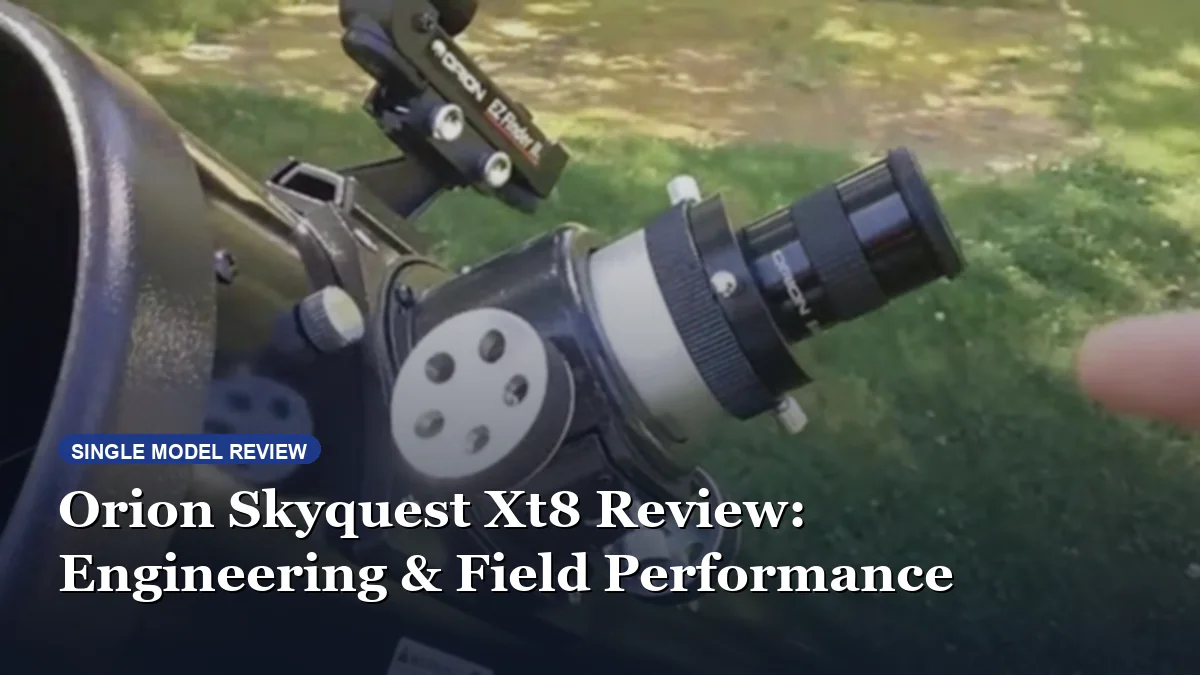

This manual Dobsonian reflector delivers bright deep-sky views using robust mechanical design and reliable optics, though its physical bulk requires careful vehicle transport.
See our flagship Best Telescope: Top Backyard Picks for Astronomy.
Verified Specifications
| Category / Type | Newtonian Reflector Dobsonian |
|---|---|
| Rated Output / Capacity | 203mm Primary Mirror Aperture |
| Power / Motor | Manual Operation (No power required) |
| Build & Materials | Enamel-coated steel tube, particle board base |
| Operating Noise | Silent manual operation |
| Duty Cycle / Runtime | Unlimited visual observing runtime |
| Dimensions & Weight | 43 lbs total assembled weight |
| Key Safety & Controls | CorrecTension altitude friction system |
What We Liked
- Generous 8-inch aperture gathers ample light for faint deep-sky nebulae.
- Sturdy CorrecTension base maintains smooth altitude balance without tools.
- Parabolic primary mirror effectively eliminates spherical aberration.
- Intuitive manual point-and-view operation simplifies backyard setup.
Trade-Offs
- Large tube assembly requires significant storage and car trunk space.
- Lacks tracking motors for high-magnification astrophotography tracking.
- Particle board base material is vulnerable to moisture damage if wet.
Optical Design and Primary Mirror Engineering
The Orion SkyQuest XT8 utilizes a precision parabolic primary mirror measuring 203 millimeters in diameter. You can evaluate options inside our Apertura AD8 vs Orion SkyQuest XT8 comparison today.
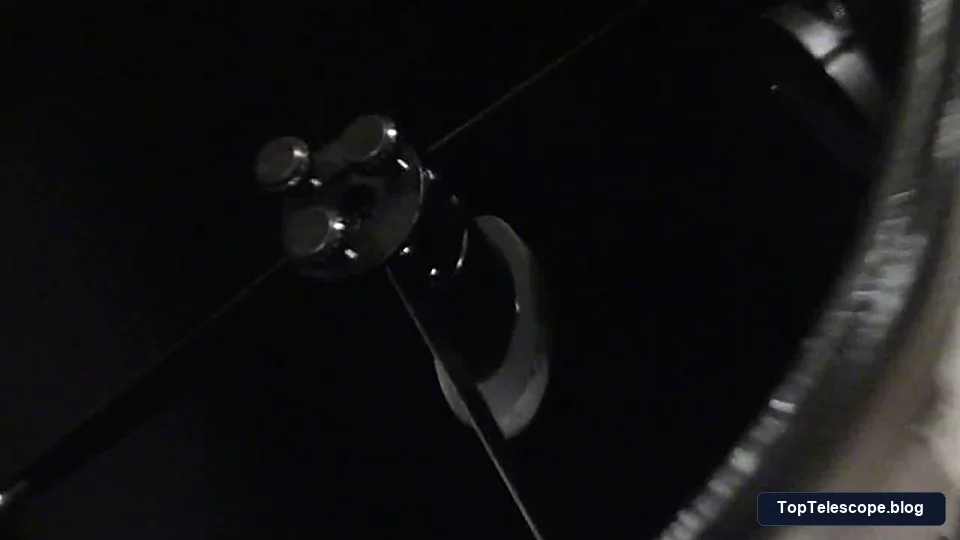
With a focal length of 1200mm at f/5.9, this Newtonian optical tube delivers a versatile balance of wide fields and high magnification capabilities during clear nights.
The optical tube assembly houses an 8-inch parabolic primary mirror featuring a focal length of 1200mm. This configuration yields a focal ratio of f/5.9, balancing planetary magnification with wide-field deep-sky scanning capabilities effectively.
Pyrex glass substrate minimizes thermal expansion during rapid temperature drops. Enhanced aluminum coatings deliver 94% reflectivity, ensuring maximum photon throughput reaches the focal plane for faint nebulae and distant globular cluster observations.
- 203mm aperture gathers 784 times more light than the human eye.
- Aluminum reflective coatings feature protective silicon dioxide overcoats.
- Thin spider vanes minimize diffraction spikes around bright star targets.
Collimation Mechanics
Maintaining optical alignment is straightforward thanks to the rear cell collimation thumbscrews. Users can adjust primary mirror tilt without requiring any specialized tools in the field.
Spring-loaded locking screws keep your optical adjustments secure throughout transport across rough terrain to dark sky observing sites.
- Rear cell utilizes large adjustment knobs for gloved hands.
- Center spot on the primary mirror aids laser collimator setup.
Mechanical Build Quality and Base Construction
Constructed from heavy-duty engineered wood, the Dobsonian base provides a remarkably stable foundation. To scale up aperture, check our Orion XT8 vs XT10 comparison guide for sizing details.
The optical tube rides smoothly on Teflon bearings. This material combination ensures effortless manual tracking across both altitude and azimuth axes without stuttering.
The CorrecTension primary mirror cell utilizes a robust three-point flotation design. Heavy-duty particle board forms the Dobsonian base, providing a rigid mounting platform that absorbs vibrational energy quickly during high-power eyepiece swaps.
Teflon bearings paired with Corning tracks ensure silky smooth altitude and azimuth movements. Users can adjust tension knobs manually to achieve ideal rotational resistance without requiring specialized tools in the field.
- Melamine-coated particle board resists minor scratches and scuffs.
- Sturdy carry handle bolted directly to the base plate.
- Nylon spacers prevent metal-on-wood friction during elevation adjustments.
CorrecTension Friction System
Orion equips this telescope with patented spring connectors linking the tube to the base. These tension springs hold heavy eyepieces securely without causing sudden balance shifts.
Users can easily adjust tension levels by hand to match varying accessory weights mounted at the focuser end.
- Eliminates the need for cumbersome counterweight balancing systems.
- Maintains smooth motion across all viewing angles.
Video Review: The Best Telescope to Buy \u0026 How to use it | Orion SkyQuest XT8 Dobsonian Review | Astronomy
Real-World Output and Field Performance
Under dark rural skies, this 8-inch aperture resolves spiral arms in galaxies and distinct details within stellar nurseries. Faint objects appear with brightness explored further in our Apertura AD10 vs Orion XT10 analysis.
Lunar and planetary targets reveal crisp cloud belts on Jupiter and Cassini division gaps in Saturn's ring system when atmospheric seeing conditions remain steady.
Under dark skies, the aperture resolves spiral arms in galaxies like M51 with striking clarity. Planetary observers benefit from a sharp Airy disk pattern when seeing conditions permit high magnification viewing of Jupiter.
Manual tracking requires a gentle touch at 200x magnification due to Earth's rotation. Experienced operators learn to anticipate drift, making minor corrective nudges to keep celestial targets centered comfortably within the eyepiece field.
- Reaches magnitude 14 visual limits under pristine dark skies.
- Delivers bright color saturation in large globular star clusters.
Thermal Equilibrium and Cooling Efficiency
Large mass glass mirrors require time to match ambient outdoor temperatures before delivering peak high-magnification images. Thermal acclimation typically takes around forty-five minutes outdoors.
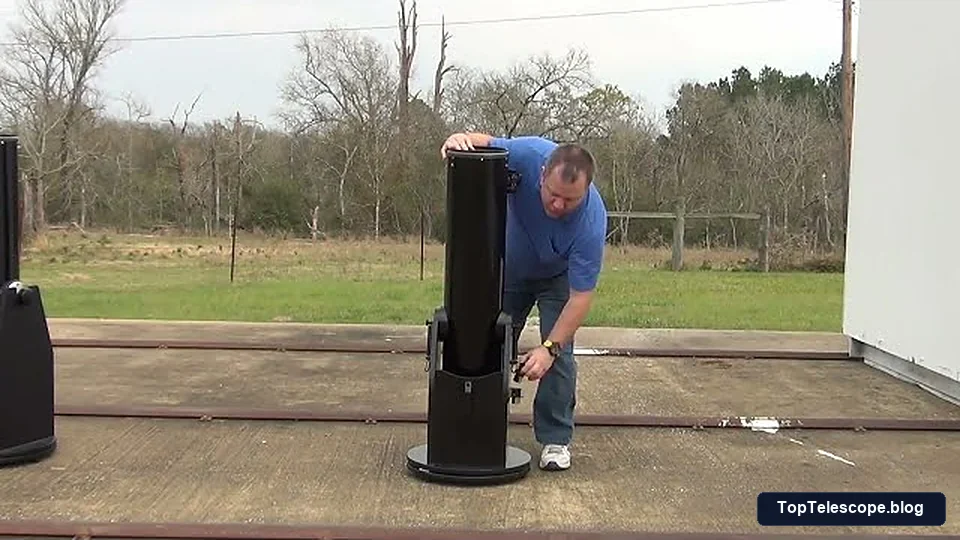
Leaving the tube outside prior to serious viewing sessions prevents internal air currents from degrading fine planetary surface details during early evening hours.
Thick glass substrates require adequate time to acclimate to ambient nighttime outdoor temperatures. Storing the tube in a garage or unheated mudroom significantly reduces internal thermal gradients before starting evening observing sessions.
Adding an after-market cooling fan accelerates heat dissipation from the primary mirror cell. This proactive measure prevents boundary layer air currents from degrading high-resolution planetary views during rapid temperature drop cycles.
- Open optical tube design promotes passive convective heat dissipation.
- Optional cooling fans can accelerate thermal stabilization significantly.
Usability, Ergonomics, and Setup Workflow
Transporting this instrument involves carrying two separate components: the optical tube and the wooden base. While manageable, the combined weight demands deliberate lifting technique.
Point-and-view Dobsonian mechanics remove all frustrating computer alignment routines, allowing astronomers to start observing within minutes of stepping outside.
Transporting the system involves carrying the optical tube and base separately. The integrated carrying handle on the wooden base helps users maneuver the heavy assembly safely from indoor storage locations to vehicles.
The 2-inch Crayford focuser accepts standard 1.25-inch adapters via a brass compression ring. This mechanism prevents marring on eyepiece barrels while delivering backlash-free focusing precision across wide-field night sky scanning targets.
- Optical tube weighs approximately twenty pounds by itself.
- Base assembly adds another twenty-three pounds of dead weight.
Maintenance, Durability, and Long-Term Care
Protecting the exposed primary mirror from dust requires keeping the front dust cover secured whenever the instrument is stored indoors between observing sessions.
Avoid leaving the particle board base exposed to heavy dew or rain to prevent edge swelling and structural degradation of the wood laminate.
Routine maintenance requires keeping dust off optical surfaces using a bulb blower. Avoid touching the reflective coating to preserve the specialized protective overcoat that shields the aluminum layer from premature atmospheric oxidation.
Collimation checks using a Cheshire eyepiece ensure peak optical performance before every session. Adjusting the rear primary mirror screws takes only minutes, maintaining sharp stellar images and accurate collimation alignment under field conditions.
- Primary mirror cleaning should be performed rarely and very carefully.
- Keep mechanical pivot points lightly lubricated for smooth motion.
Buyer Verdict and Comparative Positioning
This telescope represents an exceptional value for visual astronomers prioritizing raw light-gathering capability over computerized tracking features and automated GoTo electronics. It earns high marks within our best Orion telescope for beginners guide.
Beginners and intermediate observers willing to learn manual star-hopping will find this optical instrument serves as a lifelong gateway to deep-space exploration.
Intermediate astronomers seeking substantial light-gathering power find this Newtonian reflector exceptionally capable. Its balance of aperture size, optical quality, and structural rigidity delivers unmatched value proposition within amateur astronomy markets.
While storage footprint and total weight demand dedicated transport space, observational rewards outweigh logistical challenges. Dedicated observers will appreciate how reliable mechanics support years of deep-sky astronomical exploration without requiring frequent mechanical servicing.
- Outperforms smaller computerized scopes in raw optical resolution.
- Offers a low cost per millimeter of aperture.
Frequently Asked Questions
Can I use this telescope for serious astrophotography?
This manual Dobsonian mount lacks motorized tracking capabilities required for long-exposure astrophotography. However, it handles short lunar and planetary snapshot captures successfully when using specialized high-speed video cameras.
How often does the primary mirror need collimation?
Collimation checks should happen before every observing session to ensure maximum image sharpness. Transporting the telescope in a vehicle usually necessitates minor adjustments using the rear mirror knobs.
Is this telescope suitable for complete beginners?
Beginners willing to learn basic celestial navigation and star-hopping techniques will thrive with this design. The intuitive manual operation teaches fundamental astronomy skills without electronic setup frustrations.
How heavy is the entire telescope setup?
The complete assembled telescope weighs approximately forty-three pounds split between two components. The twenty-pound optical tube and twenty-three-pound base can be carried separately outdoors.
Does the telescope require batteries or external power?
This manual Newtonian reflector requires zero electrical power for standard visual operation. You never need to worry about dead batteries or charging cables during field sessions.