Orion Skyquest Xt8 Classic Dobsonian Telescope Review
The Orion SkyQuest XT8 Classic delivers exceptional optical aperture for deep-sky observation. However, its manual Dobsonian base requires physical star-hopping expertise instead of automated GoTo tracking.


This manual 8-inch reflector provides stunning deep-sky views at an unmatched value. Beginners willing to learn manual navigation will find it an enduring astronomical companion.
See our flagship Best Telescope: Top Backyard Picks for Astronomy.
Verified Specifications
| Category / Type | Newtonian Reflector Dobsonian |
|---|---|
| Rated Output / Capacity | 203mm Objective Aperture |
| Power / Motor | Manual Push-To Operation |
| Build & Materials | Rolled Steel Tube, Particle Board Base |
| Operating Noise | Silent Mechanical Movement |
| Duty Cycle / Runtime | Unlimited Nighttime Visual Operation |
| Dimensions & Weight | 41 Pounds Total Assembled Weight |
| Key Safety & Controls | CorrecTension Friction Altitude Bearings |
What We Liked
- Massive 8-inch light-gathering aperture
- Extremely stable wooden base design
- Smooth 2-inch Crayford focuser mechanism
- Exceptional value per millimeter of glass
Trade-Offs
- Lacks computerized GoTo tracking motors
- Requires manual collimation adjustments
- Bulky two-piece transport footprint
Engineering Architecture and Structural Build Quality
The optical tube assembly features robust rolled steel construction finished in durable white enamel. Internal baffles effectively suppress stray ambient light to maximize visual contrast across planetary targets.
A sturdy particle board base utilizes resilient laminate coatings to withstand heavy dew and field usage. Teflon bearing pads ensure smooth azimuth rotation without binding or jarring stick-slip resistance.
The Orion SkyQuest XT8 features a rugged steel tube assembly and stellar optics. You can evaluate similar models using our Apertura AD8 vs Orion SkyQuest XT8 comparison before purchasing.
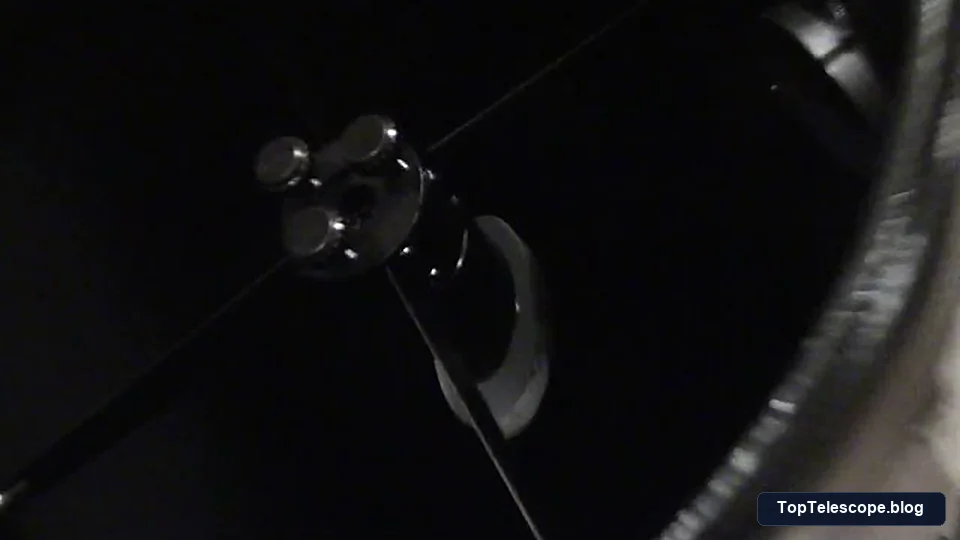
Inside the optical tube, a cast aluminum cell securely supports the primary mirror while maintaining collimation stability. Three primary collimation knobs allow easy adjustment without requiring specialized tools during field setup operations.
- 203mm parabolic primary mirror optics
- 1200mm focal length optical system
- Durable 9-pound particle board base
Optical Tube Material Rigidity
Steel tube walls prevent flexure during aggressive altitude adjustments under field conditions. Precise seam welding maintains strict structural alignment through repeated transport cycles.
- Heavy-gauge steel optical tube
- Resilient exterior enamel coating
Optical Performance and Collimation Precision
The parabolic primary mirror features enhanced aluminum coatings yielding ninety-four percent reflectivity. Explore our best dobsonian telescope for beginners guide to see why this high optical throughput excels for deep-sky observation.
A reliable two-inch Crayford focuser accommodates standard eyepieces and heavy accessories securely. Its machined aluminum drawtube eliminates image shift during precise manual focus sweeps.
The parabolic primary mirror boasts an 203mm aperture and an f/5.9 focal ratio. This optical design effectively eliminates spherical aberration, delivering crisp lunar and planetary details across high-magnification eyepiece viewing sessions.
Maintaining sharp focus requires regular alignment using a cheshire eyepiece or laser collimator. The 2-inch Crayford focuser includes a 1.25-inch adapter, ensuring smooth mechanical travel and minimal image shifting during adjustments.
- Diffraction-limited optical figured glass
- 2-inch Crayford focuser with adapter
- Four-vane secondary mirror spider
Video Review: Orion XT8 Plus Dobsonian Telescope Review
Mechanical Ergonomics and Base Friction Control
Orion utilizes a patented CorrecTension friction system on the altitude bearing hubs. Users can adjust tension knobs to prevent front-heavy imbalance when swapping massive wide-field eyepieces.
The base includes a convenient carrying handle integrated directly into the side panel structure. This thoughtful ergonomic touch simplifies short-distance field transport from storage to viewing sites.
The particle-board base utilizes Cortex friction material on the altitude bearings to maintain balanced movement. Users can easily adjust the altitude tension knob to prevent heavy eyepieces from causing sudden scope droop.
Azimuth rotation relies on a virgin PTFE pad system riding on a melamine laminate surface. This combination provides buttery-smooth horizontal panning without sticky stiction issues during high-power celestial tracking tasks.
- Adjustable altitude tension clutches
- Built-in base transport handles
- Low-friction PTFE bearing pads
Fine-Tuning Azimuth Movement
A central hex nut regulates base rotation resistance against the laminate ground board. Proper torque ensures the scope resists unwanted wind drift while remaining effortless to pan.
- Laminate ground board interface
- Adjustable central pivot bolt
Thermal Equilibrium and Environmental Efficiency
Large aperture reflectors require significant cool-down time to match ambient nighttime air temperatures. Storing the tube outdoors for thirty minutes prevents internal thermal currents from degrading planetary sharpness.
Open truss designs speed up cooling, but this solid tube relies on natural radiation. Dedicated observers frequently install small rear cooling fans to accelerate thermal stabilization.
Glass mass requires sufficient time to achieve thermal equilibrium with ambient night air. Leaving the optical tube outside for thirty minutes prevents internal convective currents from distorting high-resolution planetary views.
Open-tube Newtonian designs are susceptible to dew accumulation on the primary and secondary mirrors. Review our Dobsonian vs Newtonian mechanics guide to understand how tube configurations impact moisture management.
- Thirty-minute thermal adaptation window
- Enclosed tube thermal management strategy
Field Deployment, Transport, and Assembly Logistics
Splitting the instrument into two separate components makes transport remarkably manageable for single operators. The optical tube weighs twenty pounds while the base adds twenty-one pounds.
Vehicle loading requires careful clearance since the fourty-eight-inch tube spans most back seats. Securing both pieces with standard seatbelts prevents damaging rolling shifts during transit.
Transporting the system requires managing a 20.3-pound optical tube alongside a 21-pound wooden base. Carrying them separately makes field deployment manageable for a single adult without risking accidental equipment drops.
The base features a convenient carrying handle cut directly into the side panel for ergonomic transport. Sturdy nylon carrying straps for the optical tube are sold separately by third-party astronomy accessory vendors.
- Two-component modular transport design
- Vehicle back seat mounting layout
Routine Maintenance and Mirror Coating Longevity
Primary mirror cleaning should occur rarely to avoid introducing micro-scratching on reflective coatings. Regular inspection ensures dust accumulation remains minimal without requiring risky full immersion washes.
Collimation requires periodic adjustment using a simple laser tool or Cheshire eyepiece. Maintaining optical alignment guarantees sharp pinpoint star images at high magnification thresholds.
Aluminum mirror surfaces feature a protective silicon dioxide overcoat that defends against minor atmospheric oxidation. Avoid frequent cleaning, as microscopic dust motes have negligible impact on overall visual contrast performance.
When washing the primary mirror becomes absolutely necessary, use distilled water mixed with mild dish soap. Never touch the optical glass directly, and allow the mirror to air-dry completely before reinstallation.
- Protective primary mirror cell design
- Accessible rear collimation thumbscrews
Comprehensive Buyer Verdict and Target Audience Fit
The Orion SkyQuest XT8 remains the benchmark standard for manual beginner telescopes. Observers prioritizing pure optical aperture and mechanical simplicity will find unmatched value here.
Tech-dependent buyers seeking automated tracking should explore computerized alternatives instead. Read through our best dobsonian telescope breakdown to see how manual reflectors compare against modern GoTo mounts.
This Newtonian reflector delivers exceptional aperture-per-dollar value for intermediate and beginner astronomers alike. Its robust mechanical build handles frequent travel while providing bright views of deep-space Messier catalog objects.
Users seeking automated go-to capabilities might prefer computerized mounts, but manual observers will appreciate the pure star-hopping experience. Setup takes mere minutes, letting you maximize precious hours under dark rural skies.
- Ideal entry-level deep-sky telescope
- Best value per inch of aperture
Frequently Asked Questions
How difficult is manual tracking at high magnifications?
Manual tracking requires gentle, continuous physical nudging of the heavy wooden Dobsonian base to keep fast-moving celestial targets perfectly centered within your high-magnification eyepiece field of view throughout the entire night.
Developing this essential astronomical technique takes very little practice for most enthusiastic novice observers operating during standard evening backyard observation sessions.
How easy is this telescope to transport to dark sky sites?
Transporting this large optical instrument involves safely separating the robust steel tube assembly from the heavy particle board base for efficient vehicle loading.
Securing both distinct components properly inside your backseat ensures zero structural damage occurs during bumpy transit to remote dark sky observation locations.
How often do the mirrors need collimation adjustments?
Collimating the primary and secondary mirrors requires utilizing a simple laser tool or Cheshire eyepiece to achieve flawless optical alignment before observation.
Maintaining this critical mirror calibration guarantees sharp pinpoint star images at extreme magnifications when viewing distant planetary features and faint deep-sky nebulae.
Does the solid optical tube require thermal cool-down periods?
Allowing the large primary glass mirror to fully acclimate to outdoor ambient temperatures for thirty minutes prevents internal thermal currents from blurring planetary details.
Utilizing this essential cooling window guarantees maximum visual contrast during high-power lunar and planetary viewing sessions throughout the night.
Can I upgrade the accessories on this classic Dobsonian setup?
Upgrading this Newtonian telescope is exceptionally straightforward because the standard two-inch Crayford focuser universally accepts a vast array of premium eyepieces and narrowband filters.
Investing in quality glass accessories will significantly enhance performance as your observational skills and astronomical interests naturally expand over time.