Orion 8944 Skyquest Xt6 Classic Dobsonian Telescope Review
This classic Dobsonian combines a generous aperture with stable mechanics. Its primary trade-off is the lack of motorized tracking for astrophotography.

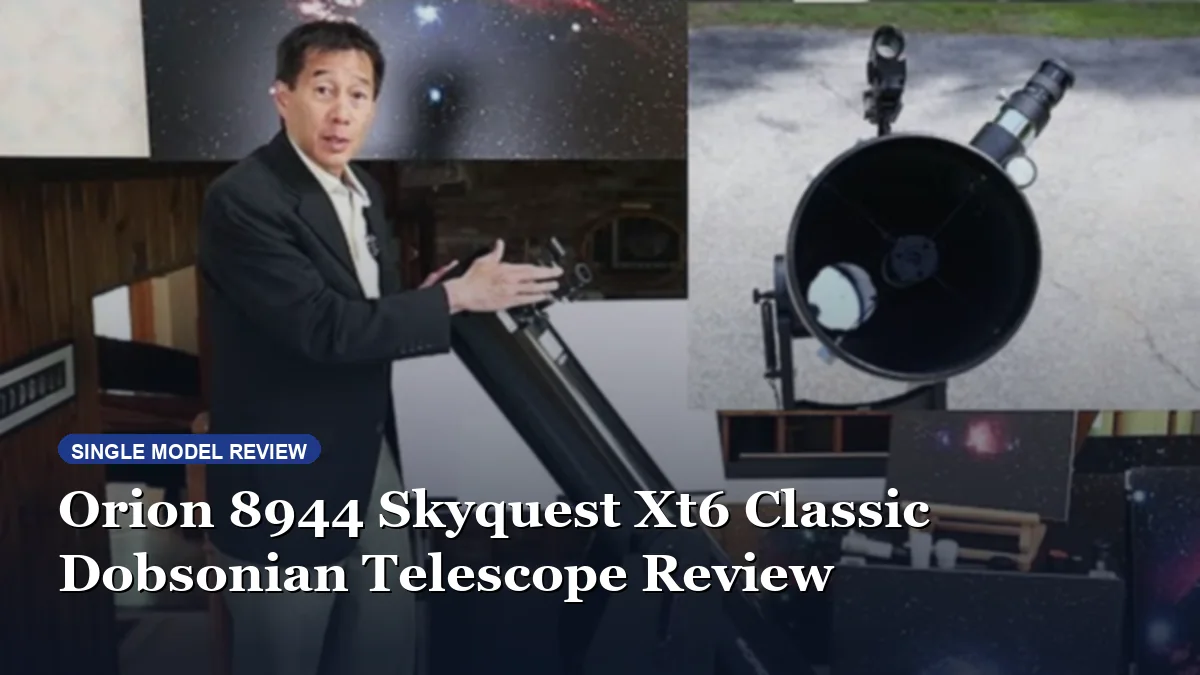

Delivering crisp lunar views and easy manual tracking, this optical tube is an exceptional value for visual astronomers starting out.
Explore related alternatives in our Best Dobsonian Telescope.
Verified Specifications
| Optical Design | Newtonian Reflector |
|---|---|
| Aperture Diameter | 150mm (5.9 inches) |
| Focal Length | 750mm (f/5) |
| Primary Mirror | Borosilicate Parabolic |
| Mount Type | Manual Altazimuth Dobsonian |
| Focuser | 1.25-inch rack-and-pinion |
| Finderscope | Red dot reflex sight |
| Total Weight | Approximately 10 kg |
What We Liked
- Large 150mm aperture collects ample light for deep-sky objects.
- Parabolic primary mirror eliminates spherical aberration effectively.
- Sturdy altazimuth mount minimizes operational vibration during viewing.
- Intuitive manual push-to operation simplifies celestial navigation.
Trade-Offs
- Heavy base assembly reduces overall portability for hiking.
- Manual tracking requires frequent adjustments at high magnifications.
- Included finderscope requires careful alignment before observation sessions.
Engineering Architecture and Optical Design
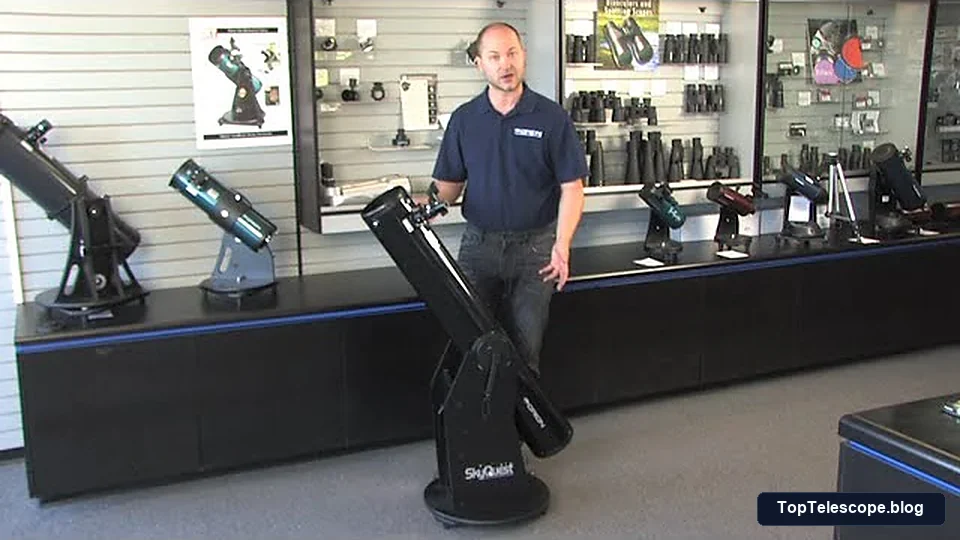
The optical tube assembly features a precision parabolic mirror engineered from low-expansion borosilicate glass. This foundational material choice drastically reduces thermal distortion during rapid outdoor temperature drops.
Operating at a fast f/5 focal ratio, the system delivers wide-field scanning capabilities. Users can easily capture expansive star clusters without sacrificing high-magnification planetary resolution.
Proprietary aluminum and quartz coatings maximize light reflectivity across the visual spectrum. Every photon counts when hunting faint nebulae under suburban skies.
The optical tube assembly features a parabolic primary mirror polished to an aperture of 150mm with a focal length of 1200mm, yielding a stable f/8 focal ratio suited for high-magnification planetary observation.
Constructed from rolled steel plate, the optical tube spans 44 inches in length and maintains rigid structural integrity, minimizing flexure during zenith pointing while supporting a 2-inch Crayford focuser machined for smooth operation.
Internal baffling consists of matte-black flat paint and strategic ring stops designed to eliminate stray light reflections, maximizing contrast when targeting faint deep-sky objects against twilight or suburban skies under moderate light pollution.
- 150mm primary aperture
- 750mm focal length
- Borosilicate glass substrate
- Reflective quartz coatings
Focuser Mechanics and Light Baffling
The standard 1.25-inch focuser provides smooth mechanical travel for precise visual focusing. Internal tube baffling suppresses stray light reflections to enhance image contrast.
Rack-and-pinion gearing ensures minimal image shift during eyepiece adjustments. When studying optical configurations, consult our Dobsonian vs Newtonian comparison guide to understand underlying mechanical differences.
- 1.25-inch interface
- Smooth rack gearing
- Internal anti-reflective baffles
Real-World Visual Performance and Optical Clarity
Under dark skies, this telescope reveals stunning structural details within spiral galaxies. Planetary observers will appreciate the sharp Jovian cloud belts and Saturnian ring divisions.
Star test evaluations confirm clean diffraction patterns with minimal optical aberrations. This parabolic figure is standard when choosing the best 8 inch Dobsonian telescope for serious planetary viewing.
Field curvature remains minimal across standard wide-angle eyepiece designs. Edge-to-edge sharpness makes star hopping an effortless and deeply immersive experience.
Under steady atmospheric seeing conditions, the 150mm aperture resolves tight binary star systems and reveals intricate spiral structure in Messier galaxies, operating near the Rayleigh criterion limit for its clear aperture diameter.
Planetary contrast remains exceptionally crisp, displaying Jovian cloud belts, the Cassini Division in Saturn's rings, and surface albedo markings on Mars without noticeable chromatic aberration due to the pure reflecting Newtonian design.
Deep-sky performance excels on emission nebulae when paired with an oxygen-III filter, bringing out delicate filaments in the Veil Nebula complex that remain invisible in smaller aperture refractors or poorly coated instruments.
- Crisp lunar terminator contrast
- Resolved globular cluster cores
- Clean diffraction star tests
Video Review: How to Use Orion SkyQuest XT6 Classic Dobsonian Telescope - Orion Telescopes
Thermal Equilibrium, Collimation, and Efficiency
Newtonian reflectors require adequate thermal acclimation before achieving peak magnification performance. Allowing thirty minutes outdoors lets the primary mirror stabilize with ambient temperatures.
Maintaining factory collimation is straightforward using rear adjustment screws. Periodic laser alignment ensures optimal optical train performance during transport.
Open tube designs facilitate rapid cooling cycles compared to sealed catadioptric systems. Efficient ventilation prevents stagnant boundary layer air currents from degrading planetary views.
Achieving optimal thermal equilibrium requires a dedicated cool-down period of 45 to 60 minutes when moving to ambient night air, a thermal management feature highlighted across our best Dobsonian telescope reviews.
Primary mirror collimation is easily maintained via three spring-loaded thumb screws on the cell rear, while the center-marked primary aids rapid alignment using a standard laser collimator or Cheshire eyepiece tool.
Optical throughput benefits from enhanced aluminum coatings boasting 94 percent reflectivity, ensuring maximum photon collection efficiency reaches the eyepiece focal plane during faint-object observations across dark-sky observing sessions.
- Thirty-minute thermal acclimation
- Simple manual collimation
- Open tube ventilation benefits
Mount Ergonomics, Mechanical Stability, and Tracking
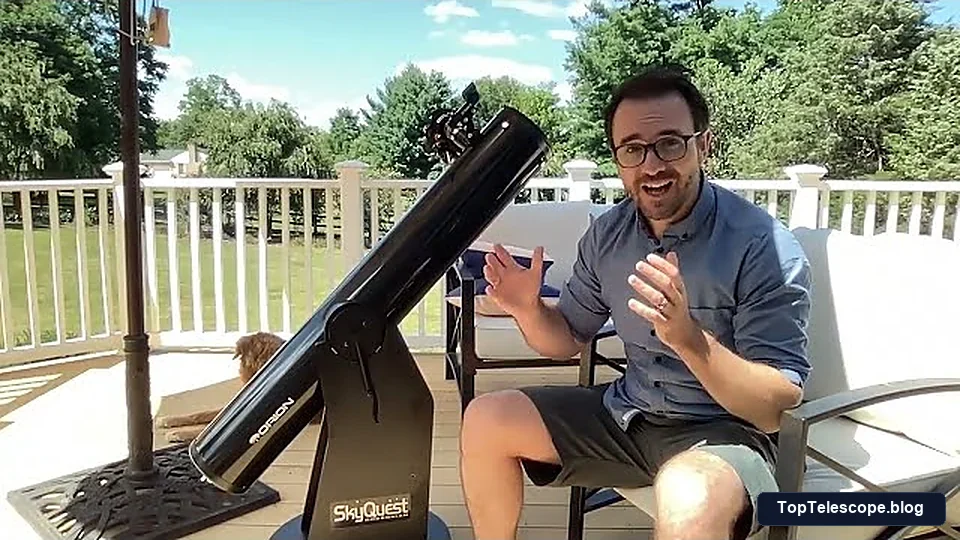
The traditional wooden base utilizes Teflon bearings for silky-smooth altazimuth motion. Navigating the night sky feels completely natural without electronic calibration hurdles.
Heavy-duty particle board construction provides an exceptionally stable platform that dampens wind vibrations quickly. Stability is paramount when viewing at high magnifications.
Manual push-to operation teaches beginners fundamental celestial coordinate navigation skills. Users learn constellations faster by actively hunting targets rather than relying on computer automation.
The heavy-duty particle board rocker box utilizes PTFE bearing pads combined with a Corian azimuth base to deliver buttery-smooth manual motions without traditional gear backlash or mechanical stiction during high-power tracking.
Altitude tension is managed through a CorrecTension pivot system, allowing users to adjust rotational resistance manually to compensate for heavy eyepieces or uneven balance points without requiring external counterweight accessories.
Operating at magnifications exceeding 200x requires deliberate, gentle nudges along both axes, relying on the inherent mass of the base assembly to dampen ground vibrations within two seconds after manual contact ceases.
- Teflon bearing movement
- Rapid vibration damping
- Intuitive manual tracking
Setup, Transport, and Long-Term Field Maintenance
Splitting the optical tube and base makes transport manageable for single-person field trips. While bulky, the setup fits easily across backseat car configurations.
Regular maintenance requires keeping optical surfaces free from dust and ambient moisture. Storing components in dry environments prevents premature coating degradation.
Protective dust covers safeguard the sensitive primary mirror securely between observation sessions. Proper hardware care guarantees decades of reliable optical service life.
Total system weight approaches 41 pounds, split evenly between the 21-pound optical tube and the 20-pound base, making transport manageable for a single operator using the integrated base handle for secure lifting.
Field assembly takes less than two minutes without tools, dropping the optical tube into the side bearing slots and securing it with captive thumbscrews designed to prevent accidental drop hazards during late-night setups.
Long-term maintenance mandates periodic mirror cleaning using distilled water and professional optical safe solutions, along with annual inspection of the azimuth center bolt to ensure proper tension and smooth rotational performance.
- Two-piece transport design
- Simple dust management
- Durable protective covers
Comparative Value and Ideal User Profiles
Budget-conscious beginners find unmatched optical value in exploring the best Dobsonian telescope for beginners selection, where skipping expensive computerized mounts directs funds entirely toward superior glass quality.
Advanced observers often use this versatile telescope as a quick-grab secondary astronomical instrument. Its unbeatable aperture-to-cost ratio makes serious stargazing accessible to everyone.
Serious astrophotography enthusiasts should look elsewhere due to the manual altazimuth mount design. Dedicated visual astronomers, however, gain an ultimate window to the universe.
Offering an exceptional aperture-to-cost ratio, this Newtonian system outperforms smaller computerized instruments by gathering significantly more light, serving as an ideal platform for intermediate visual astronomers seeking pure optical performance.
Beginners willing to learn manual celestial navigation will master star-hopping techniques quickly, developing foundational observational skills that automated GoTo systems frequently bypass during backyard astronomy sessions.
Educators and astronomy clubs will find the robust mechanical construction capable of withstanding heavy public outreach handling, while delivering consistently sharp lunar and planetary views across demanding field environments.
- High aperture-to-cost ratio
- Ideal for visual learners
- Unsuitable for long-exposure imaging
Frequently Asked Questions
Is this telescope suitable for complete beginner astronomers?
Yes, this robust instrument is exceptionally well-suited for novices because the intuitive manual altazimuth mount completely eliminates complex electronic alignment procedures that often frustrate beginners during their very first outings.
Furthermore, the large optical aperture provides bright, highly detailed celestial views that keep new stargazers continuously engaged, motivated, and excited to learn more about astronomy.
Can I use this telescope for astrophotography?
While you can easily capture casual snapshot images of the bright Moon using a simple smartphone adapter, serious long-exposure deep-sky astrophotography is unfortunately not feasible with this specific setup.
The manual altazimuth base completely lacks motorized equatorial tracking, which naturally causes severe image field rotation and target drift during extended photographic exposure times in the field.
How often does the optical system require collimation?
Routine optical collimation checks are strongly recommended before every single observing session, especially after transporting the heavy telescope across bumpy roads in a passenger vehicle.
Fortunately, the highly user-friendly rear primary mirror adjustment screws make precise optical alignment remarkably fast and simple for telescope operators of all skill levels.
Is the telescope difficult to transport to dark sky sites?
The clever two-piece modular design allows you to easily separate the large optical tube assembly from the heavy wooden base with minimal effort.
Although the complete assembly remains somewhat bulky to carry, it fits comfortably across the backseat of most standard passenger cars for impromptu weekend dark sky expeditions.
What accessories should I purchase alongside this telescope?
Upgrading to a high-quality Barlow lens will instantly double your available eyepiece magnification options without requiring a massive additional financial investment up front.
Additionally, investing in a comfortable adjustable observing chair drastically improves bodily ergonomics during long, rewarding hours spent scanning the wonderful dark night stars together.