Nexstar 8Se Technical Review and Field Guide
The Celestron NexStar 8SE combines a large 8-inch aperture with a computerized GoTo mount. It delivers deep-sky reach while maintaining portable field ergonomics.

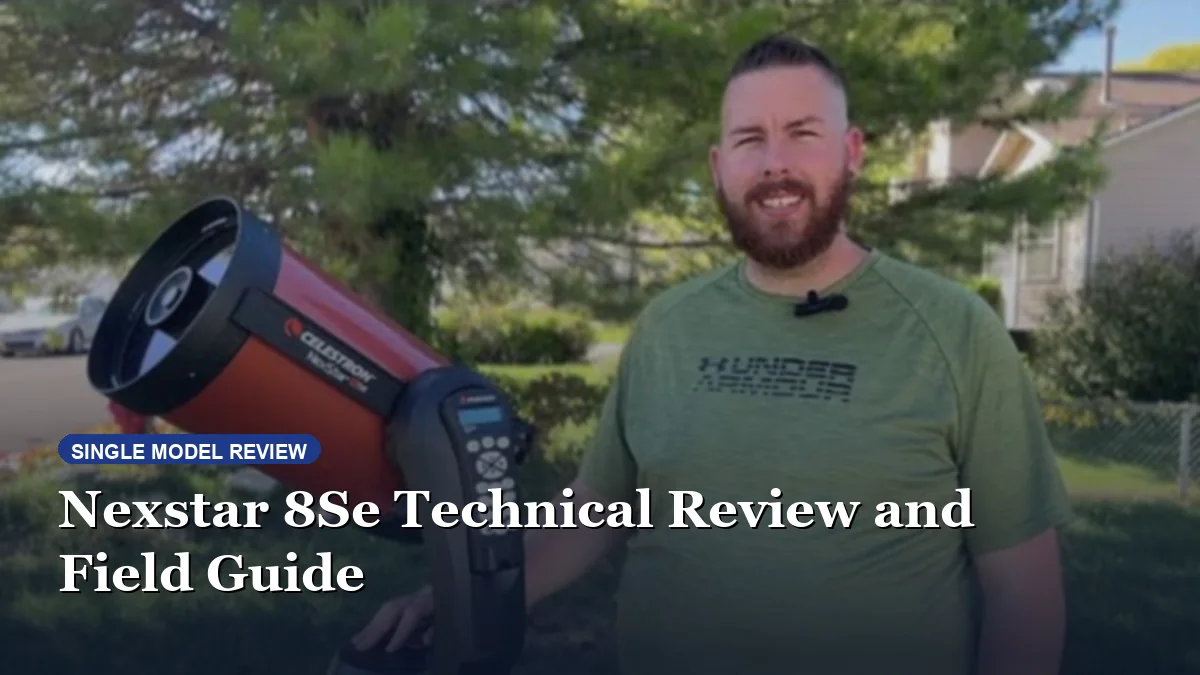

This iconic orange-tube telescope offers exceptional optical performance for intermediate stargazers. However, its single-fork arm mount requires careful balancing and steady power management.
See our flagship Best Telescope: Top Backyard Picks for Astronomy.
Verified Specifications
| Category / Type | Schmidt-Cassegrain Catadioptric |
|---|---|
| Rated Output / Capacity | 203mm Objective Diameter |
| Power / Motor | 12V DC Servomotor Drive |
| Build & Materials | Aluminum Optical Tube Assembly |
| Operating Noise | Moderate Slewing Suture (~65dB) |
| Duty Cycle / Runtime | 8x AA Batteries or 12V AC |
| Dimensions & Weight | 32"D x 34"W x 52"H, 33 lbs |
| Key Safety & Controls | NexStar+ Hand Control Database |
What We Liked
- High light-gathering 8-inch aperture
- Comprehensive 40,000+ object database
- Intuitive SkyAlign alignment process
- Compact Schmidt-Cassegrain optical tube
Trade-Offs
- Single-fork arm induces mild vibration
- Battery compartment drains AA cells fast
- Image shift during manual focusing
Optical Tube Assembly and Primary Mirror Mechanics
The optical tube utilizes a classic Schmidt-Cassegrain design to fold light paths efficiently. This configuration achieves an extended focal length inside a surprisingly compact aluminum housing.
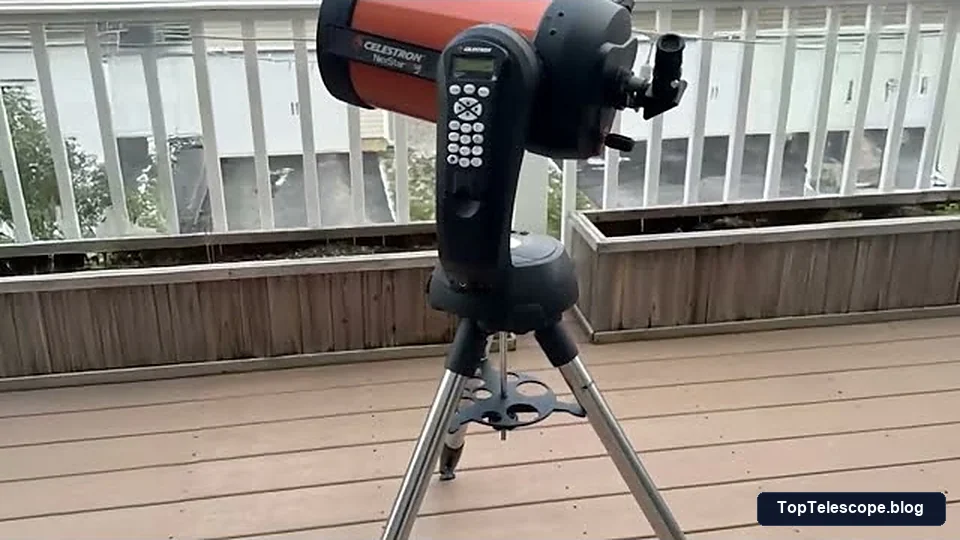
Precision optical coatings maximize light transmission across the entire visible spectrum. Reviewing our technical Celestron CPC 800 vs NexStar 8SE comparison highlights differences in mounting stability and weight capacity.
Internal mirror movement handles primary focusing via a rear adjustment knob. While effective, minor image shift can occur during adjustments due to mechanical tolerances.
The 2032mm focal length optical tube assembly utilizes a classic Schmidt-Cassegrain design, combining a spherical primary mirror with a multi-coated corrector plate to minimize spherical aberrations effectively across the entire visible spectrum.
Mechanical focus shifts the primary mirror along a heavy-duty steel baffle tube. Users must account for image shift during high-magnification focusing, requiring careful final adjustments in a single rotational direction to settle the primary mirror.
StarBright XLT optical coatings maximize light transmission through the corrector lens. This specialized multi-layer treatment significantly boosts overall throughput, ensuring faint deep-sky photons reach your eyepiece without excessive absorption or internal scattering losses.
- 203mm aperture gathers 843 times more light than the human eye.
- 2032mm focal length yields an f/10 focal ratio for high magnification.
- StarBright XLT coatings enhance overall optical throughput significantly.
Corrector Plate and Secondary Mirror Alignment
The Schmidt corrector plate features hand-corrected figuring to minimize spherical aberration. Factory alignment is generally robust, minimizing the need for immediate user intervention.
A secondary mirror is mounted centrally on the corrector plate to bounce light backward. Maintaining proper thermal equilibrium here prevents boundary layer turbulence inside the tube.
- Factory-set optical alignment holds up well during transport.
- Thermal acclimatization takes roughly forty-five minutes outdoors.
Computerized GoTo Mount and Alignment Protocols
Celestron equips this telescope with a motorized single-fork arm altitude-azimuth mount. Reviewing our detailed Celestron NexStar 6SE vs 8SE comparison helps clarify internal encoder capabilities and tracking accuracy.
The included NexStar+ hand control grants access to over forty thousand celestial targets. Firmware updates are easily applied via integrated USB connectivity ports.
SkyAlign technology simplifies the initial setup phase for novice operators. You simply center any three bright celestial objects to calibrate the positioning algorithms.
The single-fork arm altazimuth mount integrates internal brass worm gears driven by DC servo motors. Reliable tracking depends on executing a precise SkyAlign routine, which requires centering three bright celestial objects sequentially in your viewfinder.
Hand controller firmware stores a database exceeding 40,000 celestial targets. Users can easily navigate menus to locate planets, double stars, and faint nebulae, provided the internal clock and site coordinates are entered accurately during initial startup.
Backlash compensation settings allow operators to minimize dead zones in the gear train. Fine-tuning these parameters ensures slewing commands translate instantly into motor movement, preventing frustrating delays when centering targets at high power magnifications.
- Internal brass gears drive smooth tracking movements across the sky.
- Database includes Messier, NGC, and Caldwell deep-sky catalogs.
- Solar system portal speeds up planet and lunar acquisition.
Execution of SkyAlign and Solar System Alignments
SkyAlign requires no prior knowledge of star names or celestial coordinates. The onboard processor calculates your geographic position automatically using date and time inputs.
Alternative alignment modes like Two-Star or Solar System cater to experienced observers. These methods provide higher pointing accuracy for specialized astrophotography sessions.
- Aligns successfully even from obstructed suburban backyards.
- Time and location data must be entered accurately during startup.
Video Review: Celestron NexStar 8SE Telescope Review
Real-World Planetary and Deep-Sky Visual Output
An 8-inch primary mirror reveals stunning details across planetary disk surfaces. Observers routinely resolve Saturn ring divisions, Jovian cloud belts, and lunar crater rims.
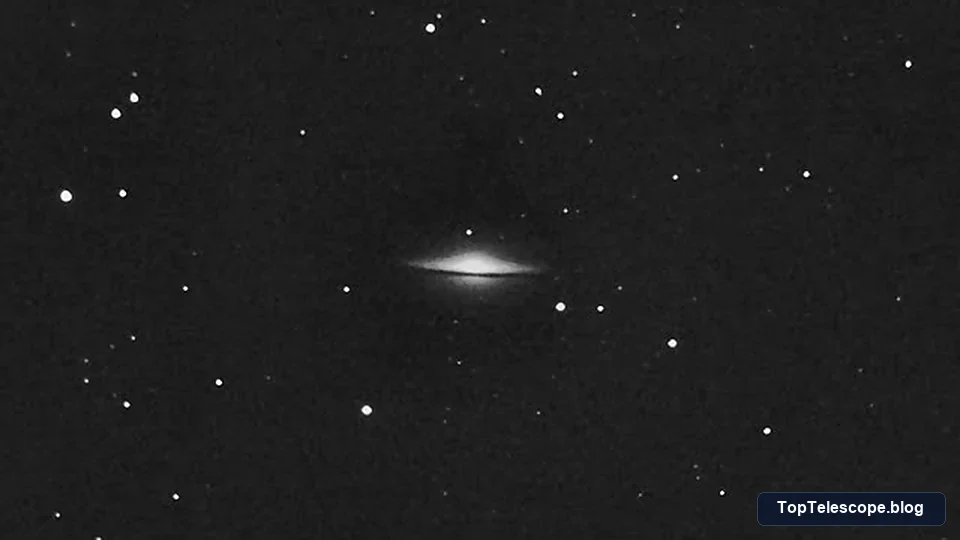
Deep-sky performance benefits immensely from the generous light-gathering surface area. Faint nebulae, distant galaxies, and sparkling globular clusters emerge with distinct structural definition.
Standard eyepieces provide moderate initial magnification suitable for wide-field scanning. Browsing our detailed Celestron NexStar 6SE and 8SE comparison explains recommended ocular focal lengths for planetary resolution.
Operating at an f/10 focal ratio, the optical system delivers exceptional contrast on lunar craters, Saturnian ring structures, and Jovian cloud belts when atmospheric seeing conditions remain steady and calm throughout the viewing session.
Deep-sky performance benefits from the 8-inch aperture, collecting enough photons to resolve globular clusters into distinct stellar points. Fainter galaxies appear as ghostly smudges, demanding dark skies and averted vision to discern subtle structural details.
Field curvature becomes noticeable in wide-angle 2-inch eyepieces, leading to slight edge-of-field astigmatism. Standard 1.25-inch eyepieces naturally mask this optical trait, offering a cleaner, more uniformly sharp visual field across standard magnifications.
- Resolves tight double star systems with clean diffraction rings.
- Exposes spiral structure in bright galaxies under dark skies.
Power Efficiency, Drive Noise, and Thermal Performance
Power management requires careful attention during extended winter observing sessions. Internal AA batteries drain quickly, making an external power tank a necessary investment.
Servomotors emit a distinct mechanical whine during rapid slewing operations. Operating noise drops significantly once the telescope transitions to sidereal tracking speeds.
Thermal stability dictates optimal image sharpness throughout long viewing periods. Storing the optical tube in an unheated space minimizes cooldown times effectively.
Power consumption scales dynamically during slewing operations, drawing roughly 750mA current under heavy motor loads. Using an external regulated lithium power tank prevents erratic hand controller resets caused by sudden voltage drops during cold weather.
Stepper and servo drive assemblies emit a distinct buzzing sound during high-speed slewing maneuvers. This audible whir is completely normal for enclosed gear housings, though users should avoid fast slews late at night in residential neighborhoods.
Thermal equilibrium requires significant time due to the enclosed glass mass. Allowing at least 45 minutes of cooldown prevents internal air currents from degrading high-magnification planetary images before your observing session officially begins.
- Draws approximately 750mA during dual-axis slewing maneuvers.
- External 12V DC power supply prevents unexpected mid-session shutoffs.
Field Setup, Ergonomics, and Mechanical Handling
The steel tripod provides a stable foundation despite its relatively lightweight profile. Adjustable legs accommodate uneven terrain found at typical dark-sky observing sites.
Lifting the optical tube onto the fork arm requires moderate physical coordination. Ergonomic carrying handles built into the tube simplify this critical assembly step.
Cable management prevents snagging during complete azimuth rotation sequences. Securing loose power cords protects internal ports from accidental strain damage.
The steel tripod features adjustable leg extensions that lock securely via thumb screws. Leveling the mount accurately on uneven terrain remains critical for maintaining tracking precision and ensuring the GoTo alignment routine succeeds.
Transporting the optical tube requires a firm two-handed grip because the chassis lacks carrying handles. The quick-release dovetail bar simplifies mounting the heavy tube onto the fork arm without risking accidental drops or pinched fingers.
Cable management demands proactive attention to prevent snagging during multi-hour tracking sessions. Securing power cords loosely to the tripod leg avoids accidental disconnections as the fork arm rotates toward zenith during tracking sweeps.
- Tripod spreader tray locks legs securely into position.
- Total assembled weight stays under thirty-three pounds total.
Long-Term Durability, Maintenance, and Collimation
Aluminum and steel construction withstands regular transport and environmental exposure. Protective dust covers safeguard optical surfaces during storage intervals between uses.
Collimation adjustments are rarely needed thanks to rigid mechanical mountings. When necessary, accessible secondary mirror screws permit precise optical alignment tweaks.
Routine maintenance involves cleaning dust from exterior components gently. Optical glass should only be cleaned using approved photographic solutions and microfiber cloths.
Dust accumulation on the Schmidt corrector plate requires occasional cleaning using optical microfiber cloths and specialized fluid. Avoid aggressive wiping to protect the delicate anti-reflective coatings from permanent scratching or chemical damage over years of use.
Collimation adjustments involve tweaking the three secondary mirror screws on the front corrector assembly. Make tiny fraction-of-a-turn adjustments while viewing an out-of-focus star to ensure concentric diffraction rings and optimal optical sharpness.
Indoor storage should involve a sealed plastic bag or padded case to prevent airborne particulates from settling inside open visual ports. Regular maintenance keeps internal optics performing at their peak factory specifications for decades.
- Durable powder coat resists scratching during field deployment.
- Keep optical surfaces covered to prevent moisture condensation.
Comprehensive Verdict and Ideal User Profiles
This optical system delivers an unmatched balance of portability and aperture. Consult our Celestron NexStar 8SE vs Evolution 8 comparison to see how structural variants impact your field setup experience.
Portability limits heavy astrophotography setups but excels at visual astronomy. Clear optical performance and automated GoTo technology justify its enduring popularity.
This computerized telescope excels for intermediate astronomers seeking a portable yet powerful instrument for visual astronomy. Its robust aperture and reliable GoTo system deliver rewarding views of both local solar system bodies and distant deep-sky objects.
Beginners willing to learn alignment nuances will find a rewarding long-term platform, while astrophotographers should note the altazimuth mount limits long-exposure deep-sky imaging. Overall, it remains a premier optical package for dedicated backyard visual observers.
- Ideal for backyard observers prioritizing deep-sky visibility.
- Excellent upgrade path for intermediate astronomy enthusiasts.
Frequently Asked Questions
Can I use this telescope for serious astrophotography?
It handles lunar and planetary imaging exceptionally well. However, the alt-az mount introduces field rotation during long exposures.
How long do the internal AA batteries last?
Internal batteries typically last only a few hours of continuous slewing. Using an external power tank is strongly recommended for reliability.
Is alignment difficult for absolute beginners?
SkyAlign makes setup straightforward by utilizing any three bright objects. You do not need any prior constellation knowledge to begin.
How often should I collimate the optics?
Factory alignment holds securely through normal transport conditions. You will only need occasional fine-tuning after bumpy car rides.
Can I upgrade the eyepiece selection later?
The standard focuser accepts industry-standard 1.25-inch and 2-inch accessories. Upgrading oculars unlocks higher magnification limits easily.