Celestron NexStar 4SE Technical Review
The Celestron NexStar 4SE pairs legendary orange-tube aesthetics with a computerized Maksutov-Cassegrain optical system. It delivers high-contrast planetary views while maintaining a compact, highly portable footprint.

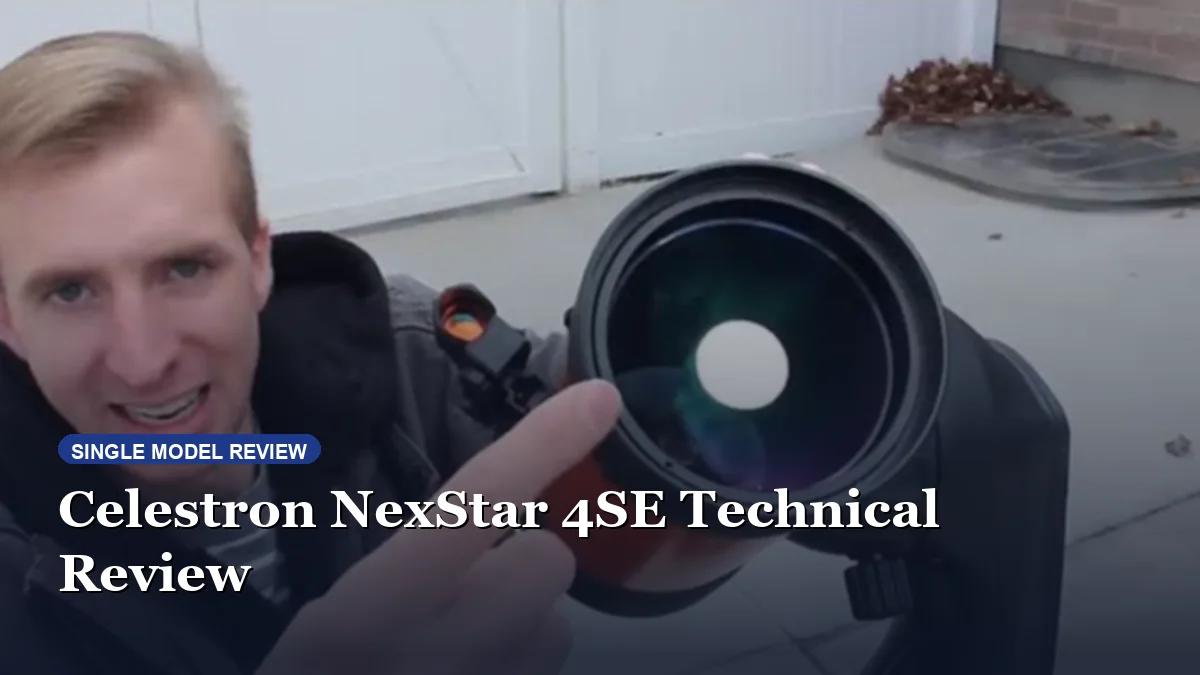
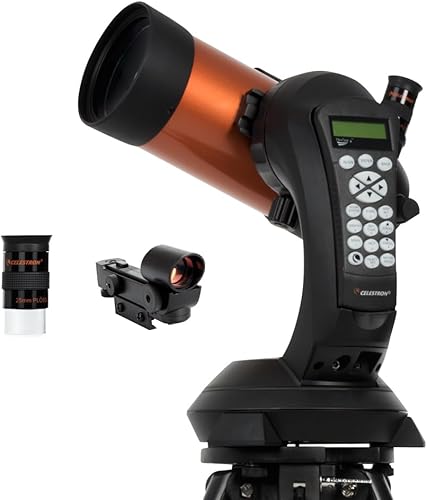
This GoTo telescope offers exceptional optical sharpness and user-friendly automation for beginners. However, its long focal length demands careful thermal acclimation and steady power management during extended sessions.
See our flagship Best Telescope: Top Backyard Picks for Astronomy.
Verified Specifications
| Category / Type | Maksutov-Cassegrain GoTo Telescope |
|---|---|
| Rated Output / Capacity | 102mm Objective Lens Diameter |
| Power / Motor | 8 AA Batteries or 12V DC Adapter |
| Build & Materials | Aluminum Optical Tube, Molded Composite Fork |
| Operating Noise | Moderate Servo Motor Whine During Slews |
| Duty Cycle / Runtime | Approx. 4-6 Hours on Fresh Alkaline Cells |
| Dimensions & Weight | 34.3cm Tube Length, 21 lbs Total Weight |
| Key Safety & Controls | NexStar+ Hand Control with SkyAlign Tech |
What We Liked
- Sharp 4-inch Maksutov optics excel at lunar and planetary details
- Compact single-fork arm simplifies transport and field setup
- SkyAlign technology provides fast and reliable alignment routines
- Built-in equatorial wedge accommodates entry-level astrophotography
Trade-Offs
- Long focal length creates a relatively narrow apparent field of view
- Sealed optical tube requires extended cooldown periods before viewing
- Battery compartment demands frequent cell replacement during cold nights
Optical Architecture and Tube Engineering
The optical tube utilizes a 102mm aperture Maksutov-Cassegrain design. This folded configuration achieves a long focal length within a compact, easily transportable aluminum chassis.
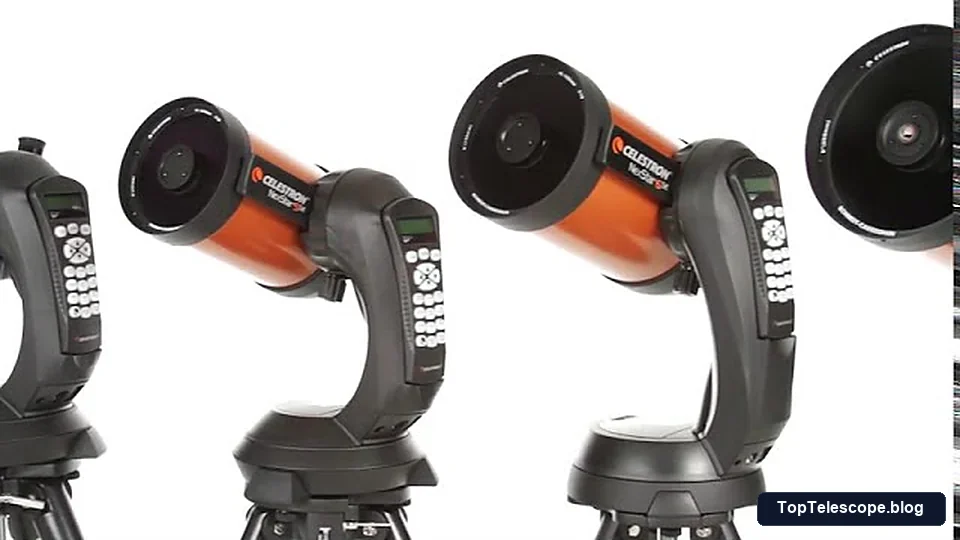
Internal baffling suppresses stray light reflections to maximize contrast. When sizing up options like our celestron nexstar 4se vs 5se guide, this optical layout handles high magnifications exceptionally well during planetary viewing sessions.
The Maksutov-Cassegrain design features a 102mm aperture and a 1325mm focal length, yielding an f/13 focal ratio. This folded optical path delivers high-contrast planetary resolution without chromatic aberration.
Internal baffling suppresses stray light reflections effectively. The primary mirror uses a heavy-duty aluminum casting housing, while the corrector plate relies on advanced coatings to maximize light transmission across the spectrum.
- 102mm primary objective lens diameter
- Multi-coated optics optimize light transmission
- Compact 34.3cm physical optical tube length
Secondary Mirror and Corrector Plate
A thick meniscus corrector lens features an aluminized spot acting as the secondary mirror. This design eliminates traditional spider vanes, eradicating diffraction spikes on bright stars.
Collimation is factory-set and permanently fixed, preventing alignment drift during transit over rough terrain.
- Factory-fixed primary and secondary alignment
- Thick meniscus corrector plate with spot mirror
Mount Mechanics and Automation Performance
A single-fork alt-azimuth arm houses the drive electronics and internal gear motors. The mount relies on brass worm gears to drive both axes smoothly during tracking.
The included NexStar+ hand control interfaces directly with a database exceeding forty thousand celestial objects. Consult our nexstar 4se vs 5se vs 6se comparison to evaluate these standard motor slewing speeds.
Driving the alt-azimuth base are brass worm gears coupled to DC servo motors. These mechanical actuators provide smooth tracking rates, though backlash must be managed properly during high-magnification centering adjustments.
The SkyAlign routine simplifies initial alignment by using any three bright celestial objects. Internal encoders maintain positional awareness, allowing accurate GoTo slewing across the comprehensive 40,000-object database stored in the hand control.
- Computerized Altitude-Azimuth Single Fork Arm
- Database containing over 40,000 celestial targets
- Variable slew speeds up to 9 degrees/sec
SkyAlign Alignment Protocols
SkyAlign technology eliminates the need for manual star identification. Users simply center any three bright celestial objects in the eyepiece to calibrate the internal computer.
Internal sensors calculate exact latitude, longitude, and local time parameters automatically once initialization sequences conclude successfully in the field.
- No star name knowledge required for alignment
- Fast three-point calibration routine
Video Review: Celestron NexStar 4SE: The Best Beginner Telescope?
Thermal Dynamics, Cooling and Efficiency
Maksutov-Cassegrain tubes trap air masses internally due to sealed optical configurations. Thick corrector lenses require careful thermal acclimation, which you can examine further in our celestron nexstar 6se vs 8se technical comparison.
Failure to allow adequate thermal acclimation results in persistent internal air currents. These thermal plumes degrade high-magnification planetary resolution until complete equilibrium occurs.
Sealed Maksutov tubes trap ambient heat efficiently, requiring up to 45 minutes of thermal acclimatization. Without this stabilization period, internal air currents will severely degrade high-power planetary and lunar viewing clarity.
Managing tube currents demands proactive measures. Users should store the instrument in unheated transition spaces prior to sessions, minimizing the delta between ambient outdoor temperatures and the optical assembly.
- Sealed optical tube traps internal warm air
- Requires 45 to 60 minutes for thermal stabilization
- Thermal plumes impact high-power sharpness initially
Power Consumption and Drive Efficiency
Internal servo motors draw steady electrical current during tracking operations. Voltage drops below eleven volts can trigger erratic hand control reboots during slewing maneuvers.
Operators should utilize external regulated power tanks to ensure consistent voltage delivery throughout lengthy astronomical observation sessions.
- Sensitive to low input voltage fluctuations
- External power tanks recommended for stability
Field Ergonomics and Setup Procedures
The entire assembly disassembles into manageable components for safe transport. As noted throughout our celestron nexstar 8se vs evolution 8 comparison, steel tripod legs provide a rigid foundation while keeping total system weight low.
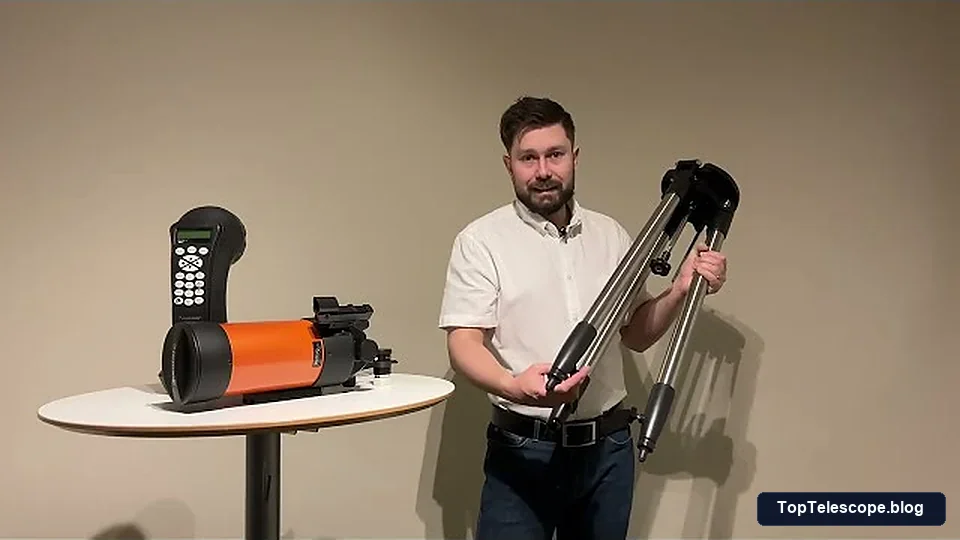
Ergonomic locking levers on the altitude clutch allow manual adjustments when power is unavailable. Cable management requires attention to prevent snagging during automated multi-axis slewing.
Weighing just 21 pounds fully assembled, the entire system transport is exceptionally manageable. The steel tripod provides a stable foundation, though securing the accessory tray is vital for dampening vibrations.
Power management relies on an internal 8 AA battery compartment or an external 12V DC adapter. Utilizing a regulated power tank prevents erratic slewing behavior caused by voltage drops during cold operations.
- Total assembled weight under twenty-one pounds
- Sturdy steel-tubed adjustable field tripod
- Manual altitude clutch for non-powered adjustments
Long-Term Durability and Maintenance Standards
Aluminum castings and reinforced composite plastics withstand standard field wear and tear. Protective powder coating guards the optical tube against minor scratches and atmospheric moisture.
Routine maintenance remains minimal due to the sealed optical design. Users only need to clean external corrector lens surfaces periodically using specialized optical microfiber cloths.
Routine upkeep requires minimal intervention, yet optical cleaning must be performed sparingly. Compressed air removes loose particulate matter, while archival optical wipes clear stubborn grease from the meniscus corrector.
Mechanical longevity depends on proper clutch engagement and dry storage conditions. Periodic tension checks on the tripod fasteners prevent structural wobble and ensure consistent tracking performance over years of use.
- Durable powder-coated aluminum optical tube
- Sealed design keeps dust off internal optics
- Backed by a two-year manufacturer warranty
Buyer Alignment: Who Wins and Who Skips
Beginners seeking automated GoTo functionality will find this telescope exceptionally rewarding. Lunar and planetary observers benefit immensely from the high-contrast focal length capabilities.
Wide-field deep-sky observers should skip this model due to its restrictive focal length. Astrophotographers seeking advanced deep-space imaging platforms may also outgrow its fork-arm design quickly.
Lunar, planetary, and double star enthusiasts will appreciate the sharp, uncolored focal images. Urban astronomers benefit immensely from the compact footprint, which easily navigates restrictive apartment balconies and tight spaces.
Wide-field deep-sky observers should skip this model due to its narrow maximum field of view. Astrophotographers seeking serious long-exposure capability will also find the alt-azimuth mount tracking limits too restrictive.
- Ideal for lunar, planetary, and double-star viewing
- Not suited for wide-field nebulae or galaxies
- Great entry point for automated GoTo astronomy
Frequently Asked Questions
Can this telescope track objects automatically?
Yes, the computerized alt-azimuth mount utilizes internal servo motors to automatically track targets across the night sky once aligned.
What power sources are compatible with the mount?
The system accepts eight AA batteries, a standard twelve-volt AC adapter, or external lithium-ion power tanks for extended field operation.
Is this telescope suitable for viewing deep-space nebulae?
While it can locate brighter deep-sky objects, its narrow field of view makes it best optimized for planets and the Moon.
How difficult is the initial alignment process?
Alignment is straightforward using SkyAlign technology, requiring the user to center three bright objects without knowing their specific names.
Does the telescope include an equatorial wedge?
Yes, it features a built-in equatorial wedge on the bottom plate to enable entry-level long-exposure astrophotography capabilities safely.