Meade Polaris 130 Eq Review: Technical Performance Guide
This 130mm Newtonian reflector pairs robust aperture with manual equatorial tracking. It delivers notable deep-sky views despite minor mechanical trade-offs.

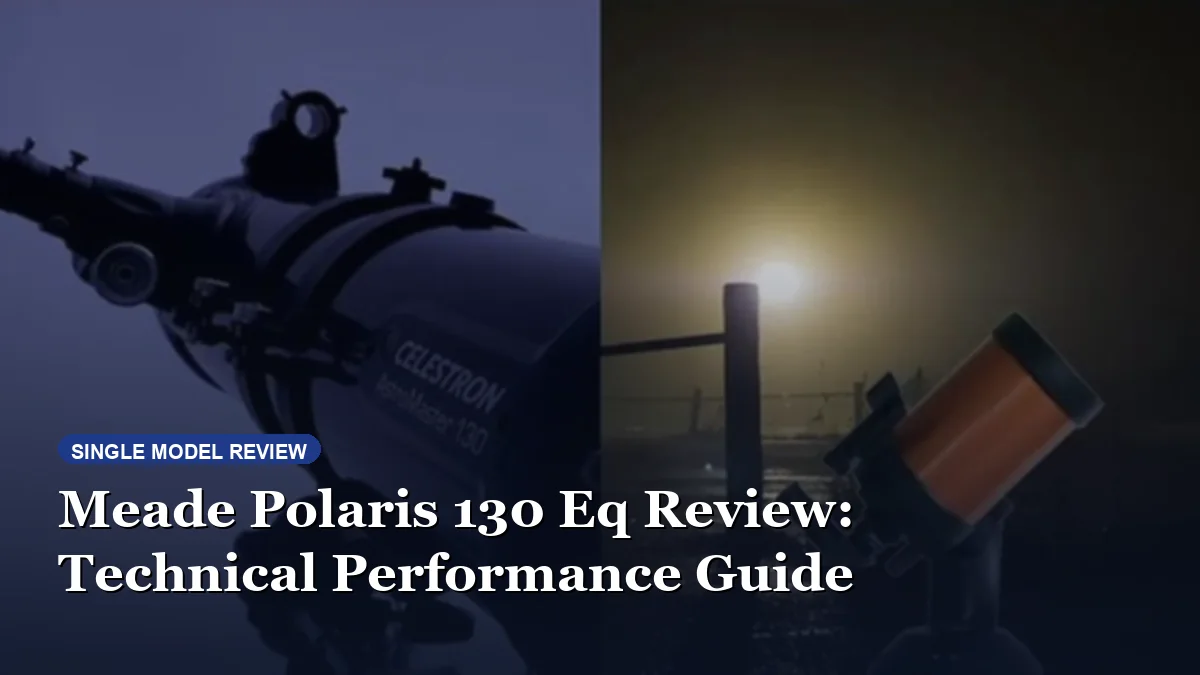

The Meade Polaris 130 EQ offers impressive light-gathering power for entry-level budgets, though its mount requires patience during precise polar alignments. It remains a capable deep-sky instrument for dedicated beginners.
Explore related alternatives in our Best Meade Telescope For Beginners.
Verified Specifications
| Optical Design | Newtonian Reflector |
|---|---|
| Objective Aperture | 130 mm (5.1 inches) |
| Focal Length | 650 mm (f/5) |
| Mount Type | German Equatorial (EQ) |
| Tripod Material | Adjustable Aluminum |
| Optical Coatings | Fully Coated Glass |
| Finderscope | Red Dot or Straight-Through |
| Included Eyepieces | Three standard 1.25-inch |
| Total Weight | Approx. 27 pounds assembled |
| Power Source | Manual (Optional RA Motor) |
What We Liked
- Generous 130mm light-gathering aperture for faint fuzzies
- Stable aluminum tripod frame reduces low-frequency vibrations
- Comprehensive accessory bundle including barlow and filters
- Smooth fine-turned control cables for manual celestial tracking
- Sturdy optical tube assembly with protective exterior finish
Trade-Offs
- Equatorial mount learning curve can frustrate absolute beginners
- Plastic accessory tray fasteners require careful handling over time
- Factory collimation may shift during rough shipping transit
- Included red dot finder requires precise manual calibration
Optical Design, Aperture Metrics, and Tube Construction
The optical tube features a generous 130mm aperture housed inside a durable metal chassis. This physical diameter collects significantly more light than smaller beginner scopes.
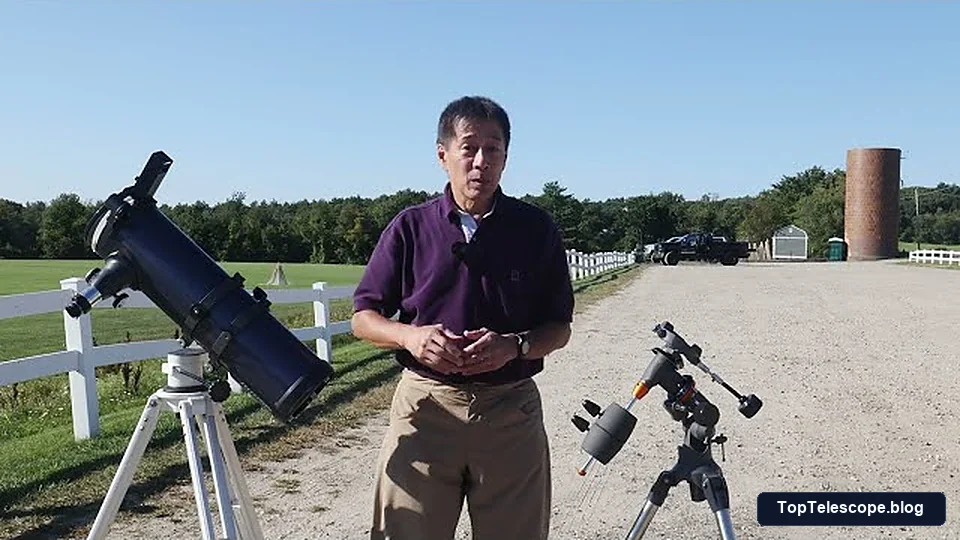
Fully coated glass optics maximize light transmission across the primary parabolic mirror. Optical comparisons such as our Celestron EdgeHD 8 vs Meade LX90 8 breakdown illustrate how proper coatings minimize internal reflection losses.
The compact focal length of 650mm yields a fast f/5 optical system. Such focal ratios produce wide, expansive star fields that benefit large deep-sky object observations.
The optical tube assembly features a 130mm primary mirror housed inside a sturdy rolled-steel chassis measuring roughly 650mm in length. This physical dimension balances focal reach with manageable transport weight for field excursions.
Operating at a focal length of 650mm, the system yields an overall focal ratio of f/5. Such specifications deliver wide-field sky coverage while demanding proper mechanical tolerances to maintain alignment during routine handling sessions.
Internal baffling plays a vital role in suppressing stray light reflections. The matte black interior coating absorbs off-axis photons, helping to preserve essential contrast when observing faint deep-sky targets under moderately light-polluted suburban skies.
- 130mm primary mirror diameter balances portability and light grasp
- Fast f/5 focal ratio provides wide visual star fields
- Fully coated glass surfaces reduce internal light scattering
Primary Mirror Physics and Light Gathering
Aperture size dictates overall resolution limits for any amateur reflecting telescope. The 130mm mirror resolves tight double stars easily.
Light grasp exceeds smaller 70mm or 90mm refractors by substantial margins. Fainter nebulae and distant star clusters emerge clearly under dark skies.
- Resolves lunar craters down to sub-kilometer details
- Exposes spiral structure in brighter Messier galaxies
German Equatorial Mount Mechanics and Tracking Stability
A German equatorial mount anchors this system, providing smooth tracking along the celestial sphere. Users align the polar axis with Polaris for effortless manual tracking.
Slow-motion control cables let observers make minute adjustments in both right ascension and declination. These flexible cables prevent hand vibrations from shaking the eyepiece view.
Balancing the tube correctly on the declination axis prevents excessive wear on internal worm gears. Proper counterweight placement ensures butter-smooth movement across the night sky.
The included equatorial head relies on setting circles and slow-motion cables to facilitate manual tracking across celestial coordinates. Users must align the polar axis with celestial north to compensate for Earth rotation during long-exposure sessions.
Supported by a sturdy aluminum tripod, the mount platform absorbs moderate vibrational energy. However, heavy wind gusts or aggressive focusing adjustments can induce noticeable image shaking that requires a brief settling time to fully dissipate.
Proper balancing requires careful counterweight adjustment along the DEC shaft. Securing equilibrium prevents excessive gear wear inside the worm drives and ensures smooth manual tracking across the night sky without binding the mechanical axes.
- German equatorial configuration facilitates accurate celestial tracking
- Flexible slow-motion cables isolate hands from optical vibrations
- Adjustable setting circles help locate coordinates using star charts
Polar Alignment Procedures and Best Practices
Achieving precise polar alignment requires tilting the mount latitude bolt to match your exact local horizon. This step is critical for tracking objects.
Locking down altitude and azimuth adjustments secures the polar axis firmly against shifting wind loads. Take time to balance counterweights before final viewing sessions.
- Match latitude scale to your current geographic positioning
- Secure locking knobs firmly to maintain tracking alignment
Video Review: Space Launcher 76mm vs Astromaster 130EQ Reflector Telescope | Zooming in on JUPITER \u0026 ORION NEBULA
Optical Performance, Coatings, and Deep-Sky Output
Optical performance remains remarkably sharp across bright lunar surfaces and planetary disks. Contrast levels stay high due to internal tube baffling suppressing stray light.
Broadband anti-reflection coatings applied to corrective lenses improve overall photon throughput. You will notice brighter planetary cloud belts and crisper lunar terminator shadows.
When touring deep-space targets, wide fields reveal extensive star clusters. Faint nebulae benefit greatly from the light-gathering capacity of the primary mirror.
Aluminum mirror surfaces feature protective silicon dioxide overcoats to resist oxidation over years of field use. These reflective optical coatings maximize light transmission while safeguarding the delicate glass substrate from atmospheric humidity and atmospheric dust.
Planetary observations reveal crisp cloud belts on Jupiter and the Saturnian ring system when using high magnification. Spherical aberration remains well managed at the f/5 focal ratio, rendering sharp lunar craters during optimal atmospheric seeing conditions.
Deep-sky performance excels on extended emission nebulae and bright open clusters. The generous light grasp resolves individual stellar components within crowded galactic fields while maintaining pleasing contrast against dark background skies across rural observing sites.
- High contrast optical baffling minimizes stray atmospheric glare
- Broadband coatings optimize photon transmission efficiency
- Delivers bright, high-resolution views of lunar craters
Planetary Contrast and Deep-Sky Resolution
Observing Saturn requires steady atmospheric seeing conditions combined with proper thermal acclimatization. High-magnification eyepieces reveal planetary ring divisions cleanly.
Distant deep-sky objects appear as delicate gray patches due to human eye limitations. Using averted vision helps detect subtle outer structures in galaxies.
- Resolves Jovian cloud bands and Galilean moon disks
- Reveals mottled core structures in globular star clusters
Included Accessories, Eyepieces, and Optical Add-ons
The comprehensive accessory package includes standard 1.25-inch eyepieces for variable magnification steps. These optics cover low-power wide-field scanning and high-power planetary study.
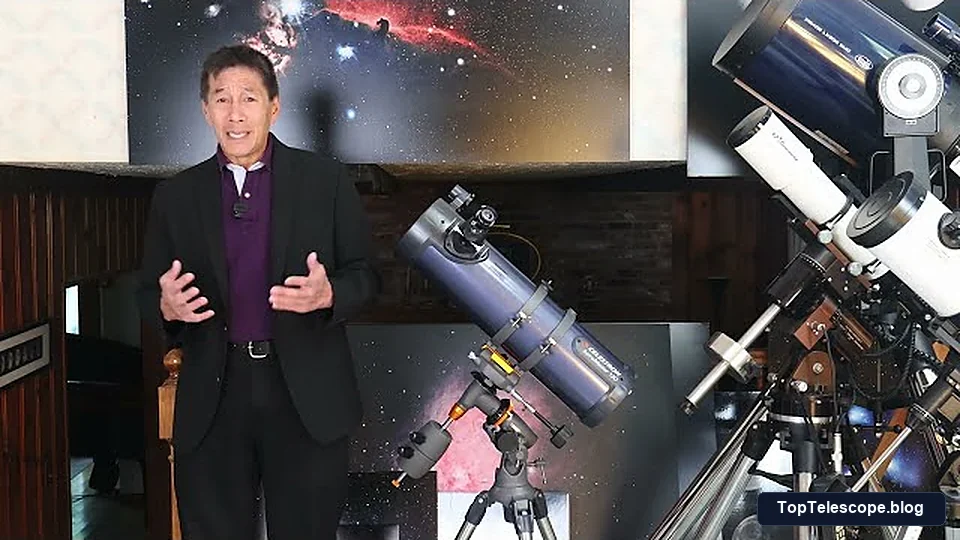
A dedicated erecting barlow lens doubles magnification while keeping images right-side up. This versatile tool effectively doubles your available eyepiece inventory instantly.
The bundled moon filter cuts glare significantly during bright lunar phases. Smartphone adapters let casual observers capture quick afocal snapshots through the eyepiece.
Standard package inclusions feature two distinct Kellner eyepieces delivering differing magnification levels for versatile target acquisition. Their multi-element optical designs provide acceptable eye relief for casual stargazers without introducing excessive edge distortion.
The bundled red dot finder projects an adjustable LED point onto a clear glass window. This reflex sight accessory allows rapid alignment without reversing image orientations, streamlining the initial star-hopping process before moving to higher magnifications.
Users seeking higher power often add a 2x Barlow lens to double the effective focal length of any inserted eyepiece. This modular expansion doubles available viewing options without requiring a massive collection of individual ocular elements.
- Multiple 1.25-inch eyepieces cover diverse magnification requirements
- Erecting barlow lens extends focal length and versatility
- Included lunar filter preserves dark adaptation during full moons
Evaluating the Barlow Lens and Smartphone Adapter
Barlow lenses introduce glass elements that can slightly reduce light transmission if dirty. Keep optical surfaces pristine for maximum clarity.
The smartphone adapter clamps securely onto standard eyepieces for quick lunar photography. Aligning your phone camera lens takes patience but yields fun results.
- Barlow doubles power for high-magnification planetary viewing
- Phone clamp fits most modern mobile device dimensions
Setup, Ergonomics, and Field Assembly Procedures
Field assembly requires no complex tools thanks to oversized hand knobs securing major components. The aluminum tripod spreads wide to lock into a rigid stance.
Attaching the optical tube involves sliding the dovetail bar directly into the mount saddle. Tightening the side clamps secures the heavy metal tube safely.
Ergonomic cable placement allows comfortable seated viewing during extended backyard astronomy sessions. Finding the right hardware often starts by reviewing our best telescope options for backyard stargazing.
Assembling the mount outdoors requires locking the spreader tray firmly to increase structural rigidity. Proper tripod leg extension ensures a stable working height while preventing accidental tipping during evening operations in unlit environments.
Attaching the optical tube involves securing the dovetail bar into the saddle clamp locking knobs. Tightening these fasteners securely prevents accidental slippage during steep vertical orientation shifts required for zenith viewing targets.
Ergonomic positioning of the slow-motion control cables ensures comfortable access from standard observing chairs. Keeping cables within easy reach minimizes physical fatigue during extended stargazing sessions across dynamic celestial coordinates.
- Tool-free hand knobs simplify rapid field assembly
- Vixen-style dovetail bar ensures secure optical tube attachment
- Adjustable aluminum tripod legs accommodate uneven ground
Tripod Stability and Field Transportability
A sturdy tripod base prevents dampening time from dragging out after focusing touches. Aluminum legs absorb minor bumps without disrupting alignment.
Transporting the entire assembly requires two separate trips for safety and ease. Breaking down the tube from the mount reduces accidental impact risks.
- Wide stance aluminum tripod maximizes load stability
- Lightweight components allow manageable backyard transport
Maintenance, Collimation, and Long-Term Durability
Newtonian reflectors require occasional mirror alignment known as collimation to maintain sharpness. Using a simple collimation cap ensures optical axes align correctly.
Dust accumulation on the primary mirror is normal and rarely requires immediate cleaning. Excessive cleaning risks scratching delicate mirror coatings over time.
Storing the telescope indoors within a dry environment prevents internal moisture corrosion. Choosing durable units from our best starter telescope guide ensures long-term reliability against everyday environmental wear.
Newtonian reflectors demand periodic mirror collimation to maintain sharp focus and optimal optical resolution. Adjusting the rear cell alignment screws using a simple Cheshire eyepiece guarantees precise optical axis alignment prior to critical planetary sessions.
Dust accumulation on optical surfaces should be removed using a bulb blower rather than abrasive cleaning cloths. Proper lens maintenance techniques prevent microscopic scratching of aluminum reflective layers while preserving maximum light throughput.
Storing equipment in climate-controlled environments prevents moisture condensation from attacking metallic mount components. Routine inspection of fastener tightness guarantees long-term mechanical reliability across multiple seasons of outdoor astronomical exploration.
- Routine collimation maintains peak high-magnification sharpness
- Minimalist cleaning preserves fragile optical mirror coatings
- Dry indoor storage protects metal chassis from oxidation
Collimation Mechanics and Mirror Care
Adjustment screws on the rear mirror cell let users tweak tilt angles precisely. Small turns make massive differences in star diffraction patterns.
Never touch mirror reflective surfaces with bare fingers or abrasive cloths. Dust particles affect images far less than microscopic scratches do.
- Rear cell thumb screws adjust primary mirror tilt
- Avoid direct physical contact with aluminized glass surfaces
Comparative Buyer Verdict and Ideal User Profile
When selecting starter equipment, many novice astronomers evaluate choices featured in our best meade telescope for beginners roundup. This specific scope suits dedicated hobbyists seeking serious optical light grasp.
If you want instant point-and-view simplicity without polar alignment, a Dobsonian might fit better. However, this equatorial platform offers a great stepping stone.
Ultimately, the balanced optical output and rich accessory bundle deliver enduring value. It remains a compelling choice for backyard astronomers ready to explore deep space.
This telescope serves as an ideal starter instrument for aspiring astronomers seeking genuine Newtonian reflector performance without overwhelming complexity. Its balanced focal specs bridge the gap between wide-field nebulas and detailed planetary viewing.
Experienced hobbyists will appreciate the optical capacity as a portable grab-and-go setup for dark-sky excursions. However, absolute beginners should expect a learning curve regarding equatorial mount operation and manual polar alignment procedures.
Overall value remains strong for users willing to master manual tracking mechanics and routine collimation upkeep. This optical system delivers rewarding visual experiences for dedicated enthusiasts willing to invest time in proper field setup.
- Ideal for hobbyists wanting equatorial tracking mechanics
- Offers superior light collection over smaller beginner refractors
- Rewards user patience with detailed planetary and lunar views
Who Should Buy Versus Who Should Skip
Choose this model if you enjoy learning equatorial mechanics and deep-sky navigation. It rewards inquisitive minds with impressive celestial views.
Skip this instrument if you need ultra-portable grab-and-go simplicity for quick camping trips. Setup complexity can deter casual users who lack patience.
- Recommended for dedicated backyard astronomy hobbyists
- Not ideal for casual users seeking zero-setup simplicity
Frequently Asked Questions
Is the Meade Polaris 130 EQ difficult to assemble for beginners?
Assembly requires basic mechanical patience and takes about thirty minutes. Tool-free knobs simplify the process, though learning equatorial alignment takes practice.
Can I use this telescope for serious astrophotography work?
This manual equatorial mount is optimized for visual astronomy. While you can snap quick phone pictures, long-exposure deep-sky imaging requires motorized tracking drives.
How often do I need to align the primary mirror optics?
Collimation checks should happen before every viewing session, especially after transport. Minor adjustments using rear thumb screws keep optical sharpness at its peak.
What kind of objects can I see with a 130mm aperture?
You will easily observe lunar craters, Saturn rings, and Jovian belts. Dark skies also reveal brighter deep-space nebulae and distant star clusters.
Does the package include everything needed for first observations?
Yes, the kit includes multiple eyepieces, a barlow lens, and a moon filter. You have all essential optical accessories right out of the box.