Meade LX90 ACF Review: Advanced Performance Guide
The Meade LX90 ACF delivers advanced coma-free optics inside a robust fork mount. Users face trade-offs regarding its substantial weight and power draw during long field sessions.


This system excels at deep-sky imaging and lunar observation thanks to its crisp focal plane. However, the heavy fork assembly requires patience during transport and careful power management.
See our flagship Best Telescope: Top Backyard Picks for Astronomy.
Verified Specifications
| Optical Design | Advanced Coma-Free (ACF) |
|---|---|
| Aperture | 203 mm (8 inches) |
| Focal Length | 2000 mm (f/10) |
| Mount Type | Dual-Fork Altazimuth |
| Computer Control | AudioStar Hand Controller |
| Coatings | Ultra-High Transmission Coatings (UHTC) |
| Power Source | 12V DC External Battery |
| OTA Weight | 6.1 kg (13.5 lbs) |
| Total Weight | 19 kg (42 lbs) |
| Finderscope | 8x50 Optical |
What We Liked
- Stunning edge-to-edge optical sharpness without coma
- Robust dual-fork mount minimizes vibration effectively
- Extensive internal GoTo database of celestial objects
- UHTC coatings maximize light transmission across the spectrum
Trade-Offs
- Heavy assembly requires careful transport and handling
- Internal motors generate audible noise during slewing
- High power draw demands reliable external battery solutions
Optical Design and Advanced Coma-Free Engineering
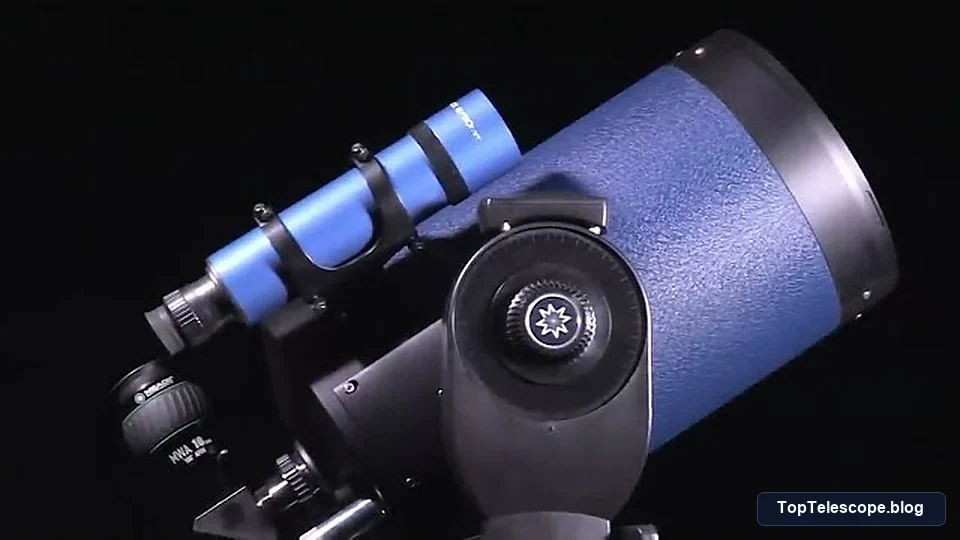
Meade engineered this optical tube to eliminate astigmatism and diffraction spikes across wide fields. The Advanced Coma-Free design mimics ritchey-chretien performance while maintaining a more accessible price point for serious hobbyists.
Multi-layer coatings maximize light transmission through the corrector plate to enhance contrast. Star clusters appear sharply defined right up to the very edge of standard 1.25-inch and 2-inch eyepieces.
The Meade ACF optical design utilizes a hyperbolized secondary mirror to eliminate coma aberrations. Review our detailed optical comparison to see how flat-field imaging systems stack up.
Baffle systems inside the optical tube assembly minimize stray light reflection. Precision aluminum castings house the primary mirror cell, ensuring structural rigidity during long exposures under variable night sky conditions.
- Eliminates off-axis coma artifacts completely
- Improves photographic field flatness significantly
- Utilizes specialized UHTC glass treatments
Corrector Plate Specifications
The Schmidt corrector incorporates high-transmission glass to minimize chromatic aberration. Precise figuring ensures wavefront errors remain well below diffraction-limited thresholds during normal operating conditions.
- High-transmission crown glass construction
- Strict surface accuracy tolerances
Fork Mount Mechanics and GoTo Tracking Accuracy
Dual-fork arms provide rigid support that significantly minimizes vibration during manual focusing adjustments. Internal servomotors drive precision worm gears for smooth tracking across celestial coordinates.
The integrated AudioStar computer controller features a massive database of celestial targets. When evaluating entry-level options, consult our beginner telescope guide to find ideal tracking mounts.
The dual-fork mount features oversized worm gears driven by high-torque DC servo motors. This mechanical setup supports precise tracking essential for astrophotography and deep-sky observation sessions lasting several hours.
AutoStar computer controllers interface smoothly with alignment routines. Internal sensors map the celestial sphere, utilizing multi-star alignment algorithms to achieve consistent GoTo accuracy across various viewing angles.
- Rigid dual-arm aluminum fork casting
- Precision brass worm gear drives
- Over 30,000 object database built-in
Tracking Performance under Load
Motors compensate for Earth's rotation with minimal periodic error during long exposures. Adding heavy imaging cameras requires careful balancing to prevent motor strain and tracking drift.
- Smooth sidereal tracking rates
- Adjustable backlash compensation settings
Video Review: Meade LX90 ACF Telescope Review. 12 inch.
Field Setup, Ergonomics and Power Requirements
Setting up a heavy catadioptric system requires a sturdy tripod and careful leveling. Beginners can explore our favorite starter scopes for lighter alternatives that simplify field assembly.
Field power relies heavily on external battery packs to prevent voltage drops. Standard alkaline batteries deplete rapidly under cold operating temperatures, making rechargeable lithium solutions essential.
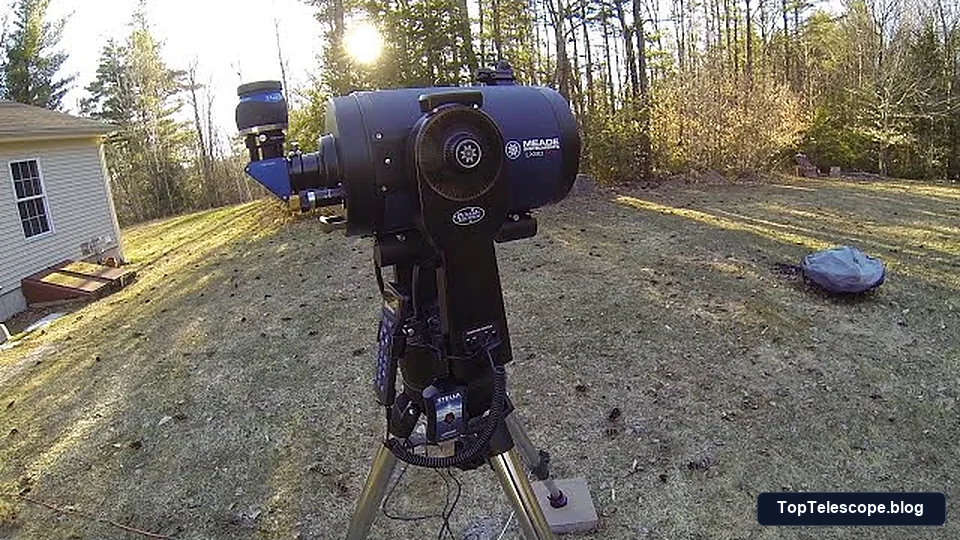
Field assembly requires securing the heavy optical base onto a sturdy giant field tripod. Operators should always verify locking lever tension before mounting heavy camera payloads to prevent accidental slips.
Power demands require a stable twelve-volt DC supply capable of delivering continuous current. Using regulated lithium power tanks prevents voltage drops that disrupt internal microprocessor functions during cold weather operations.
- Heavy-duty adjustable field tripod included
- Quick-lock base attachment mechanisms
- Requires dedicated 12V DC power
Ergonomic Handling and Portability
Carrying handles integrated into the fork base improve grip during transport. Splitting components into separate cases protects sensitive optics from accidental bumps.
- Balanced carry handle placements
- Modular breakdown for vehicle transport
Optical Output, Contrast and Planetary Performance
Long focal lengths deliver high magnification capabilities well-suited for planetary and lunar observation. Faint nebulae benefit from the generous aperture, revealing intricate structural details under dark skies.
Baffle systems inside the optical tube effectively suppress stray light reflections. Observers will notice deep background blackness that enhances planetary disc contrast considerably.
High-reflectivity coatings maximize light transmission through the optical train. Observers will notice sharp lunar terminators and high-contrast planetary detail when viewing Jupiter’s cloud belts under steady atmospheric seeing.
Diffraction-limited optics resolve tight double stars effortlessly. The absence of chromatic aberration ensures pure star colors without false purple halos, satisfying critical visual observers and lunar imagers alike.
- High-contrast lunar feature resolution
- Effective internal light baffling
- Deep sky magnitude reach
Magnification Limits and Seeing Conditions
Atmospheric stability dictates usable magnification thresholds during high-power planetary viewing sessions. Exceptional nights allow pushing power past nominal limits without image degradation.
- Responds well to high-power eyepieces
- Atmosphere limits maximum usable power
Thermal Stability, Cooling and Structural Durability
Sealed optical tubes trap internal heat, requiring adequate cooldown time before critical viewing sessions. Aluminum housing materials conduct ambient temperatures gradually across the primary mirror surface.
Optional cooling fans accelerate thermal equilibrium to prevent image distortion during rapid temperature drops. Rugged structural joints withstand the rigors of frequent transport to remote dark sky sites.
Large glass masses trap ambient heat during temperature drops. Optional cooling fans accelerate thermal equilibrium, reducing internal air currents that degrade image sharpness during early evening sessions.
Cast aluminum fork arms and sealed electronics housings protect internal components from moisture. This rugged structural design withstands frequent transport to dark sky sites without losing mechanical alignment integrity.
- Sealed tube design prevents dust ingress
- Gradual thermal adaptation process
- Durable exterior powder coating
Managing Thermal Currents
Internal air currents can disrupt high-magnification views until thermal equilibrium is reached. Storing the tube in a cool garage helps reduce overall cooldown duration.
- Minimizes internal boundary layer turbulence
- Improves initial viewing clarity
Maintenance, Collimation and Long-Term Reliability
Factory-set mirror alignment rarely requires adjustment unless the OTA suffers severe physical impacts. Dust accumulation on the corrector plate needs occasional gentle cleaning with specialized optical wipes.
Mechanical gears benefit from periodic inspection and re-greasing to maintain smooth slew movements. Proper storage in padded cases protects electronic components from moisture and dust ingress.
Routine maintenance involves cleaning exterior corrector plates with optical-grade microfibers. Users should avoid touching internal mirror surfaces to preserve the delicate antireflective coatings applied at the factory.
Collimation adjustments require fine-tuning the secondary mirror tilt screws. Making minor adjustments using a high-magnification eyepiece ensures optimal on-axis performance and sharp stellar profiles.
- Stable factory mirror alignment
- Simple external corrector cleaning
- Low routine mechanical maintenance
Preventative Care Practices
Keeping dust caps secured during storage prevents airborne particles from settling. Inspecting electronic cable connections prevents intermittent power failures in the field.
- Protective dust covers required
- Regular cable pin inspections
Comparative Verdict: Ideal Users vs. Skip Recommendations
Intermediate astronomers seeking sharp astrography will appreciate this versatile platform. Before buying, check our top backyard telescope picks to evaluate alternative aperture sizes and mounting styles.
Evaluating your local viewing conditions helps determine if this aperture size suits your needs. Investing in proper power accessories ensures reliable performance throughout long observation nights.
Advanced astrophotographers and dedicated planetary observers will appreciate the flat field design. Its robust aperture handles high-magnification tasks splendidly, satisfying users seeking deep sky versatility.
Beginners seeking ultra-portable grab-and-go setups should skip this heavy fork system. The total weight demands permanent observatory integration or significant physical strength during field deployment procedures.
- Best for dedicated deep-sky imagers
- Requires commitment to transport weight
- Delivers exceptional optical performance
Final Purchasing Considerations
Ensure you have adequate storage space and vehicle capacity for transport. Weighing these practical factors guarantees long-term satisfaction with your investment.
- Check storage and vehicle space
- Plan for auxiliary power investments
Frequently Asked Questions
Does this telescope require frequent mirror alignment?
Does this telescope require frequent mirror alignment? Factory alignment remains remarkably stable under normal transport conditions, meaning you will rarely need to adjust the primary or secondary mirrors yourself during regular operational use.
Only severe physical impacts or exceptionally rough handling will necessitate professional collimation procedures to restore absolute optical perfection across the field.
What type of power source works best for field sessions?
What type of power source works best for extended field sessions? External rechargeable lithium battery packs provide stable voltage output throughout freezing winter nights without experiencing sudden voltage drops.
Avoid standard alkaline batteries entirely because they deplete rapidly and cause erratic computer controller behavior during vital alignment sequences.
Can beginners easily operate the GoTo system?
Can absolute beginners easily operate the computerized GoTo tracking system? Automated alignment routines simplify the initial setup process significantly, though users must still understand basic celestial coordinates.
Beginners should practice terrestrial alignment procedures during bright daylight hours to build operational confidence before attempting complex nighttime astronomy.
Is the optical tube suitable for astrophotography?
Is this optical tube suitable for serious astrophotography applications? Advanced coma-free optics deliver flat, pin-point stars across large camera sensors, making it an exceptional platform for capturing deep-sky imaging targets.
However, you will require a sturdy equatorial wedge to completely eliminate field rotation artifacts during extended exposure sequences.
How heavy is the entire setup for transport?
How heavy is the entire setup for field transport? The complete assembly weighs quite substantially, requiring careful lifting techniques and modular transport methods to avoid physical strain.
Splitting the optical tube from the heavy fork base makes field deployment much safer and far more manageable for single users.