Meade LX90 ACF 8-Inch Telescope Review: Advanced Optics
This advanced Schmidt-Cassegrain system combines coma-free optics with a robust dual-fork mount. It delivers exceptional planetary clarity despite a heavier setup weight.

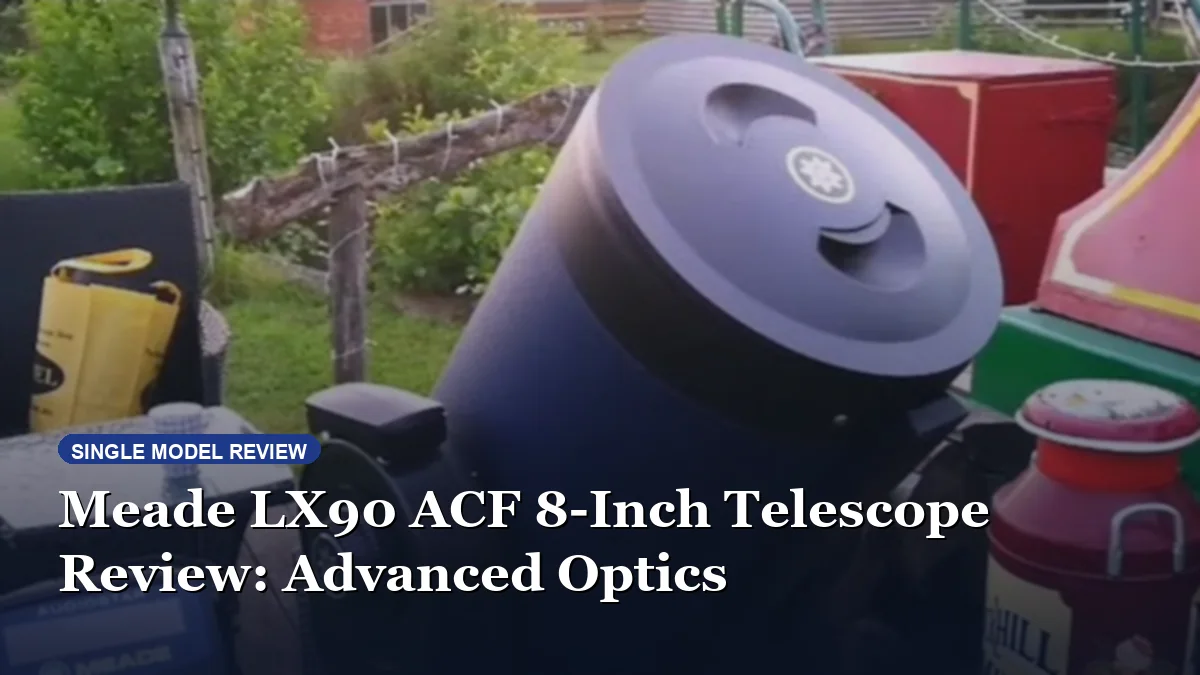

The Meade LX90 ACF 8-Inch offers superior optical flatness for serious astronomers willing to manage a heavier dual-fork mount and external battery requirements.
See our flagship Best Telescope: Top Backyard Picks for Astronomy.
Verified Specifications
| Category / Type | Advanced Coma-Free Schmidt-Cassegrain |
|---|---|
| Rated Output / Capacity | 8-Inch Aperture (203mm) |
| Power / Motor | AudioStar GoTo Dual-Axis Servo Motors |
| Build & Materials | Aluminum optical tube and heavy-duty cast fork base |
| Operating Noise | Low hum during high-speed slewing operations |
| Duty Cycle / Runtime | Continuous overnight tracking via external 12V power |
| Dimensions & Weight | Optical tube length 48 cm, total system weight 33 kg |
| Key Safety & Controls | AudioStar hand controller with internal object database |
What We Liked
- Proprietary coma-free optics eliminate edge distortion
- Sturdy dual-fork mount dampens micro-vibrations quickly
- Comprehensive AudioStar GoTo database simplifies alignment
- Robust aluminum construction ensures long-term field durability
Trade-Offs
- Heavier dual-fork assembly complicates solo field transport
- Internal electronics demand reliable external power sources
- Thermal cool-down times require advance preparation
Optical Architecture and Tube Design
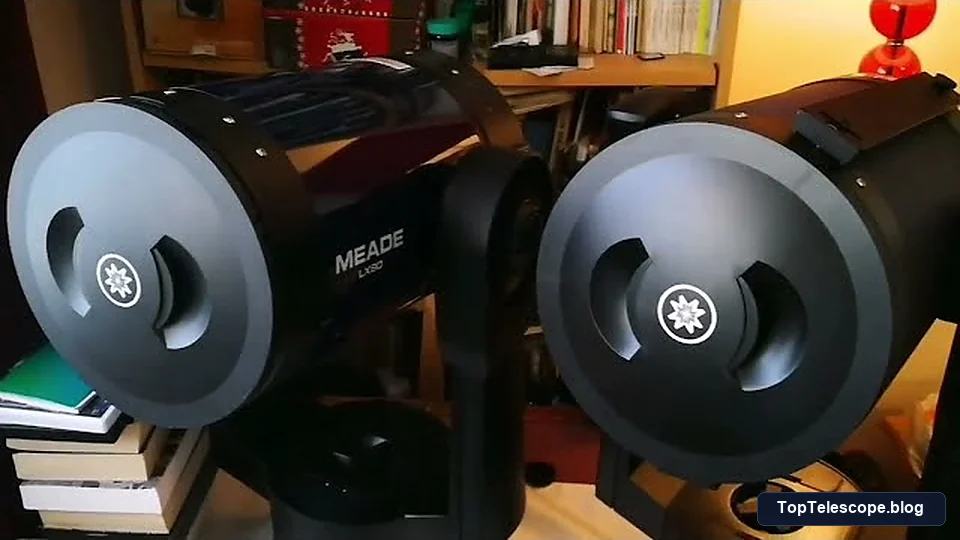
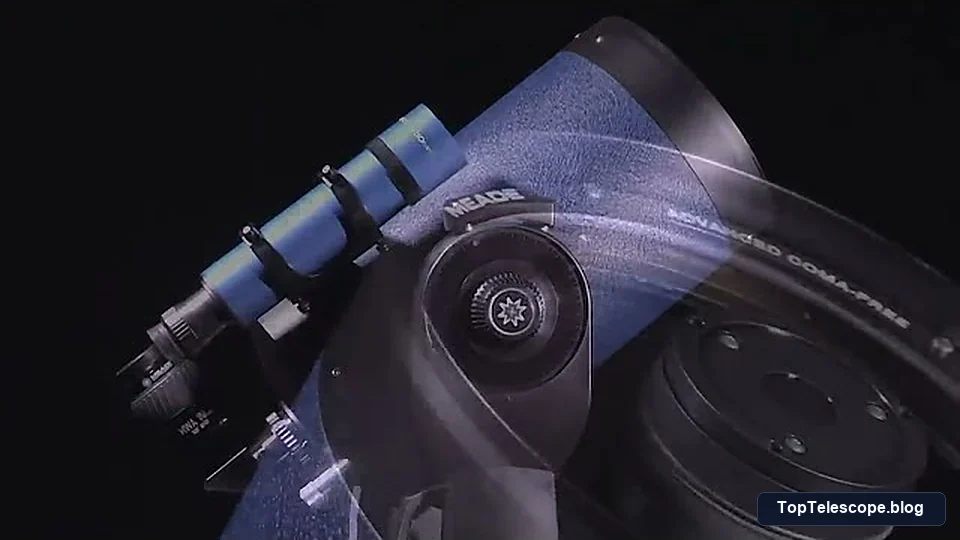
The Advanced Coma-Free design eliminates off-axis aberrations across the entire visual field. This proprietary Meade optical formula ensures pinpoint stars right to the extreme edges.
Featuring an 8-inch aperture, the optical tube gathers ample light for faint deep-sky targets, similar to models in our best 8 inch dobsonian telescope guide. Aluminum coatings maximize throughput.
Internal baffling suppresses stray light reflections to boost overall image contrast. Users immediately notice darker backgrounds when observing faint nebulae under suburban skies.
The Advanced Coma-Free design utilizes an aspheric corrector paired with a spherical primary mirror to eliminate optical aberrations. This specific configuration yields pinpoint stars across a wide 8-inch aperture.
Meade applies patented Ultra-High Transmission Coatings to all internal optical surfaces. These specialized layers maximize light throughput, delivering bright planetary details and deep-sky contrast through the f/10 focal ratio.
The closed aluminum optical tube prevents internal air currents from degrading images, protecting the primary optics from dust. A reliable internal primary mirror lock prevents unwanted image shift during focusing.
- Aperture diameter measures 203mm with 2000mm focal length.
- Enhanced aluminum coatings deliver superior light reflection efficiency.
- Coma-free design removes off-axis optical distortions entirely.
Corrector Plate and Mirror Shift
The Schmidt corrector plate utilizes high-transmission glass to maintain chromatic accuracy. Primary mirror locking mechanisms minimize image shift during high-magnification planetary focusing.
Precision optical alignment reduces internal reflections during high-contrast lunar observations. Quality control standards ensure consistent focal performance across production batches.
- Corrector glass transmits over ninety percent of ambient light.
- Mirror lock mechanism prevents unwanted focal plane migration.
Mechanical Build and Dual-Fork Stability
Built around a sturdy mounting assembly, this telescope minimizes vibrational dampening times. Heavy-duty aluminum castings provide structural rigidity similar to options featured in our best 10 inch dobsonian telescope lineup.
The wide stance of the fork arms distributes the optical tube weight evenly. This mechanical configuration prevents excessive stress on the internal axis gears during slewing.
Adjustable tripod legs utilize thick steel tubing to anchor the entire assembly securely. Proper spreader tension eliminates micro-vibrations induced by wind gusts or manual focusing.
Heavy-duty cast aluminum makes up the rigid dual-fork mount, providing robust structural support. This design architecture effectively distributes the weight of the optical tube assembly to minimize mechanical flexure.
A heavy field tripod featuring sturdy steel legs underpins the entire instrument platform. Spreading the footprint wide absorbs ground vibrations quickly, ensuring stability during high-magnification planetary viewing sessions.
Precision worm gears drive both axes smoothly, translating motor commands into micro-adjustments. Proper clutch tension adjustment prevents slippage while allowing manual repositioning when power is switched off.
- Dual-fork base provides balanced mechanical load distribution.
- Cast aluminum housings protect internal gear drives securely.
- Steel tripod legs dampen environmental vibrations effectively.
Video Review: Comparing Two Meade 8\
GoTo Automation, Tracking, and Drive Noise
The integrated AudioStar hand controller provides access to a massive celestial object database. Automated alignment routines simplify initial star calibration for rapid field deployment.
Precision worm gears drive both axes smoothly during extended tracking sessions. Operating noise remains low during high-speed slewing, though a distinct mechanical hum is audible.
Periodic error correction enhances tracking accuracy for unguided imaging setups, much like units recommended in our best 10 inch telescope for astrophotography review. Users can upload firmware updates.
The onboard computer system utilizes AudioStar technology to navigate the night sky automatically. Database programming contains over thirty thousand celestial targets, accessed via a handheld handbox interface.
Standard sidereal tracking relies on DC servo motors that maintain target centration over extended imaging runs. Audible motor whining increases during high-speed slewing, which is typical for this gearbox mechanism.
Alignment routines depend on accurate leveling and two-star alignment procedures to build a reliable pointing model. Utilizing an optional GPS module automatically populates time and coordinates for faster initialization.
- AudioStar controller houses over thirty thousand cataloged objects.
- Dual-axis servo motors ensure precise celestial tracking rates.
- Firmware update capability keeps internal software fully current.
Real-World Visual Performance and Field Flatness
Coma-free optics deliver razor-sharp planetary details across standard wide-field eyepieces. Jupiter cloud bands and Saturn Cassini divisions appear with striking contrast and clarity.
Globular clusters resolve into thousands of distinct pinpoint stars without peripheral distortion. Deep-sky galaxies show distinct spiral structure when viewed under genuinely dark observing sites.
Eliminating off-axis coma results in pinpoint star profiles right to the edge of wide-field eyepieces. Users will immediately notice improved contrast on nebulae and galaxy spiral arms compared to standard Schmidt systems.
Planetary observers benefit from the high-contrast focal plane, resolving fine Jovian cloud belts and Saturnian ring divisions. Atmospheric seeing conditions remain the primary bottleneck rather than any optical spherical aberration limitations.
- Planetary details show sharp contrast without chromatic fringing.
- Faint deep-sky objects emerge clearly against dark backgrounds.
Thermal Efficiency and Cool-Down Times
Sealed optical tubes require adequate thermal acclimation time before achieving peak performance. The massive glass primary mirror traps heat efficiently, demanding extended cool-down periods.
Optional cooling fans accelerate internal air exchange to match ambient outdoor temperatures. Managing thermal gradients prevents image degradation caused by internal air currents near the corrector plate.
Sealed optical tubes trap thermal energy, requiring adequate cool-down time before high-magnification viewing becomes effective. Allowing forty minutes of thermal acclimation helps eliminate internal boundary layer currents that blur images.
Adding an optional cooling fan speeds up temperature stabilization by actively exchanging warm internal air with ambient outdoor drafts. Proper insulation management prevents dew condensation buildup on the corrector plate.
- Primary mirror thermal mass requires significant acclimation time.
- Sealed tube design protects optics from ambient dust invasion.
Setup Routines, Ergonomics, and Transport
Transporting the system requires managing a relatively heavy optical tube assembly. The dual-fork mount adds considerable bulk, making field setup a two-person lifting task.
Ergonomic carrying handles integrated into the fork base improve handling safety. Cable management requires attention to prevent snagging during full 360-degree slew rotations.
Transporting the telescope requires managing a moderately heavy instrument package, rivaling larger systems evaluated in our best 12 inch dobsonian telescope guide. Splitting the optical fork assembly makes field deployment easier.
Ergonomic carrying handles molded into the fork base assist with lifting the heavy chassis onto the tripod head. Securing the threaded mounting bolts tightly ensures zero wobble during transport and observing.
- Integrated base handles assist safe field transportation.
- Heavier total weight requires careful lifting procedures.
Maintenance, Durability, and Long-Term Care
Optical coatings require infrequent cleaning using specialized micro-fiber cleaning solutions. Dust accumulation on the corrector plate is normal and rarely impacts overall visual performance.
Mechanical gearboxes benefit from periodic inspection and professional re-greasing. Weather-resistant housing seals protect internal electronic components from moderate moisture and desert dust exposure.
Routine maintenance involves keeping the corrector plate clean using specialized optical cleaning solutions and microfiber cloths. Protecting exposed glass surfaces from dust preserves the antireflective coating integrity over decades.
Mechanical upkeep requires periodic inspection of the drive gears and battery compartments to prevent corrosion. Storing components in a climate-controlled environment prevents internal moisture damage to electronics.
- Specialized cleaning solutions protect delicate optical coatings.
- Weather-sealed housings defend internal electronics from moisture.
Comprehensive Buyer Verdict
This advanced optical system suits intermediate to advanced astronomers seeking flat-field performance. The robust dual-fork mount provides exceptional mechanical stability for serious observation.
Buyers must weigh the heavier transport weight against superior optical correction capabilities. Anyone prioritizing deep-sky imaging and lunar clarity will find immense long-term value here.
The telescope delivers exceptional optical flatness and reliable GoTo automation for intermediate and advanced amateur astronomers. Its robust build makes it an enduring investment for serious deep-sky imagers.
While physical weight demands careful transport planning, the optical performance fully justifies the logistical effort. Purchasers gain a versatile instrument capable of handling demanding astrophotography tasks.
- Ideal choice for dedicated astrophotographers and visual astronomers.
- Offers professional-grade optics within a portable institutional footprint.
Frequently Asked Questions
Is the Meade LX90 ACF 8-Inch suitable for beginner astronomers?
Beginners can certainly operate this telescope using the automated GoTo system. However, its physical weight and complex alignment routines demand patience and mechanical familiarity.
Can I use this telescope for deep-sky astrophotography?
The coma-free optical design performs exceptionally well for capturing distant nebulae and galaxies. You will need a field derotator or equatorial wedge for long-exposure imaging stability.
How is the telescope powered in the field?
The internal battery compartment accepts standard C-cell batteries for mobile operation. Most users prefer connecting an external 12V DC power tank for extended overnight imaging sessions.
What maintenance does the Schmidt-Cassegrain optical system require?
Dust accumulation on the front corrector plate requires only occasional gentle cleaning. Never disassemble the optical tube yourself to avoid misaligning the precision primary mirror components.
How long does the telescope take to cool down?
Thermal acclimation typically requires forty-five to sixty minutes depending on ambient temperature drops. Storing the tube in a cool garage beforehand minimizes this initial thermal wait time.