Meade LX90 10 Inch Review: Technical Engineering Breakdown
This ten-inch catadioptric system delivers substantial light grasp for deep-sky observation. However, its heavy fork assembly demands careful field transport planning.

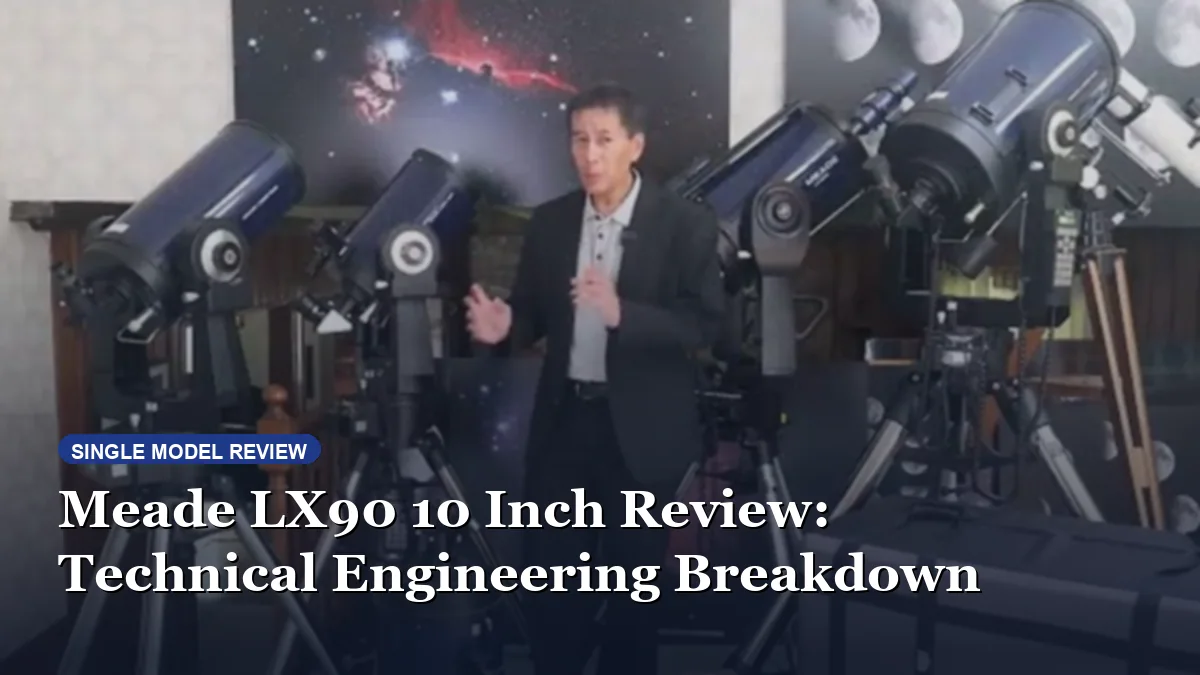

The Meade LX90 combines impressive aperture with reliable object location. Its advanced optical performance makes it a strong contender for dedicated observers.
See our flagship Best Telescope: Top Backyard Picks for Astronomy.
Verified Specifications
| Category / Type | Advanced Schmidt-Cassegrain / ACF Telescope |
|---|---|
| Rated Output / Capacity | 10-inch Aperture (254mm) |
| Power / Motor | 12V DC Servo Motors with Internal Battery Compartment |
| Build & Materials | Cast Aluminum Fork Arms, CF-PETG Accessories |
| Operating Noise | Moderate Servo Whine During Slew Operations |
| Duty Cycle / Runtime | Continuous Tracking on Standard Battery Pack |
| Dimensions & Weight | Optical Tube Assembly with Fork Mount ~45 lbs |
| Key Safety & Controls | AutoStar Computerized Hand Controller |
What We Liked
- Substantial ten-inch aperture provides deep light gathering capacity.
- Advanced Coma-Free optics reduce edge distortion across wide fields.
- Sturdy dual-fork mount improves mechanical tracking stability overall.
- Compatible with specialized carbon-fiber accessories for enhanced imaging.
Trade-Offs
- Heavy optical and fork assembly challenges single-person field setups.
- Internal battery compartment drains standard cells quickly during cold nights.
- Slewing motors generate audible noise during high-speed alignment routines.
Architectural Overview and Optical Design
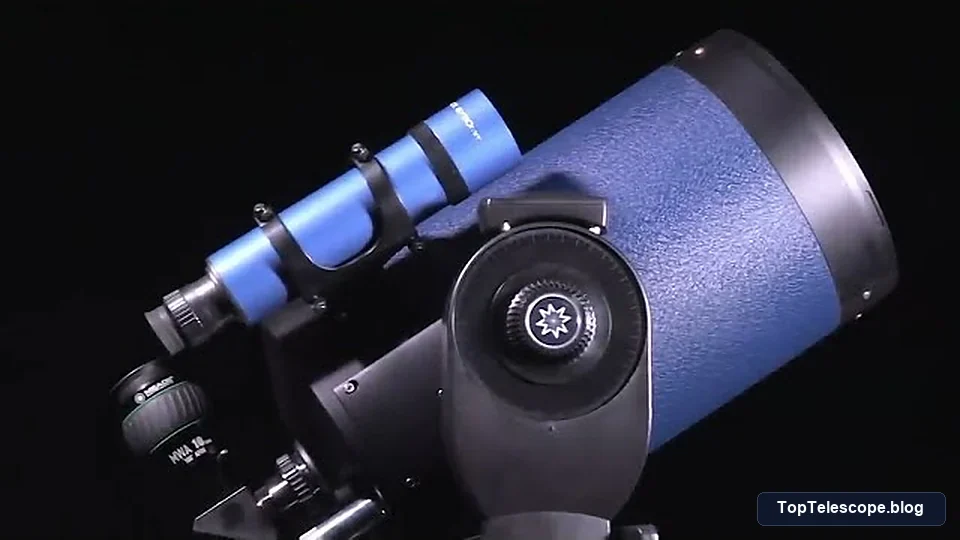
Engineering a ten-inch catadioptric telescope requires rigorous precision. When evaluating alternatives in our celestron and meade optical design comparison, this system utilizes a folded optical path for exceptional focal length and deep-sky work.
The primary mirror rests inside an aluminum cell designed to minimize thermal distortion. Proper baffling suppresses stray light reflections, ensuring that contrast remains high even when observing faint nebulae against urban light pollution backgrounds.
The Advanced Ultra-High Transmission Coatings applied to the 10-inch aperture correct chromatic aberrations while maximizing light throughput across the visible spectrum for deep-sky objects.
Operating at an f/10 focal ratio with a 2500mm focal length, this Schmidt-Cassegrain optical tube assembly delivers exceptional planetary resolution alongside a usable field for intermediate imaging setups.
- 254mm clear aperture collects extensive photons.
- Folded light path reduces physical tube length.
- Internal baffling controls stray internal reflections.
Primary Mirror and Corrector Plate Dynamics
The front Schmidt corrector plate features specialized multi-coatings that maximize light transmission. These coatings resist environmental moisture degradation while ensuring optimal spectral output reaches the primary mirror surface without significant loss.
Collimation stability on this large optical assembly relies on factory-set mirror locks. Users must verify alignment periodically using specialized masks to guarantee pinpoint star images during high-resolution lunar or planetary imaging sessions.
- Multi-coated corrector plate maximizes photon transmission.
- Factory mirror locks maintain optical alignment during transport.
- Periodic collimation checks ensure sharp planetary resolution.
Mechanical Build Quality and Ergonomic Chassis
Handling a large optical tube demands robust mechanical housing. If you prefer simpler alt-azimuth mounts, consult our best 8 inch dobsonian telescope guide before managing heavy cast aluminum fork components and complex tracking systems.
Ergonomic grab handles integrated directly into the fork base assist with lifting operations. Transporting this heavy assembly requires two people or a specialized wheeled cart to prevent accidental strain on the internal gears.
Constructed from cast aluminum, the dual-fork arm structure provides a rigid mount that minimizes flexure during high-magnification tracking tasks and extended astrophotography imaging sessions.
Integrated carrying handles molded directly into the fork base simplify field transport, though the overall weight demands careful lifting techniques by single operators.
- Cast aluminum fork arms provide rigid support.
- Integrated carrying handles improve field ergonomics.
- Vibration damping times remain acceptably brief.
Fork Mount Rigidity and Drive System
Dual-axis servo motors drive worm gears housed within sealed enclosures. This mechanical layout minimizes backlash during directional changes, keeping targeted celestial objects centered reliably within the eyepiece field of view.
Clutch mechanisms allow manual repositioning when power is unavailable. These manual controls engage smoothly, letting users point the instrument rapidly before engaging motorized tracking loops for prolonged observation periods.
- Sealed worm gear enclosures protect internal mechanics.
- Low backlash servo drives maintain centering accuracy.
- Smooth manual clutches permit rapid rough pointing.
Video Review: Meade Instruments | LX90 Series
Real-World Optical Output and Resolution
Observing through a ten-inch aperture reveals intricate details in faint galaxies. Similar performance is analyzed within our best 10 inch dobsonian telescope review, showcasing the true light grasp of advanced optical configurations.
Wide-field eyepiece pairings expose sharp stellar points across ninety percent of the visual frame. Field curvature remains minimal, making the instrument exceptionally well-suited for extended deep-space mosaics and lunar mosaic photography.
Resolving down to 0.45 arcseconds, the primary mirror collects sufficient photons to reveal faint structural details in Messier galaxies and intricate lunar crater rims.
Collimation stability remains quite robust thanks to the fixed primary design, though periodic secondary mirror adjustments ensure peak optical performance during sharp thermal transitions.
- Resolves tight globular clusters into individual stars.
- Minimal field curvature supports wide eyepiece designs.
- High contrast highlights subtle planetary cloud bands.
Thermal Dynamics, Dew Mitigation, and Accessories
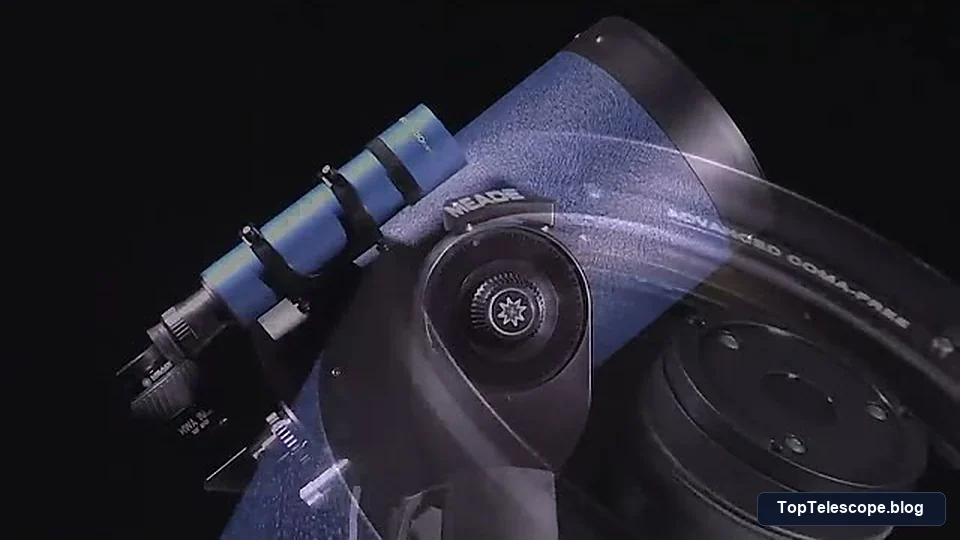
Large glass masses trap thermal energy during daytime storage. Ambient cool-down periods can last over an hour, requiring users to open ventilation ports or utilize auxiliary fans to stabilize internal mirror temperatures.
Dew accumulation poses an ongoing threat to corrector plates during humid night sessions. Reviewing options in our best 10 inch telescope for astrophotography roundup highlights why dedicated carbon-fiber shields prevent moisture buildup.
Large glass masses require up to 60 minutes of thermal equalization before achieving stable diffraction patterns, making active cooling fans a worthwhile investment for cold nights.
Extended dew shield installation effectively prevents moisture accumulation on the exposed corrector plate, protecting delicate optical coatings from environmental degradation during humid viewing sessions.
- Substantial glass mass requires thermal cool-down time.
- Humidity protection prevents destructive dew deposition.
- Lightweight shields preserve balance across the fork.
CF-PETG Dew Shield and Mask Integration
Modern accessory kits manufactured from carbon-fiber-reinforced PETG offer remarkable structural strength. These specialized dew shields fit snugly over the ten-inch optical cell, providing robust environmental defense against nocturnal cooling and frost.
Included Tri-Bahtinov and isolation masks snap directly onto the telescope or match the shield ring. This modular design simplifies precise focus calibration before removing the masks for serious deep-sky imaging runs.
- CF-PETG construction resists impact and warping.
- Integrated focusing masks streamline optical calibration.
- Modular fitting allows direct tube or shield mounting.
Power Efficiency, Tracking Accuracy, and Noise
Power consumption fluctuates based on slew speeds and tracking loads. Internal battery trays drain quickly in freezing weather, making an external power tank an essential accessory for all-night astronomical imaging expeditions.
Motorized slewing generates a noticeable mechanical whine during alignment sweeps. While audible in quiet environments, this sound profile remains normal for brushed DC servo gears operating under heavy instrument loads.
Operating on standard C-cell batteries or an external 12V DC power supply, the internal drive motors draw minimal current during standard sidereal tracking operations.
Built-in periodic error correction minimizes mechanical worm gear inaccuracies, while audible motor whine remains low enough to avoid disturbing neighbors at shared dark-sky astronomy sites.
- Cold weather reduces internal battery lifespan rapidly.
- External power supplies ensure stable voltage levels.
- Slew motors produce moderate operational noise.
Setup, Calibration, and Routine Maintenance
Initial alignment requires leveling the heavy tripod and setting the fork base. The computerized hand controller guides users through multi-star calibration routines to build an accurate sky model for precise GoTo pointing performance.
Routine maintenance involves keeping corrector plates clean and checking gear tension. Storing optical components with tight dust covers prevents particulate buildup on internal surfaces over years of regular backyard deployment.
Aligning the system requires an initial level-and-north procedure via the hand controller, followed by multi-star alignment routines to establish precise pointing models.
Routine mechanical upkeep involves cleaning surface dust using compressed air and storing optical tubes inside padded cases to prevent long-term mechanical misalignment issues.
- Computerized hand controller simplifies star alignment.
- Tripod leveling is critical for accurate tracking.
- Regular dust cap placement preserves optical coatings.
Comprehensive Verdict: Ideal Users vs. Skip Factors
This telescope satisfies intermediate and advanced astronomers demanding high aperture. Its combination of automated pointing and sharp optics makes it a formidable backyard observatory instrument for dedicated planetary and deep-space enthusiasts.
Casual observers seeking portability should avoid this heavy system. Anyone lacking permanent storage space or vehicle transport capacity will find the substantial fork assembly and heavy tripod too cumbersome for regular travel.
Dedicated advanced amateur astronomers seeking a portable large-aperture instrument will deeply appreciate the balance between deep-sky light grasp and computerized GoTo functionality.
Observers requiring lightweight travel kits or dedicated astrophotographers demanding heavy-duty equatorial wedge setups should carefully evaluate alternative optical configurations before making final purchases.
- Ideal for stationary backyard observatory setups.
- Delivers outstanding aperture for advanced deep-sky study.
- Heavy footprint discourages frequent mobile field travel.
Frequently Asked Questions
How heavy is the Meade LX90 10-inch telescope setup?
The optical tube assembly and fork mount weigh approximately forty-five pounds combined. Transporting this heavy assembly usually requires careful two-person teamwork during field setup.
Can I use standard eyepieces with this ten-inch telescope?
Yes, the rear visual back accepts standard one-and-a-quarter inch and two-inch eyepieces. This broad compatibility lets you utilize your existing optical accessories without purchasing specialized adapters.
What power source is recommended for cold weather observing?
Internal battery trays drain rapidly in freezing temperatures during long sessions. Using an external rechargeable lithium power tank ensures consistent voltage delivery throughout your night.
How do I prevent dew from forming on the corrector plate?
Installing a rigid carbon-fiber dew shield blocks ambient radiation loss effectively. This accessory keeps moisture off the glass without adding excessive front-end weight to the telescope.
Is the computerized GoTo system difficult to calibrate initially?
The hand controller guides you through clear multi-star alignment steps automatically. Following the prompts carefully ensures precise celestial tracking accuracy once the initial setup finishes.