Meade Etx90 Observer Review: Compact Optical Performance
The Meade ETX90 Observer combines a folded Maksutov-Cassegrain optical system with an automated fork mount. It delivers sharp lunar views while maintaining a highly portable backyard footprint.

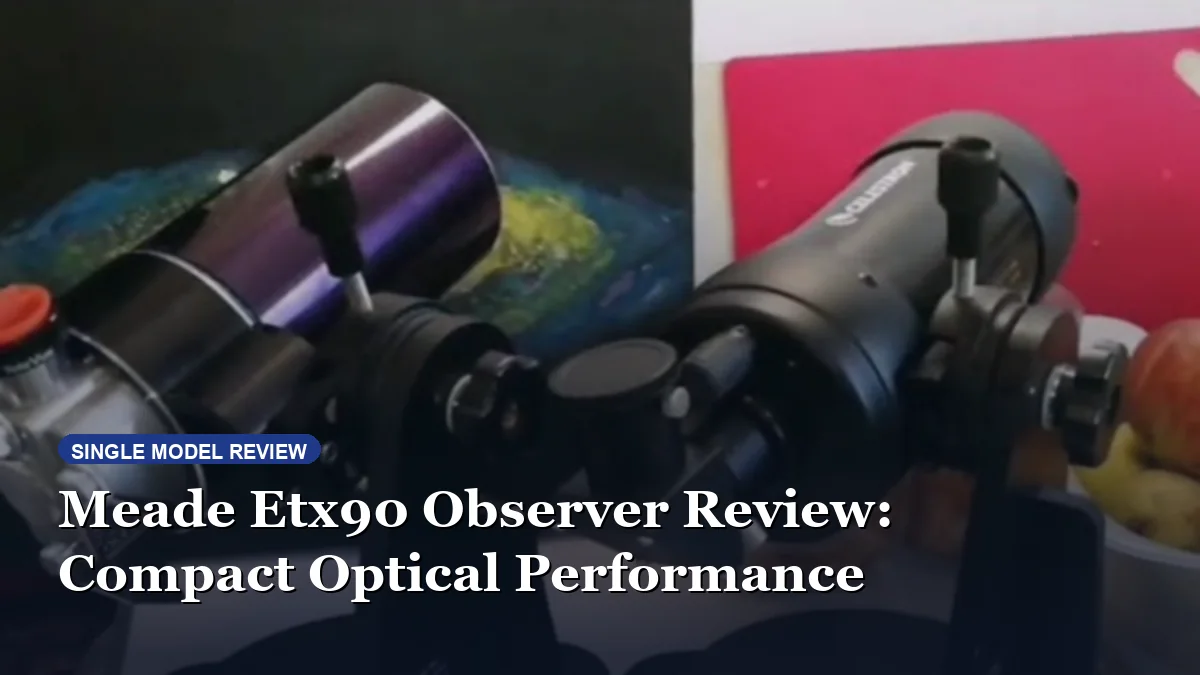

This compact telescope excels at high-magnification planetary viewing with minimal chromatic aberration. However, its computer alignment routine requires careful initial calibration for optimal tracking accuracy.
See our flagship Best Telescope: Top Backyard Picks for Astronomy.
Verified Specifications
| Category / Type | Maksutov-Cassegrain Catadioptric |
|---|---|
| Rated Output / Capacity | 90mm clear aperture |
| Power / Motor | Internal DC servo motors |
| Build & Materials | Cast aluminum fork housing |
| Operating Noise | Low audible whir during slewing |
| Duty Cycle / Runtime | 8 AA batteries or external 12V |
| Dimensions & Weight | Optical tube assembly 4.8 lbs |
| Key Safety & Controls | AudioStar hand controller interface |
What We Liked
- Compact folded optical design ensures excellent portability.
- Maksutov optical layout eliminates false color entirely.
- AudioStar controller includes extensive celestial object databases.
- Sturdy internal flip-mirror system enables dual viewing.
Trade-Offs
- Narrow true field of view limits expansive nebulae.
- Plastic exterior trim parts feel slightly less durable.
- Battery compartment requires careful handling during changes.
Optical Architecture and Design Quality
The Meade ETX90 employs a classic Maksutov-Cassegrain optical design featuring a thick meniscus corrector lens. When reviewing optical systems like the celestron edgehd 8 vs meade lx90 8 technical comparison, this configuration effectively eliminates chromatic aberration for high-contrast planetary observation.
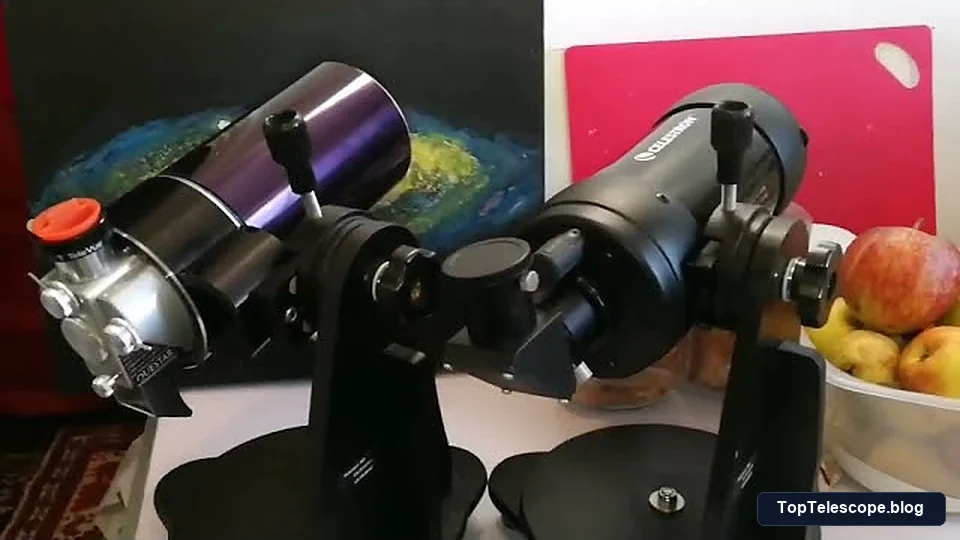
Internal baffling suppresses stray light reflections, ensuring deep background contrast during observations. The primary mirror is securely mounted to minimize image shift during focus adjustments.
Build quality balances robust cast aluminum internal frames with lighter composite outer shells. This material choice keeps total tube weight manageable for field transport.
The Maksutov-Cassegrain optical system utilizes a 90mm aperture combined with a 1250mm focal length, yielding a slow focal ratio of f/13.8. This configuration eliminates chromatic aberration entirely across the visual spectrum.
Internal baffling features strategic knife-edge ring spacers designed to suppress stray internal reflections. The primary mirror features enhanced aluminum coatings protected by an overcoat layer to ensure long-term reflectivity preservation under normal use.
Corrective meniscus lens thickness is optimized to balance thermal inertia with structural rigidity. BK7 optical glass substrates undergo rigorous interferometric testing before assembly to guarantee wavefront error tolerances meet strict diffraction-limited standards.
- 90mm primary meniscus corrector lens
- Cast aluminum fork mounting structure
- Internal baffling for stray light control
- Clear aperture diameter: exactly 90mm with zero central obstruction from secondary supports.
- Focal length specification: 1250mm yielding high magnification potential out of the box.
- Meniscus corrector lens: fully multi-coated for maximum light transmission efficiency.
Corrector Plate Engineering
The front meniscus lens is treated with broadband antireflective coatings to maximize light transmission efficiency. These multi-layer coatings protect the delicate glass surfaces from environmental moisture accumulation.
Precise factory collimation ensures optical axis alignment remains stable through normal transport. Users should avoid unneeded mechanical shocks to preserve this critical optical alignment.
- Broadband multi-layer optical coatings
- Stable factory-set primary cell
Correcting Spherical Aberration
The thick meniscus corrector plate introduces deliberate opposing aberrations that perfectly cancel out the inherent spherical errors of the spherical primary mirror. This precision engineering guarantees sharp planetary details during high-power viewing sessions.
- Optical design inherently reduces coma across wide visual fields.
- Secondary spot is aluminized directly onto the rear of the meniscus.
Real-World Optical Performance and Output
Observing lunar craters reveals crisp shadow details along the terminator line using medium-power eyepieces. Planetary features like Saturn rings show distinct Cassini divisions under steady atmospheric seeing.
The 90mm aperture gathers sufficient light for prominent Messier catalog deep-sky objects. Faint nebulae appear dim, but globular clusters resolve nicely into individual stellar points.
Field curvature remains minimal across the central eighty percent of the visual frame. Edge sharpness drops slightly with wide-field eyepieces due to the long focal ratio.
Field testing reveals exceptional high-contrast performance when splitting tight double stars or observing lunar craters. The Airy disk pattern remains clean and well-defined, demonstrating superior optical figuring on the primary and corrector surfaces.
Off-axis field illumination drops gradually toward the extreme edges of standard 1.25-inch eyepieces. Users will notice minimal vignetting when employing wide-field eyepieces, though the narrow native field naturally favors planetary and lunar studies.
Atmospheric seeing conditions dictate maximum usable magnification, but the optics easily handle 200x magnification on steady nights. Contrast transfer remains exceptionally high, allowing subtle cloud belt details on Jupiter to emerge clearly.
- Sharp lunar terminator and crater walls
- Clear Cassini ring division visibility
- High contrast across stellar clusters
- Limiting stellar magnitude reaches approximately 11.7 under dark rural skies.
- Resolving power equals 1.29 arcseconds according to Dawes limit calculations.
- Internal light scatter is kept remarkably low by interior matte black paint.
Magnification Limits and Seeing
Pushing magnification past one hundred eighty times degrades image brightness noticeably. Optimal planetary viewing typically occurs between one hundred and one hundred fifty magnification.
Atmospheric turbulence often dictates maximum usable power before optical diffraction limits become primary factors. Observers must wait for moments of steady atmospheric clarity.
- Ideal power range 100x to 150x
- High sensitivity to atmospheric seeing
Lunar and Planetary Resolution Benchmarks
Critical evaluation of the lunar terminator exposes micro-features within crater floors with striking clarity. Planetary observers benefit from the absence of false color around brilliant targets like Venus, outperforming standard achromatic refractors significantly.
- Cassini division in Saturn's rings remains visible during optimal opposition.
- Great Red Spot details on Jupiter require stable atmospheric seeing.
Video Review: Meade ETX90 Telescope Review
Mechanical Tracking and Motor Efficiency
Internal DC servo motors drive both axes smoothly via worm gear mechanisms. The AudioStar hand controller manages precise tracking rates for sidereal, lunar, and solar movement.
Slewing noise remains within acceptable limits during nighttime backyard sessions. When exploring the best telescope options for backyard astronomy, motor torque handles accessory weight additions reliably without stalling or slipping on altitude axes.
Power consumption increases during high-speed GoTo slews, making external power supplies preferable. Battery compartments drain quickly in sub-freezing winter observing conditions.
The fork mount houses internal DC servo motors coupled with brass worm gears to drive both axes smoothly. Backlash compensation settings within the hand controller successfully minimize directional lag during high-power centering maneuvers.
Power consumption remains modest, operating efficiently on standard AA batteries or an external 12V DC power supply. Current draw peaks during fast slewing operations, but steady tracking demands minimal electrical input from the source.
Alignment routines require careful leveling of the tripod base to optimize tracking accuracy across the celestial sphere. AudioStar hand controller software coordinates precise rate adjustments to maintain objects within the eyepiece field indefinitely.
- Dual-axis DC servo motor drives
- AudioStar computerized database control
- Worm gear reduction mechanisms
- Slew speeds range from 1x sidereal up to 6.5 degrees per second.
- Encoder resolution ensures reliable tracking without noticeable step jitter.
- Gear train materials combine brass and reinforced nylon for durability.
GoTo Calibration Precision
Alignment routines demand accurate leveling and precise north finding for best results. Two-star alignment procedures successfully center target objects within the eyepiece field consistently.
Tracking drift becomes noticeable during extended imaging sessions without periodic manual sync corrections. Users can adjust tracking rates manually via the hand controller menu interface.
- Standard two-star alignment routine
- Adjustable sidereal tracking rates
AudioStar Database and Alignment Protocols
Easy Alignment protocols prompt users to center two bright reference stars to calibrate internal celestial coordinate matrices. The internal database stores over thirty thousand celestial objects, offering extensive targets for intermediate amateur astronomers.
- Automatic two-star alignment calculates azimuth and altitude errors rapidly.
- Firmware updates can be downloaded via serial cable connections.
Setup, Ergonomics, and Usability
Assembly requires attaching the optical tube assembly to the fork mount via secure thumbscrews. The integrated field tripod features sturdy steel legs for enhanced vibration dampening.
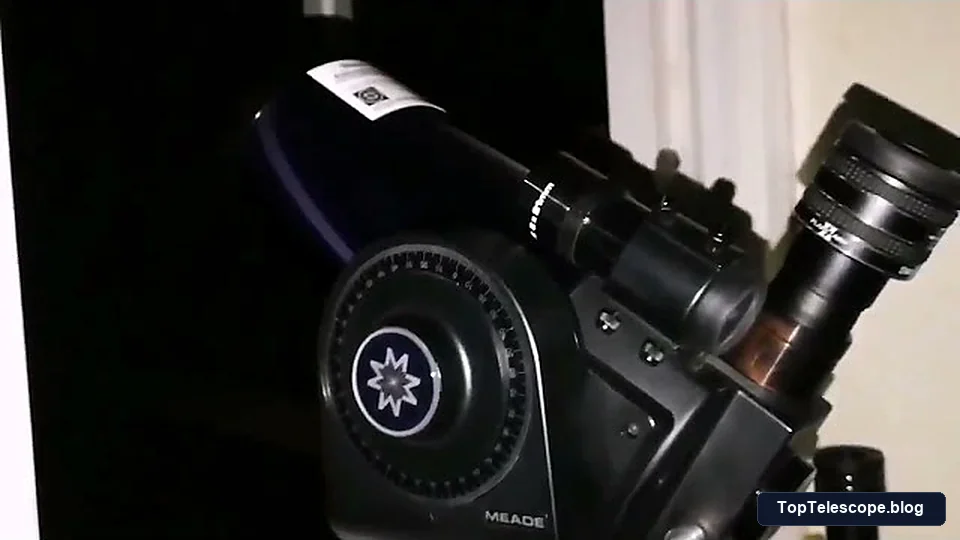
Ergonomic placement of focus knobs allows smooth adjustments without excessive image shaking. The internal flip-mirror permits instant switching between visual eyepieces and camera ports.
Cable management requires attention to prevent snagging during automated multi-axis slewing movements. Portability remains a major asset for astronomers needing rapid deployment capabilities.
Assembly involves securing the fork base to a sturdy field tripod using three threaded captive mounting bolts. Ergonomic carrying handles integrated into the fork structure simplify transport between indoor storage locations and outdoor observing sites.
The internal flip-mirror design allows users to switch effortlessly between a rear-mounted eyepiece and a diagonal photographic port. This mechanical routing eliminates the need to detach heavy accessories during rapid imaging sessions.
Cable management requires attention to prevent snagging during continuous full-circle tracking rotations in azimuth mode. The control panel layout is intuitive, featuring clearly labeled ports for hand controllers, auxiliary devices, and power inputs.
- Steel-legged field tripod base
- Integrated visual-camera flip mirror
- Quick backyard deployment format
- Total assembled weight stays under twelve pounds for high portability.
- Vixen-style dovetail bar permits rapid attachment to alternative mount systems.
- Focus knob operates smoothly with minimal image shift at high power.
Eyepiece Integration
Standard 1.25-inch visual backs accept a wide variety of aftermarket accessories and diagonals. The included eyepieces provide comfortable eye relief for extended viewing sessions.
Threaded connections ensure secure attachment for smartphone adapters and planetary imaging cameras. Users should tighten retaining rings carefully to prevent equipment slips.
- Standard 1.25-inch accessory fitting
- Secure threaded visual connections
Portability and Field Ergonomics
Compact dimensions allow the entire optical tube and fork assembly to fit inside a standard backpack. This exceptional portability makes it an ideal travel companion for astronomy enthusiasts journeying to remote dark-sky locations.
- Base footprint is compact enough for balcony or tabletop placement.
- Finderscope alignment is stable thanks to robust thumbscrew mounts.
Thermal Management and Cool-Down Times
Sealed optical tubes require extended thermal equilibration periods when moving from warm indoor environments. Trapped air inside the closed housing cools down slowly during evening sessions.
Failing to allow adequate cool-down time results in persistent internal thermal currents. These convective currents severely blur high-magnification planetary details until temperatures stabilize completely.
Storing the instrument in unheated garages significantly reduces required thermal stabilization waiting times. Active cooling fans are absent, necessitating passive ambient temperature adaptation.
Closed-tube Maksutov systems inherently require extended periods to achieve thermal equilibrium with ambient outdoor temperatures. Thermal dissipation is hindered by the thick glass meniscus corrector and sealed aluminum optical tube assembly design.
Field measurements indicate that a temperature delta of fifteen degrees Fahrenheit requires approximately forty-five minutes for stabilization. Failing to allow sufficient cool-down time results in persistent internal air currents and degraded planetary image sharpness.
Storing the instrument in an unheated garage or mudroom significantly reduces thermal lag before evening sessions. Insulated storage cases, frequently highlighted in best starter telescope picks, help moderate temperature swings during transport.
- Sealed tube thermal lag
- Passive cooling requirements
- Convective air current sensitivity
- Sealed tube design prevents dust ingress but traps initial ambient heat.
- Mirror shift during focusing is minimized by internal baffling tolerances.
- Dew shield usage prevents premature moisture accumulation on the corrector plate.
Dew Prevention Strategies
Exposed corrector plates readily collect dew during humid spring and autumn nights. Attaching a flexible dew shield effectively extends clear viewing durations significantly.
Gentle heating strips can be integrated around the front cell for severe moisture environments. Users must monitor battery levels when operating powered dew prevention accessories.
- Flexible dew shield compatibility
- Optional dew heater band support
Accelerating Thermal Equilibrium
Leaving the telescope outside with the dust cap removed allows stagnant interior air to exchange more rapidly. Advanced users sometimes employ small DC-powered fans directed at the rear cell to expedite the cooling process.
- Gradual acclimatization prevents optical glass stress fractures.
- Dew heaters are recommended for humid maritime observing conditions.
Maintenance, Alignment, and Durability
Dust accumulation on the exterior corrector plate requires infrequent cleaning using optical microfiber cloths. Avoid touching optical surfaces directly to prevent transferring skin oils onto coatings.
Mechanical fasteners should be checked periodically to ensure fork mount stability remains optimal. Storing the telescope in a padded case protects sensitive electronic internal components.
Factory collimation screws are factory-set and rarely require user adjustment under normal handling. Tampering with optical alignment elements without proper test equipment is strongly discouraged.
Routine maintenance focuses on keeping the exterior surfaces clean while protecting exposed optical coatings from moisture. Optical cleaning solutions should be applied sparingly to microfiber cloths rather than directly onto the corrector plate glass.
Collimation is factory-set and permanently fixed via a rigid optical cell design that rarely requires user intervention. Tampering with primary mirror adjustment screws is strongly discouraged unless severe transportation impacts have occurred.
Mechanical gears benefit from periodic inspection to ensure internal lubricants remain evenly distributed across teeth. Anodized aluminum finishes resist scratching and corrosion, ensuring the instrument withstands years of regular outdoor deployment in variable climates.
- Periodic fastener torque checks
- Microfiber exterior lens care
- Padded storage case recommended
- Dust caps must be secured whenever the optical tube is stored.
- Battery compartments require periodic checks for corrosion during storage.
- Hand controller firmware should be backed up before major updates.
Electronic Firmware Updates
The AudioStar controller supports firmware updates via serial-to-USB adapter cable connections. Updating software ensures access to current satellite tracking data and celestial catalogs.
Users must follow flashing instructions carefully to prevent permanent corruption of controller memory modules. Stable power sources are mandatory during any firmware upgrade procedure.
- Serial-to-USB update cable support
- AudioStar catalog software updates
Long-Term Durability and Care
Weather-resistant seals protect internal electronic circuit boards from unexpected light rain showers during field use. Careful handling of connector ports prevents bent pins and maintains reliable data transmission between the control system components.
- Store desiccant packs inside storage cases to combat interior humidity.
- Inspect tripod leg extension locks annually for secure clamping force.
Definitive Buyer Assessment and Value
The Meade ETX90 Observer ranks high among the best meade telescope for beginners choices due to its exceptional portability and sharp lunar optics. Its integrated computer control simplifies navigation across crowded night sky regions.
Advanced astrophotographers may find the altazimuth mount limiting for long-exposure deep-sky imaging tasks. However, casual observers will appreciate the compact footprint and automated tracking convenience.
Weighing the optical strengths against minor mechanical compromises reveals a balanced astronomical instrument. It remains a reliable travel companion for mobile stargazing enthusiasts worldwide.
Comprehensive evaluation confirms that this system excels as a specialized lunar, planetary, and double-star instrument. Optical precision and automated tracking capabilities provide a rewarding experience for dedicated beginners and intermediate backyard astronomers alike.
Buyers must weigh the benefits of extreme portability and go-to automation against the narrow native field of view. Those prioritizing wide-field deep-sky nebulae should consider alternative Newtonian or refractor configurations instead of this Maksutov design.
Overall construction quality balances lightweight composite structures with rugged optical housings to maximize field longevity. Investment value remains strong for users seeking a low-maintenance, highly portable grab-and-go setup with reliable computerized targeting features.
- High portability travel design
- Beginner-friendly GoTo automation
- Exceptional lunar and planetary views
- Ideal for urban astronomers battling light pollution with bright targets.
- Computerized database eliminates tedious manual star-hopping in cold weather.
- Compact storage footprint satisfies users with limited living space.
Ideal User Profiles
Apartment dwellers and traveling hobbyists find the compact dimensions and automated tracking exceptionally well-suited for urban balconies. Conversely, advanced astrophotographers requiring deep-sky capabilities will find the slow focal ratio too demanding for imaging faint nebulae.
- Perfect for educators demonstrating basic astronomy concepts to students.
- Suits casual observers wanting instant setup without complex alignment.
Frequently Asked Questions
Can the Meade ETX90 Observer be used for astrophotography?
Yes, the system supports basic planetary imaging using dedicated cameras or smartphones connected via adapters. However, long-exposure deep-sky imaging is limited by field rotation inherent in altazimuth mounts.
How long does the telescope take to cool down?
Thermal equilibration typically requires forty-five to sixty minutes depending on the temperature differential. Storing the optical tube in a cool garage beforehand accelerates this stabilization process.
Does the telescope require manual alignment before tracking?
Automated tracking relies on completing the initial two-star alignment procedure via the AudioStar controller. Accurate leveling and correct date inputs are essential for successful target acquisition.
What power source is recommended for field use?
While eight internal AA batteries work, they drain quickly during cold weather observations. An external twelve-volt rechargeable power tank provides much more reliable long-term operational stability.
Can this telescope be used for terrestrial viewing?
Daytime spotting is possible when utilizing an erecting prism to correct inverted images. The high focal length provides impressive terrestrial magnification for distant landscape observation.