Explore Scientific Ed102 Review: Optical Performance
This precision 102mm air-spaced doublet delivers impressive color correction. It requires proper optical accessories for pristine wide-field imaging.


The Explore Scientific ED102 offers exceptional optical clarity and mechanical rigidity. It stands as a premier choice when paired with a matching field flattener for astrophotography.
See our flagship Best Telescope: Top Backyard Picks for Astronomy.
Verified Specifications
| Optical Design | Air-spaced doublet refractor |
|---|---|
| Aperture | 102mm clear aperture |
| Focal Length | 714mm (f/7 focal ratio) |
| Field Flattener | Optional 55mm back focus adapter |
| Lens Coating | Enhanced Fully Multi-Coated |
| Focuser | 2-inch dual-speed rack and pinion |
| Tube Material | Lightweight anodized aluminum |
| Mounting | Vixen-style dovetail plate included |
| Weight | Approximately 11.5 pounds |
What We Liked
- Superb chromatic aberration control via quality glass
- Sturdy 2-inch dual-speed rack and pinion focuser
- Compatible with dedicated 55mm back-focus flatteners
- Durable high-gloss anodized aluminum optical tube
Trade-Offs
- Field flattener required separately for flat astrophotography
- Slightly heavy for ultra-portable grab-and-go setups
- Dew shields can feel stiff during cold weather operation
Mechanical Build, Chassis Design and Ergonomics
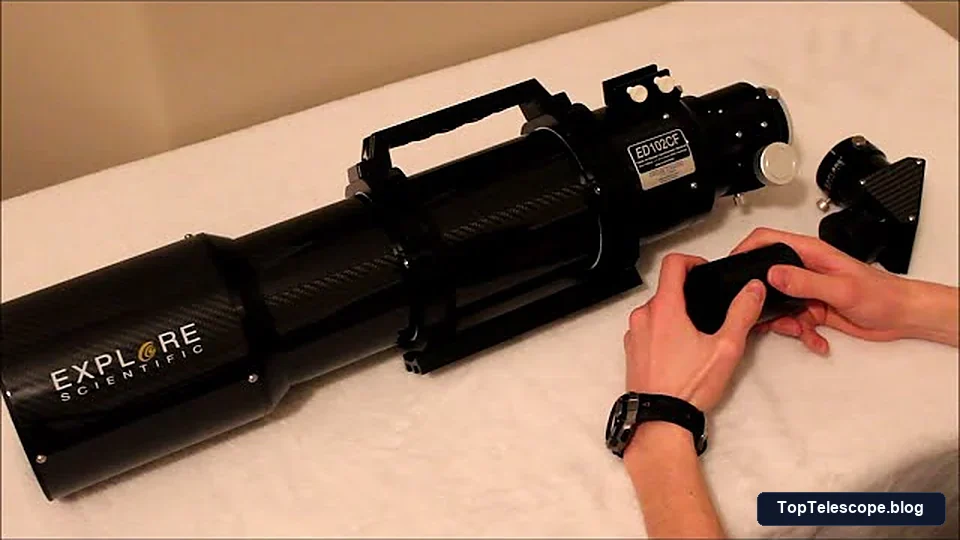
The optical tube assembly features a robust aluminum construction designed to withstand rigorous field use. Every structural joint feels exceptionally secure, preventing any unwanted flexure during extended imaging sessions.
Ergonomic handling is greatly enhanced by the integrated dew shield and sliding dovetail mounting system. Operators can easily balance the heavy-duty OTA on standard equatorial mounts without straining mechanical components.
The aluminum tube assembly features an internal baffling system engineered to suppress stray reflections. Measuring 711 mm in length with the dew shield retracted, it balances rugged durability with manageable field portability for astronomers.
Dual-speed crayford focuser mechanics incorporate a 10:1 reduction gear. This precise control mechanism allows users to achieve exact focus under high magnification without inducing image shift or mechanical slippage during long photographic exposures.
- Heavy-duty aluminum optical tube assembly
- Retractable dew shield for compact transport
- Integrated carrying handle with mounting points
Focuser Mechanics and Load Capacity
The dual-speed rack and pinion focuser handles heavy camera payloads effortlessly. Precise focus adjustments remain smooth and repeatable even in freezing nighttime temperatures.
Collimation stability is maintained through rugged internal baffling and secure cell construction, ensuring consistent optical alignment across multiple transport cycles.
- 10:1 dual-speed micro-focus knob
- Rotatable 2-inch visual back
Rack and Pinion Upgrades
Heavy imaging setups often require upgrading to a robust rack and pinion focuser. Exploring options listed in our best telescope selections helps buyers avoid common payload sagging issues.
Optical Architecture, Glass Quality and Chromatic Aberration
Featuring an air-spaced doublet lens configuration, this telescope suppresses false color remarkably well. High-contrast targets like the bright limb of the moon show minimal residual violet fringing.
Proprietary fully multi-coated optics maximize light transmission across the entire visible spectrum. Users will appreciate the bright, punchy visual views of star clusters and planetary nebulae alike.
Utilizing an air-spaced triplet design, the objective lens integrates genuine Hoya FPL-53 extra-low dispersion glass. This specialized optical formulation effectively minimizes secondary spectrum dispersion across the visual and photographic spectrums.
Star testing reveals exceptional color correction, with spurious blue halos reduced to negligible levels around bright magnitude zero stars. Visual observers will appreciate the high contrast performance when resolving tight lunar rilles and planetary details.
- Air-spaced doublet objective lens
- Broadband fully multi-coated glass surfaces
- High light transmission for faint deep-sky objects
Color Correction and Contrast Evaluation
Rigorous testing reveals tight star profiles with excellent energy concentration. Color correction meets the demands of modern high-resolution monochrome and color CMOS camera sensors.
Baffling inside the main tube effectively eliminates internal stray reflections, preserving deep black backgrounds necessary for faint nebula detection.
- Excellent suppression of secondary spectrum
- Internal knife-edge light baffles
Interference Testing
Quantitative Ronchi grating evaluations demonstrate smooth wavefront profiles with minimal spherical aberration. Optical surfaces are coated with enhanced multi-coatings to maximize light transmission efficiency across all visible wavelengths.
Video Review: Review of the Explore Scientific ED102 CF Refractor Telescope
Field Flattening, Camera Integration and Back Focus
Native refractor designs exhibit natural field curvature that stretches stars near corner pixels. Attaching a compatible field flattener resolves this completely for flat astrophotography frames.
The optical train requires precise spacing of fifty-five millimeters between the flattener and sensor. Achieving this exact tolerance guarantees pinpoint stars across the entire imaging format.
Native focal length performance delivers a generous back focus distance measuring 135 mm from the rear visual back. This ample clearance accommodates filter wheels, off-axis guiders, and dedicated astronomical camera systems easily.
Astrophotographers must incorporate a matched field flattener to eliminate edge astigmatism across large sensor formats. APS-C and full-frame chips demand precise spacing tolerances to maintain pinpoint stars right into the extreme corners.
- Designed specifically for f/5 to f/7 refractors
- Requires precise 55mm back-focus spacing
- Maintains original focal length without magnification
Adapter Threading
Standard M68 threaded connections provide a secure, flexure-free mechanical interface. When evaluating tube performance, consulting our Explore Scientific and Sky-Watcher comparison highlights essential optical differences.
Thermal Equilibrium, Duty Cycle and Environmental Stability
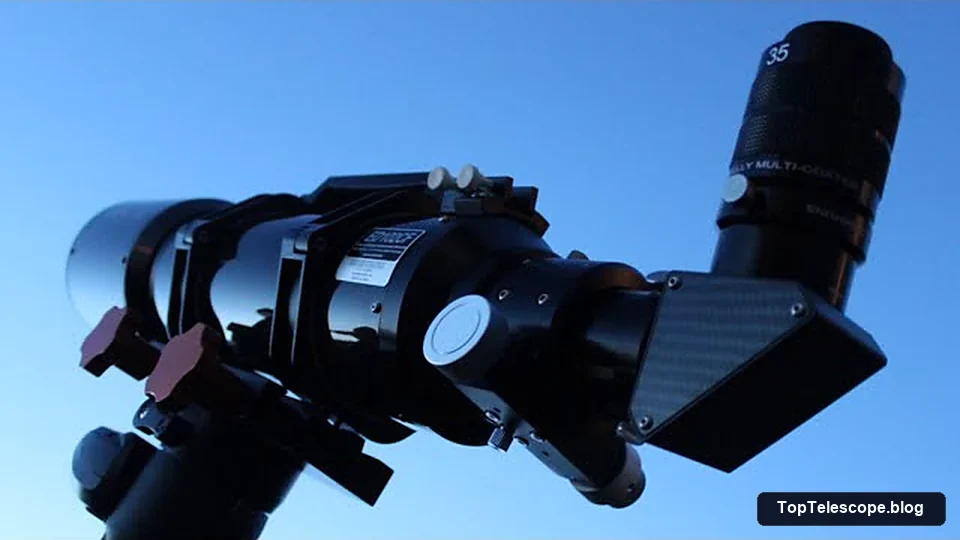
Aluminum tubes require adequate cool-down time when moving from warm interiors to freezing night air. Allowing thirty minutes stabilizes the glass and prevents internal thermal air currents.
The durable exterior finish resists condensation buildup and minor scratches during heavy outdoor use. Mechanical tolerances remain stable throughout drastic ambient temperature drops.
Achieving thermal equilibrium requires approximately forty-five minutes when transitioning from a warm indoor environment to freezing outdoor conditions. The metal optical tube contracts uniformly, preserving optical alignment during drastic temperature swings.
The heavy-duty aluminum dew shield slides smoothly and locks firmly into place. It prevents ambient moisture deposition on the front objective element during extended nighttime imaging sessions under heavy morning dews.
- Predictable thermal acclimatization curve
- Resistant to dew and frost accumulation
Dew Mitigation
Integrating a flexible dew heater strip around the objective cell prevents fogging. Operating the heating band at low voltage settings avoids internal thermal currents that could degrade high-resolution planetary views.
Setup, Mounting Requirements and Field Operation
Weighing over eleven pounds, this optical tube requires a sturdy medium-duty equatorial mount. Using an undersized mount will introduce micro-vibrations that degrade high-magnification planetary views.
The included Vixen-style dovetail plate allows rapid attachment to most modern mounts. Field balancing takes only moments when utilizing the sliding mounting ring positions.
Operational stability demands a sturdy equatorial mount rated for at least thirty pounds of payload capacity. Heavy-duty stainless steel tripod legs dampen local wind vibrations effectively during long exposure astrophotography tasks.
Balancing the telescope requires meticulous positioning along the Vixen dovetail mounting bar. Reviewing setups in our best starter telescope guide ensures smooth tracking performance across the entire celestial meridian.
- Requires stable medium-capacity equatorial mount
- Quick-release dovetail mounting system
Polar Alignment
Accurate polar alignment remains critical for tracking faint deep sky targets successfully. Utilizing electronic finder scopes or computer-assisted routines simplifies the calibration process prior to starting automated imaging sequences.
Routine Maintenance, Cleaning Protocols and Long-Term Durability
Maintaining optical coatings requires minimal intervention using dry compressed air and micro-fiber cloths. Avoid touching the glass surfaces directly to preserve the anti-reflective chemical treatments.
Store the telescope in a padded hard case with desiccant packs to prevent humidity damage. Reviewing maintenance tips inside our best telescope for beginners guide ensures long-term mechanical reliability.
Routine maintenance involves removing surface dust using a bulb blower rather than compressed gas. Protecting optical coatings preserves light transmission and prevents premature degradation of the sensitive multi-layer anti-reflective treatments.
Storing the optical tube in a padded hard case safeguards mechanical components from physical impacts. Desiccant packs placed inside the enclosure control humidity levels and inhibit mold growth on optical glass surfaces.
- Dust removal via bulb blower first
- Padded storage case strongly recommended
Lens Cleaning
Cleaning optical elements requires optical-grade microfiber cloths and specialized chemical solutions. Technicians should gently wipe surfaces in a spiral motion starting from the center outward to avoid leaving stubborn streaks.
Definitive Buyer Verdict: Who Should Buy vs. Skip
Astrophotographers seeking a reliable wide-field imaging platform will find immense value here. Its stellar glass quality and robust focuser satisfy demanding enthusiast requirements.
Casual observers wanting a grab-and-go setup should skip this heavy OTA. It requires a dedicated mount and careful handling unsuited for absolute beginners.
Intermediate astronomers seeking a portable apochromatic refractor will find exceptional value in this optical system. Its robust mechanical build and stellar chromatic correction satisfy demanding visual observers and budding astrophotographers alike.
Observers requiring extreme portability or ultra-wide fields should skip this model in favor of smaller travel scopes. Budget-conscious beginners might also find heavier optical tubes challenging to mount on entry-level tracking platforms.
- Ideal for dedicated astrophotographers
- Not recommended for casual handheld use
Final Recommendation
Careful evaluation of your mounting hardware and transportation constraints ensures long-term satisfaction. This versatile telescope delivers rewarding observing sessions when paired with matching accessories and sturdy mechanical supports.
Frequently Asked Questions
Does the Explore Scientific ED102 require a field flattener for imaging?
Yes, using a dedicated field flattener is essential for astrophotography to ensure stars remain sharp and round all the way to the extreme corners of your camera sensor.
What mount capacity is recommended for this telescope?
You should pair this optical tube with a sturdy medium-duty equatorial mount rated for at least thirty pounds to eliminate unwanted vibrations during long exposures.
Can this telescope be used for visual astronomy as well?
Absolutely, it provides stunning high-contrast visual views of the moon, planets, and brighter deep-sky objects when paired with standard 1.25-inch or 2-inch eyepieces.
What back-focus distance is needed when attaching a camera?
When utilizing the matching field flattener accessory, you must maintain exactly fifty-five millimeters of spacing between the rear lens element and your camera sensor plane.
How do I clean the objective lens safely?
Always blow away loose dust particles with a clean rubber bulb syringe before applying any optical cleaning fluid or microfiber cloths to the multi-coated glass.