Explore Scientific 102 Triplet Review
This premium air-spaced triplet delivers exceptional color correction and rigid mechanical build quality. However, its substantial optical weight demands a sturdy equatorial or heavy-duty alt-azimuth mounting system.

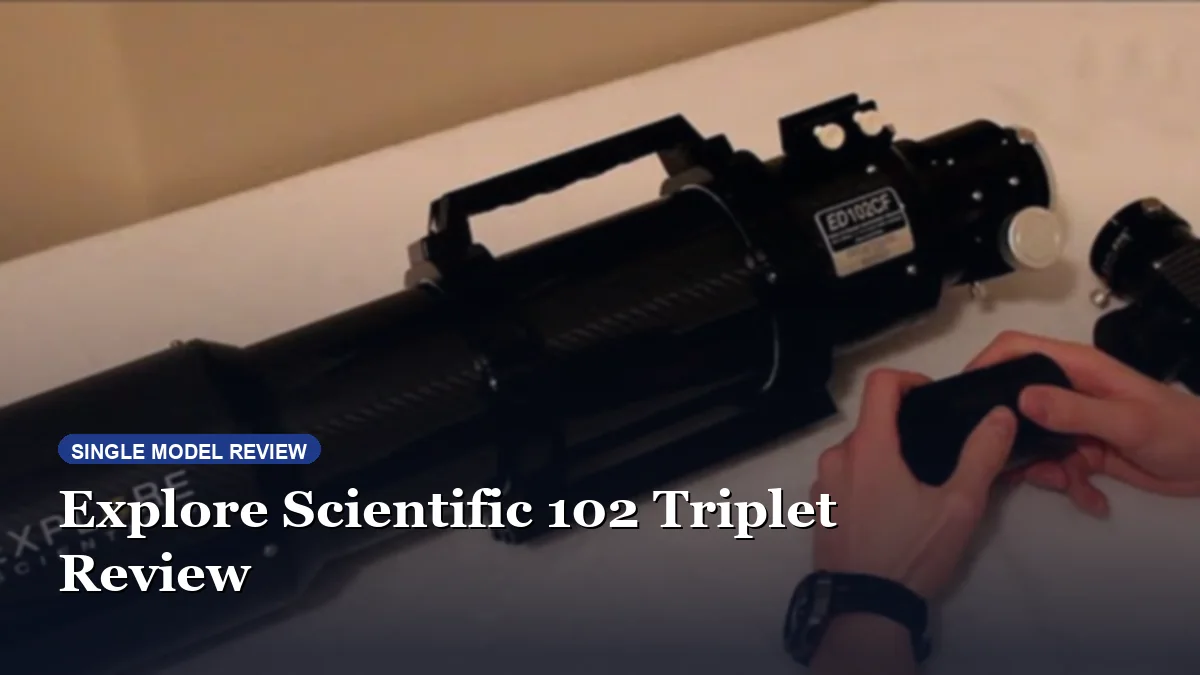

The Explore Scientific 102 Triplet provides breathtaking, color-pure views across lunar and deep-sky targets, backed by robust mechanical engineering and exceptional glass quality that satisfies demanding advanced observers.
See our flagship Best Telescope: Top Backyard Picks for Astronomy.
Verified Specifications
| Optical Design | Air-spaced 3-lens astrophotography triplet |
|---|---|
| Aperture | 102mm (4 inches) |
| Focal Length | 714mm |
| Focal Ratio | f/7 |
| Glass Type | Hoya FCD100 Extra-Low Dispersion |
| Focuser | 2.5-inch Hexagonal Dual-Speed Rack and Pinion |
| OTA Weight | Approximately 13.5 pounds |
| Tube Material | Anodized aluminum with internal baffling |
| Mounting | Vixen-style dovetail plate with cradle ring |
What We Liked
- Virtually nonexistent chromatic aberration across high-power visual fields
- Robust 2.5-inch dual-speed rack and pinion focuser handles heavy cameras
- Premium Hoya FCD100 ED glass delivers high-contrast planetary imagery
- Sturdy aluminum tube construction features extensive internal knife-edge baffling
- Includes a lockable rotating camera angle adjuster for framing ease
Trade-Offs
- Noticeable heavy optical tube weight requires a substantial mount
- Substantial cool-down time needed before reaching thermal equilibrium outdoors
- Optional field flattener or reducer required for flat-field astrophotography
Optical Architecture and Glass Formulation
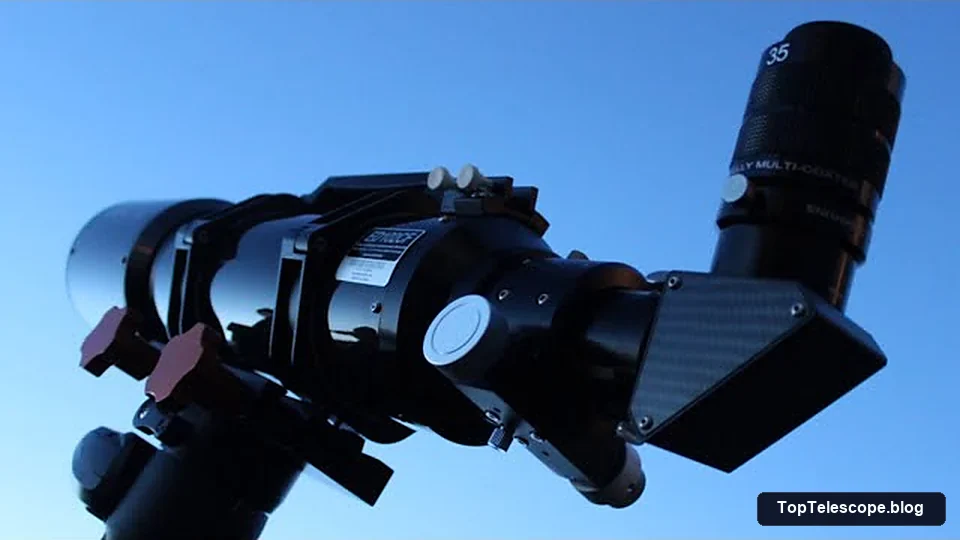
Advanced optical design relies heavily on premium glass selection to eliminate unwanted chromatic dispersion. This specific triplet uses Hoya FCD100 extra-low dispersion elements paired with high-grade crown glass to ensure pure white-light transmission without distracting false color rings.
Air-spaced three-lens configurations require precise manufacturing tolerances during assembly. Precision spacers maintain exact optical air gaps between elements, guaranteeing peak performance across wide spectral bands during complex astronomical observation sessions.
- Air-spaced 102mm triplet objective configuration
- Hoya FCD100 ED glass minimizes secondary spectrums
- Fully multi-coated optics maximize overall light throughput
Triplet Lens Configuration
Splitting focal duties across three distinct glass elements dramatically improves overall wavefront correction. Engineers can manipulate curves more effectively, taming spherical aberrations that plague traditional doublet lenses at faster focal ratios.
The front element gathers and refracts incoming starlight, while internal corrector elements fine-tune the wavefront. This intricate design achieves stunning optical clarity for high-magnification planetary viewing and wide-field deep-sky imaging.
- Three distinct optical elements working in tandem
- Optimized curve radius for minimized spherical error
Chromatic Aberration Correction
Secondary spectrum control separates premium triplets from standard achromats. When targeting bright objects like Jupiter or Vega, users will observe zero purple fringing, confirming the exceptional efficacy of the ED glass formulation.
Rigorous multi-coating applications on all six air-to-glass surfaces further enhance contrast. Internal reflections remain virtually imperceptible, allowing faint nebulae details to emerge against truly dark background skies during observation.
- Complete elimination of violet and blue halos
- Broadband coatings optimize transmission across visible spectrum
Mechanical Build Quality and Ergonomics
Constructed from heavy-duty machined aluminum, the optical tube assembly withstands rigorous field transportation. The exterior features a durable, textured white powder coat that resists scratches and sheds minor dew accumulation during night sessions.
Ergonomic handling features include a robust carrying handle integrated directly into the mounting cradle rings. This thoughtful addition provides secure one-handed transport when moving the heavy instrument between storage and tripod setups.
- Machined aluminum optical tube assembly
- Integrated carrying handle on mounting rings
- Resilient white powder-coated exterior finish
Focuser Mechanics
A smooth 2.5-inch hexagonal rack and pinion focuser anchors the rear optical train. This mechanical design prevents image shift and eliminates drawtube sagging when supporting heavy dedicated astrophotography CCD or CMOS imaging cameras.
Dual-speed coarse and fine focus knobs offer a ten-to-one reduction gear ratio. This precise control allows users to achieve pinpoint focus accuracy effortlessly under seeing conditions that challenge lesser optical instruments.
- 2.5-inch hex drawtube prevents rotational slippage
- 10:1 dual-speed micro-focuser control knobs
Tube Ring Assembly
Heavy-duty cast cradle rings clamp securely around the aluminum optical tube. They feature flat mounting surfaces and threaded accessory attachment points for mounting guidescopes or electronic filter wheels directly above.
A standard Vixen-style dovetail bar bolts firmly to the base of the cradle rings. This universal mounting interface ensures reliable telescope stability across a wide variety of commercial equatorial and alt-azimuth mounts.
- Heavy-duty cast aluminum cradle ring set
- Standard Vixen-style mounting dovetail plate included
Video Review: Explore Scientific ED102 Unboxing and Assembly
Real-World Visual Performance and Field Testing
When evaluating an ED refractor vs triplet apo design, this optic delivers breathtaking visual field performance. Star images appear as tiny, razor-sharp points right to the edge, showcasing exceptional optical flatness.
The 102mm aperture gathers ample light to resolve globular clusters and faint galactic arms. Observers will appreciate the high contrast views when studying intricate lunar craters and subtle Jovian cloud belt structures.
- Pinhole star images across wide eyepiece fields
- Substantial light-gathering power for deep-sky targets
- High contrast rendering for planetary surface features
Lunar and Planetary Observation
High-magnification lunar viewing highlights the exceptional resolving power of the ED triplet objective. Mountain peaks and shadow details along the terminator appear remarkably crisp without any washed-out chromatic haze interference.
Planetary targets like Saturn reveal subtle Cassini division details and atmospheric banding. The optical system maintains outstanding image integrity even when pushed past two hundred magnifications on nights of steady seeing.
- Crisp terminator contrast on lunar craters
- Clean planetary limb separation and ring definition
Deep-Sky Object Resolution
While primarily a medium-aperture instrument, deep-sky performance remains impressive for extended nebulae. Wide-field eyepieces reveal expansive structures in emission nebulae when paired with appropriate narrowband light pollution filters.
Open star clusters sparkle against velvety black backgrounds due to superior baffle suppression. Stray light is effectively blocked, ensuring maximum background darkness for discerning faint outer Milky Way stellar aggregates.
- Rich wide-field views of large galactic clusters
- Effective internal baffling against stray off-axis light
Astrophotography Capability and Imaging Workflow
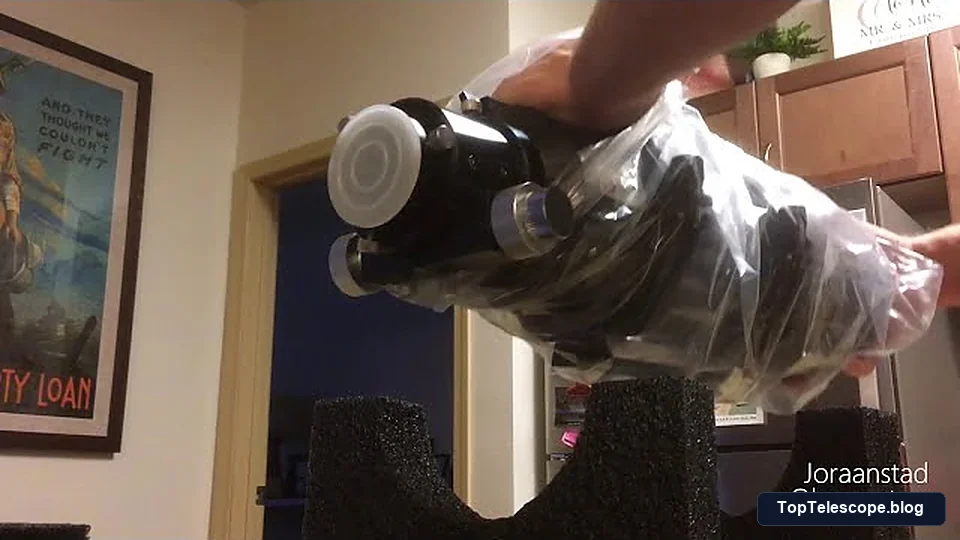
Astrophotographers will find this triplet a capable platform for deep-sky imaging projects. The native f/7 focal ratio balances exposure speed with image scale, making it ideal for capturing medium-sized galaxies and emission nebulae structures.
Integrating modern DSLR or cooled CMOS cameras requires minimal effort via standard threaded adapters. Users should note that an optional field flattener is necessary to eliminate edge star elongation across large sensor formats.
- Balanced f/7 photographic focal ratio speed
- Compatible with standard camera T-ring adapters
- Requires optional flattener for APS-C sensors
Field Flattener Integration
Refractor optics naturally exhibit slight field curvature at the extreme corners of large camera sensors. Attaching a dedicated field flattener corrects this optical geometry without altering the focal length or introducing color aberrations.
Thread-on connections prevent mechanical tilt during long exposure imaging sequences. This ensures uniform star sharpness from corner to corner across demanding modern CMOS imaging sensor arrays.
- Dedicated flatteners maintain native focal length
- Threaded connections eliminate mechanical camera tilt
Camera Payload Management
The robust 2.5-inch focuser easily manages heavy imaging trains containing filter wheels and auto-guiders. Locking thumbscrews secure the camera orientation firmly, preventing rotation during multi-hour meridian flip sequences.
Proper balance is crucial when mounting heavy cameras to this optical tube. Operators must adjust the dovetail position carefully to prevent motor strain on smaller tracking equatorial mount gearboxes.
- Rigid focuser drawtube supports heavy imaging rigs
- Secure locking mechanism prevents camera rotation
Thermal Equilibrium and Efficiency Management
Air-spaced triplet lenses contain substantial glass mass, which is an important factor among top telescope options. Bringing the tube outside thirty minutes prior to viewing allows objective elements to adjust to ambient temperatures.
Thermal management directly impacts high-magnification clarity and focus stability. Ignoring this critical equilibration phase can cause mild internal air currents that temporarily degrade fine planetary detail resolution during early evening sessions.
- Substantial glass mass requires thermal acclimation
- Thirty-minute cool-down period recommended before use
- Maintains stable focus once ambient equilibrium is met
Cool-Down Times
Temperature differentials between indoor storage and outdoor night air create internal lens currents. These micro-currents scatter incoming light rays, temporarily reducing contrast until thermal stabilization is fully achieved outdoors.
Storing the optical tube in a cool garage or mudroom significantly reduces required acclimatization times. This proactive habit ensures immediate optical readiness once astronomical twilight transitions into night.
- Indoor-outdoor temperature gaps cause internal currents
- Proactive storage habits speed up thermal settling
Dew Shield Design
A sliding metal dew shield protects the front objective lens from moisture condensation during humid nights. The internal surface features matte flocking to absorb stray oblique light rays effectively.
Extending the shield fully prevents early evening dew accumulation on the outer glass surface. This simple mechanical feature extends valuable observation hours without requiring active dew heater strips in moderate conditions.
- Retractable metal dew shield with locking thumbscrew
- Internal matte flocking absorbs off-axis stray light
Setup, Alignment, and Field Maintenance
Field deployment is straightforward thanks to the balanced weight distribution and integrated carrying handle. Attaching the optical tube to a compatible equatorial mount takes only moments using the secure dovetail clamp.
Collimation of the air-spaced triplet lens is factory-set and locked within a precision cell. Users rarely need to adjust alignment, ensuring hassle-free operational readiness across years of regular transport and travel.
- Fast assembly with integrated carrying handle
- Factory-locked lens cell maintains precise collimation
- Simple dovetail clamping mechanism for quick mounting
Mounting Requirements
The optical tube assembly weighs over thirteen pounds, demanding a sturdy mount for stable tracking. Using an under-rated tripod will introduce annoying image vibrations during focusing and high-wind conditions.
Investing in a robust equatorial or heavy-duty alt-azimuth mount guarantees rock-solid stability. This solid foundation is essential for precise manual tracking at magnifications exceeding two hundred power.
- Minimum thirteen-pound payload requirement for mounts
- Sturdy tripod eliminates high-magnification image shaking
Optical Care
Keeping the multi-coated objective clean requires minimal intervention using proper optical cleaning tools. Users should always use a bulb blower to remove loose dust particles before applying any liquid cleaning solutions.
Protecting the front glass with the included metal cover prevents accidental fingerprints and scratches. Proper storage habits ensure the pristine optical condition remains intact throughout the lifetime of the instrument.
- Always remove loose dust with a bulb blower first
- Use dedicated optical microfiber cloths and fluids sparingly
Comprehensive Buyer Assessment and Verdict
When comparing the Explore Scientific ED80 models, this triplet represents an exceptional investment for dedicated amateur astronomers. Its FCD100 glass and robust mechanics deliver professional-grade performance for serious visual work.
While the overall weight requires a sturdy mounting platform, the optical rewards justify the hardware investment. It remains a stellar instrument choice for enthusiasts demanding color-pure views of the cosmos.
- Professional-grade optical performance for amateurs
- Exceptional color correction and mechanical rigidity
- Requires a substantial mount for optimal stability
Who Should Purchase
Advanced visual observers who prioritize sharp, color-pure planetary and lunar views will find this telescope ideal. It also serves astrophotographers looking for a premium, portable refractor for deep-sky imaging projects.
Anyone upgrading past a basic instrument from our best starter telescope guide will appreciate this massive optical leap. The robust focuser and durable mechanical build ensure reliable performance for decades of stargazing.
- Ideal for advanced visual planetary observers
- Well-suited for intermediate deep-sky astrophotographers
Alternative Considerations
Beginners or casual observers on a tight budget might find lighter doublet refractors more practical. Those needing ultra-portable setups may prefer smaller apertures that require less robust and lighter mounting tripods.
Weighing portability against optical perfection helps determine the right fit. If high-power color purity is paramount, sticking with this heavy-duty triplet design remains the superior astronomical choice.
- Doublet achromats offer lighter, budget-friendly alternatives
- Smaller apertures reduce overall tripod weight requirements
Frequently Asked Questions
Does this telescope require a field flattener for astrophotography?
Yes, an optional field flattener is necessary to eliminate edge star distortion across large camera sensors. Using this accessory guarantees uniform corner sharpness during long exposures.
What size mount is recommended for this optical tube?
You need a sturdy equatorial or heavy-duty alt-azimuth mount with at least a twenty-pound payload capacity. This ensures rock-solid stability during high-magnification focusing sessions.
How long does the triplet lens take to reach thermal equilibrium?
The heavy glass elements require roughly thirty minutes of acclimatization outdoors before achieving peak performance. Storing the tube in a cool area accelerates internal temperature settling significantly.
Can I use standard 1.25-inch eyepieces with the included focuser?
Yes, the 2.5-inch focuser includes a standard adapter for traditional 1.25-inch accessories alongside native 2-inch barrels. This provides complete eyepiece compatibility for your existing collection.
Is user collimation required for the triplet objective lens?
No, the air-spaced triplet cell is factory-locked in a precision housing to maintain alignment. Users enjoy hassle-free operation without needing frequent optical adjustments.