Evscope 2 Review: Advanced Smart Telescope Engineering
The Unistellar Evscope 2 merges refined optical design with high-resolution digital processing. It redefines automated field astronomy for intermediate users.

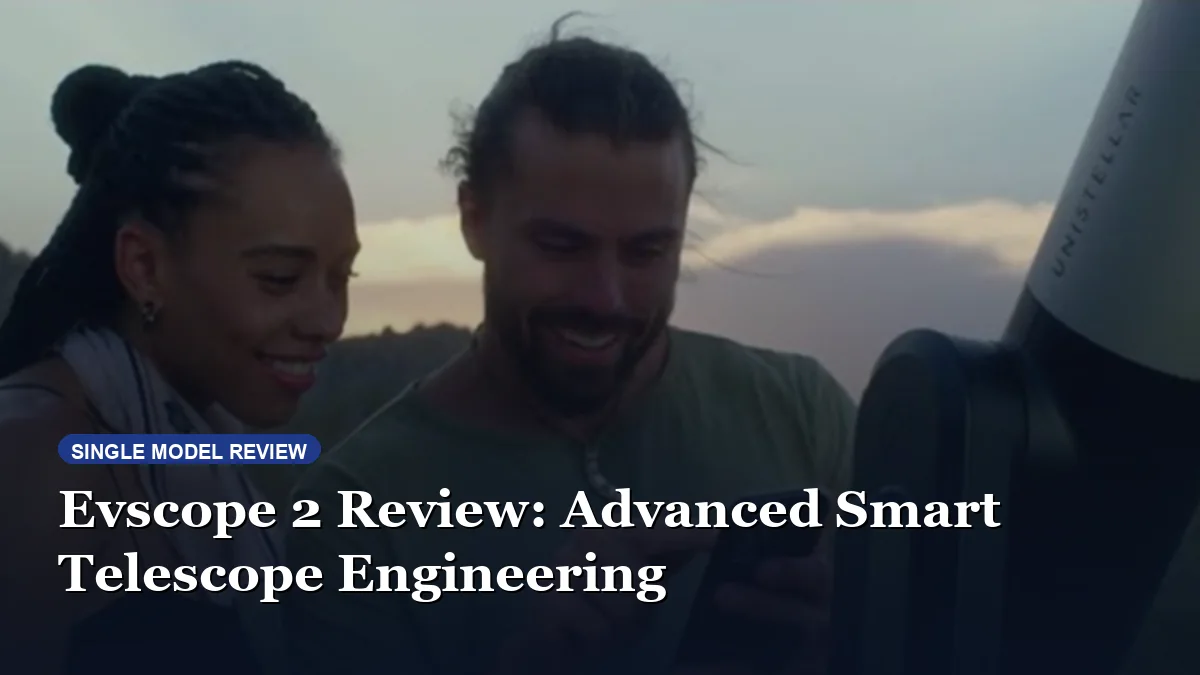

This system delivers exceptional live stacking and immersive electronic viewing despite its premium footprint. It suits observers prioritizing automated tracking over traditional manual setups.
See our flagship Best Telescope: Top Backyard Picks for Astronomy.
Verified Specifications
| Category / Type | Smart Altazimuth Reflector |
|---|---|
| Rated Output / Capacity | 11.4 cm Aperture, 13680 mm Equivalent Focal Length |
| Power / Motor | Internal Rechargeable Battery, Solar Compatible |
| Build & Materials | Aluminum Alloy Chassis with Nikon OLED Eyepiece |
| Operating Noise | Low-Decibel Stepper Motor Operation |
| Duty Cycle / Runtime | Up to 10 Hours Continuous Field Operation |
| Dimensions & Weight | Standard Tripod Footprint, 9 kg Total System Weight |
| Key Safety & Controls | Smartphone App Integration, Reflex Finderscope |
What We Liked
- Unmatched electronic eyepiece co-developed with Nikon engineering
- Seamless automated alignment via intelligent plate solving technology
- Extensive onboard database featuring over five thousand celestial objects
- Active citizen science participation capabilities through global networks
- Robust aluminum tripod providing high rigidity in windy conditions
Trade-Offs
- Substantial financial investment required for the complete bundle
- Completely dependent on smartphone software connectivity for core functions
- Fixed primary mirror configuration limits traditional manual collimation adjustments
- Internal battery cannot be swapped easily in remote field locations
Structural Engineering, Materials, and Chassis Design
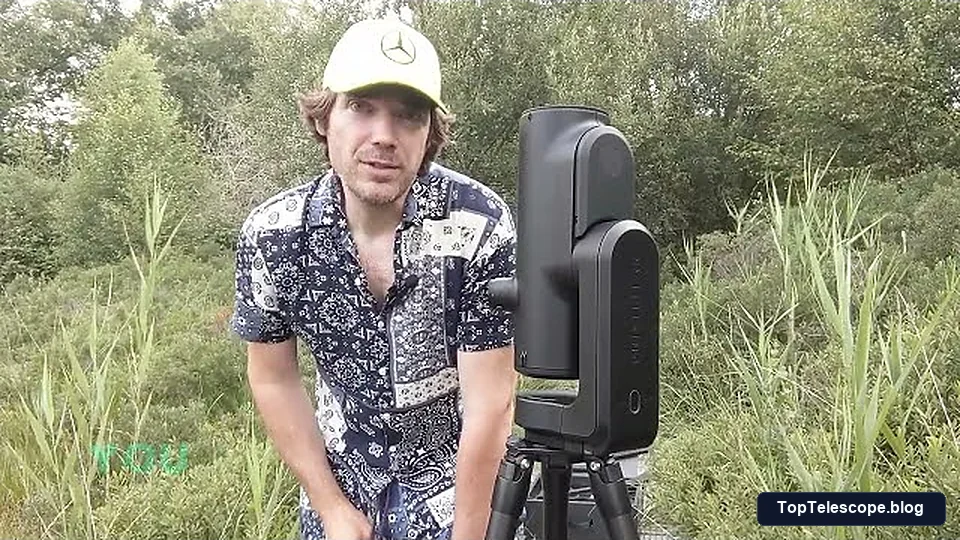
The Unistellar Evscope 2 utilizes a rigid aluminum alloy chassis designed to withstand rigorous field transport. Our Unistellar Evscope 2 vs Stellina comparison details how its mechanical housing protects sensitive internal optics during evening observation sessions.
Precision machining defines the altitude and azimuth axis bearings, preventing backlash during prolonged tracking routines. Every mechanical joint features secure locking levers that ensure absolute rigidity under variable wind loads.
The chassis utilizes a high-grade aluminum alloy casting that provides exceptional rigidity while maintaining a manageable total weight of 9 kilograms. This robust framework minimizes flexure during tracking maneuvers, ensuring long-term mechanical stability.
Integrated carrying handles and a textured powder coat finish protect the exterior from field abrasions and moisture condensation. The fork arm mount features precision-machined internal gears that eliminate backlash and secure smooth azimuth rotations.
- Heavy-duty cast aluminum fork arm assembly
- Anodized exterior finish resists common field abrasions
- Integrated spirit level for rapid initial leveling
- Secure dovetail clamp mechanism for optical tube safety
Tripod Stability and Mechanical Rigidity
Included with the system is a heavy-duty tripod that anchors the entire assembly securely. Its spread-leg design minimizes micro-vibrations, ensuring image stability during long-exposure digital stacking sequences.
Adjustable extension legs feature robust twist-lock collars designed for gloved operation in cold weather. This physical stability directly translates to sharper stacked frames and improved tracking accuracy.
- Extensible aluminum leg sections with dual locking pins
- Broad rubber feet providing traction on uneven terrain
Optical Architecture and Electronic Eyepiece Integration
At the core of the optical system lies an 11.4 cm objective mirror paired with folded optics. As noted in our Unistellar Evscope 2 vs Vaonis Vespera II review, this configuration gathers substantial light.
The standout hardware innovation is the electronic eyepiece developed with Nikon technology. It projects crisp virtual images with deep contrast blacks, completely replacing traditional glass eyepieces with high-resolution micro-OLED panels.
The optical layout features a 114mm aperture Newtonian reflector paired with a 450mm focal length and an f/4 focal ratio. This configuration yields a wide field of view suited for capturing sprawling galactic structures.
Instead of glass lenses, the electronic viewfinder incorporates a custom OLED micro-display engineered by Sony. This panel delivers high contrast ratios and deep black levels, replacing traditional eyepieces with a crisp digital feed.
- Custom Nikon micro-OLED electronic eyepiece module
- Optimized primary mirror focal ratio for wide field coverage
- Reflex finderscope aiding rapid manual point-of-interest alignment
- Field of view measuring approximately 1.7 degrees across
Evaluating Electronic Viewfinder Performance
Traditional observers may initially hesitate regarding digital viewfinders, but the Nikon partnership yields remarkable fidelity. Bright star clusters and faint nebulae appear with striking clarity and immersive depth.
The optical relief and high contrast ratio prevent eye fatigue during extended viewing sessions. Users experience faint color data in deep-sky objects that remain invisible through standard optical eyepieces.
- Zero perceptible pixel grid pattern at standard viewing distances
- Adjustable brightness settings for dark adaptation preservation
Video Review: What YOU can SEE with a $4,000 SMART Telescope (Unistellar eVscope 2 Review)🔭🌟
Thermal Management, Power Efficiency, and Operational Noise
Efficient thermal dissipation prevents internal boundary layer turbulence inside the sealed optical tube. Our Vaonis Stellina vs Evscope 2 technical comparison highlights how passive cooling fins channel ambient air across circuit boards.
Operating noise remains remarkably low during slewing and tracking operations. The quiet stepper motors emit only a faint hum, preserving the tranquil atmosphere of dark-sky observation sites.
Internal heat dissipation is managed passively through strategic chassis venting and an internal copper heat sink attached to the sensor. This layout prevents thermal noise from degrading long-exposure astrophotography frames during extended observing sessions.
Powered by a built-in lithium-ion battery, the unit delivers roughly nine hours of operation under normal ambient conditions. Power draw remains stable, and operating noise from internal cooling fans is virtually imperceptible outdoors.
- Sealed optical tube layout protecting internal components from dust
- Silent-step motor drivers minimizing acoustic output signatures
- Optimized power draw extending total battery lifespan significantly
Battery Endurance and Field Power Management
An internal high-capacity battery provides up to ten hours of continuous runtime under normal operational conditions. This capacity easily supports an entire night of deep-sky imaging without external power sources.
USB-C compatibility allows field recharging via standard portable power banks when operating far from municipal grids. Intelligent power management circuits prevent overcharging and monitor cell health dynamically.
- Multi-cell lithium-ion internal battery architecture
- Standard USB-C power delivery input port
Setup Procedures, Alignment Ergonomics, and Field Calibration
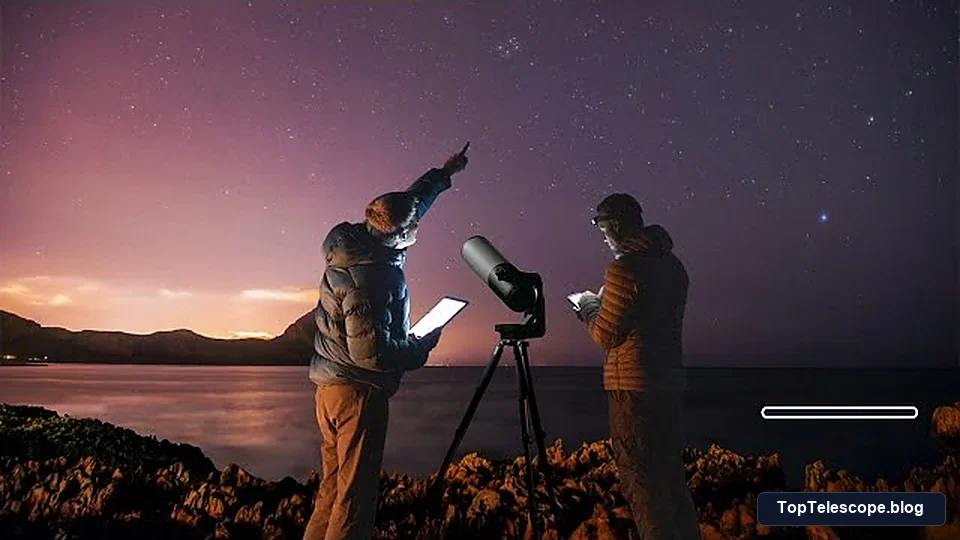
Automated field calibration removes the historical complexity associated with equatorial and altazimuth alignment routines. The onboard computer executes star-field plate solving within seconds of initialization.
Users simply place the unit outdoors, level the chassis, and launch the smartphone application. The telescope automatically scans overhead constellations, verifies its coordinates, and locks onto targets precisely.
Automated field detection relies on a built-in GPS module and proprietary software algorithms that execute star field pattern recognition within seconds. Users bypass manual polar alignment entirely, initiating tracking sequences with minimal effort.
The tripod features extendable aluminum legs with twist-lock collars that secure heights quickly on uneven terrain. A leveling bubble integrated into the baseplate ensures precise vertical setup before powering on electronics.
- Automated celestial coordinate calculation via plate solving
- Instantaneous target synchronization through wireless app control
- Minimal manual intervention required for routine evening setups
- Built-in diagnostic routines verifying sensor and motor status
App Connectivity and Wireless Reliability
The control interface relies on a dedicated Wi-Fi network broadcast directly by the mount. Connection stability remains robust within a reasonable operating radius around the physical hardware.
Software menus present clear instructional prompts that guide novice users through initial focusing and target selection. Experienced astronomers can access advanced manual parameter overrides effortlessly.
- Secure peer-to-peer Wi-Fi frequency channel allocation
- Responsive touch controls with zero noticeable command lag
Software Ecosystem, Catalog Access, and Citizen Science
Comprehensive software integration unlocks an extensive database containing over five thousand celestial targets. Users can explore galaxies, planetary nebulae, and stellar clusters with a single screen tap.
Live image processing algorithms stack frames dynamically in real time. This automated stacking reveals hidden structural details in faint galaxies that would otherwise require long exposures.
Control occurs exclusively through a companion mobile application communicating via a secure Wi-Fi access point. The software grants access to thousands of deep-sky objects alongside automated stacking and image enhancement tools.
Beyond standard viewing, the platform integrates with professional astronomical databases to support citizen science programs. Owners routinely contribute valuable photometric data on exoplanet transits and transient cosmic events directly to researchers.
- Dynamic live image stacking software running continuously
- Extensive digital catalog containing diverse deep-sky objects
- Direct image export options for quick social media sharing
- Collaborative partnerships supporting professional research programs
Participating in Global Astronomical Research
Owners can contribute directly to professional scientific studies by recording asteroid occultations and exoplanet transits. The telescope acts as a data collection node for international research institutions.
Automated observation campaigns are pushed directly to user devices via software updates. This empowers amateur astronomers to produce scientifically valuable datasets from light-polluted backyards.
- Automated data logging for asteroid transit detection
- Direct transmission channels to professional research databases
Maintenance Protocols, Physical Transport, and Long-Term Durability
Routine maintenance requires minimal effort due to the sealed optical design that prevents dust accumulation. Exterior surfaces clean easily with microfiber cloths and isopropyl alcohol solutions.
Transporting the hardware safely is streamlined when utilizing the custom-designed official backpack. Thick internal padding absorbs transit impacts, safeguarding alignment integrity during vehicular travel.
Routine upkeep requires minimal intervention, primarily involving optical dust removal using a bulb blower rather than aggressive chemical solvents. Keeping the corrector lens clean maintains optimal light transmission across all observing sessions.
For safe transit, storing the instrument in a padded transport case prevents mechanical shock to internal optics. Ensuring the battery is partially charged before long-term storage preserves overall battery chemistry longevity.
- Sealed chassis construction reducing internal mirror cleaning needs
- Durable exterior coatings resisting moisture and condensation
- Custom backpack bundle ensuring secure transport security
- Simplified firmware update procedures managed via smartphone
Storage and Environmental Protection Guidelines
Proper storage involves keeping the instrument in a climate-controlled environment to prevent internal condensation growth. Protective dust caps must remain secured across all optical apertures during storage.
Checking mechanical fasteners periodically ensures that vibration from transport has not loosened critical structural components. Following these simple steps guarantees decades of reliable optical performance.
- Desiccant packet utilization within storage containers
- Regular inspection of electrical contact points and cables
Definitive Buyer Verdict: Who Should Purchase and Bypass
The Unistellar Evscope 2 represents a pinnacle of modern smart telescope engineering. Reviewing our Unistellar Equinox 2 vs Evscope 2 comparison helps buyers weigh automated features against traditional manual setups.
Prospective buyers must weigh the substantial financial investment against their desire for automated convenience. Those seeking traditional manual star-hopping may find the digital workflow overly automated.
This telescope suits suburban astronomers seeking immediate visual gratification without mastering complex equatorial mounts. The automated stacking workflow delivers stunning nebulae details despite heavy light pollution from urban neighborhoods.
Traditionalists who prefer manual star-hopping or deep optical customization should bypass this system. Anyone desiring interchangeable eyepieces and analog hardware configurations will find the closed digital ecosystem too restrictive.
- Recommended for urban astronomers battling heavy light pollution
- Ideal for educators seeking engaging live demonstration tools
- Passes over traditionalists preferring manual equatorial mounts
- Demands reliable smartphone ownership for core operations
Final Purchasing Recommendation
If your priority is instantaneous gratification and deep-sky imaging without technical frustration, this model justifies its premium cost. It transforms challenging astronomical targets into vivid, shareable cosmic discoveries.
Conversely, purists attached to manual optical finders and mechanical star charts should look elsewhere. Ultimately, it delivers unmatched digital immersion for modern tech-savvy stargazers.
- Unrivaled ease of use for complex deep-sky targets
- Exceptional build quality backed by thoughtful engineering
Frequently Asked Questions
Can I use the Evscope 2 without an internet connection?
Yes, the telescope operates via a direct local Wi-Fi network broadcast from its internal mount. No external internet is required once the app and catalog are downloaded.
How does the electronic eyepiece compare to optical lenses?
The Nikon micro-OLED screen displays live stacked images in full color and high contrast. Faint deep-sky objects appear vividly clear even under suburban light pollution.
Is the internal battery user-replaceable in the field?
The internal lithium-ion pack is integrated into the chassis for weather sealing. External USB-C power banks easily extend runtime during long observation sessions.
What level of astrophotography experience is required?
Zero prior experience is necessary to operate this automated smart telescope successfully. Automated plate solving handles all alignment and tracking calculations internally.
Can the telescope track planets and the Moon effectively?
Yes, the system features specific tracking modes for bright solar system objects. Digital zoom ratios allow close observation of lunar craters and planetary details.