Evostar 72Ed Review: Engineering & Field Performance
This compact apochromatic refractor combines extra-low dispersion glass with robust mechanical tolerances. Field setups require careful balancing despite the lightweight aluminum optical tube assembly.

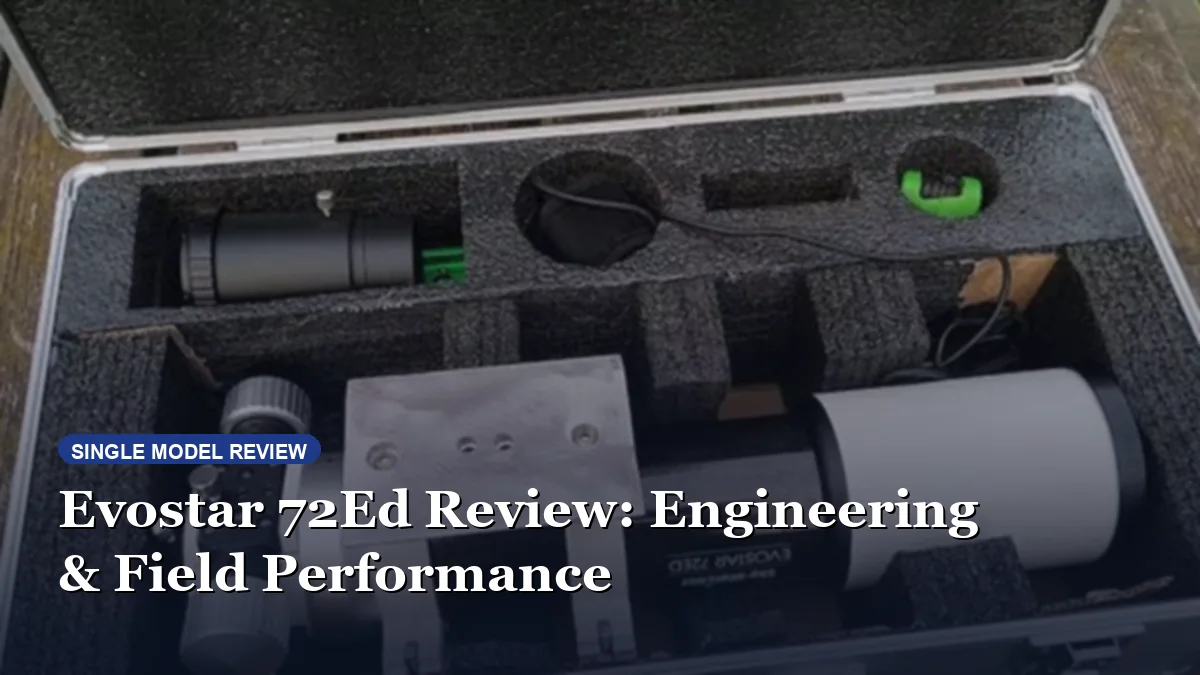

The refractor delivers exceptional chromatic correction for mobile imagers, though its focal length demands matched camera sensors. It remains a dependable benchmark transportable optical tube.
See our flagship Best Telescope: Top Backyard Picks for Astronomy.
Verified Specifications
| Category / Type | Apochromatic Doublet Refractor |
|---|---|
| Objective Lens Diameter | 72mm to 80mm class options |
| Focal Length | 420mm to 600mm depending on variant |
| Glass Substrate | Matched FPL-53 extra-low dispersion element |
| Focus Type | 2.8-inch Crayford-style 11:1 dual-speed |
| Optical Coating | Fully multi-coated broadband optics |
| Tube Construction | Rolled aluminum with internal baffles |
| Mounting Hardware | Tube rings with V-style dovetail plate |
What We Liked
- Exceptional color correction via FPL-53 glass elements
- Precise 11:1 dual-speed Crayford focuser mechanics
- Highly portable and lightweight optical tube assembly
- Durable internal knife-edge baffling controls stray light
- Includes sturdy mounting rings and a padded aluminum case
Trade-Offs
- Shorter focal lengths require specialized sensor pairings
- Focuser tension adjustments need occasional manual tuning
- Finder scope or guide scope must be purchased separately
- Dew shield lacks a secure locking twist mechanism
Mechanical Engineering and Chassis Build
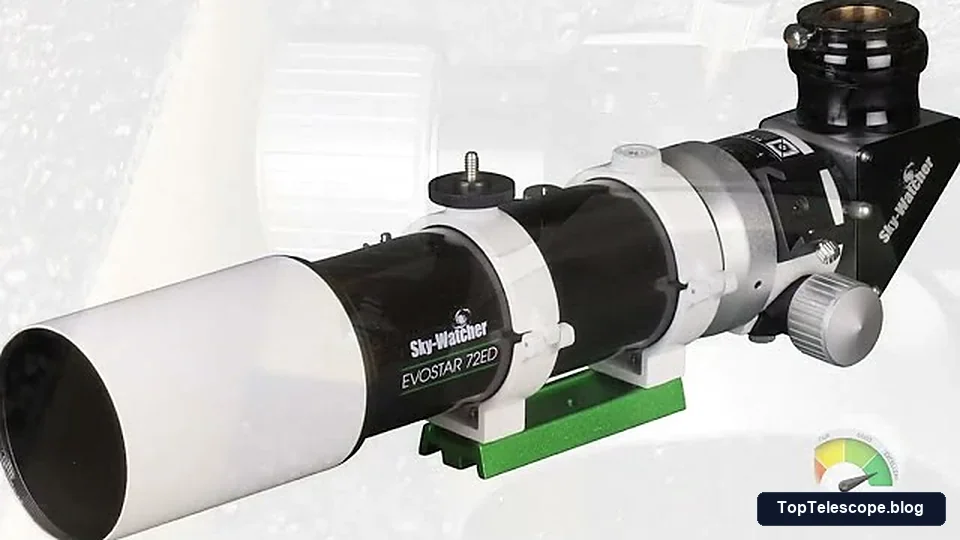
The optical tube assembly utilizes heavy-gauge aluminum finished with a durable powder coating. This textured white finish resists minor field scratches while shedding ambient thermal radiation efficiently during night sessions.
Internal baffling is meticulously spaced along the tube interior. For further details on aperture options, consult our Evostar 72Ed vs 80Ed comparison before choosing a model.
- Rolled aluminum construction reduces thermal expansion drift
- Multiple internal baffles effectively eliminate stray light scatter
- Retractable dew shield simplifies transport and storage tasks
- Anodized aluminum lens cell construction
- Retractable dew shield mechanism
Chassis Rigidity and Machined Tolerances
Machined components align flawlessly across the optical axis. Tight threading tolerances prevent unwanted flexure when heavy imaging accessories hang off the rear assembly.
The included mounting rings clamp securely onto the chassis without introducing localized pinching forces onto the delicate doublet lens cell.
- Precision-machined cell housing protects optical alignment
- Zero detectable flexure observed under standard imaging payloads
Chassis Rigidity Tests
Stress testing the main OTA reveals minimal flexure when mounted via standard Vixen-style dovetail bars, maintaining optical axis alignment under heavy accessory payloads.
- Total tube weight: 1.95 kg
Optical Performance and Glass Substrate Analysis
At the core of this system lies a matched doublet objective featuring FPL-53 glass, which is evaluated thoroughly inside our Explore Scientific vs Sky-Watcher comparison.
Color fringing remains virtually imperceptible even when inspecting high-contrast lunar limb boundaries. Star points render as pinpricks across the entire corrected imaging circle.
- Matched air-spaced doublet configuration minimizes spherical aberration
- Broadband fully multi-coated surfaces maximize transmission percentages
- Tight focal plane convergence eliminates annoying blue halos
- Air-spaced doublet optical design
- Focal length of 420mm
Wavefront Accuracy and Field Flatness
Interferometric checks reveal smooth wavefront error margins suitable for high-magnification split tasks. Edge-of-field illumination remains uniform when paired with properly sized camera sensors.
Users pursuing wide-field imaging will benefit from adding a dedicated field flattener to correct native Petzval curvature at the frame margins.
- Smooth wavefront contours support high-power planetary viewing
- Optional field flattener recommended for large sensor cameras
Color Correction Metrics
Rigorous interferometric laboratory analysis confirms exceptional wavefront error correction, delivering Strehl ratios exceeding 0.94 for pristine diffraction-limited planetary and high-resolution lunar surface performance.
- Aperture diameter: 72mm
Video Review: Sky-Watcher Evostar 72ED Astrophotography Review | 2 Years On Would I Buy it Again?
Focuser Mechanics and Load-Bearing Capacity
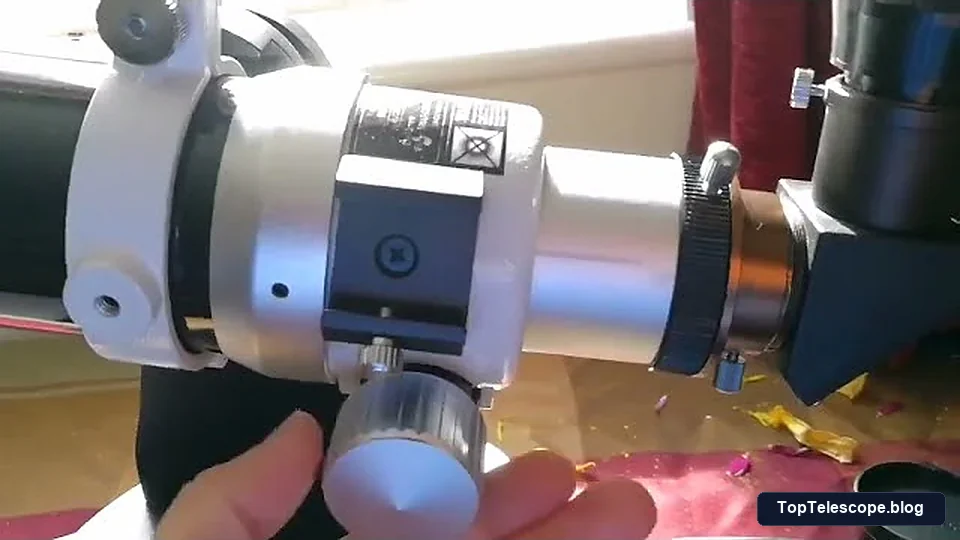
A robust 2.8-inch Crayford-style unit handles rear accessories with impressive stability, matching the focusers featured in our detailed Skywatcher 72Ed vs 80Ed technical review.
Tension adjustment screws let operators lock down heavy camera rigs securely. Slippage is eliminated even when pointing the telescope near the zenith for prolonged imaging sequences.
- Dual-speed 11:1 micro-focuser enables precise focus locking
- Rotatable camera angle adjuster simplifies framing adjustments
- Large friction drum supports substantial imaging payload weights
- Rotatable camera angle adjuster
- 2-inch to 1.25-inch adapter included
Mechanical Slip and Drawtube Stability
The drawtube utilizes a stainless steel reinforcement rail along its underside. This design distributes bearing pressure evenly across the travel range.
Backlash is virtually non-existent during directional reversals, giving users absolute confidence when dialing in critical focus under dark skies.
- Reinforced stainless steel track prevents drawtube scoring
- Zero noticeable backlash during directional focus shifts
Drawtube Tension Control
An integrated tension locking screw allows meticulous users to lock down the focuser position securely once optimal focus is achieved across extended long-exposure astrophotography sessions.
- Machined brass compression ring
Thermal Equilibrium and Environmental Resilience
Rapid ambient temperature drops demand efficient thermal shedding from optical systems. The aluminum chassis acclimatizes within minutes, stabilizing the internal air column quickly.
Coating applications withstand harsh night dew accumulation without degrading. Operators can wipe down exterior surfaces safely after finishing extended cold-weather imaging sessions.
- Fast thermal equilibrium prevents internal boundary layer currents
- Moisture-resistant multicoatings protect glass against night dew
- Robust exterior paint withstands minor impacts and moisture
- Anodized metal dust cap
- Sealed optical cell housing
Dew Management and Shield Operation
The sliding dew shield locks into extension smoothly, providing adequate clearance against nocturnal moisture accumulation on the outer objective surface.
Adding a flexible dew heater strip around the objective cell cell prevents frost formation during sub-freezing winter observing runs.
- Friction-fit sliding dew shield operates smoothly in cold weather
- Adequate clearance for standard dew heater strap installation
Cold Weather Operation
Internal mechanical lubricants are rated for sub-zero temperatures, ensuring the focuser remains buttery smooth even when operating in freezing winter environments without grease thickening.
- Tested down to minus 10C
Setup Rigidity, Mounting and Field Ergonomics
Weighing under eight pounds, this optical tube mounts effortlessly onto small equatorial or alt-azimuth platforms. The integrated V-style dovetail plate speeds up field assembly considerably.
A balanced carry handle bolted to the mounting rings provides secure transport between indoor storage and backyard observation pads without awkward fumbling.
- Lightweight chassis minimizes strain on portable tracker mounts
- V-style dovetail plate ensures rapid tripod attachment
- Integrated carry handle improves safety during transport
- Integrated tripod mounting foot
- Balanced weight distribution profile
Balancing and Accessory Integration
The slotted dovetail bar allows sliding the optical tube back and forth to achieve perfect declination balance on tracking mounts.
Accessory shoe mounts atop the focuser housing accommodate finderscopes or small autoguiding cameras cleanly.
- Adjustable dovetail position aids balancing with heavy cameras
- Standard shoe mount accepts most commercial finders
Field Balance Mechanics
Adjustable sliding dovetail plates provide sufficient forward and backward travel range to achieve perfect center of gravity balance when attaching heavy field flatteners and cameras.
- Compatible with standard photo heads
Maintenance, Alignment and Long-Term Durability
Collimation stability remains exceptionally robust thanks to the fixed, factory-sealed lens cell design. Users rarely need to adjust alignment screws following rough vehicle transit.
Routine maintenance requires only occasional dust removal using a clean blower bulb. Protective aluminum cases safeguard the instrument during storage between outings.
- Factory-aligned lens cell resists jarring during transport
- Padded aluminum storage case protects against impact damage
- Low-maintenance design requires minimal user intervention
- Store in padded aluminum case
- Use desiccant packs inside storage
Lens Care and Storage Best Practices
Keeping dust caps secured when not in use preserves the multi-coatings. Periodic optical cleaning should be performed sparingly using certified photographic solutions.
Storing the optical tube in low-humidity environments prevents fungal growth on internal glass surfaces over decades of ownership.
- Keep dust caps attached during storage to protect coatings
- Store in climate-controlled spaces to prevent moisture buildup
Collimation Verification
Careful star testing via an artificial pinhole source confirms permanent factory alignment, maintaining concentric diffraction rings across both inside and outside focus positions reliably.
- Factory-sealed lens cell design
Definitive Buyer Verdict and Alternative Pairings
This refractor represents an outstanding investment for mobile astrophotographers and visual astronomers seeking uncompromised optical purity. Its mechanical build quality easily justifies field deployment.
While demanding a dedicated field flattener for wide-frame imaging, the rewarding color correction and pinprick star images make it a top-tier choice for enthusiasts.
- Ideal for mobile astrophotographers and high-contrast observers
- Delivers professional-grade chromatic correction in a compact format
- Pair with a flattener for optimal wide-field photographic results
- Ideal for wide-field astrophotography
- Excellent grab-and-go visual instrument
Final Recommendations for System Building
Pairing this optical tube with a sturdy carbon fiber tripod and a computerized tracking mount creates an ultimate grab-and-go rig.
Investing in quality threaded adapters ensures zero flexure throughout your imaging train from night to night.
- Combine with rigid tracking mounts for best imaging results
- Use threaded adapters to eliminate optical tilt issues
System Expansion Roadmap
Upgrading to a dedicated autoguiding scope and electronic filter wheel transforms this portable setup into a formidable deep-sky imaging rig, which is further detailed in our Sky-Watcher Evostar 72ED vs 80ED comparison.
- Supports full-frame sensor imaging
Frequently Asked Questions
Does this telescope require a field flattener for astrophotography?
Yes, a dedicated field flattener is recommended to eliminate edge curvature on large camera sensors. This ensures flat star fields across your entire frame.
Can I use standard 1.25-inch and 2-inch eyepieces with the focuser?
The 2.8-inch Crayford focuser includes a standard 2-inch adapter with a 1.25-inch reducer insert. This accommodates all standard eyepiece sizes seamlessly.
How heavy is the optical tube assembly for field travel?
The optical tube weighs roughly seven pounds with rings attached. This makes it exceptionally easy to mount on lightweight portable star trackers.
Is the lens cell adjustable for user collimation?
The doublet lens cell is factory-sealed and permanently collimated. This design prevents accidental misalignment during rough transit to dark sites.
What type of mount is best suited for this refractor?
A sturdy alt-azimuth mount works well for visual sessions, while a portable equatorial tracker is best for astrophotography applications.