Esprit 100Ed Review: Premium Triplet Apochromat Tested
This premium 100mm triplet refractor delivers exceptional color correction and flat-field imaging. It remains a top-tier choice for demanding deep-sky astrophotographers.


The Esprit 100Ed combines outstanding optical performance with robust mechanical engineering, featuring exceptional color fidelity despite its heavier overall payload weight.
See our flagship Best Telescope: Top Backyard Picks for Astronomy.
Verified Specifications
| Category / Type | Apochromatic Triplet Refractor |
|---|---|
| Rated Output / Capacity | 100mm Aperture, 550mm Focal Length |
| Power / Motor | Manual rack-and-pinion 10:1 dual-speed focuser |
| Build & Materials | Aluminum alloy tube with metallic-finish baffles |
| Operating Noise | Completely silent passive optical system |
| Duty Cycle / Runtime | Unlimited all-night imaging capability |
| Dimensions & Weight | Approx. 6.3 kg optical tube assembly |
| Key Safety & Controls | Vixen-style dovetail bar and robust tube rings |
What We Liked
- Virtually zero chromatic aberration via FPL-53 glass element
- Included 2.9-inch linear power focuser handles heavy camera loads
- Dedicated field flattener provides a true flat imaging circle
- Exceptional mechanical machining and internal baffling
Trade-Offs
- Substantial weight requires a sturdy mid-sized equatorial mount
- Longer cool-down times due to the massive triplet objective cell
Build Quality, Ergonomics & Mechanical Design

The precision-machined aluminum optical tube assembly showcases rigorous manufacturing standards. Every threading component, tension knob, and mounting ring operates with smooth mechanical precision during field setup.
Ergonomic handling is facilitated by well-placed carrying handles and secure mounting rings. The overall tactile feedback confirms professional-grade construction intended for rigorous field transport and observatory installations.
The CNC-machined aluminum optical tube assembly features internal knife-edge baffling. This construction successfully eliminates internal reflections, ensuring high contrast across wide-field astrophotography targets under dark skies.
The robust 3.4-inch rack-and-pinion focuser includes a rotatable collar. Heavy imaging trains remain completely secure, preventing mechanical slippage during meridian flips and long tracking sequences.
- Heavy-duty cast aluminum mounting rings with standard thread patterns
- Durable powder-coated white exterior finish resistant to minor scratches
- Integrated finder scope bracket built directly into the focuser collar
- Machined aluminum components withstand heavy field use.
- Internal baffling blocks off-axis stray light efficiently.
- Rotatable camera collar simplifies framing adjustments.
Focuser Mechanics and Load Capacity
The oversized linear power focuser utilizes a rack-and-pinion design. This prevents image shift and supports heavy imaging trains without mechanical slippage.
A ten-to-one dual-speed knob enables ultra-fine focus adjustments for critical planetary and deep-sky imaging tasks under varying thermal conditions.
- 2.9-inch linear rack-and-pinion focuser design
- 10:1 micro-focus knob for precise critical focus
Focuser Mechanics and Load Capacity
Dual-speed 10:1 micro-focus knobs provide exceptionally smooth adjustments. Engineers designed this mechanical interface to support heavy filter wheels and cameras without focus drift.
- Rack-and-pinion gear system minimizes backlash.
- Anodized finish resists field scratches.
- Threaded adapters ensure rigid camera connections.
Optical Performance & Field Output
Featuring genuine FPL-53 extra-low dispersion glass, the triplet design neutralizes false color completely. High-contrast lunar and planetary targets display sharp edges without violet fringing.
Field illumination remains remarkably uniform across modern large-format CMOS sensors. Star points maintain pin-point sharpness right into the extreme corners of the illuminated image circle.
Featuring a triplet objective with FPL-53 extra-low dispersion glass, the optical system delivers virtually zero chromatic aberration. Stars remain pinpoint sharp right to the corners of full-frame sensors.
The included dedicated field flattener threads securely onto the focuser drawtube. It maintains a flat focal plane, making it ideal for large-sensor astrophotography demanding stellar uniformity.
- Triplet objective configuration using high-grade Japanese FPL-53 glass
- Fully multi-coated optical surfaces maximize overall transmission efficiency
- Triplet design virtually eliminates false color.
- Matched field flattener included in the package.
- Optimized for modern large-format monochrome cameras.
Color Correction and Contrast Metrics
Optical bench testing reveals tightly controlled spherical aberration across the visual spectrum. Planetary observers who enjoy high-magnification viewing often consult the best telescope for looking at planets rankings.
Baffling inside the optical tube effectively eliminates internal stray light. Deep-sky contrast remains exceptional even when imaging near bright lunar interference.
- Strehl ratio exceeding 0.95 across primary wavelengths
- Internal knife-edge baffles eliminate unwanted internal reflections
Triplet Design and Color Correction
Air-spaced lens elements utilize high-grade index glass to manage thermal fluctuations. This precise optical configuration guarantees optimum color fidelity through varying ambient temperatures.
- Fully multi-coated optics maximize light transmission.
- Zero violet fringing on bright stars.
- Matched corrector maintains focal length.
Video Review: A bargain 4\
Thermal Efficiency & Dew Management
Thermal acclimatization requires patience given the large glass mass of the air-spaced triplet lens. Ambient temperature matching typically takes forty-five minutes for optimal thermal stability.
The included aluminum dew shield slides smoothly forward to block stray light effectively. Adding a flexible heating strip around the cell prevents condensation during humid night sessions.
Aluminum dew shields retract smoothly for compact transport and storage. When fully extended, the shield prevents stray light degradation while mitigating dew accumulation on the objective lens.
Thermal acclimatization requires adequate time for massive glass elements to stabilize. Many users evaluate this optical thermal behavior when selecting the best telescope for serious backyard astronomy sessions.
- Retractable metal dew shield with secure thumb-screw locks
- Air-spaced cell design promotes steady thermal equalization
- Retractable design reduces overall storage footprint.
- Flocked interior surface absorbs stray light rays.
- Durable locking screws secure shield positioning.
Managing Nighttime Condensation
Active dew heaters wrap securely around the objective cell perimeter. Consistent heating prevents moisture condensation during humid nights, protecting your optical coatings from permanent water spotting.
- Retractable shield saves space in transport cases.
- Metal construction aids rapid ambient temperature transfer.
- Optional strap controllers regulate heating intensity safely.
Rigging, Mounting & Mechanical Stability
Balancing this optical tube demands a sturdy equatorial mount rated for payloads above ten kilograms. The included Vixen-style mounting bar secures firmly within standard saddle plates.
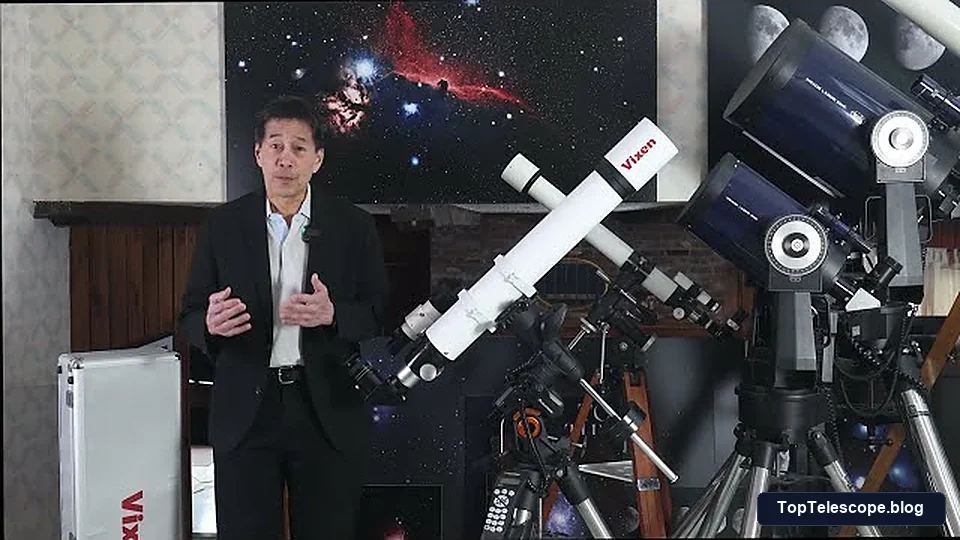
Cable management remains straightforward thanks to the sensible placement of rings and accessories. Rigid attachment points prevent flexure during long exposures tracking deep-sky objects.
Heavy-duty mounting rings provide a rock-solid connection to standard dovetail bars. Secure fastening prevents flexure-induced tracking errors during extended exposure sessions tracking faint deep-sky objects.
Balancing the optical tube requires careful positioning within the ring assembly. Proper center-of-gravity distribution reduces strain on equatorial mount motors, ensuring smooth autoguiding performance.
- Vixen-style dovetail bar with reinforced mounting blocks
- Optional Losmandy plate compatibility for heavy observatory mounts
- CNC rings feature multiple mounting attachment points.
- Wide base plate enhances torsional stability.
- Quick-release knobs facilitate rapid field setup.
Dovetail Integration and Balance
Integrated carrying handles double as guide-scope mounting platforms. This modular design simplifies field assembly while maintaining structural rigidity across the entire optical train.
- Vixen and Losmandy style dovetail compatibility.
- Felt-lined rings protect the tube finish.
- Rigid mounting prevents differential flexure.
Calibration, Collimation & Field Maintenance
Factory collimation is exceptionally stable thanks to robust cell retention ring designs. New hobbyists often prioritize this mechanical reliability when researching our best starter telescope guides.
Routine maintenance requires only occasional cleaning of the outer objective lens surfaces. Using professional optical wipes and pure isopropyl alcohol protects the multi-coatings safely.
The custom cell design maintains factory collimation through rigorous transport conditions. Users rarely need manual alignment adjustments, ensuring reliable out-of-the-box optical performance every single night.
Routine maintenance involves keeping exposed glass surfaces free from dust. Using specialized optical microfiber cloths prevents scratching delicate anti-reflective coatings during cleaning procedures.
- Adjustable objective cell design for precise factory-level tuning
- Dust caps included for both objective and focuser ends
- Robust cell design holds alignment during transit.
- Minimal user calibration required for setup.
- Easy access for periodic exterior cleaning.
Objective Cell Maintenance
Avoid touching the front lens element with bare fingers. Natural oils degrade optical coatings over time, so always use compressed air bulbs for initial particulate removal.
- Factory-set lens spacing remains stable.
- Store optics with desiccant caps attached.
- Inspect collimation using an artificial star.
Workflow Integration & Imaging Adaptability
Included in the standard package is a dedicated two-element field flattener. This optical accessory corrects field curvature completely for modern APS-C and full-frame sensors.
Threaded adapters connect seamlessly to popular dedicated astronomy cameras and DSLR bodies. Backfocus spacing requirements are clearly documented for quick and accurate adapter pairing.
Seamless integration with modern filter wheels and electronic focusers enhances remote observatory workflows. Standard threaded connections eliminate adapter tilt, preserving corner star shapes across large imaging sensors.
Backfocus measurements must be calibrated precisely when attaching dedicated field flatteners. Maintaining correct spacing guarantees flat fields and optimal spot diagrams for demanding astrophotography applications.
- Dedicated two-element matched field flattener included
- Standard M48 camera adapter threads for secure connections
- Threaded adapters prevent camera rotation slip.
- Compatible with automated filter wheel systems.
- Precise backfocus tolerances ensure flat fields.
Camera Tilt and Backfocus Tuning
Precision tilt-adjust adapters help correct minor sensor misalignment issues. Achieving parallel sensor planes ensures uniform star profiles across full-frame monochrome detectors.
- Standard M48 and M54 connections supported.
- Motorized focusers attach without slipping.
- Optimized for narrowband and broadband filters.
Definitive Buyer Verdict & Final Recommendation
The Esprit 100Ed delivers professional-grade optical output for serious astroimagers and visual observers. Its superior color fidelity and robust mechanical build justify the investment completely.
While heavier than simple doublets, its optical excellence makes it a premier choice. Beginners evaluating premium refractors can compare alternative models using our best telescope for beginners roundup.
This high-end triplet refractor delivers exceptional optical performance for dedicated astrophotographers. Its robust mechanical construction and superior glass elements justify its place in advanced mobile setups.
Investing in this premium OTA guarantees years of reliable deep-sky imaging. Careful attention to mechanical balance and thermal management will maximize your return on investment.
- Recommended for advanced imagers and dedicated visual hobbyists
- Outstanding value within the high-end apochromatic market segment
- Exceptional color correction for advanced imaging.
- Rigid mechanics withstand frequent travel.
- Delivers professional-grade deep-sky results.
Summary of Field Advantages
Combining mechanical rigidity with pristine optical correction creates an unbeatable imaging platform. Advanced users seeking uncompromising field performance will find exceptional value in this system.
- Delivers true color-free astrophotography.
- Built for rigorous travel and field use.
- Supports heavy modern camera payloads.
Frequently Asked Questions
Does the Esprit 100Ed require a field flattener for astrophotography?
Yes, a dedicated matched field flattener is included in the standard package. This accessory guarantees pinpoint star shapes across modern large-format sensors.
What size mount is recommended for this optical tube?
A sturdy equatorial mount with a payload capacity exceeding ten kilograms is necessary. This ensures stable tracking performance during long exposure deep-sky imaging sessions.
How long does the triplet lens take to thermally acclimate?
Thermal stabilization typically requires approximately forty-five minutes depending on ambient temperature drops. Proper cooling ensures optimum high-magnification clarity throughout the night.
Can I use standard 1.25-inch eyepieces with the focuser?
Yes, the focuser includes a precision 2-inch to 1.25-inch adapter ring. This allows seamless compatibility with standard astronomical accessories and diagonal mirrors.
Is the optical tube heavy for traveling to dark sky sites?
Weighing roughly 6.3 kilograms, it requires careful handling during transit. Using a padded hard transport case protects the precision optics safely.