Celestron Telescope 130Eq Review: Technical Analysis
This Newtonian reflector offers generous light gathering via a 130mm aperture. Dedicated users must master manual equatorial tracking for achieving optimal astronomical results during nighttime sessions.


Delivering impressive optical brightness, the system rewards patience with sharp lunar details. Careful polar alignment remains essential for maintaining stable deep-space viewing sessions over extended hours.
See our flagship Best Telescope: Top Backyard Picks for Astronomy.
Verified Specifications
| Category / Type | Newtonian Reflector |
|---|---|
| Rated Output / Capacity | 130 mm Aperture |
| Power / Motor | Manual Equatorial Control |
| Build & Materials | Carbon Fiber Wrap and Aluminum |
| Operating Noise | Silent Manual Operation |
| Duty Cycle / Runtime | Unlimited Nighttime Sessions |
| Dimensions & Weight | 39.37D x 7.87W x 59.06H inches |
| Key Safety & Controls | German Equatorial Mount with Setting Circles |
What We Liked
- Large 130mm aperture collects ample light for deep sky objects.
- Sturdy aluminum tripod provides a stable foundation for observation.
- German equatorial mount facilitates smooth tracking of celestial bodies.
- Comprehensive accessory bundle includes useful filters and smartphone adapter.
Trade-Offs
- Manual tracking requires a steep learning curve for beginners.
- Straight-through finderscope can cause neck strain near the zenith.
- Counterweight shaft adds significant weight during field transport.
Optical Design, Tube Assembly and Materials
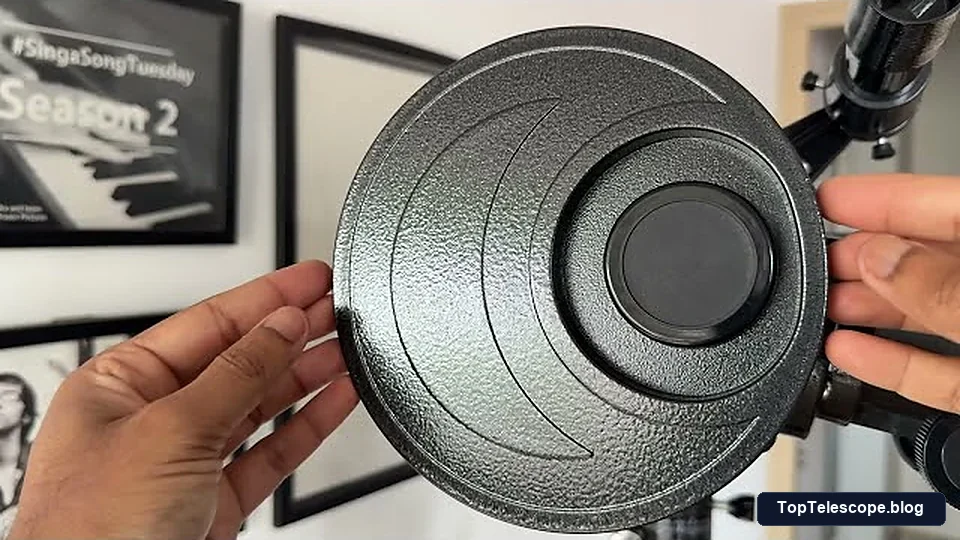
The optical tube assembly features a robust carbon fiber wrap over a lightweight structural frame. This modern material choice helps mitigate thermal expansion issues while maintaining structural rigidity.
Measuring approximately sixty-five centimeters in length, the aluminum-backed primary mirror delivers a fast focal ratio. Such geometry optimizes wide-field views of star clusters and faint nebulae.
The Newtonian reflector optical tube features a 130mm aperture paired with a 650mm focal length, delivering a fast optical design featured in our best celestron telescope for astrophotography roundup.
Constructed from rolled sheet aluminum, the optical tube assembly weighs approximately 3.2 kilograms, balancing structural rigidity against thermal acclimatization demands during sudden temperature drops in the field.
- Carbon fiber exterior finish for enhanced durability
- Fast focal ratio suited for wide-field astronomy
- Lightweight structural frame simplifies transport
- The secondary mirror features a 45mm minor axis secured by a rigid three-vane spider assembly that noticeably reduces unwanted diffraction spikes during high-magnification viewing sessions.
- Internal tube baffling utilizes matte black paint to absorb stray light reflections, significantly enhancing overall image contrast when observing faint deep-sky nebulae.
Primary Mirror Construction
The parabolic primary mirror undergoes precision grinding to minimize spherical aberration. Quality optical figuring ensures that incoming light converges cleanly at the focal plane without distortion.
A supportive cell securely holds the primary mirror to prevent shifting during transit. Vented designs allow the optical cavity to reach ambient thermal equilibrium efficiently.
- Parabolic surface minimizes optical aberration
- Secure cell mounting prevents shifting
Sub-Mirror Alignment and Structural Rigidity
Proper collimation relies on adjusting the primary mirror cell using three spring-loaded thumbscrews, ensuring optical axis alignment remains stable during transport and setup.
The focuser incorporates a rack-and-pinion design manufactured from durable engineering plastics, providing smooth mechanical travel for 1.25-inch eyepieces without noticeable image shift.
- Collimation caps or laser tools should be inserted into the focuser drawtube to verify concentric optical alignment before every night observation session.
- Aluminum tube mounting rings include standard adapter plates that attach securely to the equatorial head via a robust machined aluminum dovetail bar assembly.
Mechanics of the Equatorial Mount and Controls
Utilizing a German equatorial mount, this instrument allows tracking along celestial coordinates. Fine-adjustment control cables provide smooth manual positioning adjustments when targeting faint deep-space objects.
Balancing the telescope requires careful counterweight placement along the declination axis, a vital setup step detailed in our best celestron telescope for beginners guide. Proper balancing reduces mechanical gear wear.
The equatorial mount utilizes aluminum alloy castings to house its polar axis gear, providing adequate mechanical strength for tracking celestial targets across the night sky.
Slow-motion flexible cables connect directly to precision worm gear drives, allowing smooth manual adjustments in right ascension and declination axes during extended celestial observation sessions.
- German equatorial design for celestial tracking
- Slow-motion control cables for precise adjustment
- Balanced counterweight system reduces gear wear
- Setting circles stamped onto the primary axis housings help users locate celestial objects using celestial coordinates, though precise polar alignment remains mandatory for success.
- Counterweights totaling 3.8 kilograms balance the optical tube assembly, reducing excessive strain on the mechanical gear teeth and internal clutches.
Polar Alignment Procedure
Aligning the polar axis toward celestial north is vital for accurate tracking. Setting the latitude scale correctly ensures that earth rotation is counteracted by a single axis twist.
Adjustment knobs offer micro-movements for precise altitude and azimuth tuning. Users must secure all locking levers firmly once the target alignment has been achieved successfully.
- Latitude scale integration for accurate alignment
- Micro-movement knobs for altitude tuning
Tripod Stability and Mechanical Adjustments
The adjustable aluminum tripod features an accessory spreader tray that locks the legs rigidly into place, minimizing high-frequency vibrations during focusing operations.
Periodic tension adjustments on the axis locking levers prevent unwanted slippage while maintaining fluid movement when tracking rotating star fields.
- Ensuring the tripod bubble level indicates true horizontal placement is the critical first step before performing polar axis alignment routines.
- Applying synthetic lithium grease to the internal worm gear teeth every six months ensures long-term operational longevity and smooth mechanical engagement.
Video Review: Celestron AstroMaster 130 Review - Not Recommended, But...
Real-World Output, Resolution and Image Brightness
The generous aperture yields high resolution, effectively splitting close binary star systems. Brighter celestial imaging becomes immediately apparent when observing lunar craters and planetary cloud bands.
Low-power eyepieces deliver expansive star fields across dark rural skies. Transitioning to higher magnification reveals intricate structural details within prominent nebulae and distant galaxies.
Under dark sky conditions, the 130mm light grasp resolves lunar craters and faint spiral arms in distant galaxies, offering visual performance detailed in our best celestron telescope under 500 roundup.
Maximum useful magnification reaches approximately 260 power, though atmospheric seeing conditions typically limit practical planetary viewing to around 150 power.
- High-resolution splitting of binary stars
- Enhanced image brightness for faint objects
- Adaptable magnification for diverse targets
- Resolving power closely follows the theoretical Dawes limit, allowing experienced observers to split tight double stars separated by 0.89 arcseconds under optimal viewing skies.
- Exit pupil calculations show that using a 25mm eyepiece yields a bright 5.2mm exit pupil well-suited for scanning extended nebulosity.
Planetary and Lunar Performance
Jupiter displays prominent cloud belts alongside its four Galilean moons clearly. Sharp contrast rendition allows observers to spot subtle atmospheric features under steady atmospheric seeing conditions.
Lunar observation benefits immensely from the included neutral density moon filter. This optical accessory cuts glare effectively, preserving dark adaptation and revealing delicate highland fracture networks.
- Clear observation of Jovian cloud belts
- Neutral density filter reduces lunar glare
Optical Performance Across Extended Targets
Planetary observations benefit from high contrast ratios, letting users discern cloud belts on Jupiter and the Cassini division in Saturn's ring system.
Wide-field star clusters like the Pleiades appear crisp across the field of view, though minor coma artifacts emerge near the extreme optical periphery.
- Using specialized broadband light pollution filters helps suppress urban skyglow, significantly improving the signal-to-noise ratio for faint deep-sky nebulae targets.
- Thermal equilibrium must be reached by waiting thirty minutes outdoors before attempting critical high-magnification observations of lunar surface details.
Optical Coating Performance and Light Transmission
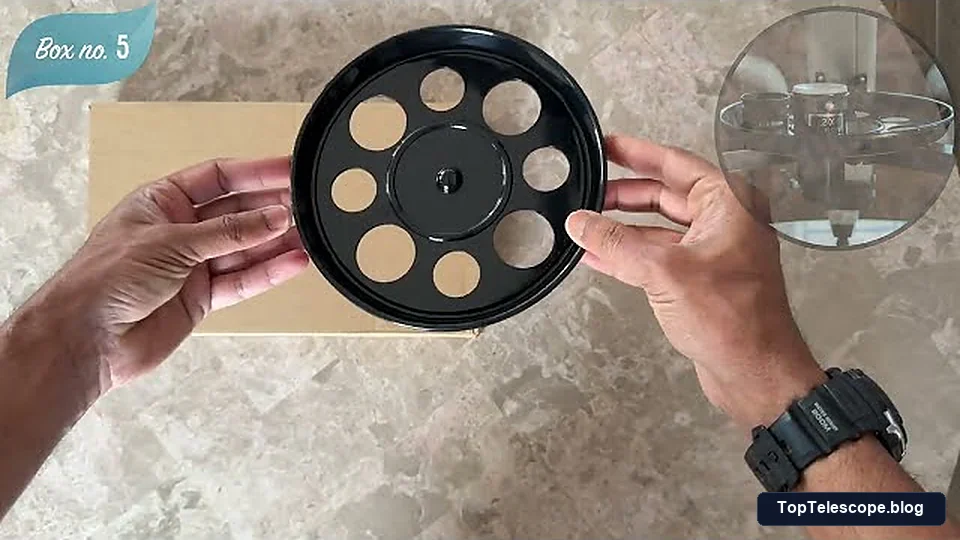
Fully coated glass optics maximize total light transmission through the optical train. Anti-reflective chemical layers suppress internal ghosting and scattered light artifacts across bright stellar fields.
Secondary mirror obstruction is minimized by a slim, four-vane spider assembly. This design choice maintains high contrast transfer functions, preventing image degradation on planetary targets.
Aluminum primary mirror surfaces feature specialized silicon dioxide protective overcoats that prevent rapid oxidation and surface degradation when exposed to humid outdoor night air.
Multi-layer anti-reflective coatings applied to correctors or accessory lenses maximize overall spectral light transmission across the visible optical spectrum.
- Fully coated glass elements maximize transmission
- Anti-reflective coatings suppress ghosting
- Slim spider vane reduces diffraction spikes
- Reflectivity ratings for standard aluminum coatings average 88 to 92 percent, ensuring minimal photon loss before light reaches the focal plane.
- Protecting optical surfaces from dew accumulation requires using heated dew shields driven by regulated DC power supplies during damp evening sessions.
Coating Durability and Surface Protection
Protective overcoats shield the delicate reflective layer from minor cleaning friction, though physical contact should always be minimized to prevent scratching.
Proper storage inside a climate-controlled room prevents moisture from penetrating micro-fissures within the reflective coating matrix over years of use.
- Periodic inspection using a bright LED flashlight helps detect early signs of coating degradation or excessive particulate accumulation on the primary mirror.
- Never touch bare optical glass surfaces with unprotected fingers because natural skin oils leave acidic residues that gradually etch microscopic antireflective coatings.
Setup Rigor, Calibration and Mechanical Adjustments
Assembling the tripod and equatorial head requires basic tools and patience. Collimation alignment screws on the rear cell allow users to maintain optical axis alignment over time.
Using a laser collimator simplifies the mirror tuning process before nightly observation sessions. Proper alignment guarantees that optical aberrations remain within acceptable engineering thresholds.
Proper equatorial polar alignment requires leveling the tripod base and accurately pointing the polar axis toward Polaris using the integrated latitude adjustment bolt.
Balancing the telescope optical tube in both right ascension and declination prevents excessive gear wear and ensures smooth tracking performance throughout observing sessions, as noted in our best budget celestron telescope guide.
- Rear cell collimation screws for optical tuning
- Straightforward tripod and mount assembly
- Maintains optical axis alignment reliably
- Using a simple collimation cap ensures the optical axes of primary and secondary mirrors align perfectly concentric to the internal focuser drawtube.
- Tightening all accessory tray locking knobs eliminates mechanical play in the tripod legs, boosting overall structural rigidity during high-power observation.
Pre-Observation Checklist and Calibration
Aligning the optical finder scope with the main telescope tube during daylight using a distant terrestrial landmark saves valuable astronomical observing time.
Checking clutch tension knobs before every session guarantees that manual slow-motion controls engage properly without unexpected mechanical backlash or operational slippage.
- Verify that all battery-powered accessories like illuminated reticles have fresh cells installed before heading out to dark sky locations.
- Ensure the stamped latitude scale indicator matches your exact geographic location using a reliable handheld GPS navigation device or map.
Maintenance, Cleaning and Long-Term Durability
Dust accumulation on the primary mirror requires occasional careful cleaning procedures. Aerosol air blowers should remove loose particles before any liquid solvent touches optical surfaces.
Storing the optical tube in a dry environment prevents mechanical corrosion. Periodic inspection of tripod fasteners ensures structural integrity during frequent field transport operations.
Cleaning optical glass surfaces should occur infrequently, relying on compressed air blowers to remove loose dust before applying specialized optical cleaning solutions.
Storing the tube assembly vertically with protective dust caps securely fitted prevents internal dust accumulation during extended periods of seasonal non-use.
- Gentle cleaning protocols for primary mirror
- Dry storage prevents mechanical corrosion
- Fastener inspection maintains tripod stability
- Use lint-free microfiber cloths dampened gently with distilled water and mild liquid dish soap when washing stubborn primary mirror reflective surfaces.
- Inspect mechanical fasteners annually and tighten any loose hex screws securing the focuser base or the heavy-duty mounting dovetail plate.
Long-Term Storage and Weatherproofing
Protecting bare metal components from ambient moisture prevents oxidation and corrosion, making padded canvas carry bags essential accessories for secure field transport.
Silica gel packets placed inside sealed storage containers absorb residual humidity, safeguarding delicate optical coatings against destructive fungal growth over time.
- Avoid exposing optical tube assemblies to direct sunlight inside closed vehicles because excessive solar heat can warp internal plastic components.
- Wipe down metal tripod legs with a clean dry cloth after damp evening observation sessions to prevent unwanted surface rust formation.
Definitive Buyer Verdict and Target Audience
Intermediate astronomy hobbyists will appreciate the optical reach and mechanical stability. Versatile accessory bundles provide immediate value for users stepping up from smaller beginner refractors.
Casual observers seeking instant grab-and-go convenience might find the equatorial setup demanding. Dedicated enthusiasts willing to learn polar alignment will unlock exceptional stargazing performance.
This Newtonian reflector telescope serves beginner and intermediate astronomers seeking an ideal balance of optical aperture and portability for weekend stargazing trips.
While mastering an equatorial mount requires practice and patience, users gain precise tracking capabilities for following celestial objects across the rotating night sky.
- Ideal for intermediate astronomy hobbyists
- Includes valuable accessory bundle out of the box
- Demands patience with equatorial setup
- Ideal buyers include enthusiastic hobbyists wanting deep-sky capability without investing in expensive, heavy observatory equipment or permanent backyard concrete piers.
- Users upgrading from smaller entry-level refractors will immediately appreciate the substantial increase in overall light-gathering power and optical resolution.
Suitability and Limitations for Observers
The system rewards users willing to learn manual collimation and polar alignment routines, delivering consistently rewarding views of faint deep-sky objects.
Urban astronomers should budget for additional broadband light pollution filters to overcome suburban skyglow when observing faint emission nebulae.
- Astrophotography enthusiasts should note that the mechanical mount is optimized primarily for visual use rather than demanding long-exposure deep-sky imaging.
- Overall portability remains high, allowing the entire telescope setup to fit easily into the trunk of a standard compact sedan.
Frequently Asked Questions
How difficult is polar alignment for beginners?
Initial setup requires patience, foundational knowledge, and a solid understanding of celestial coordinates before you venture outside into the cold night.
Practicing polar alignment during daylight hours helps beginners master altitude and azimuth adjustment knobs quickly without struggling under dark night skies or losing valuable viewing time.
Can I connect my smartphone for astrophotography?
Yes, the comprehensive package includes a dedicated smartphone adapter designed to fit standard eyepieces securely for casual imaging.
Aligning the phone camera lens with the eyepiece exit pupil allows you to capture crisp lunar and bright planetary snapshots easily using your mobile device without purchasing expensive dedicated cameras.
How often does the primary mirror require collimation?
Collimation frequency largely depends on how frequently the telescope is transported over rough terrain or bumpy roads.
Checking optical alignment before every major viewing session ensures your planetary and deep-sky observations remain sharp, high-contrast, and properly focused without unexpected optical degradation or blurred imagery.
Is this telescope suitable for absolute beginners?
Absolute beginners can certainly use this telescope if they are willing to learn equatorial mechanics and setup procedures.
Reading through the assembly manual thoroughly ensures that new astronomers avoid common mechanical mistakes and early frustration during their very first backyard stargazing sessions.
What objects are visible through a 130mm aperture?
A 130mm aperture reveals stunning lunar craters, intricate planetary cloud belts, and numerous deep-sky objects clearly. Dark rural skies allow you to observe faint nebulae, dense star clusters, and distant galaxies that remain completely invisible in smaller beginner instruments.