Celestron StarSense Explorer LT 114AZ Technical Review
This innovative Newtonian reflector combines traditional optics with app-driven plate-solving technology. It transforms casual backyard stargazing sessions into seamless astronomical tours.

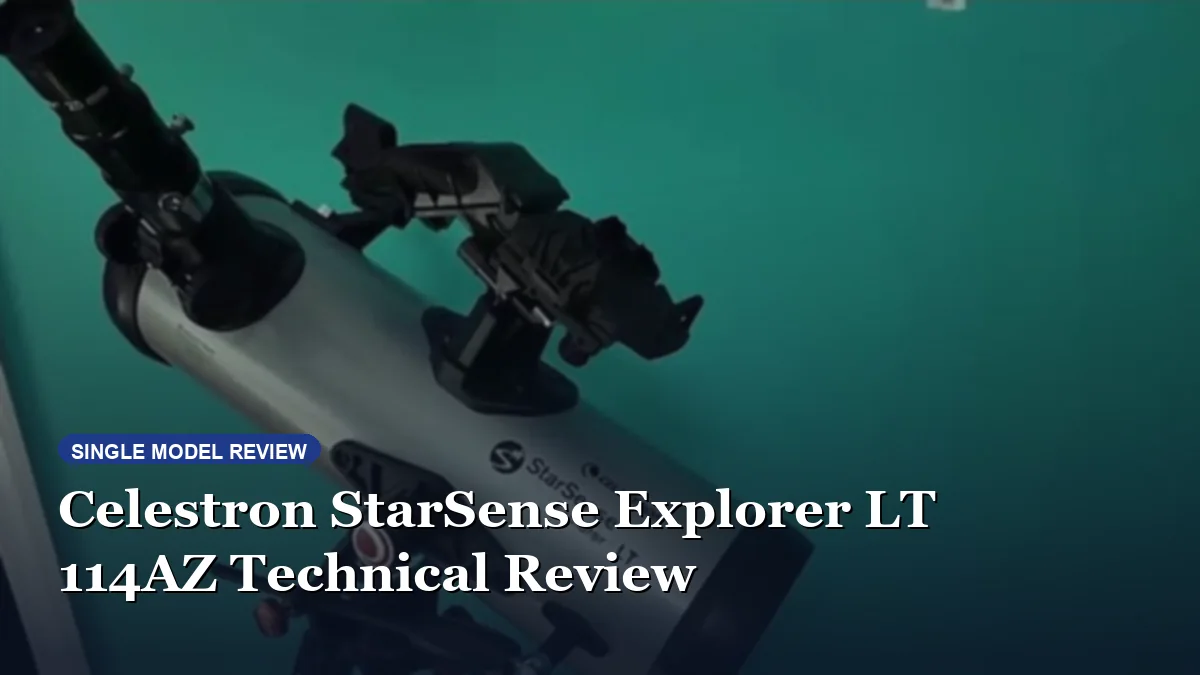

The StarSense Explorer LT 114AZ offers exceptional app navigation, though its lightweight altazimuth mount demands careful handling during high-magnification viewing.
Explore related alternatives in our Best Celestron Telescope For Beginners.
Verified Specifications
| Category / Type | Newtonian Reflector Telescope |
|---|---|
| Rated Output / Capacity | 114mm Objective Aperture |
| Power / Motor | Manual Altazimuth with Slow-Motion Rod |
| Build & Materials | Aluminum Tripod and Steel Optical Tube |
| Operating Noise | Silent Manual Positioning Operation |
| Duty Cycle / Runtime | Unlimited Visual Observing Duration |
| Dimensions & Weight | 18-inch Tube Length, 10.4 lbs Total Weight |
| Key Safety & Controls | StarPointer Red Dot Finderscope Included |
What We Liked
- Innovative smartphone dock simplifies target location
- Decent 114mm light-gathering primary mirror diameter
- Complete accessory kit includes eyepieces and Barlow
- Lightweight aluminum tripod facilitates easy transport
Trade-Offs
- Plastic focusing mechanism exhibits minor mechanical play
- Altazimuth mount struggles with stability at high power
- Collimation requires frequent adjustment on Newtonian optics
Optical Architecture and Newtonian Tube Construction
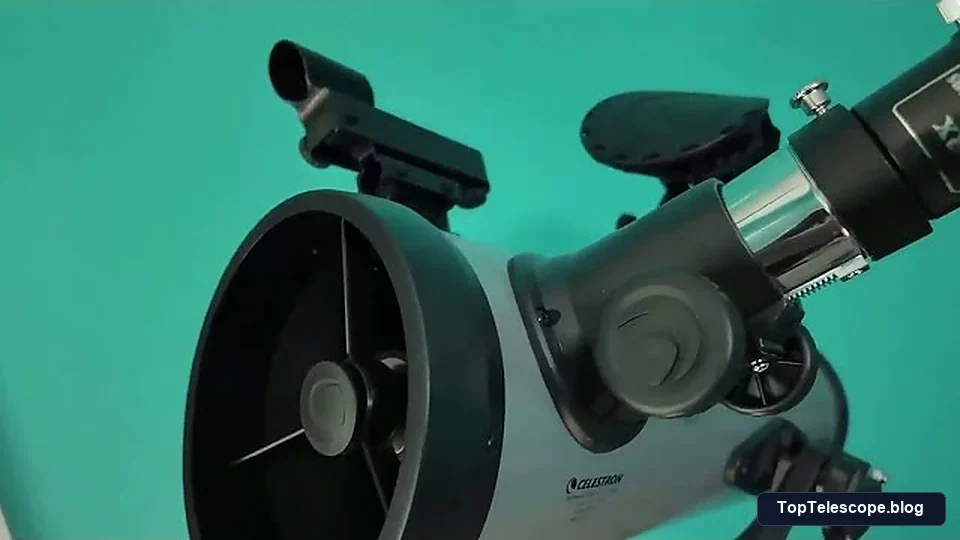
The Newtonian optical design utilizes an 114mm parabolic primary mirror to capture incoming starlight. This aperture size collects significantly more light than small beginner refractors.
Constructed from rolled steel, the optical tube assembly provides robust structural protection for internal optics. Readers can examine our celestron starsense explorer 8 vs apertura ad8 comparison to explore alternative aperture sizes.
Internal baffling suppresses stray light reflections, enhancing contrast when viewing faint deep-sky targets. Proper alignment of these optical components remains vital for sharp planetary imaging.
The optical tube assembly utilizes a 114mm aperture spherical primary mirror housed inside a lightweight aluminum chassis designed to minimize flexure during transport across uneven terrain or observation sites.
Operating at a native f/8 focal ratio, the system yields a 1000mm focal length that naturally suppresses chromatic aberration while presenting manageable exit pupils for standard eyepieces included in the kit.
Internal baffling relies on a matte-black inner coating to reduce stray light reflections, though users must occasionally inspect the spider vane alignment supporting the secondary mirror assembly.
- 114mm aperture gathers moderate celestial light
- Steel optical tube resists thermal expansion flexing
- Internal baffle rings reduce unwanted ambient glare
Primary Mirror and Secondary Vane Assembly
The primary mirror features a reflective aluminum coating protected by silicon dioxide. This protective overcoat prevents oxidation during humid outdoor observing sessions.
A sturdy four-vane secondary spider holds the flat diagonal mirror precisely in optical alignment. Thin vane profiles minimize diffraction spikes on bright stellar objects.
- Protected aluminum mirror coatings resist degradation
- Four-vane spider maintains secure secondary placement
Smartphone Integration via Plate-Solving Mechanics
Celestron integrates an innovative smartphone dock that leverages internal device cameras. Read our guide on mastering the starsense explorer lt to determine exact pointing coordinates.
Patented plate-solving algorithms match visible constellations against an onboard database. This eliminates complex polar alignment procedures for casual backyard astronomers.
Users simply follow intuitive directional arrows displayed on their mobile screen. Once the target bullseye turns green, the desired object rests firmly in the eyepiece.
The proprietary StarSense dock relies on an internal optical mirror that reflects a designated quadrant of the night sky directly into your smartphone camera lens for real-time astrometric plate solving.
Alignment requires precise initial calibration between the phone camera field of view and the main optical axis using bright reference stars to ensure accurate tracking and GoTo target positioning.
Software dependency means operational success is tied to processing power, requiring compatible operating systems and a clear internet connection solely during initial application download and license validation.
- Camera-based plate-solving eliminates manual star hopping
- Intuitive directional arrows guide beginner users quickly
- App database covers planets, clusters, and nebulae
App Calibration and Alignment Procedures
Initial setup requires aligning the phone camera with the main optical axis. A simple daytime procedure ensures accurate pointing performance during night sessions.
The software compensates for minor alignment offsets automatically using celestial reference frames. This guarantees reliable tracking accuracy across varied observing locations.
- Daytime alignment aligns camera with optical path
- Software algorithms correct minor pointing discrepancies
Video Review: Review of the Celestron StarSense LT 114AZ - A Popular Inexpensive Telescope with Phone Navigation
Mount Kinematics and Altazimuth Stability Performance
A manual altazimuth mount handles vertical and horizontal axis adjustments smoothly. This mechanical simplicity allows rapid positioning across wide sections of the night sky.
An altitude slow-motion sliding rod permits precise target centering at higher magnifications. Users can track moving celestial objects without inducing excessive mechanical vibration.
The lightweight aluminum tripod features adjustable legs for uneven terrain. However, heavy wind gusts can introduce noticeable image jitter during high-power observation.
The manual altazimuth mount utilizes an aluminum yoke configuration featuring flexible slow-motion control cables on both axes for precise adjustments during high-magnification celestial tracking sessions.
Friction locks on both altitude and azimuth axes allow users to balance payload weight, though moderate winds can induce noticeable micro-vibrations along the lightweight tubular steel tripod legs.
Periodic tightening of the central accessory tray fasteners significantly enhances overall torsional rigidity, effectively reducing settling time whenever manual inputs are applied to the mounting platform.
- Manual altazimuth movement offers intuitive positioning control
- Altitude sliding rod enables fine positional adjustments
- Adjustable aluminum tripod accommodates uneven ground surfaces
Friction Controls and Pan Handles
Adjustable tension clutches let observers customize axis resistance preferences. Proper tension prevents the optical tube from slipping during steep elevation angles.
Ergonomic pan handles provide comfortable leverage when slewing across wide coordinate arcs. Every control interface emphasizes straightforward mechanical reliability for beginners.
- Tension clutches prevent unwanted optical tube drift
- Ergonomic handles ensure comfortable manual slewing actions
Optical Output and Planetary Observation Limitations
The 114mm mirror resolves prominent lunar craters and Jupiter's cloud belts clearly. Saturn's ring system remains visible alongside several bright Galilean moons.
Deep-sky performance depends heavily on dark skies and light pollution levels. Brighter nebulae and open star clusters appear as distinct patches through the eyepiece.
Achieving optimal high-magnification performance requires careful focus adjustment using the rack-and-pinion focuser. Users should allow adequate thermal acclimation time before critical viewing.
Detailed lunar observations reveal crisp crater walls and rilles using the included eyepieces, though spherical aberration inherent to the mirror design limits extreme high-power image sharpness.
Planetary targets like Jupiter and Saturn show primary cloud belts and the Cassini Division under steady seeing conditions, but surface details remain modest due to the 114mm aperture ceiling.
Deep-sky performance excels on bright Messier objects such as the Orion Nebula and Andromeda Galaxy, capitalizing on the generous field of view provided by the optical setup.
- Resolves lunar craters and planetary ring structures
- Performs best under dark rural observing skies
- Rack-and-pinion focuser delivers precise image sharpness
Eyepiece Performance and Magnification Scaling
Included 25mm and 10mm eyepieces offer versatile low and high-power options. The 25mm lens provides wide-field views, while the 10mm focuses on planets.
A included 2x Barlow lens effectively doubles the magnification of inserted eyepieces. This accessory expands your overall observing toolkit without requiring extra purchases.
- Standard eyepieces cover wide and narrow fields
- Barlow lens doubles effective eyepiece magnification power
Thermal Equilibrium and Collimation Maintenance Routines
Newtonian reflectors require thermal acclimation to eliminate internal tube currents. Allowing the telescope thirty minutes outside ensures sharp, stable high-magnification images.
Transporting the optical tube can occasionally knock primary mirrors slightly out of alignment. Routine collimation checks using a simple cap maintain crisp optical performance.
Adjustment screws on the rear mirror cell make optical tuning straightforward. Check out mastering the starsense explorer dx 130az for additional setup tips to guarantee long-term clarity.
Allowing the optical tube assembly to acclimate outdoors for at least twenty minutes effectively eliminates internal thermal currents that otherwise degrade high-magnification planetary views.
Newtonian reflectors require periodic optical alignment using a collimation cap or laser tool to ensure primary and secondary mirrors direct light cleanly to the focal plane.
Transporting the telescope in a vehicle trunk can easily knock optical components slightly out of alignment, making pre-session checks an essential maintenance habit for consistent performance.
- Thermal acclimation eliminates internal air current blur
- Regular collimation checks preserve peak optical sharpness
- Accessible mirror cell screws simplify alignment adjustments
Collimation Tools and Mirror Care
A simple collimation cap helps users center optical reflections accurately. Keeping optical surfaces clean from dust protects the delicate reflective mirror coatings.
Avoid touching glass surfaces directly to prevent oil residue accumulation over time. Proper storage bags shield the entire assembly from environmental moisture.
- Collimation cap ensures accurate mirror alignment checks
- Protective storage routines prevent premature coating degradation
Ergonomics, Assembly, and Field Portability Parameters
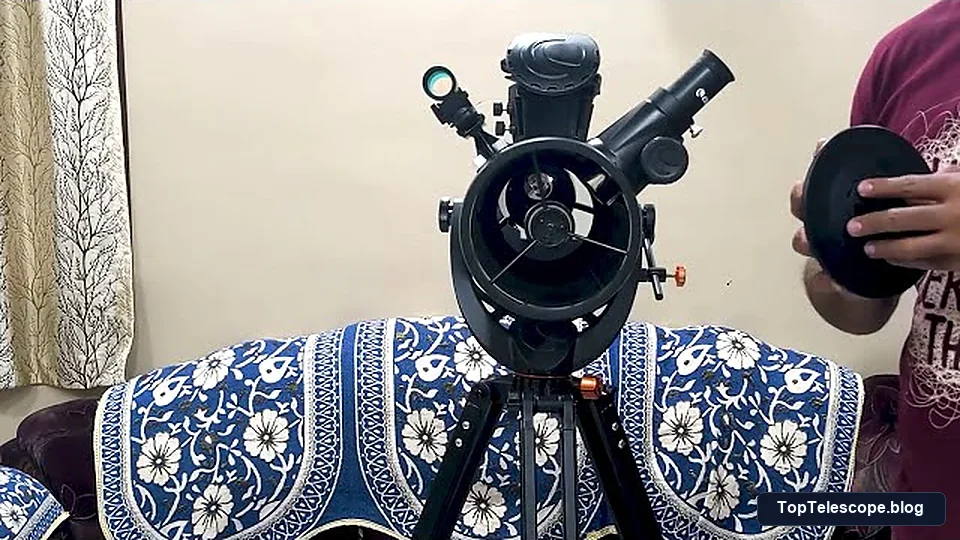
Weighing just over ten pounds, the entire telescope assembly is easily portable. Users can transport the rig to dark-sky parks without experiencing physical strain.
Tool-free assembly procedures allow fast setup in backyard environments. Clear manual instructions guide first-time users through tripod deployment and tube mounting.
The red dot finderscope simplifies initial rough alignment before launching app navigation. Battery-powered illumination helps users locate reference stars during twilight hours.
Total system weight remains remarkably low, easily allowing backyard astronomers or traveling observers to carry the fully assembled setup with minimal physical strain during transport.
Initial assembly takes under fifteen minutes utilizing standard thumb screws, completely eliminating the need for specialized tools when attaching the optical tube to the altazimuth mount.
The sturdy accessory tray snaps securely between the tripod legs to dampen vibrations while providing convenient holding slots for extra eyepieces during dark sky observing sessions.
- Lightweight construction facilitates effortless field transport
- Tool-free assembly speeds up backyard deployment times
- Red dot finderscope aids initial rough alignment
Accessory Tray and Field Storage Practicalities
A central accessory tripod spreader holds extra eyepieces securely in place. This rigid tray also adds structural stability to the unfolding aluminum legs.
Compact dimensions allow convenient trunk storage inside standard passenger vehicles. Field observers will appreciate the thoughtful integration of practical transport features.
- Accessory spreader stabilizes tripod leg assemblies
- Compact form factor fits easily inside vehicles
Definitive Buyer Assessment and Technical Value Summary
Master alignment quickly by following our guide to using the starsense explorer lt 114az. This innovative smartphone integration removes traditional navigational barriers for beginner astronomers.
While lightweight mounts require careful handling, optical performance delivers satisfying views. This complete kit provides an accessible gateway into amateur astronomy and stargazing.
This Newtonian reflector provides a highly compelling entry point for beginners seeking guided stargazing experiences without the operational complexity of traditional computerized GoTo alignment systems.
While minor optical limitations exist at high magnifications, the innovative smartphone integration framework delivers unmatched educational value and robust celestial navigation support for all novice astronomers.
- Successful fusion of traditional optics and smartphone tech
- Removes frustrating learning curves for beginner stargazers
- Delivers strong optical value across varied celestial targets
Final Recommendations for Prospective Users
Beginners seeking hassle-free navigation will find this model exceptionally rewarding. Backyard astronomers valuing portability will appreciate its lightweight design.
Investing time in proper alignment yields stunning views of deep-sky objects. Proper care ensures years of reliable astronomical exploration and discovery.
- Ideal choice for tech-savvy beginner astronomers
- Rewards patient setup with clear celestial views
Frequently Asked Questions
How does the StarSense app locate stars?
The integrated smartphone camera captures star fields and uses plate-solving algorithms to match patterns with an onboard database, instantly calculating precise telescope pointing coordinates.
Does this telescope require manual tracking?
Yes, this model features a manual altazimuth mount. Users must adjust position controls by hand to keep targets centered within the eyepiece field of view.
What celestial objects can I observe?
The 114mm aperture reveals lunar craters, planetary rings, bright star clusters, and several prominent nebulae. Dark sky conditions significantly improve deep-sky visibility.
Is regular mirror collimation necessary?
Yes, Newtonian reflectors require periodic mirror alignment checks. Using a collimation cap ensures optimal optical sharpness during every observing session.
Can I use this telescope for astrophotography?
It supports casual smartphone photography through the eyepiece for bright targets. Long-exposure deep-sky imaging requires motorized equatorial mounts instead.