Celestron StarSense Explorer LT 114AZ Review
This Newtonian reflector combines optical reach with digital plate-solving. It offers an accessible gateway for stargazers.

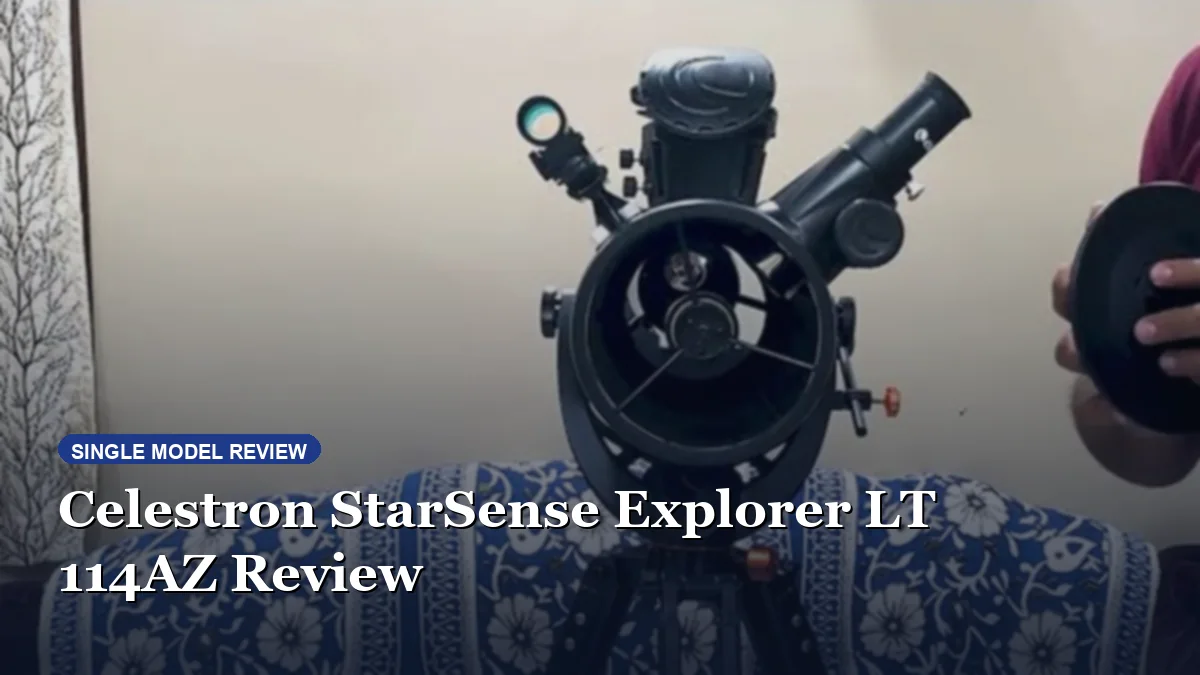

The Celestron StarSense Explorer LT 114AZ delivers smart celestial navigation paired with decent optics, though manual tracking requires a steady hand.
See our flagship Best Telescope: Top Backyard Picks for Astronomy.
Verified Specifications
| Category / Type | Newtonian Reflector |
|---|---|
| Optical Diameter | 114 mm (4.5 inches) |
| Focal Length | 1000 mm (f/8.8) |
| Mount Type | Manual Altazimuth with Slow-Motion Rod |
| Guidance System | StarSense Explorer Smartphone App |
| Included Eyepieces | 25mm (40x) and 10mm (100x) |
| Total Weight | 10.4 pounds (4.7 kg) |
| Optical Coatings | Aluminum with SiO₂ Overcoat |
What We Liked
- Innovative StarSense smartphone plate-solving app simplifies navigation.
- Decent 114mm aperture captures bright lunar and planetary details.
- Lightweight aluminum tripod and optical tube assembly (10.4 lbs).
- Includes two practical eyepieces and a red dot finderscope.
Trade-Offs
- Long focal length folded via internal lens requires careful collimation.
- Altazimuth mount lacks motorized tracking for high magnifications.
- Plastic components on the smartphone dock demand careful handling.
Optical Design and Build Specifications
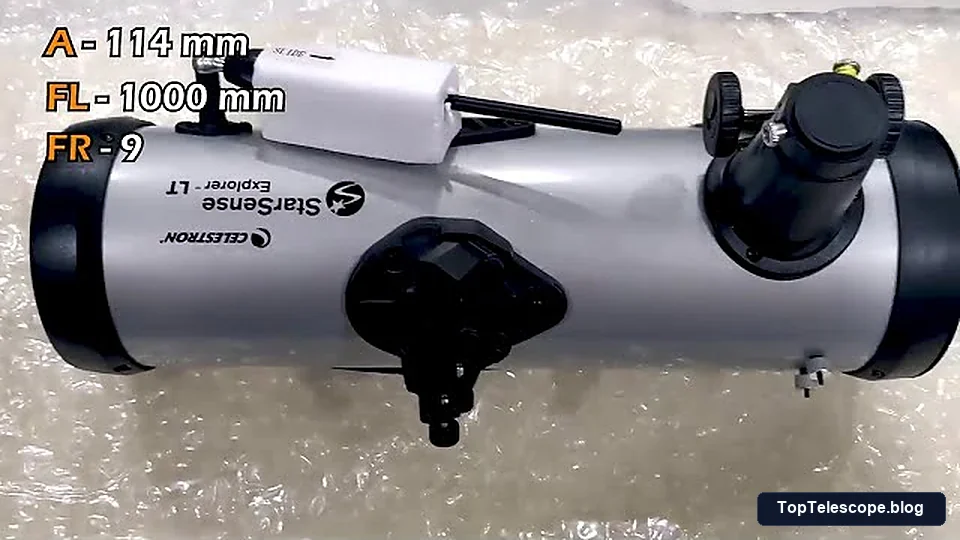
The Celestron StarSense Explorer LT 114AZ utilizes a 114mm parabolic-figured Newtonian optical tube. Consult our StarSense Explorer LT manual guide to master alignment and field maintenance.
Measuring 24 inches in length, the optical tube houses a glass mirror coated with aluminum and silicon dioxide. These protective coatings maximize reflectivity while resisting everyday environmental degradation over time.
The 114mm aperture Newtonian reflector features a focal length of 1000mm, yielding a focal ratio of f/8.8. This optical configuration balances magnification capability with manageable physical tube dimensions for field transport.
Constructed from rolled aluminum, the optical tube assembly weighs approximately 6.4 pounds. Internal baffling suppresses stray light reflections, while the primary mirror cell utilizes a standard three-point mounting system for structural alignment stability.
- 114mm aperture diameter
- 1000mm focal length ratio
- Aluminum and SiO2 coatings
- 24-inch optical tube length
Optical Configuration Details
Engineers implemented a novel corrector lens inside the drawtube to achieve a 1000mm focal length within a compact physical housing. This layout provides higher magnification potential for planetary viewing.
While this catadioptric-style Newtonian design shortens the physical tube, it places strict demands on factory optical alignment. Users must understand basic collimation principles to maintain image sharpness.
- Integrated corrector lens element
- Catadioptric optical train
- Compact physical profile
Real-World Optical Output and Performance
Under dark skies, the 114mm primary mirror collects adequate light to reveal prominent deep-sky targets. Reviewing specs in our StarSense 8 vs Apertura AD8 comparison helps buyers understand aperture trade-offs.
Lunar craters and Saturn rings appear remarkably sharp when utilizing the included 10mm eyepiece. However, atmospheric seeing conditions will frequently limit your maximum useful magnification during planetary observations.
Collimation tolerance on the f/8.8 system is forgiving compared to faster reflectors, helping maintain sharp axial images. Diffraction spikes on bright stars remain minimal due to the slim four-vane spider supporting the secondary mirror.
Eyepiece pairing with the included 25mm Kellner delivers 40x magnification, while the 10mm ocular pushes output to 100x. Resolving lunar craters and major planetary cloud belts requires steady atmospheric seeing conditions for optimal contrast.
- Resolves major Messier catalog objects
- Crisp lunar crater shadow details
- Clear separation of Saturn rings
Eyepiece Performance and Magnification
The package includes a 25mm eyepiece providing forty power magnification for wide-field views. Swapping to the 10mm eyepiece jumps magnification to one hundred power for closer planetary inspection.
Both eyepieces feature standard 1.25-inch barrels, allowing easy future upgrades to superior Plössl or wide-angle designs. Eye relief on the 10mm unit requires close positioning for comfortable viewing.
- 25mm wide-field eyepiece (40x)
- 10mm planetary eyepiece (100x)
- Standard 1.25-inch barrel diameter
Video Review: Celestron StarSense Explorer 114LT - Ultimate Review
Mount Mechanics and Ergonomic Handling
The telescope rests on a lightweight manual altazimuth mount constructed from aluminum legs and molded plastic brackets. Total system weight remains a manageable 10.4 pounds for field transport.
Altitude adjustments rely on a sliding rod mechanism featuring a fine-motion slow-control knob. This lets users make precise pointing corrections when centering objects at higher magnification levels.
The altazimuth mount utilizes a manual slow-motion altitude rod for precise adjustments. Aluminum tripod legs extend to a maximum working height that accommodates standing adults when fully deployed on level outdoor terrain.
Friction clutches on both axes allow smooth free-sweeping across the night sky. Operators should balance the optical tube assembly carefully within the mounting bracket to prevent sudden slippage during zenith observations.
- Manual altazimuth mount structure
- Sliding rod altitude adjustment
- Aluminum accessory tray included
Tripod Stability and Vibration Damping
The adjustable aluminum tripod provides adequate height extension for standing or seated observing sessions. Users should fully tighten all leg spreader knobs to minimize unwanted mechanical vibrations.
Lightweight mounts inevitably suffer from brief damping times after manual focus adjustments. Tapping the focuser wheel causes minor image tremors that settle within two or three seconds.
- Adjustable aluminum leg sections
- Accessory spreader brace
- Minor damping oscillation times
Smartphone Integration and StarSense App
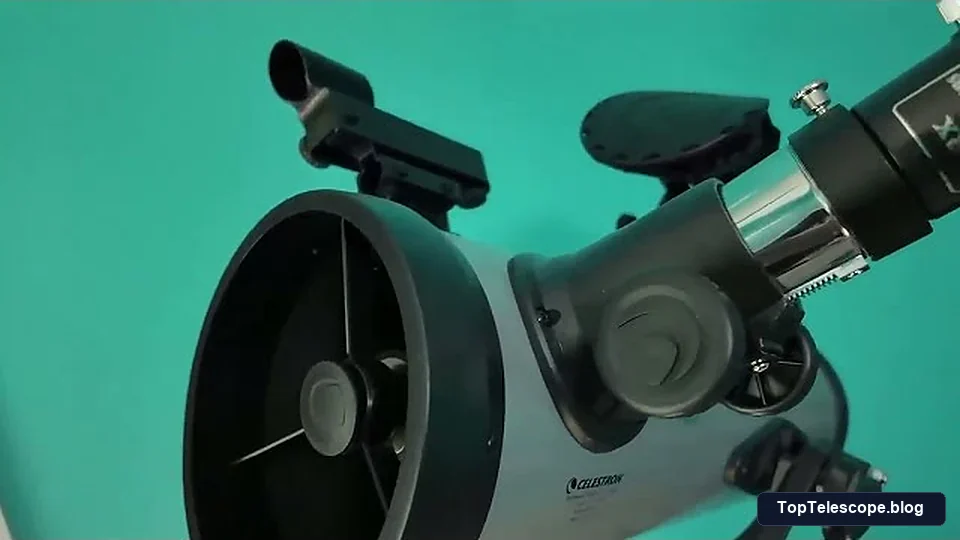
The defining feature is the StarSense Explorer smartphone dock, which pairs with a proprietary mobile application. Explore our StarSense Explorer DX setup guide for advanced alignment tips.
After a quick calibration routine, the app displays directional arrows guiding you toward planets, nebulae, and constellations. Once the target bullseye turns green, you are properly aligned.
The patented StarSense dock relies on a specialized mirror and lens assembly to capture a wide-field view. The companion mobile application processes this optical star pattern via plate-solving algorithms without relying on cellular data.
Alignment calibration requires daytime setup using a distant terrestrial landmark to center the camera view. Once synced, the interface provides directional arrows guiding users smoothly toward visible celestial targets in real time.
- StarSense plate-solving technology
- Real-time directional arrows
- Automated object database selection
App Compatibility and Setup Nuances
The software operates seamlessly on most modern iOS and Android smartphone operating systems without requiring cellular data. GPS location services help the application generate customized target lists instantly.
Proper mirror alignment between your phone camera and the telescope optics remains crucial during initial setup. Taking time to calibrate this alignment ensures accurate pointing precision all night.
- Offline celestial plate-solving
- GPS location integration
- Camera-to-optics alignment routine
Maintenance, Collimation and Long-Term Care
Regular maintenance ensures your Newtonian reflector delivers peak optical performance over years of backyard stargazing. Keep dust covers securely attached whenever the instrument is not actively in use.
Primary and secondary mirrors require occasional collimation using adjustment screws located at the rear cell. Maintaining proper optical alignment prevents image distortion during high-magnification planetary viewing sessions.
Regular upkeep involves checking primary mirror clips and secondary alignment using a basic collimating cap. Store the optical tube vertically with dust caps sealed tightly to protect exposed coatings from moisture accumulation and particulate settlement.
Aluminum coatings benefit from occasional dry air dusting using a professional bulb blower. Avoid touching optical surfaces directly to prevent transferring skin oils that can permanently etch delicate protective quartz overcoats.
- Dust cover protection protocols
- Rear cell collimation screws
- Regular mirror alignment checks
Storage and Environmental Protection
Store the optical tube assembly in a dry, temperature-controlled environment to prevent moisture condensation on glass surfaces. Avoid touching optical coatings directly with fingers to prevent oil residue accumulation.
Transporting the telescope in a padded case protects the aluminum tripod and plastic mount brackets from impact damage. Periodic hardware checks ensure all mounting screws remain properly secured.
- Dry storage environment protection
- Bare-hand optical avoidance
- Padded transport case recommendations
Performance Under City Versus Dark Skies
Observing from urban backyards introduces significant light pollution that washes out faint galaxies and nebulae. Despite urban glow, bright planets, double stars, and the Moon remain exceptionally rewarding targets.
Traveling to rural dark-sky locations dramatically improves contrast and reveals intricate structural details within dim deep-sky objects. The lightweight 10.4-pound setup travels easily in standard vehicle trunks.
Light pollution in urban environments severely limits faint deep-sky targets like distant galaxies and nebulae. Observers under Bortle class 8 skies will find success restricted primarily to the Moon, bright planets, and major double stars.
Transporting the apparatus to rural dark-sky locations reveals significantly fainter clusters and structured nebulae. Using an optional broadband light pollution filter can marginally improve contrast when observing emission nebulae from suburban backyards.
- Urban planet observation capacity
- Rural dark-sky contrast gains
- Compact vehicle transportability
Light Pollution Mitigation Strategies
City observers should utilize broadband light pollution filters threaded onto eyepieces to boost contrast on emission nebulae. Selecting high-magnification eyepieces also helps darken the background sky perspective.
Surrounding neighborhood lights can occasionally interfere with smartphone camera plate-solving accuracy during initial alignment routines. Shielding your phone screen from direct glare resolves this minor operational challenge.
- Broadband light pollution filters
- Background sky darkening tactics
- Screen glare shielding methods
Comprehensive Buyer Verdict and Alternatives
Learning proper setup procedures ensures optimal performance when operating the Celestron StarSense Explorer LT 114AZ. Review our comprehensive StarSense Explorer LT setup guide for detailed operational instructions.
While optical limitations and manual tracking require realistic expectations, the overall value proposition remains exceptionally strong for beginners. This instrument delivers rewarding views of our solar system.
This telescope suits beginner astronomers prioritizing automated smartphone navigation over complex equatorial polar alignment routines. The manual altazimuth platform encourages fast setup times for spontaneous backyard stargazing sessions and educational outreach events.
Alternative entry-level systems include larger Dobsonians for pure aperture seekers or computerized GoTo mounts. Buyers must weigh the convenience of plate-solving against the mechanical simplicity of traditional manual tracking Dobsonian reflector setups.
- Ideal beginner astronomical platform
- Excellent smartphone guidance integration
- Strong overall value proposition
Who Should Buy Versus Skip
Beginners wanting effortless celestial navigation without complex equatorial alignment will love this setup. Experienced astronomers seeking motorized tracking or larger light buckets should explore advanced computerized systems.
Assess your local light pollution levels and physical storage space before purchasing this lightweight telescope. It represents an approachable entry point into practical backyard astronomy and stargazing adventures.
- Recommended for tech-savvy beginners
- Skip if motorized tracking is required
- Ideal for lunar viewing
Frequently Asked Questions
Does the StarSense app require an active internet connection?
The application works offline using your smartphone camera to map overhead star patterns. An internet connection is only needed during initial app download and software updates.
Can I use this telescope for terrestrial daytime viewing?
Newtonian reflectors produce inverted and upside-down images unsuited for standard nature viewing. This optical design is engineered specifically for astronomical targets like planets and stars.
How difficult is it to collimate the 114AZ optical tube?
Collimation requires basic adjustment of the rear mirror screws using a simple cap or laser tool. Following online guides makes this routine maintenance procedure manageable for beginners.
What smartphones are compatible with the dock?
The adjustable dock accommodates most modern iPhone and Android devices available today. Most phones featuring standard camera placements will fit securely within the padded holding bracket.
Does the telescope come with a manufacturer warranty?
Celestron includes a two-year US warranty alongside unlimited technical support from their domestic customer service team. This coverage provides reassuring protection for your new optical investment.