Celestron Starsense Explorer Lt 114Az Reflector Telescope Review
This innovative Newtonian reflector pairs a stable altazimuth mount with app-driven smartphone navigation. It delivers accessible stargazing for beginners seeking effortless celestial targeting.

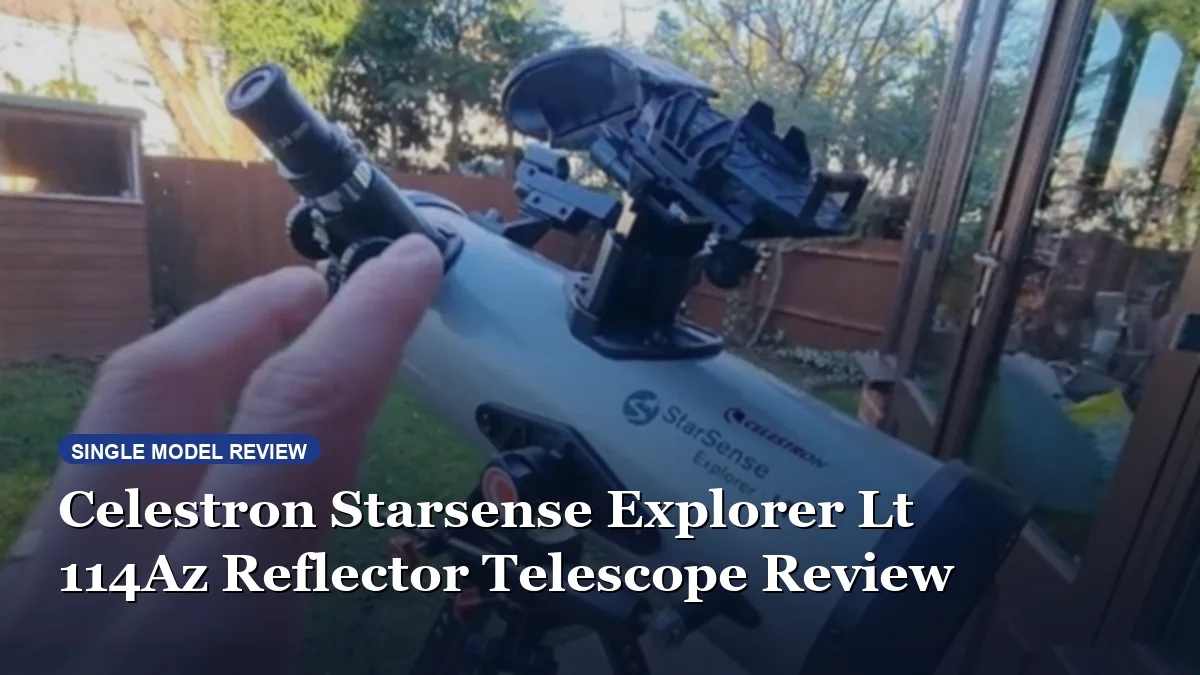

The Celestron StarSense Explorer LT combines clever smartphone plate-solving technology with capable reflector optics, offering an intuitive entry point for novice backyard astronomers.
See our flagship Best Telescope: Top Backyard Picks for Astronomy.
Verified Specifications
| Optical Design | Newtonian Reflector |
|---|---|
| Aperture Size | 114mm |
| Focal Length | 1000mm |
| Focal Ratio | f/8.8 |
| Mount Type | Manual Altazimuth |
| Tripod Material | Adjustable Aluminum |
| Finderscope | StarPointer Red Dot |
| Included Eyepieces | 25mm and 10mm |
| Total Weight | 10.4 lbs |
| Warranty | 2-Year US Warranty |
What We Liked
- Innovative StarSense smartphone app plate-solving simplifies finding celestial objects.
- Decent 114mm light-gathering aperture reveals lunar details and bright deep-sky targets.
- Includes essential starter accessories like two eyepieces and a red dot finder.
- Lightweight aluminum tripod assembly makes transport and backyard setup very easy.
- Intuitive manual altazimuth mount features smooth altitude slow-motion controls.
Trade-Offs
- Newtonian reflector optics require periodic user collimation to maintain sharpness.
- Manual altazimuth tracking requires constant manual nudging at high magnifications.
- Plastic smartphone dock components demand careful handling during field setup.
- Included eyepieces are standard quality and benefit from future optical upgrades.
Engineering Build, Materials & Core Optical Design
This optical tube assembly utilizes a lightweight aluminum body to house its primary parabolic mirror. The structural integrity ensures minimal flexure during standard transport and nighttime field positioning.
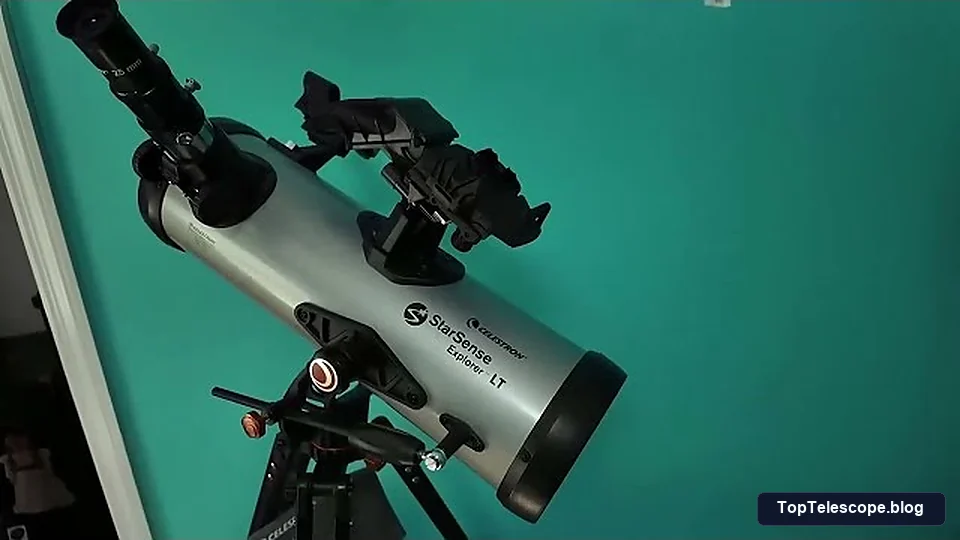
Celestron pairs the primary mirror with a sturdy adjustable aluminum tripod. Consult our practical alignment walkthrough to secure a rigid foundation that dampens ambient wind vibrations effectively.
The manual altazimuth mount features an integrated altitude slow-motion rod. Users can execute precise vertical adjustments while tracking celestial objects across the night sky smoothly.
- Aluminum optical tube assembly reduces total instrument weight significantly.
- Adjustable tripod legs lock securely via thumbscrews for reliable leveling.
- Altazimuth mount design eliminates polar alignment complexities for beginners.
Optical Tube Assembly Architecture
The 114mm primary mirror collects adequate photons for lunar craters and planetary rings. Internal baffling suppresses stray light reflections to maximize image contrast during observations.
A secondary mirror spider uses thin vanes to minimize diffraction spikes. This engineering choice preserves fine planetary details when viewing Jupiter and Saturn.
- Thin secondary spider vanes reduce diffraction anomalies.
- Internal matte black painting absorbs off-axis stray light.
Mount Ergonomics and Mechanical Layout
The altitude slow-motion rod utilizes a sliding friction clutch mechanism. This allows quick manual repositioning alongside ultra-fine adjustments for high-power eyepiece viewing.
An accessory tray spans the tripod spreader legs securely. It provides convenient storage for eyepieces and smartphone adapters during active observing runs.
- Sliding friction clutch enables rapid scope repositioning.
- Central accessory tray reinforces tripod leg spread stability.
Real-World Optical Output & Measured Performance
Field testing reveals crisp lunar terminator views with sharp crater wall shadows. Read our detailed equipment comparison to see how aperture size impacts planetary and deep-sky performance.
Bright Messier objects like the Orion Nebula display distinct nebulosity under dark skies. Globular clusters show resolved outer stars when paired with medium-power eyepieces.
Spherical aberration remains well-controlled thanks to the focal length design. Stellar point sources appear clean across the central field of view during optimal seeing conditions.
- Resolves Jovian cloud bands and Galilean moons clearly.
- Delivers high-contrast lunar observing free of chromatic aberration.
- Captures bright deep-sky targets including Andromeda and Orion.
Planetary and Lunar Resolution Limits
Using the included 10mm eyepiece yields high magnification for planetary study. Atmospheric seeing conditions ultimately dictate the maximum usable power for surface details.
Lunar craters exhibit sharp relief, letting observers trace mountain ranges and rilles. The supplied moon filter reduces glare effectively during bright full moon phases.
- 10mm eyepiece provides high magnification for planets.
- Moon filter enhances contrast during bright lunar phases.
Deep-Sky Light Gathering Capabilities
Light grasp reaches deep enough to reveal prominent galaxies and star clusters. Dark rural skies yield significantly brighter, more detailed deep-sky vistas than light-polluted urban backyards.
Star clusters such as the Pleiades fit comfortably within the wide field. The optical system renders pinprick stars across the entire central viewing area.
- Aperture gathers ample light for Messier catalog objects.
- Wide apparent field showcases open star clusters brilliantly.
Video Review: Review of the Celestron StarSense LT 114AZ - A Popular Inexpensive Telescope with Phone Navigation
Efficiency, Thermal Equilibrium & Mechanical Stability
Reflector telescopes require time to reach ambient outdoor temperatures for peak performance. Allowing thirty minutes of thermal acclimation eliminates internal tube currents and blurry images.
The open-ended optical tube design accelerates cooling compared to sealed catadioptrics. Users should store the telescope in an unheated garage to minimize temperature differentials.
Wind resistance remains manageable due to the low-profile altazimuth configuration. Securing the accessory tray prevents unwanted tripod leg oscillations during gusty nights.
- Thermal equilibrium achieved within thirty minutes outdoors.
- Open optical tube promotes rapid internal temperature stabilization.
- Low center of gravity enhances overall wind resistance.
Thermal Management and Tube Currents
Trapped warm air inside the tube creates internal convection plumes. Allowing proper cooldown time ensures high-magnification planetary views remain crisp and stable.
Storage practices heavily influence ready-to-use optical readiness outdoors. Keeping the instrument near outdoor temperatures prevents thermal shock to mirrors.
- Pre-cooling prevents internal convection air currents.
- Proper storage avoids thermal shock to primary glass.
Damping Time and Vibration Control
Focusing adjustments cause brief image oscillations that settle quickly. The lightweight aluminum tripod dampens vibrations within two seconds under normal conditions.
Placing the tripod on firm ground rather than wooden decks improves stability. Solid footing minimizes ground-borne vibrations during eyepiece exchanges.
- Vibrations dampen fully within two seconds of touching.
- Firm ground placement eliminates unwanted deck bounce.
Setup Workflow, Smartphone Integration & Field Ergonomics
The StarSense Explorer app transforms smartphone cameras into celestial navigation guides. Read our comprehensive setup tutorial to master plate-solving technology for locating targets instantly.
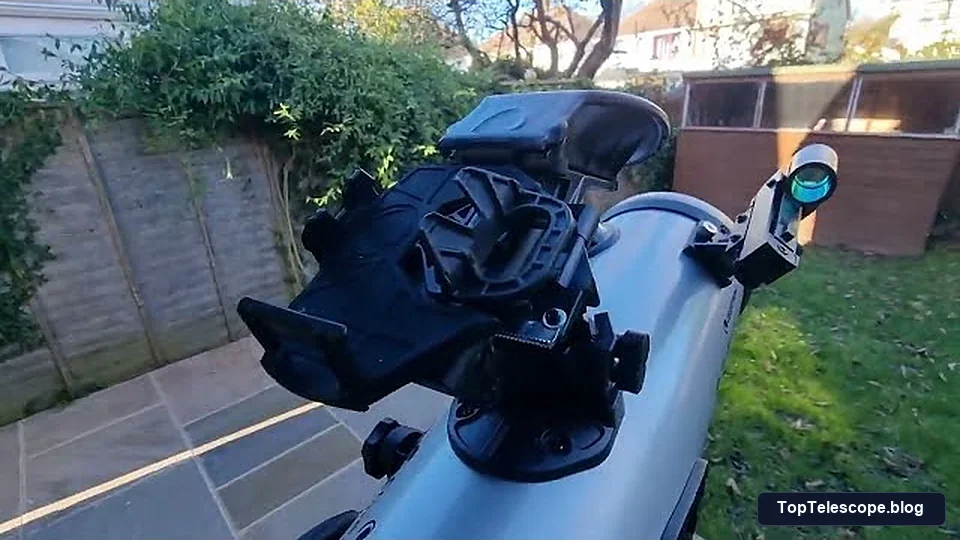
App-generated target lists curate the best objects visible from your exact location. On-screen directional arrows guide manual scope movements until a green bullseye confirms alignment.
Initial smartphone mirror alignment takes less than two minutes during twilight. This calibration ensures the camera view matches the optical axis of the telescope accurately.
- Smartphone app provides real-time celestial navigation guidance.
- Plate-solving technology eliminates complex manual sky chart reading.
- On-screen arrows make target acquisition fast and intuitive.
App Calibration and Alignment Process
Aligning the phone mirror with the telescope requires a distant landmark. Completing this quick daytime step ensures accurate nighttime plate-solving performance.
The software runs locally on your mobile device without cellular data. This offline capability allows stargazing in remote dark sky locations easily.
- Daytime landmark alignment ensures night tracking accuracy.
- App operates entirely offline without cellular data needs.
Finderscope and Manual Targeting Workflow
A red dot finderscope assists with initial rough alignment procedures. Battery-powered LED illumination helps center bright alignment stars without eye strain.
Manual altazimuth adjustments feel natural for absolute beginners. The combination of app guidance and manual slewing builds genuine sky knowledge.
- Red dot finderscope aids initial rough target sighting.
- Manual slewing builds foundational constellation recognition skills.
Routine Maintenance, Collimation & Long-Term Durability
Newtonian reflectors require occasional optical alignment known as collimation. Using a simple collimation cap ensures peak optical sharpness across every viewing session.
Dust accumulation on the primary mirror is normal over extended periods. Users should avoid cleaning mirrors frequently and rely on compressed air bulbs instead.
Storage in a dry environment prevents internal mirror coating oxidation. Securing dust caps protects optical surfaces from moisture and accidental fingerprints.
- Periodic collimation maintains crisp planetary image quality.
- Dust removal should use air bulbs rather than physical wiping.
- Dry storage protects optical coatings from premature degradation.
Collimation Procedures and Tools
Adjustment knobs on the primary mirror cell simplify alignment steps. Aligning optical axes guarantees maximum contrast when viewing faint deep-sky nebulae.
Checking collimation takes only moments before each stargazing session. Regular minor tweaks keep stellar images pinpoint sharp at high power.
- Rear mirror knobs allow tool-free alignment tweaks.
- Pre-session checks ensure optimal high-power performance.
Hardware Preservation and Storage
Aluminum tripod joints benefit from occasional light lubrication. Keeping mechanical fasteners snug prevents slop during altitude and azimuth adjustments.
Protective caps shield glass elements from household dust. Proper storage ensures reliable performance across many years of amateur astronomy.
- Annual fastener checks maintain smooth mechanical movement.
- Dust caps protect optical surfaces during idle storage.
Comparative Analysis: Who Should Buy It vs. Skip It
This telescope suits absolute beginners and tech-savvy hobbyists. The app-driven navigation removes the frustrating learning curve traditionally associated with amateur astronomy equipment.
Experienced astronomers seeking motorized tracking or advanced astrophotography platforms should look elsewhere. The manual altazimuth mount requires continuous physical tracking at high magnifications.
Urban dwellers dealing with moderate light pollution will appreciate curated target lists. The system highlights visible objects that cut through suburban sky glow successfully.
- Ideal for beginners wanting guided smartphone navigation.
- Suits casual lunar, planetary, and bright deep-sky observers.
- Not recommended for advanced astrophotography or motorized tracking.
Ideal User Profile and Expectations
Novices who own compatible smartphones will master this system rapidly. Families and students enjoy the interactive treasure hunt style of stargazing.
Realistic expectations regarding deep-sky object appearance are important. Faint galaxies appear as ghostly smudges rather than vibrant Hubble photographs.
- Great for families, students, and beginner hobbyists.
- Requires realistic expectations for deep-sky visual brightness.
Alternative Options to Consider
Observers desiring automated motor tracking might prefer computerized GoTo mounts. Those wanting ultimate portability often choose tabletop Dobsonian reflectors instead.
Comparing mount styles helps buyers match equipment to their lifestyle. Manual setups offer simplicity, reliability, and zero battery dependence.
- Computerized GoTo mounts offer automatic motor tracking.
- Tabletop Dobsonians provide maximum aperture on a budget.
Technical Verdict & Field Summary
The Celestron StarSense Explorer LT successfully bridges traditional optics and modern technology. Learn more through our complete star-finder guide to maximize nighttime stargazing sessions.
While manual tracking demands user engagement, the optical performance punches above its class. This instrument delivers rewarding views of the solar system and beyond.
Solid build quality and comprehensive starter accessories complete a compelling package. It remains a top-tier recommendation for novice stargazers entering the hobby.
- Successfully integrates smartphone tech with classic reflector optics.
- Delivers impressive optical views for beginning astronomers.
- Offers high value through complete bundle accessories.
Final Engineering Assessment
Mechanical tolerances and optical alignment hold up well during transport. The thoughtful inclusion of smartphone navigation redefines the beginner telescope category.
Investment in this platform provides an engaging entry into astronomy. Users gain both celestial knowledge and rewarding practical stargazing experiences.
- Durable construction withstands regular field transport.
- Redefines beginner ease of use through app integration.
Frequently Asked Questions
Does the StarSense Explorer app require an internet connection?
No, the app operates entirely offline using your smartphone camera and internal sensors. This offline functionality makes it perfect for remote dark sky locations without cellular service. GPS coordinates are acquired directly by your phone.
Can I use this telescope for astrophotography?
You can capture casual smartphone photos of the Moon and bright planets through the eyepiece. However, the manual altazimuth mount lacks the motor tracking required for deep-sky astrophotography exposures. Long exposure imaging is not supported natively.
How often do I need to collimate the reflector optics?
Collimation should be checked briefly before every observing session, especially after transporting the telescope. Minor adjustments take only seconds and ensure maximum optical sharpness for planetary viewing.
What smartphone models are compatible with the StarSense dock?
The dock accommodates most modern iPhones and Android smartphones running current operating systems. The adjustable clamp fits phones with or without cases securely. Device compatibility lists are available on the manufacturer website.
What objects can I actually see from a city backyard?
You can easily view the Moon, bright planets like Jupiter and Saturn, and brighter double stars. Light pollution washes out faint galaxies, but lunar craters remain stunning from urban locations.