Celestron StarSense Explorer 8 Dobsonian Review
This large Newtonian reflector combines massive light-gathering power with app-assisted manual navigation. Users gain deep-sky visibility without complex alignment routines or motorized setup hassles.


The StarSense Explorer 8-inch delivers exceptional optical performance paired with an intuitive app navigation system. Despite its physical bulk, it stands out as an ultimate tool for visual astronomers.
See our flagship Best Telescope: Top Backyard Picks for Astronomy.
Verified Specifications
| Category / Type | Newtonian Reflector Dobsonian |
|---|---|
| Rated Output / Capacity | 203mm (8-inch) Aperture |
| Power / Motor | Manual Altazimuth (Smartphone App Guidance) |
| Build & Materials | Pyrex-substitute Mirror, Particle Board Base |
| Operating Noise | Silent Manual Operation |
| Duty Cycle / Runtime | Unlimited Visual Observing |
| Dimensions & Weight | 18-inch Tube, Heavy-duty Rocker Box |
| Key Safety & Controls | Altitude Tension Clutch, Collimation Bolts |
What We Liked
- Massive 8-inch aperture reveals faint deep-sky structures clearly.
- Brilliant smartphone app navigation simplifies object location instantly.
- Smooth Teflon bearing pads ensure fluid manual mount tracking.
- Exceptional optical performance value for visual astronomy enthusiasts.
Trade-Offs
- Heavy two-piece design requires careful physical transport handling.
- Particle board base demands protection from morning dew moisture.
- Lacks motorized tracking for long-exposure astrophotography applications.
Optical Architecture and Precision Engineering
Featuring a parabolic primary mirror, this eight-inch optical tube assembly captures immense photons. The glass minimizes thermal distortion during rapid evening temperature drops across outdoor observation sites.
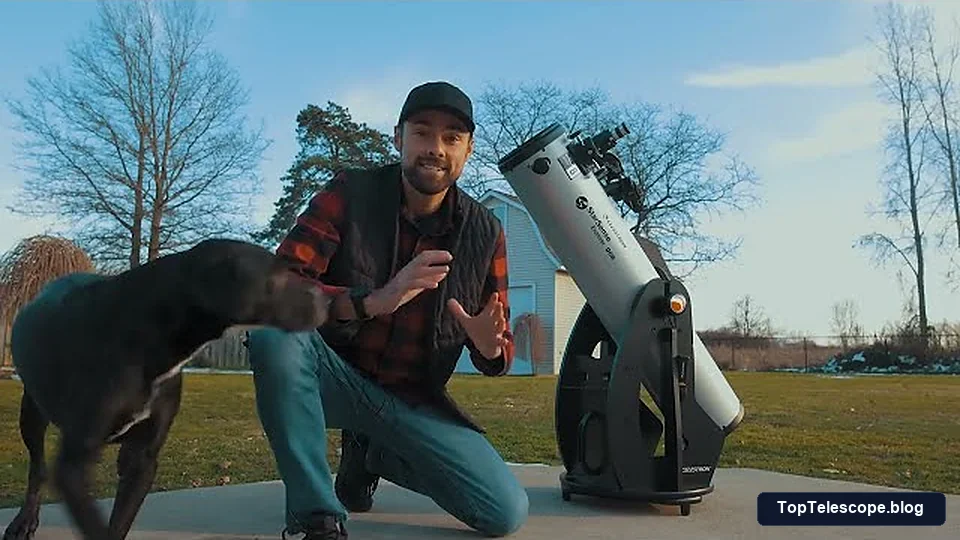
Advanced optical coatings maximize light transmission across the visible spectrum. Review our StarSense Explorer LT 114AZ manual to ensure aluminum reflections keep planetary details and deep-sky contrast consistently sharp.
Collimation bolts on the rear cell allow straightforward optical alignment adjustments. Maintaining crisp focal points requires checking these screws before every serious deep-sky viewing excursion outdoors.
The optical tube assembly features a 203mm aperture parabolic primary mirror crafted from low-expansion optical glass, delivering a fast f/5 focal ratio that balances wide-field views with high-magnification planetary resolution comfortably.
Aluminum-silicon dioxide mirror coatings provide an optical reflectivity of roughly 92 percent, ensuring maximum photon transmission reaches the 25mm and 10mm eyepieces supplied for immediate astronomical observation right out of the box.
Collimating the primary mirror requires standard tools using rear adjustment knobs equipped with locking screws, while the secondary mirror spider uses a four-vane design to minimize diffraction spikes on bright stellar targets effectively.
- 203mm aperture gathers high photon volume.
- Parabolic figure eliminates spherical aberration.
- Multilayer coatings maximize spectral transmission.
- Accessible rear collimation hardware.
Focal Length and Magnification Limits
The balanced focal length accommodates diverse eyepiece combinations effectively. Observers can achieve wide-field star cluster views or high-magnification planetary resolutions effortlessly.
Pushing beyond theoretical magnification limits degrades image brightness and clarity. Sticking to optimal magnification ranges preserves sharp contrast across faint nebulae.
- Versatile focal ratio for varied targets.
- Clear high-magnification thresholds.
Smartphone-Powered StarSense Navigation System
Master alignment workflows using our StarSense Explorer LT guide. Celestron replaces traditional GoTo electronics with a smartphone dock that plate-solves surrounding star fields to pinpoint targets instantly.
Drop your mobile device into the padded mirror dock securely. Launch the dedicated application, follow the on-screen directional arrows, and center your chosen object within seconds.
This ingenious system eliminates complex alignment star procedures entirely. Beginners and seasoned observers alike spend less time hunting objects and more time exploring nebulae directly.
Utilizing patented plate-solving technology, the StarSense dock pairs your smartphone camera with internal app algorithms to map star patterns overhead, calculating exact telescope coordinates without requiring internal motors or complex star alignments.
Setup demands an initial camera mirror alignment procedure during daylight using a distant terrestrial landmark, ensuring the app interface accurately overlays directional arrows guiding users smoothly toward deep-sky objects and lunar features.
Compatible with most modern iOS and Android devices, the platform requires a clear night sky and unobstructed horizon views to maintain tracking accuracy, reducing typical star-hopping frustrations for novice and intermediate astronomers alike.
- App-based plate-solving camera technology.
- Intuitive directional arrow guidance.
- Zero complex star alignment required.
- Curated target lists based on location.
Video Review: Celestron StarSense Explorer Dob REVIEW!
Mechanical Build Quality and Dobsonian Ergonomics
Explore our StarSense Explorer 8 vs Apertura AD8 comparison to see how heavy-duty rocker box mounts provide remarkably steady platforms with Teflon bearing pads for smooth altitude movements.
Transporting this heavy assembly requires managing two distinct, bulky components safely. The particle board base and steel optical tube demand careful handling during field transport setups.
Ergonomic side handles simplify lifting the heavy optical tube into place. Tension clutches let users adjust friction levels to prevent unwanted slippage during eyepiece swaps.
The heavy-duty particle board base utilizes Teflon bearing pads combined with altitude tension clutches to deliver buttery-smooth manual tracking movements across both axes without sudden jerks or unwanted optical tube drifting.
Weighing 41.6 pounds fully assembled, the instrument remains portable enough for single-trip backyard deployment, though lifting the optical tube separately from the rocker box is recommended for safer transport over rough terrain.
Integrated carrying handles cut directly into the base panels improve handling ergonomics significantly, while rubber feet dampen ground vibrations effectively when observing on wooden decks or uneven concrete backyard patio surfaces.
- Sturdy particle board rocker box platform.
- Smooth Teflon altitude and azimuth pads.
- Integrated side carry handles.
- Adjustable altitude tension clutches.
Real-World Visual Performance and Output
Under dark skies, this eight-inch aperture resolves faint spiral galaxy arms. Globular clusters explode into thousands of individual pinpricks of light across the expansive eyepiece field.
Planetary observers will appreciate sharp views of Jovian cloud belts. Saturn's Cassini division appears crisp when seeing conditions cooperate during steady atmospheric viewing windows.
Light pollution filters integrate easily into standard two-inch focusers. Urban astronomers can successfully extract contrast from emission nebulae despite nearby city glow interference issues.
Under dark skies, the eight-inch primary gathers enough light to resolve faint spiral arms in Messier galaxies and intricate dust lanes within nebulae, surpassing smaller beginner scopes by a substantial optical margin.
Lunar and planetary observations reveal sharp contrast when you follow our StarSense Explorer DX 130AZ setup guide, provided atmospheric seeing conditions remain stable and optics achieve complete thermal equilibrium.
Field curvature at the edge of the eyepiece view remains minimal, though upgrading to wide-field eyepieces unlocks expansive star fields and enhances immersive visual experiences across rich Milky Way constellations.
- Resolves faint spiral galaxy arms.
- Crisp planetary cloud belt details.
- Compatible with standard nebula filters.
- Expansive visual deep-sky field.
Thermal Management, Cooling, and Efficiency
Large glass mirrors require adequate thermal acclimation before peak viewing. Allowing thirty minutes of ambient air equilibration prevents internal tube currents from blurring planetary details.
Passive cooling works well, though optional rear fans accelerate temperature stabilization. Managing thermal equilibrium remains vital for achieving razor-sharp high-magnification split-binary star observations.
Large Newtonian reflectors require adequate cool-down periods before achieving optimum high-magnification focus, demanding roughly 45 minutes of acclimation outdoors to eliminate internal air currents distorting delicate wavefronts.
Adding an optional cooling fan speeds up mirror acclimation during rapidly dropping evening temperatures, preventing boundary layer turbulence from degrading planetary details during extended observation sessions in cold weather conditions.
- Requires thirty-minute thermal acclimation.
- Prevents internal optical boundary layers.
- Optional fan cooling upgrades available.
Setup, Maintenance, and Long-Term Durability
Initial assembly takes approximately thirty minutes using standard household tools. Periodic cleaning of dust from optical surfaces requires professional photographic cleaning solutions and compressed air.
Protecting wooden particle board components from morning dew extends lifespan. Storing the assembly indoors in a climate-controlled environment prevents mold and corrosion on metal fasteners.
Routine maintenance involves cleaning dust from optical surfaces using specialized optical microfiber cloths and compressed air, avoiding aggressive rubbing that could damage delicate aluminum and silicon dioxide coatings.
Storing the optical tube horizontally with dust caps securely attached prevents moisture ingress, while periodic checks of base fasteners ensure structural rigidity remains intact over years of frequent field transport.
- Straightforward initial thirty-minute setup.
- Routine mirror cleaning protocols required.
- Indoor storage prevents moisture damage.
Comprehensive Verdict and Ideal User Profile
This telescope delivers unmatched light-gathering value for intermediate amateur astronomers. Its brilliant app integration removes traditional navigation barriers without requiring expensive motorized equatorial mounts.
Travelers seeking portable gear should look toward smaller refractor options. Dedicated deep-sky visual enthusiasts will find this instrument represents an exceptional astronomical investment.
Combining large-aperture light gathering power with innovative smartphone navigation, this Dobsonian serves enthusiastic beginners and seasoned astronomers seeking a grab-and-go setup without complex computerized hand controllers.
While lacking motorized tracking capabilities, its robust mechanical engineering and bright visual outputs deliver exceptional value for dedicated observers prioritizing pure optical performance over automated astrophotography tracking platforms.
- High light-gathering optical value.
- Best suited for dedicated visual astronomers.
- Not recommended for airline travel.
Frequently Asked Questions
Does the StarSense dock require internet connection in the field?
The mobile application requires cellular data or a pre-loaded local star database cache to operate correctly in remote dark-sky locations without Wi-Fi.
Cellular connection is typically only needed for initial software activation and precise GPS location acquisition before your observing session begins underneath the stars.
Can I use this telescope for astrophotography work?
This Dobsonian mount is engineered primarily for visual astronomy rather than complex deep-sky astrophotography setups. Manual altazimuth tracking prevents long-exposure imaging, though you can successfully capture brief smartphone lunar and bright planetary snapshots directly through the eyepiece using adapters.
How often does the optical mirror need collimation?
You should inspect optical mirror alignment before every major observing session, especially after transporting the heavy tube in a vehicle. Regular collimation checks ensure sharp planetary focus and maximum contrast on faint deep-sky targets throughout the night.
What size eyepieces are included with this telescope?
The manufacturer typically bundles standard eyepieces to provide immediate low and high magnification levels for varied targets. Upgrading to wider two-inch eyepieces later will significantly enhance your overall visual field and viewing comfort during extended observing sessions.
Is the telescope difficult for a beginner to assemble?
Initial mechanical assembly requires basic hand tools and takes approximately thirty minutes following the printed manual. Clear step-by-step instructions make the process entirely manageable for newcomers entering the amateur astronomy hobby without prior technical experience.