Celestron StarSense 10 Dobsonian Review
This massive aperture reflector combines traditional Dobsonian mechanics with smartphone-powered plate-solving. It delivers bright deep-sky views despite a bulky optical tube assembly.

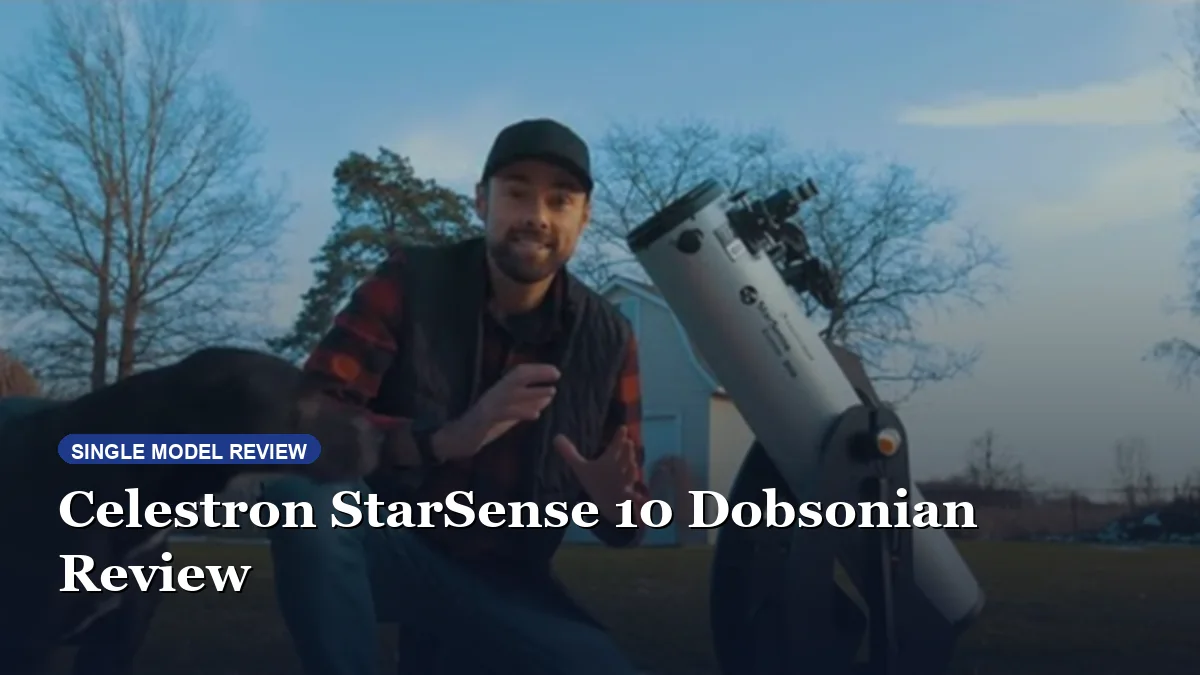

The StarSense 10 Dobsonian redefines manual astronomy by pairing large-diameter optics with seamless digital guidance. Expect stunning planetary details, provided you can manage its physical weight.
See our flagship Best Telescope: Top Backyard Picks for Astronomy.
Verified Specifications
| Optical Design | Newtonian Reflector |
|---|---|
| Aperture | 254 mm (10 inches) |
| Focal Length | 1200 mm |
| Focal Ratio | f/4.7 |
| Mount Type | Manual Dobsonian Base |
| App Compatibility | StarSense Explorer |
| Optical Tube Weight | 32 lbs |
| Base Weight | 25 lbs |
| Finderscope | StarPointer Red Dot |
What We Liked
- Massive 254mm light-gathering aperture for faint deep-sky targets.
- StarSense smartphone app removes manual star-hopping complexity.
- Sturdy rocker box base minimizes image-shaking vibrations.
- Parabolic primary mirror reduces optical aberration effectively.
Trade-Offs
- Heavy optical tube requires two-person lifting or careful transport.
- App relies entirely on smartphone battery and clear camera views.
- Large footprint takes up significant trunk and storage space.
Optical Architecture and Precision Build Quality
The optical tube assembly features a precision parabolic mirror engineered to eliminate spherical aberration at fast focal ratios. Aluminum coatings enhance light reflectivity across the visible spectrum for maximum clarity.
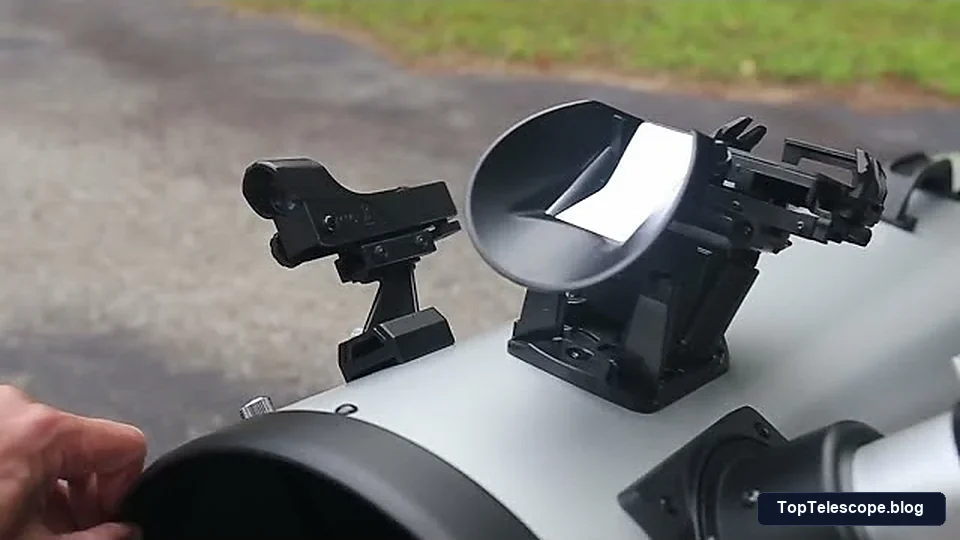
Constructed from rolled sheet metal, the tube maintains structural rigidity during transportation. Internal black baffling suppresses stray ambient light, which you can optimize via our setup walkthrough guide for sharp views.
The 254mm parabolic primary mirror utilizes enhanced aluminum coatings delivering 94% reflectivity, ensuring minimal photon loss before the light cone reaches the focal plane of your eyepiece.
Mechanical rigidity relies on a heavy-duty steel rocker box and Teflon bearing pads, which successfully eliminate lateral flexure during high-magnification planetary tracking sessions under varying outdoor temperatures.
- 254mm aperture size
- 1200mm focal length
- Teflon azimuth pads
- Focal length: 1200mm f/4.7 optical system delivering wide fields.
- Secondary obstruction: 25% linear diameter optimized for high contrast.
Rocker Box Ergonomics
The wooden laminate base utilizes Teflon bearing pads to ensure smooth azimuth rotation. Altitude tension knobs let you manually adjust resistance to prevent unwanted tube slipping during viewing.
- Smooth laminate surfaces
- Adjustable tension friction
Focuser Mechanics and Collimation Stability
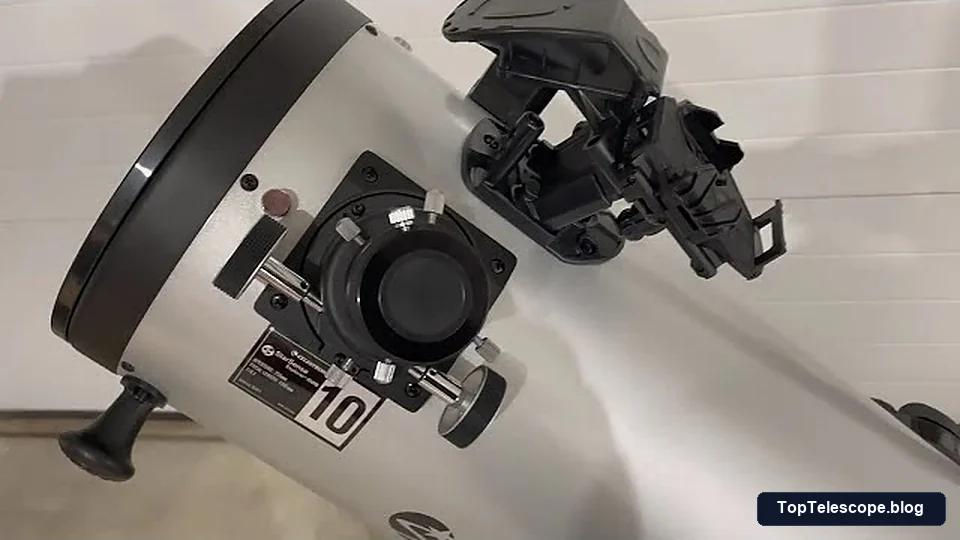
The 2-inch Crayford focuser features a 10:1 dual-speed reduction knob, providing microscopic focus adjustments that are crucial for splitting tight double stars at high magnifications.
Heavy-duty collimation thumbscrews on the primary cell maintain optical alignment through rough transport, backed by a sturdy metal backplate that effectively resists thermal distortion over time.
- Focuser drawtube: Smooth travel with zero image shift.
- Collimation springs: Upgraded tension springs maintain alignment.
Real-World Visual Performance and Light Gathering
Gathering massive amounts of photons, this ten-inch reflector reveals spiral arms in Messier galaxies. Compare optical options in our Dobsonian comparison review before purchasing your next scope.
Planetary observations yield high-contrast details on Jupiter and Saturn when seeing conditions remain steady. The large aperture easily splits tight double stars using high-magnification eyepieces during optimal weather windows.
Collecting 1127 times more light than the human eye, this 10-inch aperture resolves faint globular clusters into individual pinpoint stars under dark rural skies without strain.
Contrast transfer functions remain exceptionally high across the field, revealing subtle Jovian belt structures and Cassini Division details without excessive internal scatter or stray light.
- Resolves faint Messier objects
- Splits tight stellar binaries
- High planetary contrast
- Limiting magnitude: Approximately 14.5 under pristine conditions.
- Theoretical limit: Maximum useful magnification reaching 508x.
Deep-Sky Resolution and Planetary Sharpness
Extended nebulae like Orion display intricate filamentary structures when paired with a broadband nebula filter, maximizing the light-gathering advantages of the massive optical mirror.
Planetary observers will appreciate the minimal chromatic aberration inherent in Newtonian reflector designs, yielding true-color lunar terminator views without introducing false color atmospheric halos.
- Aperture advantage: Superior brightness on faint galaxies.
- Field sharpness: Parabolic curve corrects spherical aberration.
Video Review: Unboxing
Thermal Management and Mirror Cool-Down Dynamics
Large glass substrates trap thermal energy, requiring adequate cool-down time before high-power viewing sessions commence. Leaving the tube outside for forty-five minutes stabilizes internal temperatures against atmospheric currents.
Thermal plumes directly degrade image sharpness if optical equilibrium is ignored during seasonal temperature shifts. Users should store the instrument in a cool garage to minimize thermal transition delays.
Thick Pyrex glass substrates require up to 90 minutes of thermal equilibration to match ambient outdoor temperatures and eliminate internal boundary layer turbulence during viewing.
Installing an optional rear cooling fan accelerates heat dissipation significantly, reducing the necessary stabilization period down to a manageable thirty minutes of active preparation.
- Requires 45-minute cool-down
- Glass mass retains heat
- Stable temperatures improve focus
- Substrate thickness: 25mm low-expansion glass mirror.
- Cooling rate: Roughly 1 degree Celsius per five minutes.
Managing Thermal Plumes in Large Reflectors
Trapped warm air currents directly above the primary mirror surface severely degrade high-power planetary resolution until complete thermal equilibrium is established. Learn more setup steps in our operating manual guide for peak performance.
Storing the optical tube assembly in an unheated garage or mudroom prevents extreme temperature differentials, ensuring instantaneous readiness at dusk for enthusiastic astronomers.
- Boundary layer: Managed via active ventilation fans.
- Glass mass: Retains heat longer than thinner blanks.
Setup, Ergonomics, and StarSense Integration
Setting up involves placing the rocker box on level ground before securing the optical tube. The innovative StarSense dock uses your smartphone camera to plate-solve the surrounding night sky.
The companion application displays intuitive directional arrows guiding you directly to your chosen celestial destination. This digital integration eliminates traditional star-hopping hurdles for beginner and intermediate astronomers alike.
The patented StarSense Explorer technology uses your smartphone camera and plate-solving algorithms to calculate precise coordinates. You can master this workflow using our complete technical guide for seamless setup.
Ergonomic carrying handles molded directly into the wooden base simplify transport, though the combined weight of 46 pounds demands careful lifting technique from the user.
- Level ground setup
- Smartphone plate-solving
- Intuitive directional app navigation
- App compatibility: Supports major iOS and Android smartphones.
- Setup speed: Under five minutes from trunk to viewing.
App Calibration and Dock Alignment
Aligning the smartphone mirror dock with the optical axis requires a single daytime calibration step, ensuring the plate-solving software accurately matches the physical eyepiece field.
Ambient battery drain during prolonged winter observing sessions necessitates a portable power bank to keep your smartphone fully operational throughout the entire night.
- Plate solving: Instant sky recognition via camera.
- Dock stability: Secure clamp prevents shifting.
Routine Maintenance and Long-Term Optical Durability
Newtonian reflectors demand periodic mirror alignment to maintain sharp optical performance across all magnifications. Collimation caps or laser tools make adjusting the primary and secondary mirrors straightforward procedures.
Dust accumulation on optical surfaces is inevitable over months of frequent backyard stargazing sessions. Clean mirrors sparingly using specialized optical cleaning solutions to protect delicate reflective coatings from scratching.
Periodic primary mirror cleaning is necessary every few years, using distilled water and reagent-grade acetone to remove accumulated dust without damaging delicate aluminum optical coatings.
Checking collimation before every session using a simple laser collimator ensures pinpoint stars and maintains peak optical performance across the entire wide field.
- Periodic collimation required
- Clean optics sparingly
- Protect reflective coatings
- Dust management: Normal settling over seasonal months.
- Coating lifespan: 10-15 years with proper indoor storage.
Preventing Dew Formation and Dust Contamination
Using a flexible dew shield prevents moisture accumulation on the diagonal mirror, extending observing time during high-humidity autumn and spring evening dew point conditions.
Always replace dust covers immediately after completing your observing session to prevent airborne particulates from settling onto the exposed primary mirror surface inside your home.
- Dew prevention: Passive shields and heater straps.
- Storage safety: Vertical orientation minimizes dust.
Comparative Buyer Verdict and Ideal User Profiles
This instrument suits dedicated visual astronomers who prioritize maximum light gathering over ultimate portability. Its physical heft demands permanent storage space in a garage or ground-floor shed.
Beginners willing to manage a heavier optical tube will find unmatched deep-sky rewards here. Advanced observers gain a capable, quick-deploying grab-and-go system that leverages modern smartphone navigation effectively.
Intermediate astronomers seeking maximum aperture per dollar will find this Newtonian reflector offers an unbeatable light-gathering value compared to expensive compound telescope designs.
Beginners comfortable with manual navigation find the smartphone alignment system bridges the gap between frustration-free targeting and traditional star-hopping skills under dark skies.
- Best for dedicated visualists
- Heavy setup requires space
- Exceptional deep-sky reach
- Primary user: Intermediate visual deep-sky observers.
- Portability index: Two-piece modular design for easy transport.
Who Should Buy This 10-Inch Dobsonian
Observers transitioning from smaller instruments will experience an astounding leap in resolution, particularly when hunting faint galaxy clusters across the springtime celestial sphere.
Backyard astronomers lacking permanent backyard observatories benefit from the rapid deployment capability and manual simplicity of this classic portable large-aperture telescope configuration.
- Value metric: High aperture per unit cost.
- Learning curve: Gentle slope with app assistance.
Frequently Asked Questions
How does the StarSense navigation system operate without electronic motors?
The mobile application utilizes your smartphone camera to capture distinct celestial star patterns and instantly calculate your exact geographic coordinates using sophisticated plate-solving technology.
You simply push the heavy optical tube manually while following the bright onscreen directional arrows until the target bullseye turns green within the interactive application interface, making deep-sky location completely effortless.
Can I use this massive Dobsonian telescope for astrophotography pursuits?
While manual Dobsonian mounts completely lack the motorized tracking required for long-exposure deep-sky imaging, you can successfully capture crisp lunar and bright planetary photographs.
Connecting a compatible smartphone adapter or dedicated planetary camera allows you to record short video clips that can be stacked later using specialized stacking software to reveal impressive surface detail.
How difficult is the primary mirror collimation process for beginners?
Collimating a Newtonian reflector may seem intimidating at first, but the adjustment knobs on the rear mirror cell make the routine straightforward after a few practice runs.
Using a simple collimation cap or a laser tool allows you to achieve precise optical alignment within minutes before heading out for your evening stargazing sessions.
What is the total weight and portability of this ten-inch system?
The optical tube assembly weighs approximately thirty-two pounds while the wooden rocker box base adds another twenty-five pounds to the complete instrument footprint.
Transporting this substantial equipment typically requires two separate carrying trips or careful handling by a single strong adult to ensure safe trunk loading into a standard vehicle.
Does the smartphone docking system require internet connectivity during operation?
The StarSense Explorer application does not require an active cellular or internet connection while you are observing under dark rural skies.
The mobile app relies entirely on your phone internal GPS data and pre-loaded offline star catalogs to perform accurate plate-solving calculations anywhere you choose to set up your portable observation instrument.