Celestron NexStar 8SE Review: Compact 8-Inch GoTo Power
The Celestron NexStar 8SE pairs an 8-inch Schmidt-Cassegrain optical tube with a computerized alt-azimuth mount. It delivers bright planetary views while remaining exceptionally portable.

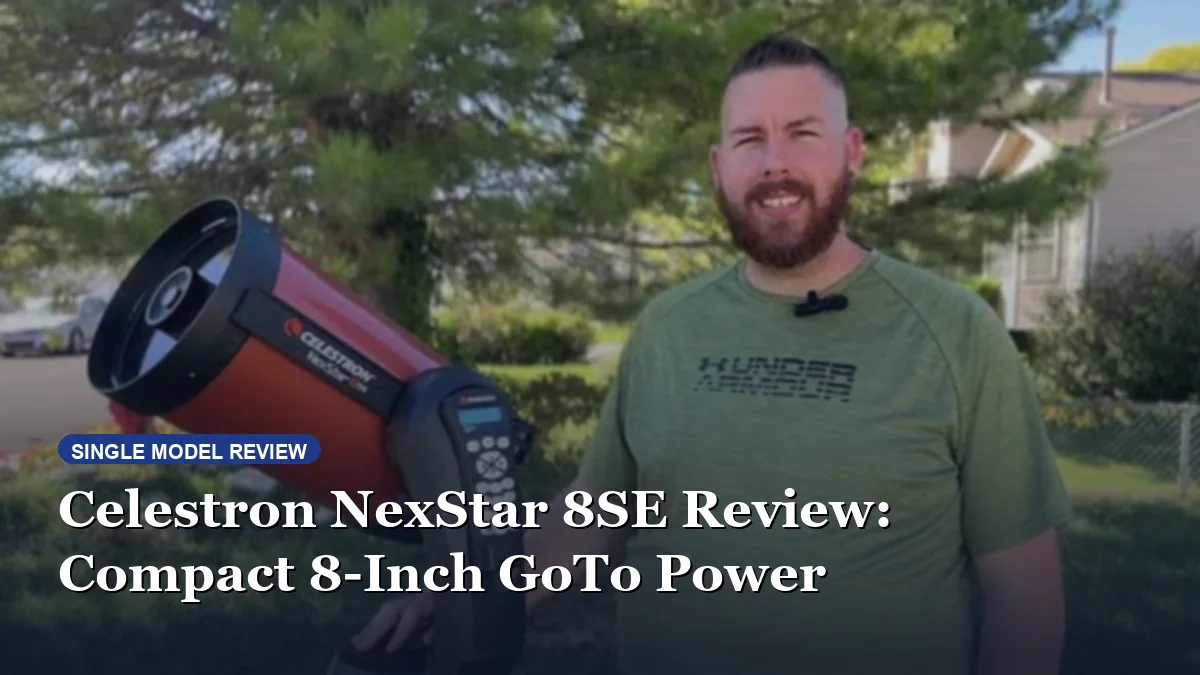

This iconic orange-tube telescope offers exceptional optical performance for visual observers. Despite some mount limitations during long imaging sessions, its aperture-to-weight ratio remains a benchmark for backyard astronomy.
See our flagship Best Telescope: Top Backyard Picks for Astronomy.
Verified Specifications
| Category / Type | Schmidt-Cassegrain GoTo Telescope |
|---|---|
| Rated Output / Capacity | 203mm Aperture (8 Inches) |
| Power / Motor | 8 AA Batteries or 12V DC External |
| Build & Materials | Aluminum Tube & Stainless Steel Tripod |
| Operating Noise | Moderate Motor Hum During Slewing |
| Duty Cycle / Runtime | 3 to 5 Hours on Standard Batteries |
| Dimensions & Weight | 42"D x 24.5"W x 13"H, 53.4 lbs |
| Key Safety & Controls | NexStar+ Hand Control with USB Port |
What We Liked
- Sharp 8-inch StarBright XLT optics
- Comprehensive GoTo database with SkyAlign
- Relatively portable optical tube assembly
- Includes robust stainless steel tripod
Trade-Offs
- Single-fork mount prone to vibration
- Alt-Az design limits astrophotography
- High power draw drains batteries quickly
Optical Engineering and Tube Construction
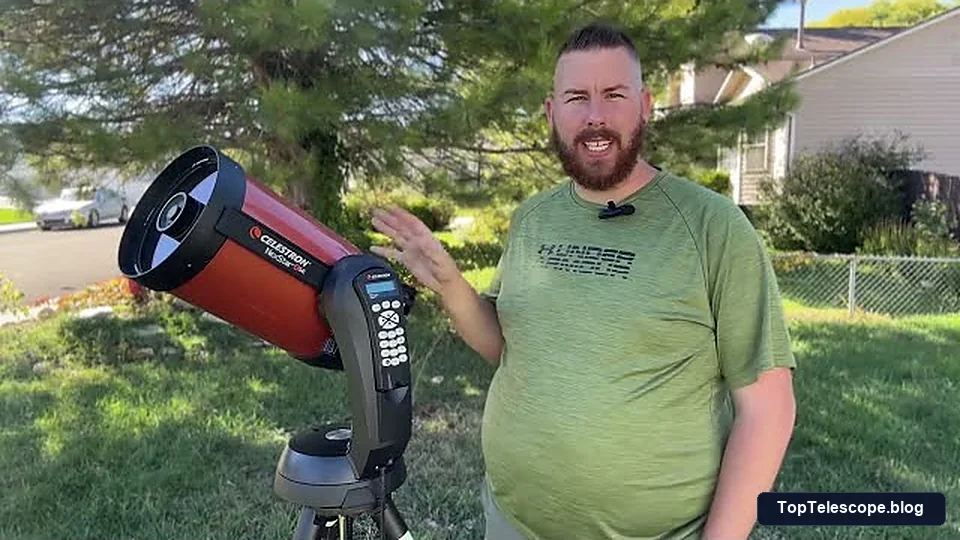
The 203mm aperture optical tube utilizes a folded Schmidt-Cassegrain design to deliver a long focal length in a remarkably compact aluminum housing. This configuration balances portability with significant light-gathering power for deep-sky targets.
Following setup steps outlined in our starsense explorer usage guide, Celestron applies proprietary StarBright XLT coatings across all optical surfaces to maximize light transmission. Users notice enhanced contrast on faint planetary details.
Focusing is achieved via a primary mirror translation mechanism located at the rear cell. While practical, this system can introduce minor image shift during rapid directional adjustments if not handled with care.
The 8-inch aperture Schmidt-Cassegrain optical tube delivers a focal length of 2032mm operating at an f/10 focal ratio. This folded design balances high magnification potential with a remarkably compact physical footprint.
Aluminum optical tube assemblies require precise factory collimation of the primary mirror and spherical secondary mirror. Star-testing remains the gold standard for verifying optical alignment before engaging in high-resolution planetary imaging sessions.
StarBright XLT coatings applied across all optical surfaces maximize light transmission. These specialized multi-layers drastically reduce internal reflections while protecting the corrector plate against rapid environmental dew formation during nocturnal observations.
- 203mm aperture with 2032mm focal length
- Advanced StarBright XLT optical coatings
- Compact aluminum optical tube assembly
Primary Mirror Focus Dynamics
The internal mirror shift is a normal mechanical artifact of moving primary focus designs. Utilizing a separate micro-focus accessory can greatly mitigate image jump during critical high-magnification planetary viewing.
Collimation holds exceptionally well during transport, ensuring crisp stellar point sources night after night without constant optical realignment in the field.
- Rear cell manual focusing knob
- Stable alignment retention
Mount Mechanics and GoTo Tracking Performance
The single-fork alt-azimuth mount utilizes internal brass gears and DC servo motors to drive both axes. It offers reliable tracking once properly aligned, though rapid manual slewing creates audible motor hum.
The included NexStar+ hand controller houses a database of over 40,000 celestial objects. Its multi-line liquid crystal display provides clear text navigation, making target selection straightforward for both beginners and experienced astronomers.
Tracking accuracy depends heavily on stable initial alignment and steady ground conditions. Readers evaluating alternative setups via our astrophotography telescope buying guide will note that field rotation makes this fork configuration primarily suited for visual astronomy.
The single-fork arm altazimuth mount houses high-torque DC servo motors driving precision brass gears. This mechanical layout provides smooth slewing speeds reaching up to three degrees per second across the night sky.
Internal backlash compensation routines must be correctly programmed within the hand controller. Minimizing gear play ensures that target centering remains dead-center when executing automatic tracking corrections during long exposure astrophotography.
Operating the mount requires a stable steel tripod featuring 2-inch diameter legs. Rigidity is paramount to dampening mechanical vibrations quickly whenever manual focusing adjustments are made at high focal lengths.
- Single-fork arm motorized alt-azimuth mount
- 40,000+ object database via hand controller
- Internal DC servo motors with brass gears
Video Review: Celestron NexStar 8SE Telescope Review
Setup, Alignment, and Field Usability
Field deployment is simplified by the quick-release coupling system connecting the optical tube to the fork arm. The heavy-duty stainless steel tripod provides a stable foundation without requiring excessive assembly tools.
Novice observers often consult our best celestron telescope for beginners guide before purchasing. Celestron’s proprietary SkyAlign technology allows users to align the telescope by centering any three bright celestial objects without hassle.
Ergonomics are generally favorable, though carrying the fully assembled mount base requires careful handling. Users should secure all locking clutches tightly before transporting the hardware across uneven terrain or grassy fields.
SkyAlign technology simplifies initial calibration by utilizing any three bright stars visible overhead. Users center each reference point through the eyepiece without needing prior knowledge of constellation names or celestial coordinates.
Ergonomic quick-release coupling mechanisms allow rapid optical tube attachment to the fork mount. This tool-free design significantly accelerates field deployment speeds during sudden clear-sky breaks at remote observing sites.
Incorporating an optional equatorial wedge transforms the altazimuth configuration for polar tracking. This hardware upgrade eliminates field rotation artifacts during multi-minute exposures of faint deep-sky nebulae and distant galaxies.
- Quick-release fork arm attachment
- Automated three-star SkyAlign routine
- Sturdy stainless steel adjustable tripod
Thermal Equilibrium and Optical Performance
Because of the sealed tube design, the large primary mirror requires adequate time to reach thermal equilibrium with ambient outdoor temperatures. Failing to acclimate the optics can result in persistent internal thermal currents.
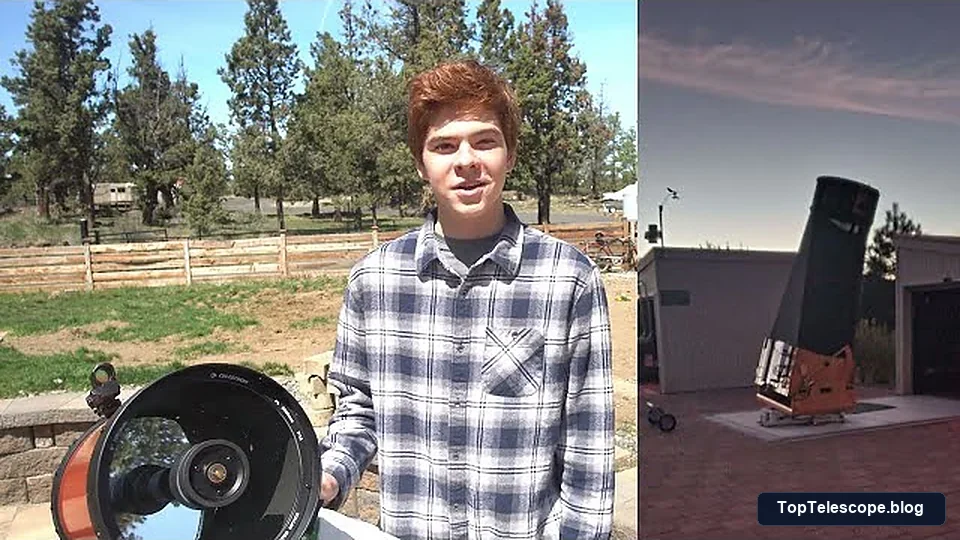
Once thermally stable, the system delivers razor-sharp planetary views featuring high-contrast cloud bands on Jupiter and Cassini division details on Saturn. Collimation remains remarkably stable even after rough transit across bumpy roads.
Sealed optical tubes trap ambient heat, creating internal air currents that degrade high-power planetary views. Allowing forty-five minutes of cool-down time lets internal temperatures match outdoor ambient conditions for sharp imaging.
Thermal blankets or localized cooling fans prevent boundary layer turbulence across the primary glass. Maintaining thermal equilibrium directly influences the Strehl ratio, yielding better contrast on lunar craters and double stars.
- Sealed optical tube thermal acclimation
- High-contrast lunar and planetary output
Power Management and Accessory Integration
The internal battery compartment accepts eight AA batteries, but internal motors draw substantial current during heavy slewing. Using an external 12V power tank or AC adapter prevents unexpected voltage drops and tracking errors.
Integrated auxiliary ports allow seamless connection of optional accessories like GPS modules or Wi-Fi control dongles. The USB port on the hand controller enables direct firmware updates and computer software integration.
GoTo computerized systems demand stable electrical current to prevent erratic hand controller reboots. Utilizing a dedicated lithium power tank avoids voltage drops that commonly disrupt processor tracking logic during cold nights.
Accessory ports accommodate GPS modules and Wi-Fi adapters for seamless wireless smartphone control. Securing loose power cables with strain-relief clips protects the auxiliary ports from accidental snagging during full-circle mount rotations.
- Accepts 8 AA internal batteries
- Auxiliary ports for smart accessories
- Direct USB computer control interface
Maintenance, Durability, and Field Transport
Routine maintenance involves keeping the corrector plate clean using optical-grade microfiber cloths and specialized cleaning solutions. Dust accumulation on the exterior can be wiped away gently with a soft dry brush.
Mechanical longevity depends on protecting the internal gears from moisture and severe dust intrusion during storage. Padded transport cases are highly recommended to shield the sensitive electronics and optical coatings during travel.
Regular upkeep involves cleaning dust from external corrector glass using optical microfiber cloths. Avoiding aggressive chemical solvents preserves the delicate anti-reflective coatings applied across the front lens element.
Transporting the telescope safely requires padded cases designed specifically for fork-mounted Schmidt-Cassegrain tubes. Securing internal components protects the altitude clutch from heavy shock loads encountered during rugged highway transit.
- Corrector plate cleaning protocols
- Gear protection and moisture defense
Definitive Buyer Verdict and Recommendations
Choosing between apertures becomes easier using our technical comparison of the 6SE and 8SE models. The Celestron 8SE remains a legendary choice for astronomers seeking maximum aperture in a lightweight portable package.
Buyers prioritizing deep-sky visual performance and straightforward computerized navigation will find immense value here. Astrophotographers seeking long-exposure capabilities, however, should explore equatorial wedge upgrades or alternative German equatorial mounts.
This telescope excels as a portable instrument for dedicated visual observers seeking deep-sky detail. Its balanced optical throughput and intuitive database make it an exceptional choice for intermediate astronomers advancing their skills.
Prospective buyers must weigh optical advantages against the necessity of stable field power sources. Investing in proper accessories guarantees long-term satisfaction with this versatile system for years of stargazing adventures.
- Ideal for dedicated visual astronomers
- Portable aperture-to-weight ratio
- Upgradable for advanced applications
Frequently Asked Questions
Can this telescope handle serious astrophotography?
The single-fork alt-azimuth mount is primarily engineered for visual observation rather than long-exposure imaging. While you can capture lunar and planetary images using a dedicated camera, deep-sky astrophotography requires an equatorial wedge.
How long does it take for the optics to cool down?
The large eight-inch primary mirror typically requires forty-five to sixty minutes to reach thermal equilibrium with ambient outdoor temperatures. Using a small aftermarket cooling fan can significantly reduce this stabilization time during winter observing sessions.
Is the setup process difficult for absolute beginners?
Celestron’s proprietary SkyAlign technology makes initial alignment remarkably straightforward for novices. You simply center any three bright celestial objects in the eyepiece, and the internal computer calculates your exact geographic position and time.
What power source is recommended for prolonged observation?
Although the mount can operate on internal AA batteries, high motor draw quickly depletes standard cells. We strongly recommend investing in an external rechargeable 12V DC power tank to ensure stable tracking throughout the night.
Can I control the telescope using a computer?
Yes, the included hand controller features a USB port that connects directly to Windows computers running CPWI software. This allows you to navigate the night sky seamlessly from a laptop without touching the keypad interface.