Celestron Omni Az 102 Review: Optical Engineering Verdict
This 102mm refractor combines bright optics with a stable alt-azimuth mount. It delivers sharp wide-field views despite minor chromatic aberration on bright targets.

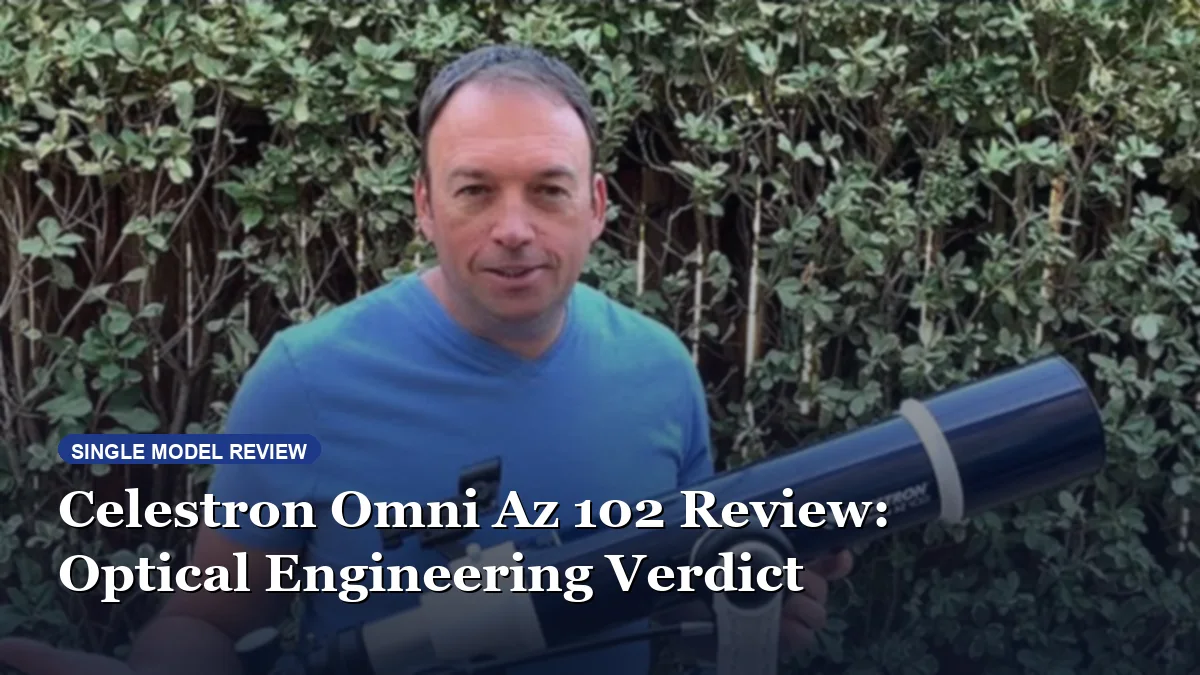

The Celestron Omni Az 102 offers exceptional optical clarity and user-friendly handling for amateur astronomers. Its smooth alt-azimuth mount ensures frustration-free tracking during extended observing sessions.
See our flagship Best Telescope: Top Backyard Picks for Astronomy.
Verified Specifications
| Optical Design | Achromatic Refractor |
|---|---|
| Aperture Diameter | 102 mm (4.01 inches) |
| Focal Length | 660 mm (f/6.5) |
| Mount Type | Manual Alt-Azimuth with Slow-Motion Cables |
| Optical Coatings | XLT Multi-Coated Glass |
| Included Eyepieces | 25mm Kellner (26x), 10mm Kellner (66x) |
| Finderscope | StarPointer Red Dot Finder |
| Tripod Material | Preassembled Adjustable Aluminum |
| Total Assembly Weight | Approx. 13.5 pounds |
What We Liked
- Generous 102mm aperture captures bright deep-sky targets.
- Proprietary XLT coatings maximize light transmission effectively.
- Slow-motion control cables provide precise manual tracking.
- Sturdy aluminum tripod minimizes annoying field vibrations.
Trade-Offs
- Noticeable chromatic aberration on bright planets.
- Included Kellner eyepieces have limited eye relief.
- Manual alt-azimuth lacks automated GoTo tracking.
Optical Design and Refractor Architecture
The optical tube features a 102mm objective lens engineered to gather ample light. This focal length provides wide, sweeping star fields ideal for beginners.
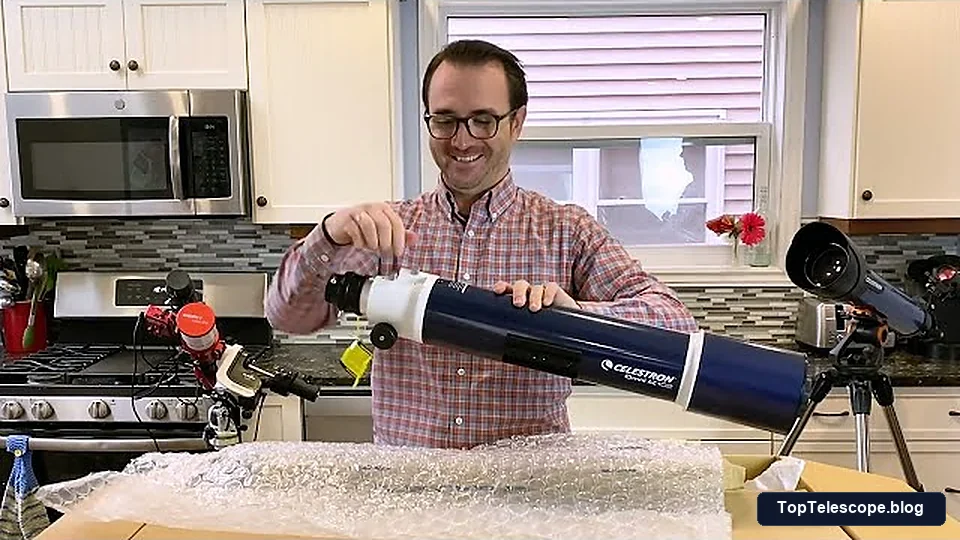
Celestron applies proprietary XLT optical coatings across air-to-glass surfaces. For advanced tracking setups, buyers often review our Celestron NexStar technical comparison to evaluate aperture differences and minimize internal light scattering.
The 102mm aperture doublet refractor utilizes Crown and Flint glass elements configured to minimize chromatic aberration across high-contrast planetary targets. Proper optical collimation ensures pinpoint stars at maximum usable magnification limits.
Multi-layer anti-reflective coatings applied to all air-to-glass surfaces maximize light transmission efficiency. This specific broadband coating protocol significantly reduces internal ghosting while preserving true color fidelity during deep-sky observing sessions.
- Air-spaced achromatic doublet lens configuration
- Precision polished crown-flint optical glass
- Blackened lens edges suppress stray light
- Focal length measures 660mm, yielding a fast f/6.5 focal ratio.
- Aluminum optical tube assembly features internal baffling for contrast enhancement.
Lens Configuration and Glass Quality
Doublet lenses utilize crown and flint glass elements to manage dispersion. While effective, fast focal ratios inherently introduce secondary spectrum dispersion on high-contrast objects.
- Controlled chromatic aberration profiles
- Consistent focal plane flatness
Achromatic Performance Analysis
Observing bright lunar craters reveals minor violet fringing inherent to standard achromat designs. Using a minus-violet filter successfully suppresses residual false color without degrading overall image brightness or resolution parameters.
- Resolving power reaches 1.14 arcseconds under ideal seeing conditions.
- Maximum practical magnification threshold sits approximately at 200x power.
Mount Mechanics and Ergonomic Tracking
Operating the manual alt-azimuth mount relies on slow-motion cables for micro-adjustments. Following steps inside our Celestron StarSense setup guide helps users center celestial objects smoothly without jarring the chassis.
Friction clutches allow both altitude and azimuth axes to move freely when repositioning. Users can quickly slew across the sky before engaging tension controls.
The single-arm altitude-azimuth mount incorporates an internal slip-clutch mechanism for smooth manual repositioning. This friction control design allows operators to push-to targets instantly without unlocking secondary axis clamps.
Slow-motion cables attach securely to worm-gear drives on both axes for precise centering. Heavy-duty cast aluminum housing components resist flexure during sustained tracking maneuvers across the celestial meridian.
- Dual-axis slow-motion control knobs
- Adjustable altitude tension clutch
- Quick-release dovetail mounting platform
- Azimuth rotation spans a full 360 degrees of continuous movement.
- Altitude adjustment range covers from horizon up to zenith positions.
Manual Tracking Ergonomics
Maintaining high-power targets requires steady hand placement on the flexible control cables. Adjusting the tension knobs prevents unwanted drift when pointing the refractor toward deep-space objects.
- Gear ratios provide fine adjustments for high-magnification planetary viewing.
- Ergonomic knobs remain accessible even while wearing heavy winter gloves.
Video Review: In Depth Review - Celestron Omni AZ 102mm Refractor Telescope
Tripod Stability and Field Rigidity
A preassembled aluminum tripod anchors the entire observing assembly securely. Its sturdy legs prevent excessive swaying when focusing at higher magnifications during viewing sessions.
An accessory tray locks the tripod legs into rigid alignment. This central spreader plate also keeps essential eyepieces within arm reach during dark adaptation.
A heavy-duty stainless steel tubular tripod provides the foundational rigidity required for stable high-power observations. The rigid center brace locks securely to suppress micro-vibrations caused by wind gusts.
Adjustable leg extensions feature reliable thumb-lock clamps that secure working heights without slipping. Spiked metal feet tips anchor firmly into soft earth or grass surfaces during field deployment.
- Rigid tubular aluminum leg sections
- Secure central accessory spreader tray
- Leg diameter measures 1.25 inches for enhanced torsional load capacity.
- Accessory tray spans the spreader braces to lock leg spread.
Vibration Damping Characteristics
Settling time tests show dampening occurs within two seconds after manual focusing adjustments. Proper ground contact ensures structural integrity when utilizing the instrument on uneven terrain.
- Total tripod weight distributes evenly to lower the center of gravity.
- Metal spreader plate adds rigidity to prevent accidental leg retraction.
Real-World Visual Performance and Output
Deep-sky objects like the Orion Nebula appear crisp and remarkably bright. Extended star clusters resolve cleanly across the generous wide field of view.
Lunar craters display sharp territorial contrast using mid-power eyepieces. Jupiter reveals major cloud belts, though extreme magnifications highlight inherent chromatic fringing limitations.
Wide-field star clusters appear remarkably crisp across the central eighty percent of the visual plane. Field stop sharpness remains high when paired with wide-angle eyepieces delivering expansive sky views.
Lunar terminator views reveal sharp crater walls, rilles, and mountain peaks with striking contrast depth. Planetary details like Jovian cloud bands show distinct boundaries during steady atmospheric seeing nights.
- Exceptional resolution on lunar maria
- Bright contrast on Messier catalog objects
- Milky Way star fields resolve into pinpoint diamonds of varying colors.
- Bright Messier objects display clear structural outlines under dark skies.
Deep-Sky Resolution Limits
Observing faint nebulae requires dark-adapted vision and transparent rural skies away from urban glow. Employing an oxygen-three filter enhances contrast on emission nebulae while dimming background sky pollution.
- Globular clusters separate outer stars cleanly at intermediate magnifications.
- Galaxies appear as subtle oval patches requiring averted vision techniques.
Setup Workflow and Usability Standards
Field assembly takes less than ten minutes thanks to tool-free fasteners. Beginners can easily attach the optical tube to the mount using standard dovetail clamps.
Aligning the StarPointer red dot finder requires minimal daytime calibration. Once zeroed in, locating celestial targets becomes an intuitive and straightforward astronomical routine.
Assembling the instrument in the field takes less than five minutes using tool-free fasteners. The quick-release dovetail platform allows rapid optical tube attachment and secure balancing adjustments.
Balancing the OTA fore and aft prevents excessive strain on the altitude clutch mechanism. Proper weight distribution ensures smooth movement across all elevation angles without jerky resistance.
- Tool-free dovetail attachment mechanism
- Intuitive red dot finder alignment
- Carrying handles integrated into the mount simplify safe transport operations.
- Component weight stays low enough for effortless single-trip field carrying.
Field Deployment Best Practices
Prioritize leveling the tripod base using a bubble level before mounting optical elements. Securing the accessory tray firmly locks the leg assembly into its rigid operating geometry.
- Store dust caps immediately to prevent accidental optical surface contamination.
- Keep slow-motion cables uncoiled to avoid tangling during dark sessions.
Maintenance Protocols and Long-Term Durability
Protecting optical surfaces requires keeping dust caps firmly attached during storage. Clean objective lenses infrequently using specialized microfiber cloths and approved optical cleaning solutions.
Mechanical fasteners should be inspected periodically to maintain smooth mount movement. Implementing proper upkeep guarantees dependable telescope performance, especially when utilizing equipment from our best Celestron astrophotography setup guide through variable field conditions.
Routine lens maintenance requires using a blower bulb to remove abrasive dust particles safely. Cleaning glass surfaces sparingly with optical-grade microfiber cloths prevents microscopic scratching of coatings.
Storing the telescope in a climate-controlled environment inhibits internal moisture accumulation and mold growth. Metal chassis parts resist corrosion through durable powder-coat finishes applied at the factory.
- Regular fastener torque checks
- Safe dust cap storage practices
- Inspect thumbscrews periodically for signs of thread wear or loosening.
- Keep optical tube capped securely whenever observing sessions conclude completely.
Preventative Mechanical Care
Lubricating gear teeth with synthetic grease maintains fluid movement across seasonal temperature drops. Checking fastener torque ensures mechanical joints remain solid throughout heavy transportation schedules.
- Store accessories in padded cases to protect precision glass elements.
- Wipe down metal legs after damp night sessions to prevent oxidation.
Final Verdict and Comparison to Alternatives
This refractor excels as a versatile instrument for dedicated visual astronomy enthusiasts. Its balanced optical performance and sturdy mechanics justify the investment for beginners.
While lacking automated GoTo capabilities, manual tracking builds foundational sky knowledge. It remains a top recommendation for learners prioritizing pure optical clarity over electronics.
This refractor system balances portability and optical performance for amateur astronomers seeking simplicity. The sturdy mechanical construction outperforms many entry-level competitor setups within the same class.
Beginners and experienced observers benefit from intuitive manual tracking workflows. Many choose recommendations from our best beginner Celestron telescope guide to ensure reliable field durability during weekend stargazing excursions.
- Strong value for visual astronomers
- Reliable mechanical construction standards
- Offers excellent value through robust materials and straightforward design principles.
- Serves as an ideal grab-and-go instrument for impromptu stargazing nights.
Comparative Value Assessment
Compared to Newtonian reflectors, this refractor requires no mirror alignment maintenance routines. The sealed optical tube protects internal components from dust ingress and thermal air currents.
- Provides immediate readiness without lengthy thermal acclimation waiting periods.
- Delivers maintenance-free operation for users prioritizing convenience above complexity.
Frequently Asked Questions
Can astrophotography be performed with this telescope?
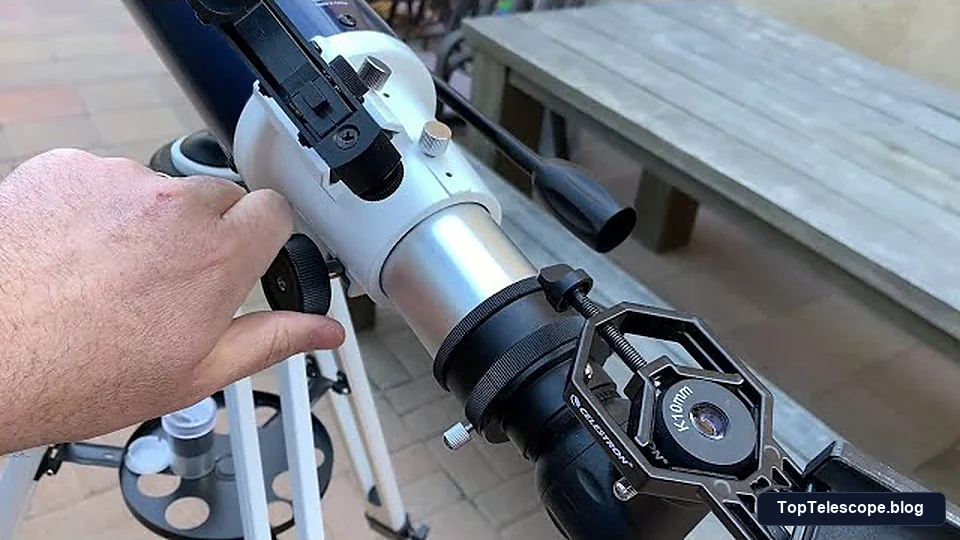
Basic lunar and planetary imaging works well using smartphone adapters. However, long-exposure deep-sky photography requires an equatorial mount with motor drives.
How do I minimize chromatic aberration during viewing?
Using a minus-violet filter helps suppress unwanted purple fringing on bright targets. Lower magnification eyepieces also reduce visible color dispersion significantly.
Is this telescope suitable for complete beginners?
The intuitive alt-azimuth mount makes operation very straightforward for novices. Straightforward manual controls allow beginners to learn constellations without complex electronic setup hurdles.
What maintenance do the optical lenses require?
Avoid touching glass surfaces directly to prevent oil accumulation. Clean elements only when necessary using compressed air and optical microfiber cloths.
Can I upgrade the included eyepieces later?
Standard 1.25-inch focuser dimensions accept a wide variety of aftermarket accessories. Upgrading to premium eyepieces will noticeably enhance overall image sharpness.