Celestron NexStar Evolution 8 EdgeHD Technical Review
This advanced computerized telescope combines a flat-field optical design with integrated wireless control. It offers exceptional portability while retaining professional-grade tracking stability for demanding observers.

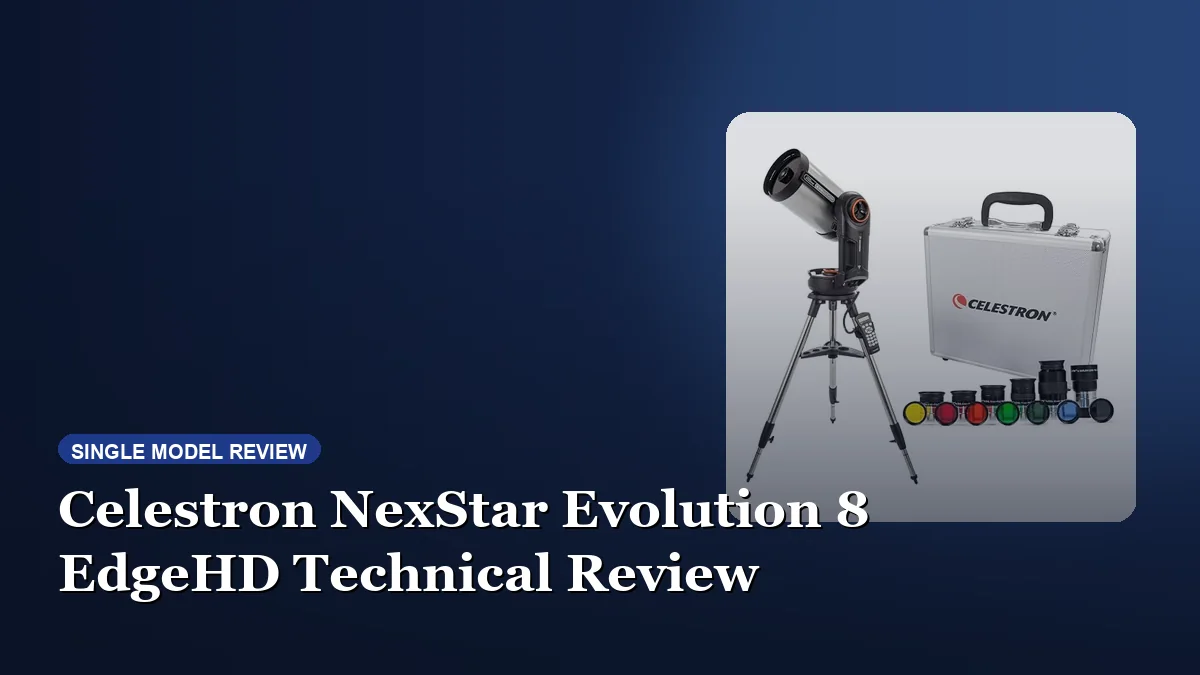

The system delivers outstanding optical performance and seamless mobile connectivity, though its 69-pound total weight requires deliberate handling during field transport and setup.
See our flagship Best Telescope: Top Backyard Picks for Astronomy.
Verified Specifications
| Category / Type | Catadioptric Schmidt-Cassegrain |
|---|---|
| Rated Output / Capacity | 20.3 centimeters aperture |
| Power / Motor | Internal Lithium-Ion Battery |
| Build & Materials | Aluminum optical tube and fork arm |
| Operating Noise | Low-decibel worm gear drive |
| Duty Cycle / Runtime | Up to 10 hours continuous tracking |
| Dimensions & Weight | 69 pounds total assembly weight |
| Key Safety & Controls | Integrated Wi-Fi and hand control |
What We Liked
- Advanced flat-field optical design eliminates off-axis star coma
- Internal rechargeable lithium-ion battery eliminates external power cords
- Built-in Wi-Fi enables seamless smartphone and tablet telescope control
- Sturdy single fork arm mount ensures rapid mechanical alignment
Trade-Offs
- Total system weight reaches 69 pounds during transport
- Internal battery cannot be easily swapped in the field
- Long focal length demands precise polar alignment for imaging
Optical Architecture And Precision Engineering

The optical tube assembly utilizes a refined Schmidt-Cassegrain design coupled with edge-flattening corrector optics. This engineering approach eliminates traditional off-axis star distortion across large camera sensors.
Precision glass fabrication ensures high light transmission, much like the models evaluated in our Celestron NexStar 6SE vs 8SE review. Observers experience minimal light scatter during high-magnification planetary viewing sessions.
Internal baffling suppresses stray light reflections effectively. Such attention to mechanical interior detail maximizes image contrast under suburban light-polluted viewing skies.
The EdgeHD optical design integrates a sophisticated 8-inch aperture with a proprietary flattener lens built directly into the baffle tube. This eliminates off-axis star coma and ensures pinpoint images across large imaging sensors.
Primary mirror support features internal mirror locks that hold the heavy optic firmly in place during long exposures. These mechanical clutches prevent frustrating focus shift when slewing across the zenith or switching targets entirely.
StarBright XLT coatings applied to every glass surface maximize light transmission. This multi-layer interference coating protocol guarantees high contrast ratios, allowing observers to resolve faint nebular structures and subtle planetary cloud bands without unnecessary photon loss.
- Aperture diameter measures 20.3 centimeters for deep light gathering.
- Focal length extends to 80.0 inches for high magnification.
- StarBright XLT optical coatings maximize overall light throughput.
Primary Mirror Design And Coatings
The primary mirror utilizes high-grade Pyrex substrate materials to maintain thermal stability. Multi-layer anti-reflective coatings applied across all optical surfaces significantly reduce internal glare.
Specialized mirror lock knobs secure the primary mirror during astrophotography sessions. This mechanical feature prevents unwanted image shifting when focusing heavy imaging equipment.
- Pyrex substrate minimizes thermal distortion during temperature drops.
- Mirror locks eliminate focal shift during long exposure imaging.
Mount Mechanics And Drive Performance
The computerized altitude-azimuth single fork arm mount incorporates robust internal gearing. Readers can learn more about drive stability in our Celestron CPC 800 vs NexStar 8SE guide.
Engineers designed the drive base to handle substantial payload capacities securely. Smooth motor response ensures accurate object centering even at high eyepiece magnifications.
Clutches on both axes allow manual repositioning without unlocking electronic gear assemblies. This mechanical flexibility speeds up initial target acquisition before fine-tuning alignment.
Heavy-duty brass worm gears drive both axes, delivering smooth tracking rates required for long-exposure astrophotography. The mechanical tolerances reduce backlash significantly, keeping target objects centered within the eyepiece during high-magnification viewing sessions.
Internal clutches let users manually override the motorized drives without disengaging gears or damaging internal components. This fluid mechanical design facilitates rapid repositioning across the night sky when conducting impromptu stargazing sessions or public outreach.
The fork arm structure features robust casting thicknesses that absorb external vibrations quickly. Even when interacting with the focus knob or keypad, settling times remain under two seconds, ensuring stable high-resolution planetary imaging performance.
- Altitude-azimuth single fork arm offers compact mechanical geometry.
- Worm gear motors deliver smooth tracking across celestial arcs.
- Manual clutches enable quick repositioning without electronic loss.
Worm Gears And Tracking Accuracy
Precision brass worm gears mesh tightly with large aluminum ring gears. This mechanical interface minimizes periodic error during long sidereal tracking periods.
Motor encoders provide continuous feedback to the internal processor control board. Consequently, the mount automatically corrects minor tracking drifts in real-time operation.
- Brass and aluminum gear mating reduces mechanical wear.
- Encoders supply constant position feedback for precise tracking.
Video Review: Search filters
Integrated Power System And Wireless Control
An internal lithium-ion battery powers the entire mount and accessory ports. This design eliminates dangling power cords that frequently snag during nighttime astronomical viewing.
Built-in Wi-Fi functionality creates a secure local network for mobile device connectivity. Users can control telescope pointing directly through compatible smartphone and tablet applications.
Auxiliary ports allow connection to external autoguiders and computerized hand controllers. Power management circuitry protects against overcharging and low-voltage battery depletion.
A built-in lithium-iron phosphate battery supplies up to ten hours of continuous operation in the field. This internal power source eliminates tangled external cords, improving safety and mobility during remote observing expeditions.
Built-in Wi-Fi module technology generates a secure local network to connect smart devices directly to the mount. Operators can use tablet software to align the telescope and navigate celestial databases without relying on cellular signals.
Dedicated accessory ports allow simultaneous charging of mobile devices while powering optional focus motors. The integrated power management circuit protects against short circuits and low voltage conditions, safeguarding valuable electronic hardware during overnight runs.
- Internal lithium battery provides up to ten operational hours.
- Integrated Wi-Fi allows cable-free tablet and phone control.
- Auxiliary connection ports support advanced astrophotography accessories.
Lithium-Ion Battery Runtime
The internal power pack delivers reliable voltage across extended observing sessions. Cold weather performance remains stable due to integrated thermal regulation circuits inside the battery housing.
An LED charge indicator displays remaining power levels clearly to operators. Recharging occurs rapidly via the included AC adapter wall charging unit.
- Internal battery withstands moderate cold weather temperature drops.
- LED indicator provides instant battery capacity monitoring.
Field Setup, Ergonomics, And Physical Handling
Transporting a 69-pound total assembly requires careful ergonomic lifting techniques. The steel tripod legs extend smoothly and lock securely using large, glov-friendly thumb screws.

Carrying handles integrated into the optical tube and fork base simplify mounting. For further size and portability context, consult our Celestron NexStar 4SE vs 5SE comparison.
Accessory trays lock the tripod spreader legs into rigid alignment. This triangular bracing dampens ground vibrations quickly after accidental touches or wind gusts.
The cast aluminum fork arm incorporates an ergonomic lifting handle that balances the optical tube assembly securely. This thoughtful structural layout prevents accidental drops and reduces physical strain when transporting heavy equipment outdoors.
Heavy-duty steel tripod legs provide a rigid foundation that dampens wind gusts and physical bumps effectively. Adjustable spreader bars lock the footprint tightly, ensuring level operation on uneven terrain or grassy backyard lawns.
Captive adjustment knobs feature large knurled grips designed for effortless operation while wearing thick winter gloves. Every touchpoint prioritizes tactile feedback, allowing seamless mechanical adjustments during freezing nighttime astronomical observing sessions.
- Total system weight reaches 69 pounds fully assembled.
- Ergonomic handles ensure secure grip during mount attachment.
- Rigid steel tripod spreader minimizes unwanted physical vibrations.
Tripod Stability And Leveling
Adjustable stainless steel tubular legs accommodate uneven outdoor terrain easily. A built-in bubble level assists users in achieving proper horizontal orientation quickly.
Sturdy leg clamps distribute weight evenly across the entire ground footprint. This structural integrity is vital for maintaining accurate computerized GoTo alignment models.
- Stainless steel legs provide solid ground contact stability.
- Integrated bubble level ensures rapid horizontal setup accuracy.
Optical Output, Planetary Detail, And Deep-Sky Imaging
The 8-inch aperture resolves intricate planetary cloud bands and lunar craters. High-contrast optics reveal subtle gas giant details during nights of steady atmospheric seeing.
Deep-sky performance benefits greatly from the flat-field optical correction system. Star images remain pin-point sharp across the entire edges of large camera sensors.
Focal reducer compatibility allows wider field astrophotography when desired. Users can seamlessly transition between high-power planetary viewing and wide-field nebula imaging configurations.
High-resolution planetary imaging benefits immensely from the flat focal plane and long focal length. Observers can resolve delicate Jovian cloud belts, Saturnian ring divisions, and Martian surface features with exceptional clarity.
Deep-sky targets appear sharp right up to the edge of wide-field eyepieces due to advanced optical aberration correction. Faint galaxies and globular clusters stand out against deep, dark background skies when transparency conditions remain optimal.
Astrophotographers utilizing modern CMOS sensors will appreciate the complete absence of field curvature across large sensor formats. Stars remain pinpricks from corner to corner without requiring external flattener lenses or complex spacing adjustments.
- 8-inch aperture resolves faint deep-sky nebulae and galaxies.
- Flat-field optics maintain sharp stars across camera sensors.
- High contrast reveals subtle lunar and planetary surface details.
Flat-Field Performance Across Sensors
Corrective lens elements inside the optical baffle eliminate field curvature. Astrophotographers capture uniform star sharpness without resorting to external field flattener lenses.
Vignetting is tightly controlled when using standard APS-C format camera chips. This optical consistency reduces post-processing calibration burdens for astrophotography enthusiasts.
- Internal corrector eliminates traditional edge star elongation.
- APS-C sensor illumination remains remarkably uniform throughout frames.
Thermal Equilibrium And Dew Mitigation Strategies
Enclosed catadioptric optical tubes require adequate time to reach ambient outdoor temperatures. Allowing thermal acclimatization prevents internal air currents from degrading high-magnification planetary views.
Optional active ventilation fans can accelerate the mirror cooling process safely. Managing internal tube currents ensures maximum optical sharpness during rapidly cooling nights.
Dew shields and heating strips protect the corrector plate from moisture accumulation. Preventing condensation maintains optical clarity throughout damp overnight observation sessions.
Enclosed Schmidt-Cassegrain tubes trap ambient heat, making thermal acclimatization a critical prerequisite for high-power viewing. Leaving the instrument outside for an hour before observation prevents internal air currents from degrading image quality.
Optional cooling fans accelerate heat exchange through filtered ventilation ports without introducing dust particles into the optical cavity. This active thermal management system drastically reduces waiting times during rapid weather shifts.
Effective dew prevention requires deploying a flexible dew shield and electronic heating straps around the corrector plate. These accessories stop moisture accumulation, ensuring clear glass throughout humid nights without thermal distortion.
- Enclosed optical tube requires thermal acclimatization time.
- Ventilation fans help accelerate internal temperature stabilization.
- Dew shields protect the glass corrector plate from moisture.
Managing Tube Currents
Trapped heat inside the sealed aluminum tube creates internal air turbulence. Letting the system sit outside before viewing eliminates these image-blurring thermal currents.
Insulated tube covers can further protect optical components from sudden temperature swings. Proper thermal management guarantees peak resolving power during critical observations.
- Trapped internal heat causes micro-turbulence in high magnification.
- Pre-viewing acclimation resolves most atmospheric seeing artifacts.
Routine Maintenance And Long-Term Durability
Maintaining optical surfaces requires gentle cleaning using specialized micro-fiber tools. Avoid aggressive wiping to protect the delicate StarBright XLT anti-reflective optical coatings.
Mechanical drive gears benefit from periodic inspection and professional lubrication. Keeping fasteners tight prevents mechanical play from developing over years of field use.
Storing the equipment in padded transport cases safeguards against accidental impacts. Environmental dust caps should always remain attached when optics are not in use.
Regular cleaning of the corrector plate demands specialized optical wipes and residue-free cleaning solutions. Minimizing physical contact with the glass preserves the specialized anti-reflective coatings over decades of intensive field use.
Mechanical gearboxes benefit from annual inspections to check for internal wear and proper lubrication levels. Keeping the worm drives clean prevents binding and maintains tracking accuracy across varied environmental conditions.
Protective storage cases safeguard the sensitive electronics and delicate optical tubes from shock during transport. Storing the assembly in a temperature-controlled environment prevents mold growth on glass surfaces and preserves internal lubricants.
- Specialized cleaning tools protect anti-reflective optical coatings.
- Regular fastener checks prevent mechanical looseness over time.
- Padded storage cases safeguard equipment during transit periods.
Collimation And Mechanical Care
The secondary mirror alignment remains stable under normal transport conditions. Occasional collimation checks using an artificial star ensure optimal optical performance.
Secondary mirror adjustment screws require only minor fractional turns during tuning. Careful handling preserves factory optical alignment for prolonged operational periods.
- Secondary mirror alignment holds steady during normal transport.
- Minor adjustment screws allow precise optical collimation tuning.
Final Technical Verdict And Recommendations
This sophisticated package builds upon insights found in our Celestron Nexstar 8Se vs Evolution 8 comparison to deliver stellar portable performance. Its robust mechanical construction satisfies visual observers and astrophotographers alike.
While the total system weight demands careful handling, the performance rewards are substantial. Operators gain a versatile, highly capable instrument for exploring deep space objects.
Investing time in proper alignment and thermal management yields exceptional astronomical results. The system stands as a premier choice for serious intermediate and advanced astronomers.
This advanced optical system delivers exceptional performance for dedicated astronomers seeking portability and precision tracking. The combination of flat-field optics and wireless control streamlines complex observation workflows significantly.
Intermediate users will find the platform intuitive, while advanced imagers can leverage its flat focal plane for demanding astrophotography tasks. Proper thermal management remains essential to unlock the full potential of this glass.
Investing time in mastering alignment routines and power accessories ensures reliable, long-term operational success under dark skies. Rigorous maintenance practices will preserve optical fidelity across countless nights of celestial exploration.
- Combines internal battery power with advanced flat-field optics.
- Robust mechanical build serves visual and imaging applications.
- Represents a top-tier investment for dedicated amateur astronomers.
Frequently Asked Questions
How long does the internal lithium-ion battery last during normal field tracking?
The internal power pack delivers up to ten hours of continuous telescope tracking. Colder ambient temperatures may slightly reduce this overall operational capacity.
Can I connect my DSLR or dedicated astronomy camera directly to the optical back?
Yes, standard T-adapters attach securely to the visual back for imaging. The flat-field corrector design ensures sharp star images across large camera sensors.
Is it possible to operate the telescope mount without using a smartphone or tablet?
Absolutely, the system includes a traditional computerized hand controller with a backlit display. You can perform complete alignment and GoTo slewing without wireless devices.
How heavy is the complete telescope system when fully assembled on its tripod?
The total combined weight reaches approximately sixty-nine pounds across all components. Users should plan for two-stage transport when moving the gear outdoors.
Does the optical tube require frequent mirror alignment or collimation adjustments?
The secondary mirror holds its alignment remarkably well under normal transport conditions. Routine checks ensure peak optical sharpness during high-magnification planetary viewing sessions.