Celestron NexStar 8SE Review: Optical Precision & GoTo Control
This iconic orange-tube telescope pairs massive 8-inch optics with automated GoTo tracking. However, its single-fork mount demands careful power management during extended winter observation sessions.


The NexStar 8SE delivers exceptional planetary and deep-sky resolution for its weight class. Its SkyAlign technology simplifies complex field calibration routines significantly.
See our flagship Best Telescope: Top Backyard Picks for Astronomy.
Verified Specifications
| Category / Type | Schmidt-Cassegrain GoTo Telescope |
|---|---|
| Rated Output / Capacity | 203mm aperture light gathering |
| Power / Motor | 8 AA batteries or external 12V DC |
| Build & Materials | Aluminum optical tube and steel tripod |
| Operating Noise | Moderate gear hum during fast slew |
| Duty Cycle / Runtime | 4 to 6 hours on standard alkaline cells |
| Dimensions & Weight | 32D x 34W x 52H inches, 33 lbs total |
| Key Safety & Controls | NexStar+ hand control with 40,000+ objects |
What We Liked
- Large 8-inch aperture resolves faint nebulae and galaxies
- Fast and reliable SkyAlign setup procedure for beginners
- Compact Schmidt-Cassegrain tube length improves portability
- Extensive database of over 40,000 celestial night targets
Trade-Offs
- Single-fork arm mount can introduce minor settling vibrations
- Internal gear mechanisms are sensitive to cold winter temperatures
- High battery consumption requires an external power tank upgrade
Optical Architecture and Tube Construction
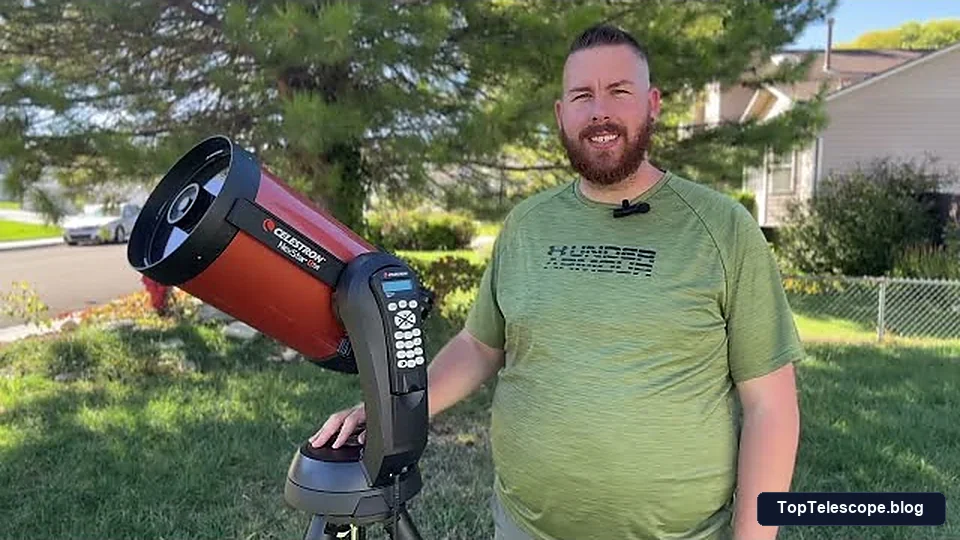
The optical tube assembly features an 8-inch aperture configured in a classic Schmidt-Cassegrain design. This folded light path keeps the physical length compact while maintaining a long focal length for high-magnification targets.
Aluminum construction balances structural rigidity with manageable transport mass. Readers can explore our Celestron CPC 800 vs NexStar 8SE comparison to evaluate chassis differences and corrector plate protection measures.
The Schmidt-Cassegrain optical design features an 8-inch aperture with a 2032mm focal length, delivering a focal ratio of f/10 for balanced planetary and deep-sky imaging capabilities.
Constructed from durable aluminum, the OTA weighs roughly 12 pounds and measures 17 inches long, requiring a secure mounting dovetail bar for safe mechanical attachment during assembly.
- 203mm objective lens diameter gathers ample photons
- StarBright XLT optical coatings maximize light transmission
- Compact 43.2-centimeter optical tube length facilitates transport
Corrector Plate and Mirror Alignment
The Schmidt corrector plate utilizes multi-layer coatings to minimize internal reflections. Maintaining factory collimation is straightforward using the rear primary mirror adjustment screws during steady seeing conditions.
Thermal acclimatization is crucial before serious viewing sessions begin. Allowing the large primary glass mirror thirty minutes to ambiently cool prevents thermal boundary layer distortion during high-magnification planetary observation.
- Multi-layer anti-reflective glass coatings
- User-adjustable primary mirror collimation cells
Computerized Mount and GoTo Performance
We evaluate these automated mounts inside our Celestron NexStar 6SE vs 8SE technical comparison. The altitude-azimuth fork arm houses powerful internal DC servo motors that drive both tracking axes smoothly.
Slew speeds range from fine centering increments up to rapid degrees per second traversals. While tracking accuracy holds targets steadily in the eyepiece, backlash can occasionally require minor manual corrections at high powers.
The single-fork arm mount utilizes a SkyAlign technology routine that requires centering three bright celestial objects to calibrate the internal database for automated tracking precision.
Internal brass gears drive the altitude and azimuth axes, providing smooth tracking rates at sidereal speeds while compensating for Earth's rotation during extended photographic exposure sessions.
- Computerized Altitude-Azimuth single fork arm architecture
- Flash-upgradeable hand control firmware via USB connection
- Variable slew speeds ranging from 2x to 5deg per second
Video Review: Celestron NexStar 8SE Telescope Review
Real-World Output and Field Observations
Under dark rural skies, the 8-inch light-gathering surface easily resolves globular clusters into individual stars. Faint spiral galaxies reveal mottled core structures when observing with properly adapted night vision.
Lunar and planetary targets exhibit striking contrast and sharp detail boundaries. Cloud belts on Jupiter and the Cassini Division in Saturn's rings remain crisp when atmospheric seeing conditions are favorable.
Observing lunar craters reveals sharp contrast along the terminator line, while planetary targets like Jupiter showcase distinct cloud belts under steady atmospheric seeing conditions.
Deep-sky performance benefits from the 2032mm focal length, though wide-field nebulae require focal reducers to capture expansive structures within a single eyepiece field of view.
- Resolves stellar clusters into distinct pinpoints
- Exhibits high contrast on lunar maria and craters
- Shows major Jovian cloud bands and planetary moons
Power Efficiency and Thermal Management
Internal electronics draw steady current during tracking operations and high-speed slewing. Standard alkaline batteries deplete rapidly in cold weather, making an external rechargeable power tank an essential field accessory investment.
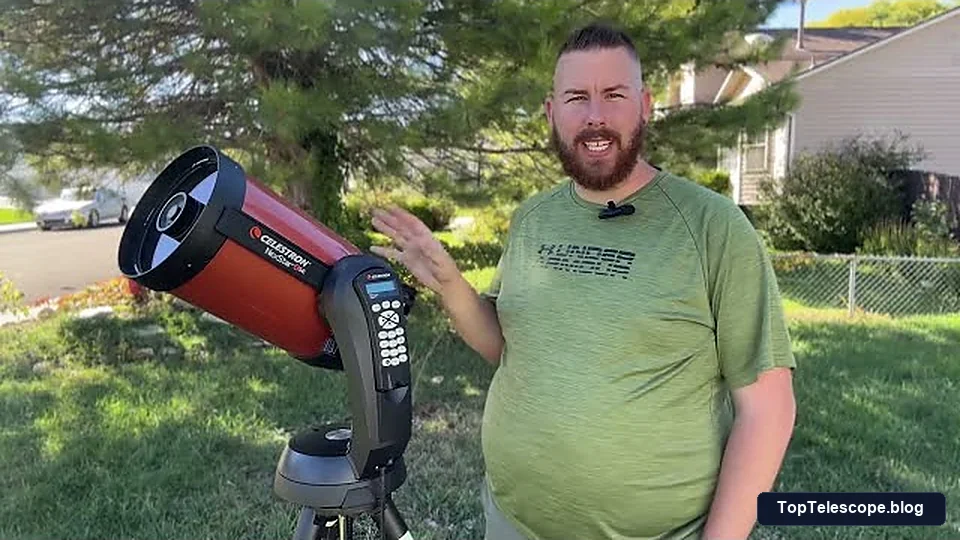
Internal thermal management relies on passive chassis dissipation rather than active cooling fans. Keeping the instrument sealed protects internal optics from dust ingress while maintaining stable interior air pockets.
Operating the computerized hand control requires eight AA batteries, but drawing power from an external 12V DC power tank prevents voltage drops during cold weather sessions.
Thermal equilibrium takes roughly 45 minutes due to the sealed aluminum tube, necessitating proper ambient temperature acclimation before achieving optimum high-magnification visual focus stability.
- Operates on eight standard AA internal batteries
- Compatible with regulated 12-volt DC power supplies
- Passive thermal dissipation prevents internal dust accumulation
Ergonomics, Setup, and Usability
Deploying the sturdy steel tripod provides a stable foundation for the optical tube assembly. Our Celestron NexStar 4SE vs 5SE optical duel details how similar quick-release base mechanisms operate in the field.
The proprietary SkyAlign technology simplifies initial calibration routines significantly. Users simply center any three bright celestial objects in the eyepiece, and the internal computer calculates precise geographic positioning instantly.
The steel tripod features adjustable legs and a heavy-duty spreader bar that enhances torsional rigidity, minimizing vibrations during manual focusing adjustments in the field.
Transporting the system involves separating the optical tube from the fork arm base, ensuring safe handling without straining mechanical locking levers or internal drive gears.
- Heavy-duty adjustable steel tripod legs
- Quick-release optical tube attachment clamp
- Intuitive three-star alignment software routine
Maintenance, Durability, and Verdict
For further structural insights, consult our Celestron NexStar 8SE vs Evolution 8 verdict. Routine upkeep involves keeping dust covers firmly attached when stored indoors to prevent particulate buildup.
This computerized telescope balances exceptional optical aperture with intuitive automation features. Despite minor mount stabilization limits, it remains a premier choice for dedicated amateur astronomers exploring deep space.
Periodic careful cleaning of the Schmidt corrector plate requires optical-grade microfiber cloths and specialized fluid to protect anti-reflective coatings from scratches or residue buildup.
This complete optical system delivers robust performance for intermediate astronomers seeking a portable yet powerful instrument for visual astronomy and lunar planetary imaging tasks.
- Protective dust covers included for optics
- Comprehensive manufacturer two-year US warranty coverage
- Robust metal housing built for frequent transport
Frequently Asked Questions
How does the SkyAlign system work on this telescope?
The computer uses your input date, time, and GPS coordinates alongside three user-selected bright stars. This process calculates precise local alignment without requiring prior knowledge of star names.
Can astrophotography be performed with this specific mount?
Basic planetary imaging is very successful using high-speed cameras. However, deep-sky long-exposure photography requires an optional equatorial wedge to eliminate field rotation over time.
What power sources are recommended for field sessions?
While internal AA batteries function adequately for short periods, they drain quickly in cold weather. Utilizing a dedicated external 12V power tank ensures stable tracking throughout long observation nights.
How difficult is it to collimate the Schmidt optics?
Collimation is straightforward and rarely needs frequent adjustment thanks to the fixed mirror design. You simply adjust the three screws on the secondary mirror housing using a defocused star.
Is this telescope suitable for complete beginner astronomers?
Novices can successfully operate the system if they take time to learn the alignment procedures. The automated GoTo database provides an accessible learning curve for eager astronomy enthusiasts.