Celestron NexStar 4SE Technical Review
The NexStar 4SE pairs classic Maksutov optics with modern GoTo automation. It offers high-contrast planetary views in a compact frame.

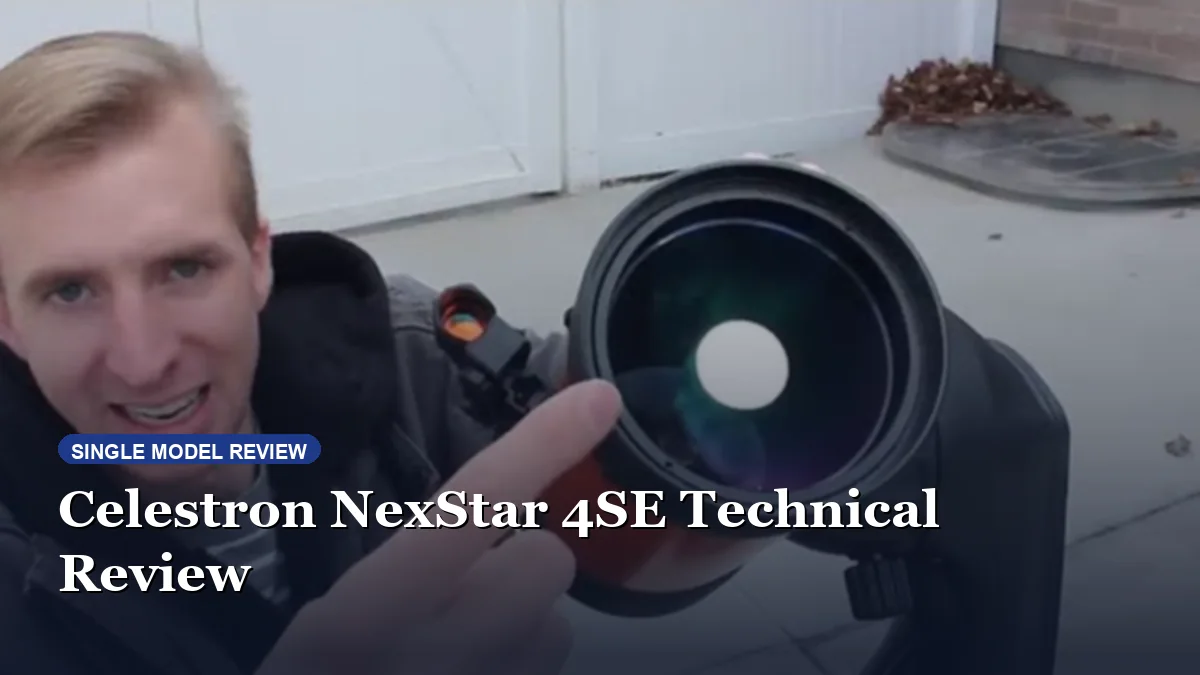
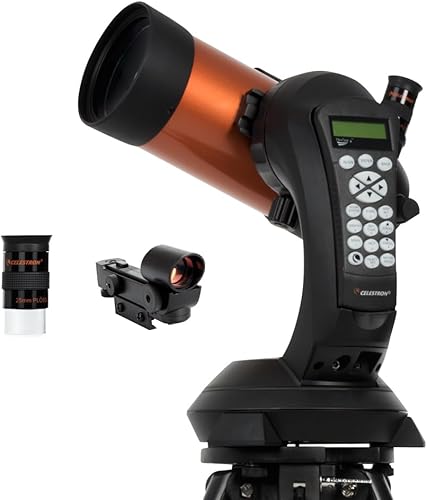
This computerized telescope delivers sharp lunar and planetary performance backed by reliable automated tracking for amateur astronomers.
See our flagship Best Telescope: Top Backyard Picks for Astronomy.
Verified Specifications
| Category / Type | Maksutov-Cassegrain GoTo Telescope |
|---|---|
| Rated Output / Capacity | 10.2 cm objective lens diameter |
| Power / Motor | 8 AA batteries or 12V DC adapter |
| Build & Materials | Aluminum optical tube and plastic fork arm |
| Operating Noise | Moderate gear hum during fast slewing |
| Duty Cycle / Runtime | 3 to 5 hours on standard alkaline batteries |
| Dimensions & Weight | 34.3 cm optical tube length, 21 lbs total |
| Key Safety & Controls | NexStar+ hand control with 40,000+ database |
What We Liked
- Compact Maksutov-Cassegrain optical tube design
- Fully automated GoTo mount with database
- Built-in equatorial wedge for basic astrophotography
- Fast SkyAlign multi-star alignment procedure
Trade-Offs
- Internal battery compartment drains power quickly
- Limited light grasp for faint deep-sky objects
- Single-fork arm introduces minor tracking vibration
Optical Architecture and Tube Design
The 102mm aperture Maksutov-Cassegrain optical tube assembly delivers exceptional long focal length performance. This folded light path maintains a compact physical footprint while maximizing magnification for planetary viewing.
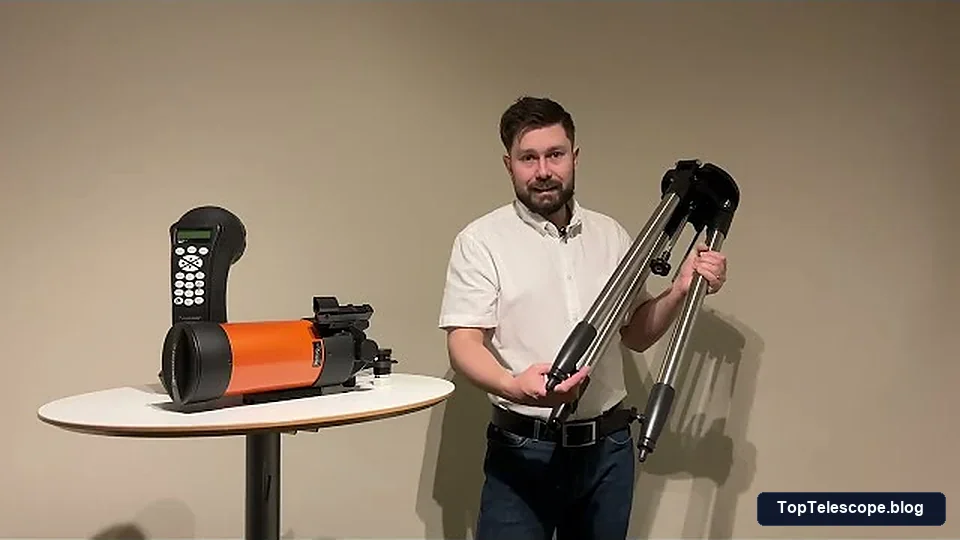
Star diagonal integration and standard visual backs accept 1.25-inch accessories easily. Exploring our CPC 800 vs NexStar 8SE guide reveals how different optical tube assemblies manage focal lengths and overall optical throughput.
The Maksutov-Cassegrain optical design features a 102mm aperture and a 1325mm focal length, delivering an f/13 focal ratio that naturally supports high-magnification planetary observing sessions under steady atmospheric seeing conditions.
Aluminum casting materials house the primary mirror cell and corrector lens, ensuring structural rigidity while maintaining a modest optical tube weight of six pounds for seamless transport and mounting ergonomics.
- 102mm clear aperture maximizes planetary resolution
- 1325mm focal length provides high focal ratios
- Extended focal design keeps the optical tube short
- StarBright XLT optical coatings maximize total light transmission across the entire glass surface path.
- Internal primary mirror focusing minimizes image shift during fine adjustments.
Corrector Plate and Mirror Shift
The internal primary mirror focusing mechanism operates smoothly with minimal image shift. Users should secure focus locks carefully during high-magnification planetary sketching sessions.
A heavy-duty meniscus corrector lens minimizes spherical aberration across the visual field. This glass element requires careful cleaning using standard optical micro-fiber cloths.
- Smooth internal focusing knob mechanics
- Minimal focal shift during adjustment
Aperture Limitations and Focal Length Physics
Operating at an f/13 focal ratio restricts wide-field nebulas, but the narrow cone angle produces exceptional lunar contrast by diffusing stray light across the long focal path within the sealed aluminum tube.
- Internal baffles suppress internal reflections effectively.
- Corrector plate thickness maintains thermal stability.
Computerized GoTo Mount Mechanics
The single fork arm houses internal servomotors geared for precise celestial tracking. Drive gears operate with acceptable backlash once internal gear mesh parameters are properly adjusted.
The NexStar+ hand control connects via auxiliary ports for firmware updates. Reviewing our NexStar 6SE vs 8SE breakdown reveals valuable insights into aperture selection and overall system payload capacities.
The single-fork arm mechanism integrates DC servo motors equipped with optical encoders on both axes, tracking celestial objects smoothly while compensating for mechanical backlash during directional slew rate transitions.
Internal brass worm gears mesh tightly with aluminum drive wheels, requiring periodic mechanical adjustments to eliminate excessive play and maintain pointing accuracy across extended observing marathons in variable ambient temperatures.
- Single fork arm altitude-azimuth base design
- High-torque DC servomotors on both axes
- Flash-upgradeable hand control firmware ports
- Hand controller firmware supports flash upgrades via standard USB connections.
- Auxiliary port enables direct connection for optional autoguiding accessories.
Tracking Accuracy and Slewing Speeds
Multiple slew speeds allow rapid repositioning across the night sky. Tracking maintains targets within the eyepiece field reliably during extended viewing sessions.
Motor noise remains moderate during high-speed slewing operations in quiet outdoor environments.
- Nine selectable slew speeds from 2x to 5deg/sec
- Sidereal, solar, and lunar tracking rates
Gear Train Tolerances and Backlash Management
Proper gear mesh tension prevents erratic tracking behavior; users must occasionally adjust the external hex screws to secure the worm gear alignment without introducing excessive friction into the drive motors.
- Nylon slip clutches protect internal gears from accidental mechanical jams.
- Slew speeds range from sidereal up to three degrees per second.
Video Review: Celestron NexStar 4SE: The Best Beginner Telescope?
Power Management and Thermal Performance
Internal battery compartments house eight AA cells beneath the base cover. Field operators should utilize external 12V power tanks to prevent voltage dropouts.
Maksutov systems require significant thermal acclimation time before achieving optimal high-magnification clarity. Storing the optical tube outdoors helps stabilize glass temperatures quickly.
Powering the internal computer requires eight AA batteries housed internally, though field longevity drops rapidly in cold weather, making an external 12V DC power tank mandatory for reliable winter observation sessions.
The sealed optical tube traps ambient heat during rapid temperature drops, requiring up to forty-five minutes of thermal equilibration time before high-magnification planetary viewing yields diffraction-limited airy disks.
- Standard 12V DC power input jack
- Optional external battery pack recommended
- Sealed optical tube requires thermal equilibrium
- Current draw averages 250mA during tracking and 750mA during dual-axis slewing.
- Aviation-style power jack prevents accidental cord disconnection in the dark.
Cold Weather Operational Constraints
Alkaline batteries drain rapidly when ambient temperatures drop below freezing point thresholds. Lithium or rechargeable NiMH cells provide superior cold-weather longevity.
Grease viscosity inside the mount gears increases during freezing winter nights.
- Alkaline battery capacity drops in cold weather
- External power tanks prevent sudden reboots
Mitigating Thermal Boundary Layers Inside the OTA
Trapped air currents degrade high-power resolution until thermal equilibrium is achieved; storing the telescope in an unheated garage significantly reduces internal cooling times before your scheduled astronomical imaging sessions begin.
- Dew shields prevent moisture accumulation on the front meniscus lens.
- Insulating wraps can stabilize internal tube temperatures during severe drops.
Alignment Precision and Field Setup
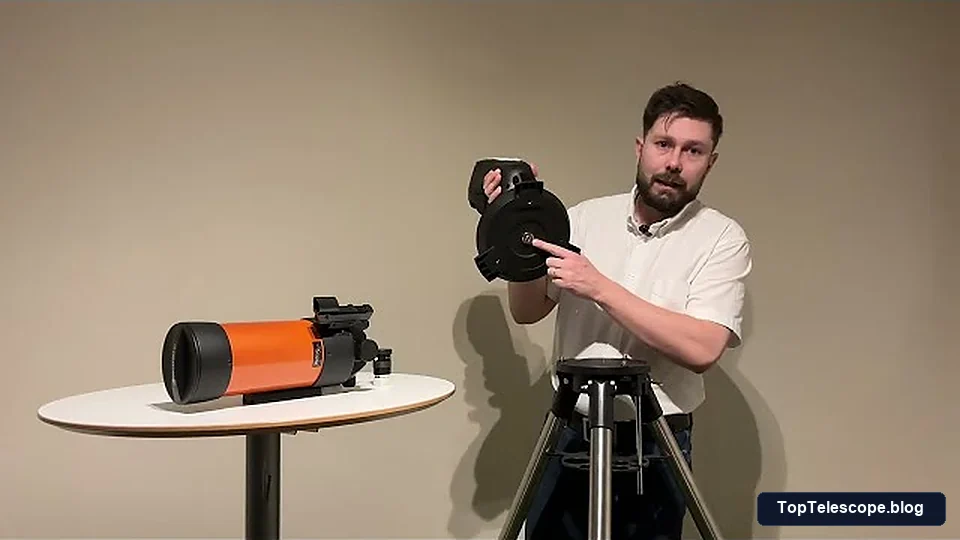
Celestron's proprietary SkyAlign technology simplifies initial setup without requiring star name memorization. Checking our NexStar 8SE vs Evolution 8 comparison helps users select the best mounting platform for field sessions.
Solar system alignment modes allow daytime viewing of bright planets and the Moon safely. Leveling the tripod accurately ensures improved GoTo positioning precision.
Utilizing the SkyAlign routine requires centering any three bright celestial objects sequentially, allowing the onboard computer to solve the internal geometry matrix and establish precise pointing models without compass readings.
Leveling the steel tripod before attaching the optical tube is critical; adjusting the extensible leg clamps ensures the base azimuth circle remains parallel to the local horizon during alignment procedures.
- SkyAlign requires three bright reference points
- Solar system and two-star alignment options
- Built-in bubble level on mount base
- Solar System Align allows daytime planet observation using bright targets.
- Built-in bubble level assists with rapid rough leveling on uneven terrain.
Tripod Stability and Field Leveling
The steel tripod provides rigid support for the optical tube assembly. Adjustable legs accommodate uneven terrain during remote camping observation trips.
Spreader bars lock the tripod legs securely to minimize unwanted dampening vibrations.
- Sturdy steel tubular tripod legs
- Accessory tray locks legs in place
Troubleshooting Cone Error and Pointing Models
Persistent pointing offsets often indicate mechanical misalignment between the optical axis and the azimuth axis, requiring systematic calibration runs to minimize cone error and restore GoTo positioning accuracy.
- Two-star alignment mode verifies calibration using known reference stars.
- Calibrate timezone and GPS coordinates accurately to prevent offset errors.
Astrophotography and Equatorial Wedge Usage
An integrated equatorial wedge lets users tilt the fork base for polar alignment. This feature helps reduce field rotation during entry-level long-exposure astrophotography.
Connecting a DSLR camera requires a standard T-adapter and T-ring combination. Short exposures of the Moon and bright planets yield surprisingly crisp digital images.
Long-exposure astrophotography requires mounting the fork arm onto an optional equatorial wedge to eliminate field rotation caused by the alt-azimuth base tracking motion during extended imaging runs.
Given the slow f/13 focal ratio, planetary imaging using a dedicated CMOS camera yields superior results compared to deep-sky photography, where tracking errors and long exposures strain the payload capacity.
- Built-in latitude wedge for polar alignment
- T-thread compatibility for camera attachment
- Suitable for lunar and planetary imaging
- Barlow lenses increase effective focal length for high-resolution lunar capture.
- T-adapter and T-ring secure DSLR cameras directly to the visual back.
Imaging Limitations and Load Limits
The fork mount payload capacity limits heavy professional camera equipment attachments. Long-exposure deep-sky imaging requires autoguiding accessories for optimal tracking.
Balancing the tube payload carefully prevents excessive strain on the drive motors.
- Moderate payload capacity for accessories
- Equatorial wedge aids polar tracking accuracy
Overcoming Alt-Azimuth Field Rotation Limits
Alt-azimuth mounts rotate the field of view over time, capping practical exposure times at roughly thirty seconds before trailing occurs, making the equatorial wedge conversion essential for faint deep-sky objects.
- Stacking software corrects minor rotational frame offsets during processing.
- Off-axis guiders are unnecessary given the modest focal length requirements.
Maintenance, Ergonomics, and Field Durability
Routine maintenance involves keeping optical surfaces clean and inspecting mechanical fasteners periodically. The orange metal tube withstands normal field transport bumps admirably.
Ergonomic carrying handles built into the fork base facilitate safe transport. Users should store the telescope inside padded protective cases between observing sessions.
Routine maintenance involves inspecting the corrector plate for dust accumulation, using compressed air sparingly, and cleaning optical surfaces exclusively with approved photographic solutions to preserve the delicate multi-coatings.
Ergonomic carrying handles molded into the fork arm base facilitate secure transport, while the compact steel tripod folds compactly into a standard gear bag for convenient field deployment in remote dark-sky locations.
- Durable metal optical tube construction
- Ergonomic chassis carrying handles
- Regular optical coating dust protection
- Store the optical tube with dust caps attached to prevent internal contamination.
- Check tripod leg fasteners periodically to maintain structural stability under loads.
Storage and Long-Term Care
Desiccant packs inside storage cases prevent moisture buildup on glass elements. Protecting corrector plates from dew accumulation prolongs optical coating integrity.
Lubrication checks on mechanical gears ensure smooth multi-year operation.
- Use protective caps on all optical surfaces
- Store in dry environments to prevent dew
Preventative Care for Electronic and Mechanical Assemblies
Protect external ports from moisture intrusion by using rubber covers, and store AA battery holders separately to prevent corrosive acid leaks from destroying internal battery compartment contacts over long periods.
- Lubricate exposed metal threads lightly with silicone grease annually.
- Keep hand controllers in protective silicone cases during freezing nights.
Definitive Buyer Verdict and Recommendations
Consulting our NexStar 4SE vs 5SE guide helps clarify optical upgrades. This portable GoTo system delivers exceptional clarity and tracking for amateur astronomers seeking reliable automated stargazing performance.
While demanding careful power management, this versatile Maksutov telescope delivers rewarding planetary views. It bridges the gap between manual beginner scopes and advanced setups.
This optical system excels as a portable lunar and planetary instrument, offering sharp views and automated tracking that satisfy intermediate observers seeking optical precision within a highly compact transportable chassis footprint.
Buyers must balance the slow focal ratio and alt-azimuth tracking limits against the benefits of easy setup and sharp optics, making it an ideal choice for urban astronomers battling light pollution.
- Balanced blend of portability and optics
- Comprehensive GoTo target database
- Ideal for lunar and planetary study
- Recommended for balcony observers and traveling astronomy enthusiasts alike.
- Pair with high-transmission eyepieces to maximize visual performance capabilities.
Ideal User Profiles and Alternative Equipment Scenarios
Observers prioritizing deep-sky wide-field vistas should consider faster Newtonian reflectors, whereas those desiring effortless go-to tracking of planets and double stars will find this Maksutov configuration exceptionally well suited.
- Invest in quality eyepieces to complement the high focal ratio optics.
- Verify power accessory requirements before planning remote dark-sky expeditions.
Frequently Asked Questions
What power source does the telescope require?
It operates on eight AA batteries or an optional 12-volt AC adapter. Using an external power tank is highly recommended for cold weather.
Can I use this telescope for deep-sky astrophotography?
It features a built-in wedge for entry-level polar alignment and imaging. However, its payload limit suits bright planets and the Moon best.
How does SkyAlign work during setup?
You center any three bright objects in the eyepiece without knowing their names. The computer calculates your exact geographic position automatically.
What size eyepieces are compatible with the optical tube?
The visual back accepts standard 1.25-inch eyepieces and accessories. A standard 25mm eyepiece is included right out of the box.
How long is the thermal acclimation period?
Maksutov systems typically require thirty to forty-five minutes to adjust outdoors. Storing the tube in a cool garage beforehand speeds up thermal equilibrium.