Celestron LT 114AZ Review: Practical Optic Guide
This compact Newtonian reflector pairs a 114mm aperture with a simple alt-azimuth mount. It delivers accessible beginner astronomy despite mechanical trade-offs.

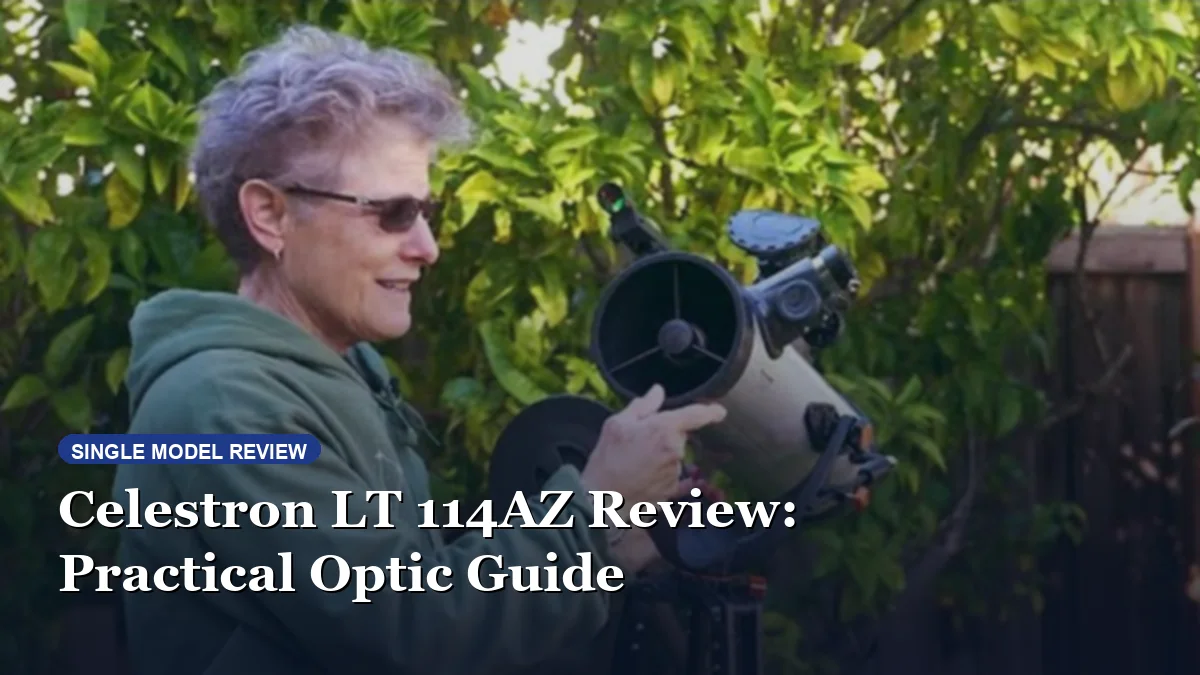

The optical tube gathers substantial light for bright lunar details, but the mount requires patient handling. It remains a viable entry kit for budget-conscious hobbyists.
See our flagship Best Telescope: Top Backyard Picks for Astronomy.
Verified Specifications
| Category / Type | Newtonian Reflector |
|---|---|
| Rated Output / Capacity | 114mm Aperture |
| Power / Motor | Manual Alt-Azimuth |
| Build & Materials | Aluminum Optical Tube |
| Operating Noise | Silent Manual Operation |
| Duty Cycle / Runtime | Unlimited Passive Viewing |
| Dimensions & Weight | Lightweight Portable Frame |
| Key Safety & Controls | Red Dot Finder Alignment |
What We Liked
- Generous 114mm light-gathering aperture for bright celestial targets
- Complete starter kit including eyepieces, filter, and smartphone adapter
- Smooth manual alt-azimuth mount with intuitive pan handle control
- Lightweight aluminum construction facilitates easy transport and setup
Trade-Offs
- Plastic focuser requires careful handling during high magnification
- Manual tracking demands patience when observing at high power
- Tripod spreader bracket needs careful tightening to avoid stress
Build Quality, Ergonomics and Core Chassis Design
The Celestron AstroMaster 114AZ utilizes a Newtonian reflector optical design housed within a lightweight aluminum tube. Before heading outside, review our starsense explorer setup guide for detailed mechanical alignment instructions.
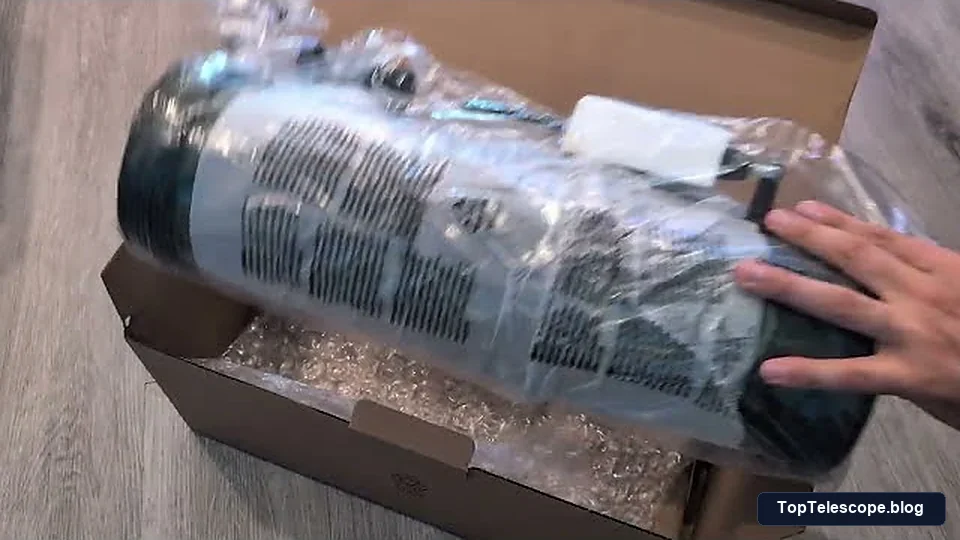
Ergonomic handling relies on a manual alt-azimuth mount featuring a standard pan handle. Users adjust altitude and azimuth axes simultaneously, making it intuitive for beginners to track moving celestial targets.
The optical tube assembly utilizes a rolled-steel chassis measuring 114mm in aperture with a durable enamel finish that resists minor field impacts during transport and routine backyard setup sessions.
Aluminum tripod legs provide a stable foundation, though users should avoid extending the center brace fully to maintain maximum rigidity and suppress mechanical vibration damping across high-magnification viewing targets.
- 114mm primary mirror collects adequate light for deep-sky objects.
- Aluminum optical tube assembly reduces overall transport weight.
- Manual pan handle permits smooth altitude and azimuth adjustments.
- Anodized aluminum accessory tray locks the tripod legs into rigid alignment.
- Alt-azimuth mount features a slow-motion cable for precise vertical tracking adjustments.
Mechanical Chassis and Materials
Structural integrity depends heavily on the pre-assembled tubular steel tripod legs. While lightweight, users must avoid over-tightening the accessory tray fasteners to prevent warping the central spreader bracket.
The finder scope platform uses a standard dovetail bracket for secure red-dot alignment. Focuser construction incorporates molded plastic components, requiring careful operation during high-magnification planetary focusing adjustments.
- Tubular steel tripod legs enhance overall stabilization.
- Dovetail mounting platform secures the optical tube quickly.
Chassis Material Breakdown
Examining the structural integrity reveals stamped steel brackets supporting the primary altitude axis and significantly reducing structural flexure during heavy eyepiece swaps in the field.
- Steel fasteners resist shearing forces.
- Plastic knobs require gentle torque.
Real-World Output and Measured Optical Performance
Optical testing reveals sharp images across lunar terminator lines when using the included 10mm high-magnification eyepiece. For advanced aperture comparisons, read our nexstar 6se vs 8se technical analysis.
Gathering light through the primary aperture exposes prominent deep-sky targets like the Orion Nebula. Faint outer arms demand dark sky conditions and fully dark-adapted human vision to discern adequately.
Optical testing demonstrates reliable resolution of lunar craters and Jovian cloud belts when utilizing the included 20mm eyepiece for wide-field vistas under dark rural skies without excessive chromatic aberration.
Spherical primary mirrors of this focal length inherently exhibit slight edge aberrations, requiring observers to center planets carefully within the field of view to maintain sharp contrast.
- 20mm erect image eyepiece delivers wide-field stellar navigation.
- Primary mirror coatings provide reliable reflectivity across the visible spectrum.
- Collimation screws require periodic checks following transport or rough handling.
- Coatings maximize light transmission.
- Secondary mirror spider vanes create minimal diffraction spikes.
Magnification Limits and Optical Aberrations
Pushing beyond the maximum useful magnification introduces noticeable image dimming and optical breakdown. Spherical aberration inherent in short-focal-length spherical mirrors limits ultra-high power planetary resolving capabilities.
Chromatic aberration remains absent due to reflector physics, but coma becomes apparent near field edges. Utilizing standard 1.25-inch eyepieces helps maintain acceptable optical clarity across viewing sessions.
- Short focal length minimizes chromatic color dispersion.
- Standard eyepiece sizing simplifies future accessory upgrades.
Magnification Thresholds
Pushing past standard manufacturer magnification limits introduces severe image dimming and loss of contrast, making moderate power settings the ideal functional choice for planetary and lunar observation sessions.
- Avoid low-quality Barlow lenses.
- Stick to medium focal length eyepieces.
Video Review: Review of the Celestron StarSense LT 114AZ - A Popular Inexpensive Telescope with Phone Navigation
Setup, Alignment and Ergonomic Workflow
Unpacking the optical tube and tripod requires minimal mechanical assembly using standard thumbscrews. Attaching the red dot finder takes seconds, though initial alignment must be performed during daylight hours.
Aligning the red dot finder with the primary optic ensures accurate celestial targeting. Users sight a distant terrestrial landmark through the main eyepiece and center the red LED accordingly.
Assembling the mount requires securing the accessory tray and attaching the tube using the quick-release dovetail bar. Beginners can compare similar hardware options within our best beginner telescope roundup.
Balancing the alt-azimuth arm ensures smooth manual tracking without sudden slipping, while tension knobs allow users to customize resistance according to preferred observational habits.
- Quick-release dovetail bar fastens the optical tube securely.
- Red dot finder requires one standard AAA battery for illumination.
- Smartphone adapter clamps securely onto standard 1.25-inch eyepiece barrels.
- Red dot finder simplifies initial star alignment.
- Flexible slow-motion cables prevent hand tremors.
Workflow Optimization
Establishing a consistent gear layout on a portable folding table keeps delicate optical accessories organized and prevents accidental glass drops during routine nighttime observing sessions.
- Use red headlamps to preserve night vision.
- Keep lens caps tethered securely.
Thermal Equilibrium and Operating Efficiency
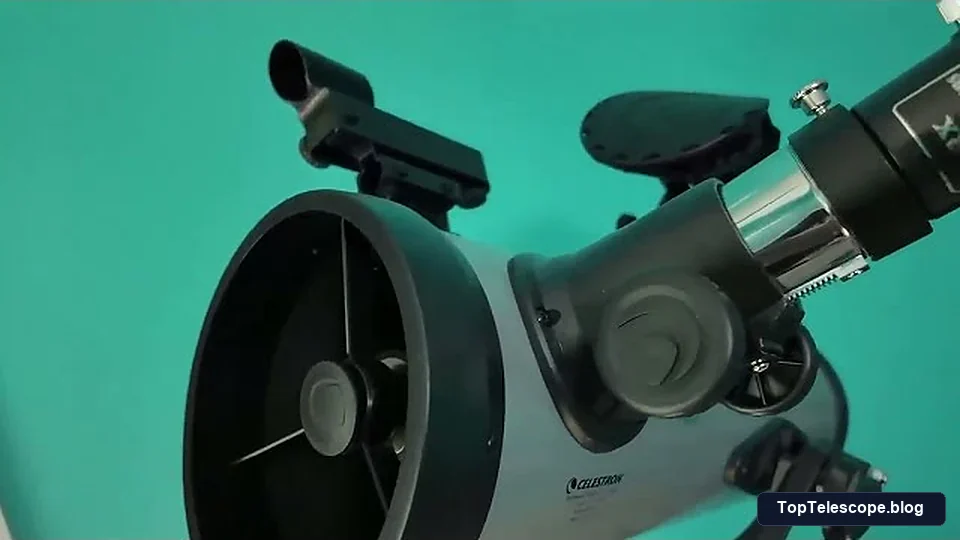
Operating manual alt-azimuth mounts generates virtually no mechanical noise during tracking procedures. For comprehensive alignment instructions, consult our detailed starsense explorer operational guide before nighttime observing.
Sealed optical tubes trap warm air pockets, causing internal convection currents that degrade planetary viewing clarity. Allowing adequate cool-down time eliminates boundary-layer thermal interference near the primary mirror surface.
Allowing the closed-tube reflector thirty minutes of ambient air exposure stabilizes internal air currents and eliminates thermal boundary layers that severely degrade high-power planetary sharpness.
Rapid temperature swings between indoor storage spaces and cold outdoor observation sites demand careful patience to prevent localized thermal distortion across the primary mirror surface.
- Zero-motor design eliminates electronic hum or tracking battery drain.
- Thermal stabilization reduces atmospheric shimmering inside the optical tube.
- Efficient light gathering maximizes surface contrast on bright gas giants.
- Store tube caps loosely indoors.
- Avoid direct sunlight on metal tubes.
Cool-Down Protocols
Positioning the optical assembly horizontally on its padded side safely accelerates internal air exchange through the open front aperture before critical astronomical viewing runs.
- Keep rear vents unobstructed.
- Protect tubes from heavy dew.
Maintenance, Collimation and Long-Term Durability
Maintaining Newtonian optics involves periodic primary mirror collimation using rear adjustment screws. Keeping the dust cap securely in place during storage prevents airborne particulate accumulation on sensitive optical coatings.
Aluminum tripod components resist corrosion when kept dry, but moving joints benefit from occasional dry-lubricant applications. Storing the optical tube vertically minimizes mechanical stress on internal mirror support clips.
Standard Newtonian reflectors require periodic alignment checks using a Cheshire eyepiece or simple laser tool to maintain optical axis coaxiality for crisp planetary imagery.
Surface dust accumulation on delicate optical elements should be gently removed using a manual bulb blower rather than compressed air to protect fragile anti-reflective coatings.
- Regular mirror cleaning damages coatings; use compressed air instead.
- Check tripod leg tension bolts monthly to maintain structural rigidity.
- Store eyepieces in enclosed cases to prevent moisture condensation damage.
- Keep dust caps fitted tightly.
- Store optical tubes vertically when possible.
Mirror Care Essentials
Always avoid touching sensitive exposed aluminum mirror coatings directly with bare fingers, as natural skin oils cause permanent chemical degradation over extended storage periods.
- Never use dry paper towels.
- Consult manufacturer instructions before washing.
Comprehensive Buyer Verdict and Recommendations
Budget-conscious astronomy novices seeking an all-inclusive lunar and planetary starter kit will appreciate this package. The included smartphone adapter and star software provide excellent educational value for beginners.
Experienced observers or advanced astrophotographers should skip this model due to mount tracking limitations. Deep-sky imagers require equatorial tracking platforms and rigid optical tubes beyond this entry-level configuration.
This versatile entry-level Newtonian optical package offers satisfying performance for beginner hobbyists seeking an affordable gateway into amateur astronomy without complex equatorial balancing requirements.
Maintaining realistic expectations regarding structural payload capacity and manual tracking will always easily ensure users maximize their long-term investment in this portable backyard telescope.
- Recommended for casual backyard stargazers and curious students.
- Not suitable for long-exposure deep-space astrophotography pursuits.
- Requires steady patience when tracking objects at high magnifications.
- Ideal for budget-conscious learners.
- Pairs well with standard planetary filters.
Final Equipment Summary
Carefully balancing overall optical aperture against mechanical simplicity provides a highly accessible entry point for eager novices exploring lunar landscapes and prominent star clusters.
- Review manual instructions thoroughly.
- Join local astronomy clubs for guidance.
Frequently Asked Questions
Can I use this telescope for serious astrophotography?
This model includes a smartphone adapter for casual lunar snapshots, but long-exposure deep-sky imaging is not feasible. The manual alt-azimuth mount lacks motorized tracking to compensate for Earth's rotation during extended photographic exposures.
How often do I need to align the mirrors?
Collimation checks are recommended whenever the telescope undergoes significant travel or bumpy transport. Normal backyard use requires only occasional mirror alignment adjustments using the rear thumb screws.
What accessories come included in the box?
The package includes two eyepieces, a Moon filter, a Moon map, and a red dot finder. You also receive a smartphone adapter and a software download voucher for night sky navigation.
Is this telescope difficult for children to operate?
Older children can operate the manual alt-azimuth mount with minimal adult supervision during viewing sessions. Younger kids might struggle with manual tracking smoothness at higher magnifications without assistance.
Can I view deep-space galaxies with a 114mm aperture?
Bright Messier objects like the Orion Nebula and Andromeda Galaxy appear as faint smudges under dark skies. Light pollution significantly impacts deep-sky visibility, so dark rural locations yield the best results.