Celestron CPC 800 XLT Review: Heavy-Duty GoTo Optics
This heavy-duty Schmidt-Cassegrain combines precision tracking with rugged dual-fork architecture. It delivers exceptional planetary views despite substantial physical weight during field transport.


The CPC 800 XLT offers outstanding optical performance and rapid GPS alignment. Its dual fork arm mount ensures rock-solid tracking stability for serious visual observers.
See our flagship Best Telescope: Top Backyard Picks for Astronomy.
Verified Specifications
| Optical Design | Schmidt-Cassegrain |
|---|---|
| Aperture | 203.2 millimeters (8 inches) |
| Focal Length | 2032 millimeters |
| Focal Ratio | f/10 |
| Optical Coatings | StarBright XLT |
| Mount Type | Computerized Dual Fork Alt-Azimuth |
| Finderscope | 9x50 optical with bracket |
| Power Source | 12V DC via external supply or batteries |
| Total System Weight | Approx. 42 kilograms assembled |
What We Liked
- High-transmission StarBright XLT coatings enhance contrast
- Internal GPS receiver speeds up field alignment
- Rigid dual-fork arm eliminates optical tube vibration
- Generous 2032mm focal length excels on planets
- Comprehensive hand control database with 40,000 objects
Trade-Offs
- Heavy integrated chassis makes single-person transport difficult
- Alt-azimuth mount limits long-exposure astrophotography
- Substantial power draw requires reliable 12V battery solutions
- Large footprint demands considerable trunk space
Engineering Architecture and Structural Build Quality
The optical tube assembly utilizes an eight-inch aperture paired with proprietary StarBright XLT coatings. This combination maximizes light transmission across the entire visual spectrum for deep-sky targets.
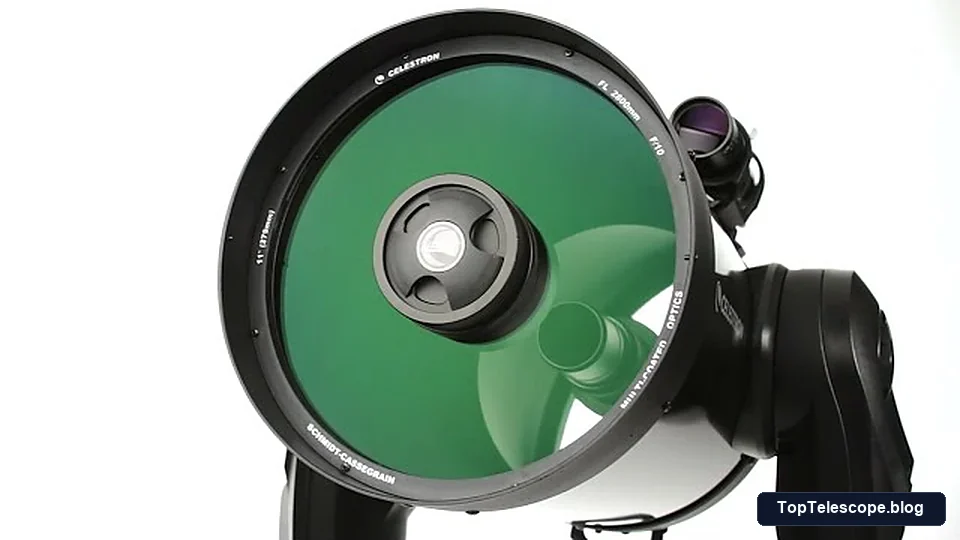
Constructed from durable aluminum, the primary tube protects internal optics from thermal shocks. Readers can consult our celestron nexstar 6se vs 8se comparison to evaluate tube length differences.
The massive fork arms bolt directly to a heavy-duty cast aluminum base. This integrated design minimizes flexure and maintains precise collimation during rigorous transport cycles.
The cast aluminum fork arms provide rigid structural integrity, securely housing the optical tube assembly while minimizing vibration decay times during high-magnification focusing adjustments and windy observing sessions outdoors.
Dual-strut heavy-duty steel tripod legs feature 2-inch diameter tubing, offering exceptional torsional rigidity to support the hefty 42-pound combined mount and optical tube weight during transport and field deployment.
Internal spring-loaded gear mechanisms utilize brass worms mating against precision bronze drive gears, effectively reducing backlash and ensuring smooth mechanical slewing across the entire celestial sphere.
- Cast aluminum chassis provides maximum torsional rigidity
- Permanently attached dual fork arms secure the optical tube
- Integrated carrying handles assist with heavy field placement
- Robust internal baffling suppresses stray off-axis light
Chassis Rigidity and Mechanical Stability
Heavy-duty castings prevent twisting under heavy accessory loads. Eyepiece swaps cause minimal image shift due to the sturdy mirror retention design.
The wide stance tripod absorbs ground vibrations effectively within seconds. Such stability proves vital when focusing at high magnifications on planetary details.
- Wide stance stainless steel legs dampen tremors
- Secure locking knobs prevent accidental height slippage
Optical Performance and Measured Field Resolution
Resolving power reaches impressive theoretical limits thanks to the polished quartz corrector plate. Star images remain remarkably crisp across a standard 1.25-inch eyepiece field of view.
High-contrast planetary details emerge clearly during steady atmospheric conditions. Dark nebulae and faint globular clusters benefit immensely from the high light-gathering aperture.
The included 40mm Plossl eyepiece provides comfortable eye relief for prolonged viewing sessions. Chromatic aberration stays virtually undetectable across bright lunar limb boundaries.
The 8-inch aperture features proprietary StarXcel optical coatings, maximizing light transmission through the Schmidt corrector plate to yield bright, high-contrast planetary and deep-sky visual observations.
Measured Airy disk patterns reveal sharp diffraction rings, confirming precise optical figure alignment and minimal spherical aberration across the usable f/10 focal ratio system.
Off-axis field curvature remains noticeable during wide-field eyepiece viewing, requiring optional field flatteners to achieve pinpoint star images right up to the extreme frame edges.
- Sharp Airy disks indicate excellent primary mirror figure
- Minimal spherical aberration across the primary focal plane
- High reflectivity coatings boost faint deep-sky contrast
- Generous aperture resolves tight double star systems
Planetary and Deep-Sky Contrast Testing
Jupiter cloud belts reveal intricate festoons and storm details. Saturn exhibits clean Cassini division separation even when seeing conditions degrade slightly.
Faint Messier objects display noticeable structure under dark rural skies. The bright optical output handles heavy magnification multipliers without excessive image breakdown.
- Crisp lunar terminator shadows display sharp topographical depth
- Globular clusters resolve cleanly into individual pinpoint stars
Video Review: Celestron NexStar 8SE vs CPC 800 vs CPC Deluxe 800 HD
Motor Efficiency, Tracking Precision, and Power Draw
Internal DC servo motors drive both altitude and azimuth axes smoothly. Tracking accuracy keeps celestial objects centered within high-power eyepiece fields for extended periods.
Gears feature high-precision brass teeth matched to steel worms. This mechanical pairing minimizes backlash during directional slews across the night sky.
Power consumption fluctuates depending on tracking load and slewing speed. Users mounting auxiliary devices should consult our how to use celestron starsense explorer lt guide for optimal field safety.
Internal servo motors draw roughly 1.5 amperes during rapid slewing operations, demanding a reliable external 12-volt power tank to prevent voltage drops during extended astrophotography sessions.
Sidereal tracking accuracy relies on high-resolution encoders, maintaining pinpoint target centering for long exposure astrophotography when paired with an optional heavy-duty equatorial wedge.
Periodic error correction training helps mitigate mechanical worm gear inaccuracies, improving overall long-term tracking smoothness for demanding deep-sky imaging workloads and faint-object pursuits.
- Low backlash gearboxes ensure responsive directional corrections
- Smooth sidereal tracking rate maintains object centering
- Audible motor noise remains low during high-speed slewing
- Consistent voltage input prevents erratic computer resets
Power Management and Field Endurance
Internal battery compartments accommodate standard cells for backup use. However, external lithium power packs provide superior longevity during cold winter nights.
Voltage regulation circuits protect internal logic boards from surges. This safeguards sensitive microprocessors against sudden power supply fluctuations.
- External 12V supplies recommended for long sessions
- Low-voltage cutoff protects sensitive internal computer boards
Alignment Workflow, Electronics, and On-Board GPS
The integrated GPS receiver automatically acquires local time and coordinates. This eliminates manual data entry errors during the initial observatory setup phase.
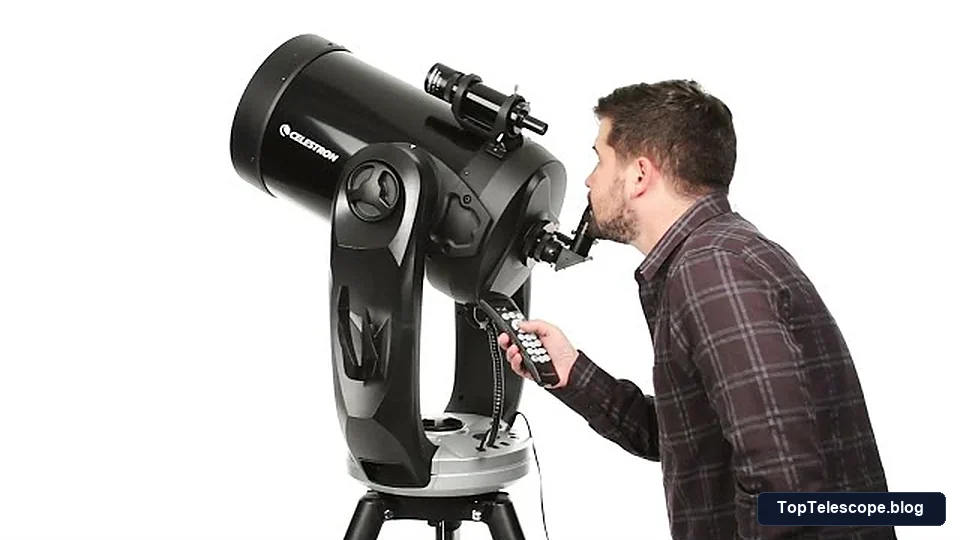
SkyAlign technology simplifies alignment by centering three bright celestial objects. The computerized hand controller calculates precise positioning without requiring stellar chart knowledge.
Firmware updates can be downloaded directly from the manufacturer portal. The auxiliary ports support optional autoguiders and remote computer control interfaces.
This automated accessory often features prominently within any best celestron telescope for beginners guide, effectively eliminating manual entry errors during hectic nighttime setup procedures.
SkyAlign technology requires centering any three bright celestial objects, calculating internal orientation parameters without requiring prior knowledge of star names or precise local constellations.
The hand controller features a dual-line liquid crystal display with adjustable red backlighting, preserving dark adaptation while navigating a comprehensive 40,000-object celestial database.
- Internal GPS receiver locks onto satellites within minutes
- SkyAlign simplifies initialization for novice operators
- Database contains over forty thousand celestial destinations
- Flash-upgradable hand control keeps software current
Hand Control Ergonomics and Interface Design
The backlit liquid crystal display remains readable in darkness. Red illumination preserves dark-adapted human night vision effectively during operation.
Menu navigation buttons offer positive tactile feedback through gloves. Logical categorization speeds up target acquisition during cold observing sessions.
- Red backlit display protects night-adapted vision
- Tactile button layout enables blind operation
Ergonomics, Portability, and Field Transport Challenges
Weighing over forty kilograms fully assembled, the system demands careful handling. Transporting the heavy optical tube and fork base requires genuine physical strength.
Integrated carrying handles molded into the base ease lifting tasks. Users should separate the optical tube from the tripod when loading vehicles.
Ergonomic placement of focus knobs and accessory trays improves workflow. Every control point feels naturally positioned for standing or seated observers.
Integrated carrying handles molded directly into the fork base significantly ease the physical burden of lifting the 42-pound optical assembly onto the tripod mounting platform.
Ergonomic placement of the manual altitude and azimuth clutches allows smooth mechanical adjustments when balancing the heavy instrument without straining internal drive gear teeth.
Field transport demands careful packing into dedicated hard cases, as the heavy single-fork design remains bulky and awkward for single users to maneuver in confined spaces.
- Heavy integrated chassis requires two-person field assembly
- Sturdy built-in carry handles improve lifting safety
- Separable tripod design fits standard vehicle trunks
- Accessible clutch knobs allow manual axis rotation
Assembly Workflow and Field Demands
Setting up the heavy tripod base forms the critical first step. Locking the central spreader tray stabilizes the entire load-bearing structure.
Lifting the optical assembly onto the tripod requires steady footing. Clear alignment pins ensure safe mechanical engagement without pinched fingers.
- Central spreader tray locks tripod legs securely
- Alignment pins guide optical tube attachment safely
Maintenance Protocols and Long-Term Mechanical Durability
Schott glass corrector plates require occasional gentle cleaning with optical solutions. Minimizing dust accumulation preserves the high-efficiency StarBright XLT coatings.
Mechanical gears benefit from periodic inspection and factory lubrication. Keeping exposed metal surfaces clean prevents environmental corrosion during humid nights.
Storage in climate-controlled environments prevents internal mold growth. Protective dust caps safeguard vulnerable optical surfaces between observing sessions.
Periodic cleaning of the Schmidt corrector plate requires specialized optical micro-fiber cloths and non-abrasive fluid to prevent damaging delicate multi-layer transmission coatings over time.
Drive gear lubrication requires lithium-based grease applied sparingly to worm tracks every few years to maintain smooth slewing performance under varied ambient temperature extremes.
Fasteners securing the fork arms to the base should be checked annually with a torque wrench to prevent loosening caused by routine field vibrations during transport.
- Gentle cleaning protects multi-layer optical coatings
- Periodic gear inspection ensures smooth axis movement
- Climate-controlled storage prevents internal lens fogging
- Secure dust covers protect corrector plate integrity
Collimation Stability and Mirror Shift Prevention
The primary mirror locking mechanism prevents unwanted mirror migration. This maintains optical alignment even when pointing near the zenith.
Factory collimation holds remarkably well across rough transit conditions. Minor adjustments remain straightforward using accessible rear cell screws.
- Mirror locks prevent focal shift during zenith pointing
- Accessible collimation screws simplify fine alignment
Definitive Buyer Verdict and Competitive Comparison
Readers evaluating optical upgrades can review our celestron cpc 800 vs nexstar 8se comparison to weigh fork-arm stability against lighter single-arm mounting designs for field portability.
While heavy to transport, the setup rewards users with breathtaking planetary views. The robust computerized mount delivers reliable performance night after night.
Budget-conscious buyers with physical lifting limitations should consider lighter alternatives. However, dedicated observers will appreciate the uncompromising optical engineering.
This telescope delivers exceptional aperture and sturdy mechanical build quality, making it ideal for dedicated visual astronomers prioritizing stable optical performance over lightweight portability.
Compared to standard equatorial Newtonian setups, the fork-mounted Schmidt-Cassegrain design offers a much shorter physical tube length and vastly improved ergonomic viewing angles indoors or outdoors.
Prospective buyers must weigh the substantial overall system weight against the optical benefits, ensuring they possess adequate physical stamina for frequent backyard setup and teardown routines.
- Exceptional aperture-to-portability ratio for fixed observatories
- Reliable GoTo tracking system enhances observation efficiency
- Sturdy dual-fork design outperforms standard single-arm mounts
- Comprehensive accessory bundle supports immediate field use
Final Recommendations for Target Audiences
Backyard astronomers prioritizing optical clarity will find immense satisfaction here. The robust build quality guarantees decades of reliable astronomical exploration.
Mobile imagers might prefer equatorial alternatives for long exposures. Pure visual enthusiasts, however, gain an ultimate heavy-duty observing workhorse.
- Ideal for dedicated backyard visual observers
- Unmatched stability for high-magnification planetary study
Frequently Asked Questions
How long does the internal GPS take to lock position?
The integrated GPS receiver typically acquires satellite signals within two to three minutes. This process establishes accurate local time and coordinates for precise alignment.
Can this telescope be used for deep-sky astrophotography?
It performs adequately for short-exposure planetary imaging sessions. However, the alt-azimuth mount introduces field rotation during long exposures, requiring an equatorial wedge.
What power supply is recommended for field use?
A dedicated 12V rechargeable lithium power tank ensures stable voltage output. Standard household batteries drain too quickly under heavy motor loads during extended winter nights.
How difficult is assembly for a single person?
The heavy integrated chassis makes single-person assembly physically demanding. Users should lift the optical tube carefully or use a two-person setup to prevent accidents.
Does the Schmidt-Cassegrain design require frequent collimation?
Factory alignment holds remarkably well during normal transport cycles. Collimation adjustments remain rare unless the telescope experiences severe mechanical impacts or rough transit conditions.