Celestron AstroMaster 130EQ MD Review
This Newtonian reflector pairs 130mm optics with an RA motor drive. However, stabilization demands patience during extended observation sessions.

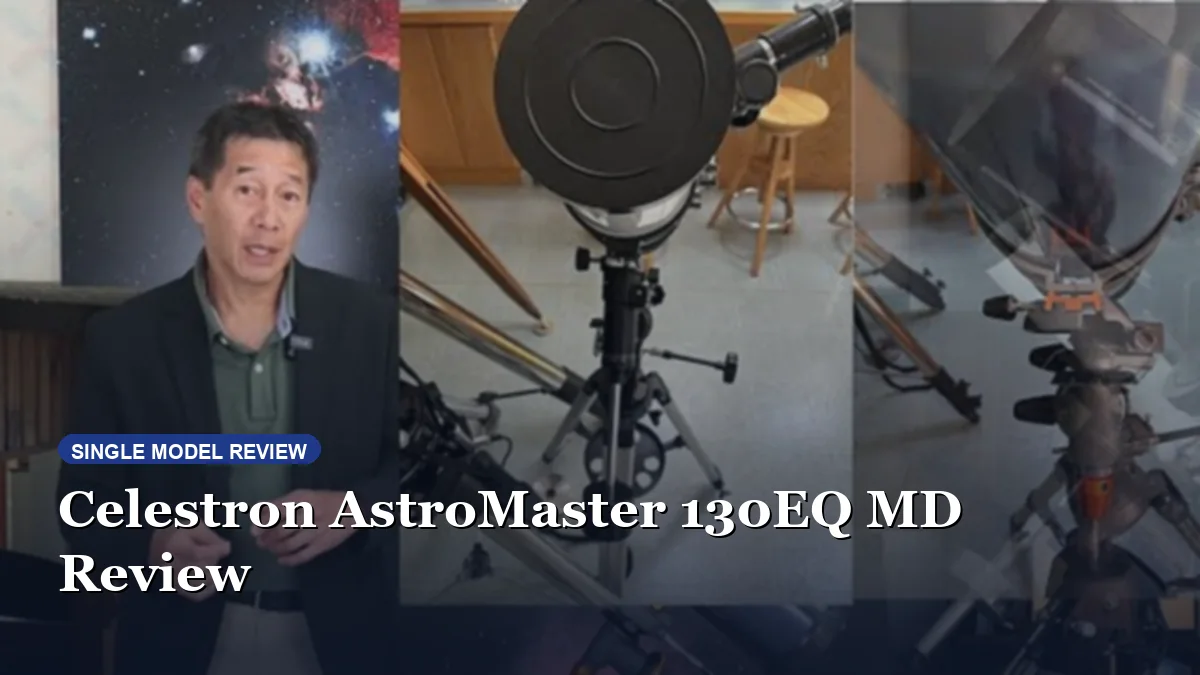

The AstroMaster 130EQ MD delivers solid beginner-level tracking and light grasp. Buyers must manage mechanical setup nuances carefully for stable astronomical viewing.
See our flagship Best Telescope: Top Backyard Picks for Astronomy.
Verified Specifications
| Category / Type | Newtonian Reflector |
|---|---|
| Rated Output / Capacity | 130mm Aperture |
| Power / Motor | Single-axis RA Motor Drive (9V) |
| Build & Materials | Steel optical tube, aluminum tripod |
| Operating Noise | Low mechanical hum |
| Duty Cycle / Runtime | Varies by battery capacity |
| Dimensions & Weight | 27 lbs total assembled weight |
| Key Safety & Controls | CG-3 mount with slow-motion cables |
What We Liked
- Decent 130mm aperture gathers substantial light for deep-sky objects.
- Single-axis RA motor drive automates right ascension tracking.
- Sturdy steel tube diameter provides rigid optical alignment.
- Includes two standard 1.25-inch eyepieces for immediate use.
Trade-Offs
- Equatorial mount setup requires a polar alignment learning curve.
- Pre-assembled tripod legs can exhibit minor flexure at full extension.
- Motor drive runs on a single 9V battery requiring spares.
Optical Design and Physical Construction
The optical tube assembly features a 130mm parabolic mirror housed in a black steel chassis. This aperture size captures sufficient photons to resolve lunar craters and bright nebulae clearly.
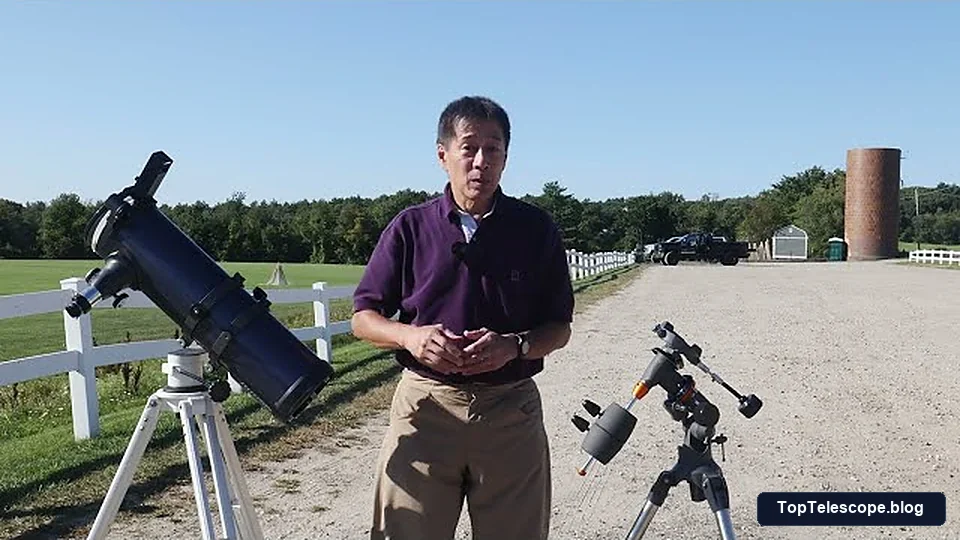
Mechanical construction relies on standard aluminum rings and a dovetail mounting bar. Users must handle the focal length of 650mm carefully to prevent accidental jarring of optical components.
The optical tube assembly features a 130mm aperture Newtonian reflector design paired with a 650mm focal length. This configuration yields a fast focal ratio of f/5, delivering wide-field views ideal for deep-sky objects.
Constructed from rolled aluminum, the optical tube maintains structural rigidity while weighing approximately 7.9 pounds. Internal baffling controls stray light reflections, improving overall image contrast during lunar observations and planetary imaging sessions.
- Primary mirror diameter measures 130mm across.
- Focal ratio sits at a fast f/5 configuration.
- Optical tube weighs approximately eight pounds total.
- Primary mirror utilizes a spherical surface requiring careful collimation.
- Rack and pinion focuser accepts standard 1.25-inch eyepieces securely.
Mirror Coatings and Collimation
Aluminum reflective coatings include a protective silicon dioxide overcoat. Periodic mirror collimation ensures pinpoint stars during high-magnification planetary viewing sessions.
Reviewing our best astrophotography telescope picks shows why rear cell adjustment screws make manual alignment straightforward. Always use a dedicated laser collimator for precise optical alignment.
- Silicon overcoat protects reflective mirror surfaces.
- Collimation screws require minor manual adjustments.
Optical Coatings and Light Transmission
Aluminum primary mirror coatings protected by silicon dioxide ensure lasting reflectivity over years of field use. Regular cleaning prevents dust accumulation on the exposed optical surface.
- Silicon dioxide overcoat safeguards aluminum against atmospheric tarnishing.
- Optical tube interior features flat black paint to suppress internal glare.
Equatorial Mount Mechanics and Tracking
The CG-3 equatorial mount utilizes heavy-duty aluminum legs to support the optical tube. Proper polar alignment remains essential for the right ascension motor drive to function effectively.
Setting circles help locate celestial coordinates using celestial charts. Users must balance the counterweight system thoroughly to avoid placing undue strain on internal gears.
The CG-3 equatorial mount incorporates setting circles and manual slow-motion cables. Proper polar alignment using the latitude scale is essential for tracking celestial objects accurately across the night sky.
Aluminum tripod legs provide a stable foundation, though extending them fully reduces overall rigidity. Securing the accessory tray locks the spreader bars firmly to dampen unwanted mechanical vibrations quickly.
- CG-3 mount includes slow-motion cables for manual adjustments.
- Counterweight weighs roughly 4.8 pounds for balance.
- Latitude scale accommodates local geographic positioning accurately.
- Counterweight shaft measures 20mm in diameter for secure balancing.
- Slow-motion cables offer smooth adjustments along both celestial axes.
Polar Axis Adjustment
Adjusting the latitude bolt alters the polar wedge angle to match your observing site. Tightening the locking knobs prevents slippage during extended astrophotography exposures.
- Latitude scale provides markings from zero to ninety degrees.
- Azimuth fine-adjustment knobs assist in precise polar alignment.
Video Review: Search filters
Real-World Visual Performance and Output
Exploring options in our best telescopes under 500 dollars guide proves how reflectors reveal faint deep-sky objects. Planetary details on Jupiter and Saturn appear sharp using the included 10mm eyepiece.
Chromatic aberration is absent due to the reflective design. However, coma distortion near the edge of the field of view becomes apparent at fast f/5 focal ratios.
Observing Jupiter reveals cloud belts and the four Galilean moons with crisp definition. High magnification eyepieces push the maximum useful magnification limit, where atmospheric seeing conditions dictate image sharpness.
Faint deep-sky targets like the Orion Nebula display mottled gas structures under dark skies. Collimation accuracy directly impacts stellar pinpoints, making routine optical alignment necessary for peak performance.
- Gathers significantly more light than standard 70mm refractors.
- Resolves lunar surface features down to small craterlets.
- Lunar craters show sharp shadow details along the terminator line.
- Open clusters resolve into individual stars across the expansive field.
High-Magnification Limitations
Spherical primary mirrors exhibit slight spherical aberration at fast focal ratios. Utilizing high-power lenses requires exceptional atmospheric steadiness to resolve fine planetary features without image breakdown.
- Barlow lenses multiply focal length but degrade overall image brightness.
- Seeing conditions dictate whether high power remains functional.
Power Delivery and Motor Efficiency
The single-axis RA motor runs on standard battery power for field portability. Managing battery voltage drops during cold winter nights prevents unexpected tracking failure mid-observation.
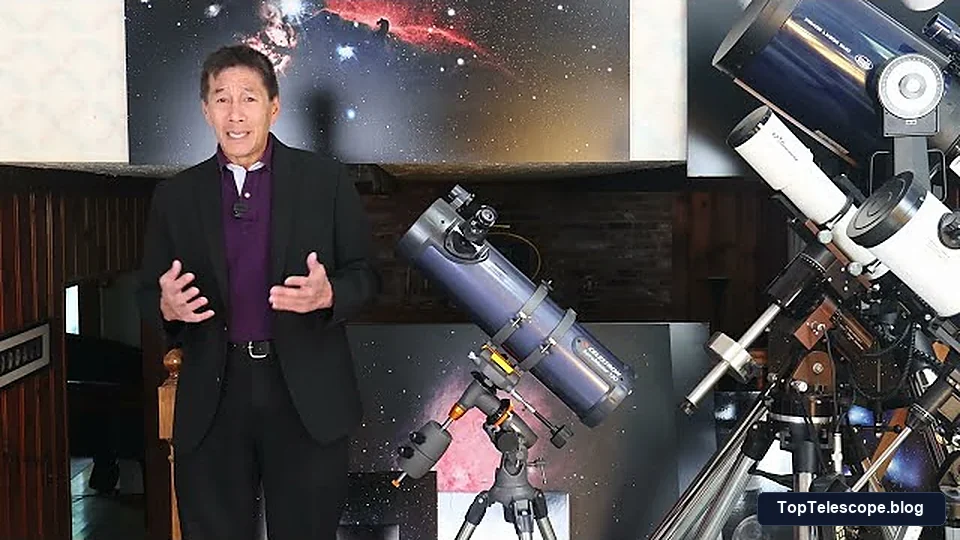
Motor speed can be adjusted slightly using the hand controller potentiometer. Consistent sidereal tracking speed keeps celestial targets centered during long exposures or extended visual viewing.
The single-axis motor drive operates on a standard 9-volt battery housed within a compact plastic enclosure. Cold weather significantly reduces battery lifespan, requiring spare power sources during winter observation sessions.
Tracking speed matches the sidereal rate to keep objects centered in the eyepiece. Adjusting the motor clutch allows manual overrides without disassembling the internal brass gear train mechanism.
- Powered by a single internal 9V battery cell.
- Includes manual speed adjustment dial for fine tuning.
- Operates quietly without excessive mechanical background noise.
- Current draw remains minimal during standard operation modes.
- Toggle switch enables quick shifting between northern and southern hemispheres.
Gear Train Maintenance
The internal worm gear requires occasional inspection to prevent mechanical backlash. Keeping the drive gears free from debris ensures smooth tracking consistency over extended imaging periods.
- Brass gears demand periodic light greasing for optimal longevity.
- Clutch tension screw regulates manual rotation resistance smoothly.
Assembly, Ergonomics and Alignment
Initial assembly requires basic tools to connect the accessory tray and tripod legs. The ergonomic control cables allow smooth adjustments while looking through the optical eyepiece.
Finding objects is aided by a simple red dot finder scope. Proper alignment of this finder during daylight hours saves valuable stargazing time once darkness falls completely.
Initial assembly requires basic hand tools to attach the accessory tray and mount head. Clear instructions guide users through balancing the optical tube using the heavy cast counterweight.
Ergonomic positioning of slow-motion cables prevents awkward arm stretches during tracking. Finding alignment stars is simplified by utilizing the included finderscope for initial target acquisition before high-power viewing.
- Tripod height adjusts to accommodate standing or seated observers.
- Red dot finder requires standard lithium coin or AAA batteries.
- Tripod spreader bracket locks securely with a threaded central rod.
- Finderscope alignment demands patience during daylight calibration procedures.
Balancing the Equatorial Mount
Consulting our best budget telescope models highlights why proper balance minimizes strain on internal motor drives. Always balance the optical tube along the declination axis.
- Release clutches slowly to test balance safety margins.
- Secure safety screws on the counterweight shaft completely.
Maintenance, Storage and Long-Term Durability
Dust caps must be kept in place when the telescope is stored indoors. Regular lens and mirror cleaning should be avoided unless particulate buildup significantly degrades contrast.
Mechanical gears require occasional inspection to ensure smooth tracking engagement. Storing components in dry environments prevents corrosion on steel hardware and maintains overall structural longevity.
Storing the optical tube in a temperature-controlled environment prevents internal condensation buildup. Protective dust caps safeguard both the primary mirror and focuser barrel from airborne particulate accumulation.
Metal surfaces resist corrosion when kept dry, but exposed hardware requires occasional lubrication. Inspecting tripod fasteners periodically prevents structural loosening caused by constant field transport and setup vibrations.
- Keep optical surfaces covered to prevent airborne dust accumulation.
- Inspect mount fasteners regularly for tightness and structural stability.
- Avoid touching glass surfaces to prevent natural skin oils from etching.
- Use canned air gently to remove loose dust particles from optics.
Primary Mirror Care
Cleaning the primary mirror should happen infrequently using specialized optical cleaning solutions. Submerging the mirror requires extreme care to avoid scratching the delicate reflective aluminum coating surface.
- Rinse mirrors with distilled water to prevent mineral spotting.
- Never use household detergents on delicate optical coatings.
Buyer Verdict and Alternative Recommendations
Evaluating our best beginner telescopes guide helps novices understand aperture choices. Beginners willing to learn equatorial mount operation will find immense value in this complete setup.
Users seeking simpler setup routines might prefer alt-azimuth alternatives. Nevertheless, astrophotography enthusiasts will appreciate the tracking motor inclusion for entry-level lunar and planetary imaging work.
This motorized telescope suits beginner astronomers seeking an introduction to equatorial tracking systems. Understanding its physical limitations helps manage expectations regarding deep-sky astrophotography capabilities and mount stability.
Alternative manual setups offer larger apertures for visual observers uninterested in motorized tracking. Beginners prioritizing portability might consider tabletop dobsonian designs for simpler setup procedures and rigid mount bases.
- Ideal for beginner astronomers expanding into deep-sky exploration.
- Provides essential motorized tracking without complex computer systems.
- Motorized tracking enhances casual planetary viewing convenience significantly.
- Equatorial setups demand a steeper learning curve than altazimuth mounts.
Suitability for Astrophotography
Basic lunar and planetary snapshots are achievable using smartphones mounted to eyepieces. Long-exposure deep-sky imaging remains challenging due to the inherent payload limits of the CG-3 mount.
- T-adapters permit DSLR camera attachment for afocal imaging.
- Tracking accuracy limits long exposure astrophotography successfully.
Frequently Asked Questions
How do you power the motor drive on this telescope?
The single-axis right ascension motor drive operates reliably using a standard internal nine-volt battery housed securely inside the compact plastic control box located near the mechanical polar axis.
Users should always carry a spare fresh battery during extended cold weather observing sessions to prevent sudden tracking interruptions when viewing deep-sky celestial objects outdoors.
Can this telescope be used for astrophotography right out of the box?
This instrument includes a motorized right ascension drive that facilitates basic lunar and bright planetary imaging through your smartphone or a specialized camera adapter device.
However, advanced deep-sky astrophotography requires extremely precise guiding accuracy and extended long exposures that completely exceed the native mechanical limits of this entry-level equatorial mount configuration.
Is collimation difficult to perform on the 130mm reflector?
Performing mirror alignment on a Newtonian reflector is a straightforward maintenance procedure once you learn the basic mechanical adjustment steps involved.
Using a specialized laser collimator allows you to quickly align both primary and secondary optical elements to ensure sharp stellar images during every single night session.
What objects can I see with the 130mm aperture?
The generous light-gathering surface area lets you clearly observe detailed lunar craters, the prominent cloud bands of Jupiter, and the majestic rings of Saturn.
Additionally, you can successfully explore brighter deep-sky marvels including the Orion Nebula, the Andromeda Galaxy, and several prominent open star clusters located overhead.
How heavy is the complete telescope assembly when set up?
The complete assembled telescope system weighs approximately twenty-seven pounds total when combining the optical tube assembly, equatorial mount, and sturdy aluminum tripod legs together.
This moderate overall weight makes it relatively portable for backyard stargazing or transporting to remote dark sky locations inside a standard vehicle.