Celestron Astromaster 130Az Review: Technical Evaluation
This Newtonian reflector pairs a generous 130mm optical aperture with a straightforward alt-azimuth mount. Beginners must balance light-gathering power against mount stability during high-magnification viewing sessions.

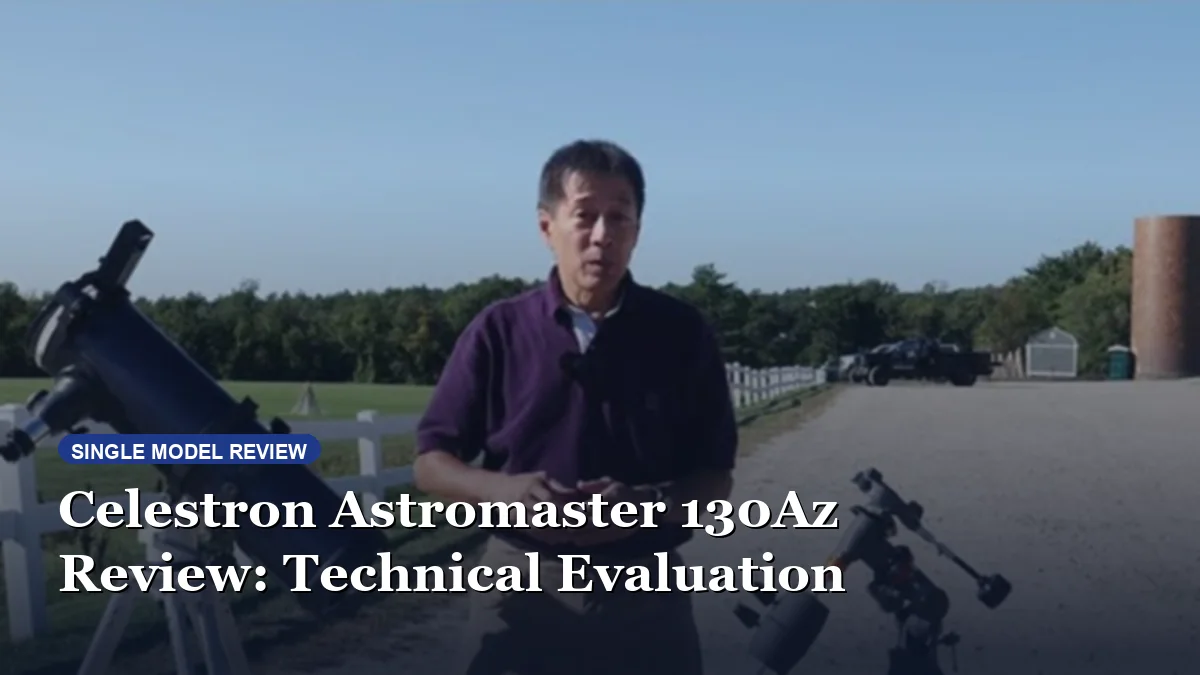

The Celestron Astromaster 130Az delivers remarkable light grasp for budget-conscious stargazers. While the tripod requires careful handling, its optics outperform smaller beginner lenses significantly.
See our flagship Best Telescope: Top Backyard Picks for Astronomy.
Verified Specifications
| Category / Type | Newtonian Reflector |
|---|---|
| Aperture Diameter | 130 mm (5.1 inches) |
| Focal Length | 650 mm (f/5) |
| Mount Type | Manual Alt-Azimuth |
| Optical Tube Material | Aluminum |
| Included Eyepieces | 20mm and 10mm (1.25-inch) |
| Finder Scope | StarPointer Red Dot |
| Total Assembled Weight | 24 lbs (10.88 kg) |
| Warranty | 2-Year US Warranty |
What We Liked
- Large 130mm aperture gathers substantial light for nebulae and galaxies.
- Fast f/5 focal ratio provides wide, rich-field astronomical vistas.
- Simple manual alt-azimuth mount requires minimal setup expertise.
- Includes standard 1.25-inch focuser for easy aftermarket eyepiece upgrades.
- Bundled red dot finder simplifies initial celestial alignment procedures.
Trade-Offs
- Lightweight aluminum tripod can introduce vibrations during focusing.
- Manual alt-azimuth tracking demands frequent manual position adjustments.
- Newtonian optics may require periodic collimation alignment checks.
Optical Architecture and Tube Design
The optical tube assembly utilizes a parabolic primary mirror measuring 130 millimeters in diameter. This generous aperture collects significantly more photons than standard entry-level refractor telescopes.
Constructed from rolled aluminum, the optical tube balances structural rigidity with manageable field portability. Internal baffling minimizes stray light reflections to enhance image contrast across dark skies.
Operating at a focal length of 650 millimeters, the system achieves a fast focal ratio of f/5. This optical configuration yields exceptionally wide fields of view for sweeping star clusters.
The 130mm aperture Newtonian reflector features a 650mm focal length operating at an f/5 focal ratio. This parabolic or spherical mirror design gathers adequate light for deep-sky targets while maintaining a portable optical tube assembly profile.
Internal baffling consists of a matte-black coated steel tube interior designed to suppress stray light reflections. A four-vane secondary mirror spider supports the 45mm diagonal mirror, balancing structural rigidity with minimal diffraction spike artifacts on bright stars.
The primary mirror cell utilizes a standard clip-retaining configuration mounted in a ventilated plastic backplate. Proper thermal acclimatization requires roughly thirty to forty-five minutes in open-air ambient conditions before achieving optimal high-magnification planetary resolution without thermal boundary layer distortions.
- 130mm aperture collects 30% more light than 114mm models.
- Aluminum tube construction maintains thermal equilibrium efficiently.
- Standard rack-and-pinion focuser accepts 1.25-inch accessories securely.
Mirror Coatings and Light Transmission
Celestron applies aluminum optical coatings enhanced with silicon dioxide overcoatings. When reviewing our StarSense Explorer setup guide, these protective layers safeguard reflective telescope surfaces against environmental oxidation.
High reflectivity coatings maximize photon throughput before light reaches the secondary mirror assembly. Users experience brighter stellar point sources during faint deep-sky observation sessions.
- Enhanced aluminum coatings maximize surface reflectivity.
- Protective overcoatings prevent environmental mirror tarnishing.
Mount Mechanics and Ergonomic Handling
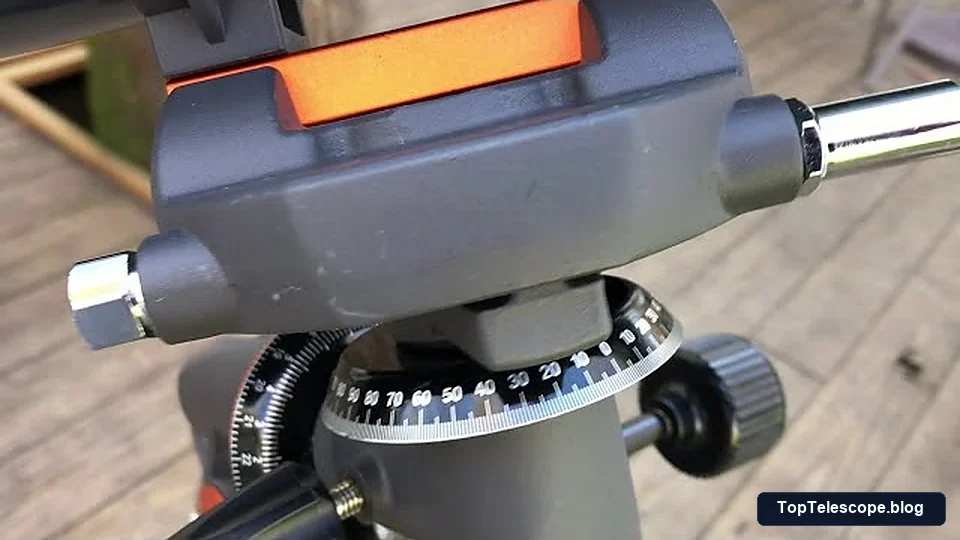
An altitude-azimuth mount anchors the optical tube assembly, operating on two perpendicular axes. Similar to platforms evaluated in our 6SE versus 8SE comparison, this intuitive design mimics standard photographic tripods.
A panning handle with a clumsy clutch lock facilitates manual tracking of celestial bodies. Operators must apply smooth, consistent pressure to compensate for Earth's rotational drift.
Ergonomic placement of the tension clutch allows quick adjustments during active viewing. However, achieving precise celestial centering requires practice to overcome initial mechanical stiction.
Supporting the optical tube is a manual altazimuth mount featuring a quick-release dovetail bar. The cast-aluminum fork arm allows smooth horizontal panning, but lacks slow-motion control cables for precise tracking adjustments at elevated magnifications.
Friction tension clutches on both altitude and azimuth axes govern movement resistance. Users must manually balance the tube within the clamp to prevent sudden tipping when pointing toward zenith positions during deep-sky viewing sessions.
The preassembled steel tripod legs provide a sturdier foundation than typical aluminum alternatives, though vibration damping times still average three to four seconds upon contact. An accessory tray securely locks the legs into rigid alignment.
- Dual-axis manual control handles elevation and azimuth smoothly.
- Integrated pan handle simplifies tracking moving celestial targets.
- Clutch mechanism secures the optical tube at desired angles.
Tripod Stability and Vibration Damping
The pre-assembled steel-legged tripod provides a rigid foundation for the optical assembly. Steel tubing reduces flexure compared to flimsy plastic alternatives found on budget competitor models.
Damping times after manual focusing inputs average approximately three seconds. Users can minimize image shake by installing vibration suppression pads under each tripod foot.
- Sturdy steel leg construction improves overall platform rigidity.
- Accessory tray braces the tripod legs to eliminate wobble.
Video Review: What Can You See Through a 130mm Telescope? (Real Views!) | Celestron Astromaster 130EQ
Field Performance and Optical Output
Observing lunar topography reveals crisp crater walls and deep ray systems through the included eyepieces. Following our StarSense Explorer LT manual, the 130mm primary mirror resolves intricate details across lunar maria effortlessly.
Planetary targets like Jupiter display prominent cloud belts and the four Galilean moons. Saturn reveals its distinct ring system clearly when viewing through higher magnification eyepieces.
Deep-sky performance benefits from the wide light funnel, exposing faint fuzzies like the Orion Nebula. Globular clusters resolve into individual stellar pinpoints under dark rural skies.
Under dark skies, the 130mm light grasp reveals faint Messier objects, including the Orion Nebula and Andromeda Galaxy, with distinct structural details. Field curvature is noticeable near the extreme edges when utilizing wide-angle eyepieces.
Planetary observations of Jupiter and Saturn display cloud belts and ring divisions cleanly at moderate power. However, chromatic aberration remains absent due to the reflective design, though spherical aberration limits absolute sharpness at extreme planetary magnifications.
Resolving double stars demands careful seeing conditions and precise collimation alignment. The Dawes limit threshold allows separation of tight binary systems down to roughly 0.9arcseconds when atmospheric turbulence remains minimal throughout your evening observing sessions.
- Resolves Jovian cloud belts and Galilean moons easily.
- Reveals lunar craters with sharp terminator contrast.
- Exposes bright Messier catalog deep-sky objects successfully.
Magnification Limits and Eyepiece Pairing
The package includes a 20mm eyepiece providing lower magnification and wider sky vistas. Swapping to the 10mm eyepiece doubles magnification for closer planetary inspection.
Theoretical maximum useful magnification reaches roughly 306 power under ideal seeing. Exceeding this optical threshold yields dim, blurred images due to atmospheric turbulence limits.
- 20mm eyepiece offers wide-field initial object acquisition.
- 10mm eyepiece delivers higher power for planetary details.
Accessory Ecosystem and Setup Efficiency
Initial assembly requires minimal hand tools and takes less than twenty minutes. As noted in our beginner telescope recommendations, the StarPointer red dot finder mounts easily via a dovetail bracket.
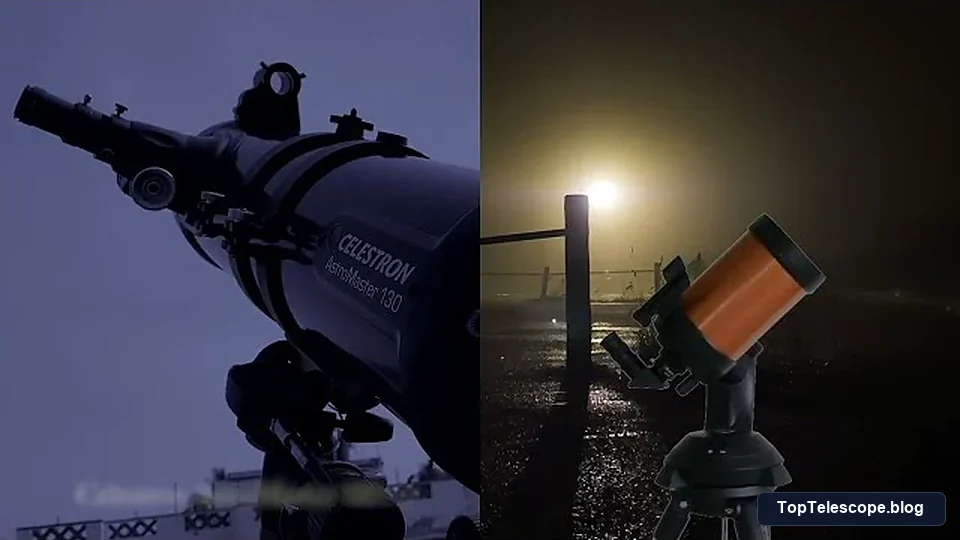
Battery-powered red dot illumination projects a reference point onto a clear viewing window. Users align this reticle with target stars for rapid, intuitive telescope pointing.
An included smartphone adapter allows amateur astrophotographers to capture lunar snapshots. This accessory clamps securely onto the eyepiece barrel for stable camera alignment.
The kit includes standard Kellner eyepieces, typically a 25mm and 9mm focal length, providing low and high magnification options out of the box. Glass element coatings improve light transmission but generate internal reflections against bright planetary targets.
A star diagonal is unnecessary for this Newtonian reflector configuration since the focuser sits conveniently at the upper side of the tube body. Eyepiece insertion utilizes a standard 1.25inch rack and pinion focuser mechanism.
Assembly speed remains high for beginners due to the intuitive hand-tightened knobs securing the optical tube to the mount base. Total setup time averages under five minutes from storage bag to backyard readiness.
- Quick-release dovetail system speeds up finder scope attachment.
- Battery-operated red dot sight eases initial star alignment.
- Smartphone adapter enables casual astrophotography recording.
Maintenance, Collimation, and Durability
Newtonian reflectors require occasional optical alignment known as collimation to maintain sharpness. Transporting the telescope across bumpy terrain can knock primary and secondary mirrors slightly out of alignment.
Adjustment screws on the rear mirror cell allow straightforward user collimation procedures. Mastering this routine maintenance ensures optimal optical performance during every stargazing outing.
Storing the optical tube with dust caps attached prevents dust accumulation on delicate coatings. Environmental protection extends the usable lifespan of internal reflective optical surfaces.
Maintaining optical alignment requires regular checks using a collimation cap or laser tool inserted directly into the focuser drawtube. Transporting the telescope in a vehicle can easily nudge the primary and secondary mirrors out of true alignment.
The rear mirror cell features accessible adjustment screws for tilt correction without requiring specialized tools. Users should perform fine-tune adjustments only after the optical tube has adapted fully to the outdoor ambient thermal environment.
Exterior housing durability relies on powder-coated aluminum and rigid structural plastics. Regular dusting with a soft microfiber cloth preserves coatings, while lens cleaning fluid should be used sparingly exclusively on optical glass elements when contaminated.
- User-adjustable mirror cells facilitate routine optical collimation.
- Included dust caps protect primary and secondary optics securely.
- Rugged exterior finishes resist minor bumps during transit.
Comparative Buyer Verdict and Recommendations
This instrument suits enthusiastic beginners desiring deep-sky light gathering capability without complexity. Its balanced optical specifications make it an exceptional gateway into amateur astronomy.
Advanced imagers tracking faint galaxies over long exposures should seek motorized equatorial mounts. Casual stargazers wanting quick backyard sessions will appreciate its straightforward mechanical operation.
This Newtonian setup excels as a budget-friendly entry point for amateur astronomers seeking deeper visual reach than standard small refractors offer. Its light-gathering capability easily surpasses smaller lenses for faint nebulae and star clusters.
Prospective buyers desiring automated tracking or slow-motion cables should consider equatorial variants instead of this altazimuth configuration. However, observers wanting grab-and-go simplicity will find this optical tube arrangement highly satisfying for casual backyard exploration.
- Ideal for budget-conscious hobbyists seeking real aperture.
- Not recommended for advanced long-exposure astrophotography setups.
- Delivers strong optical value relative to overall system weight.
Frequently Asked Questions
Does the Celestron Astromaster 130Az require frequent mirror adjustments?
Yes, Newtonian reflectors need occasional mirror alignment called collimation to maintain sharpness. Bumpy transport can shift mirror positions slightly over time.
Can I connect a digital camera to this telescope for astrophotography?
The bundle includes a smartphone adapter for casual lunar and planetary imaging. Heavy DSLR cameras require motorized equatorial mounts instead of this manual alt-azimuth base.
How difficult is the initial setup process for absolute beginners?
Assembly takes roughly twenty minutes using basic tools provided in the box. The red dot finder simplifies initial alignment once batteries are installed.
What celestial objects can I view with a 130mm aperture?
You can observe lunar craters, planetary cloud bands, bright star clusters, and nebulae. Dark skies reveal remarkable details across numerous deep-sky targets.
Is the tripod stable enough for high magnification viewing sessions?
The steel tripod provides decent stability, though heavy focus touches cause brief vibrations. Adding vibration suppression pads quickly settles unwanted mechanical shaking.